Montessori

Montessori and the Exceptional Child

exceptionchild.jpeg

Any parent considering Montessori for their child is sure to have lots of questions.  Perhaps one of the most prominent is: “Is this the best setting for my child?”  Parents of exceptional children have specific learning needs to consider.  Montessori schools can be an excellent option for many kids.  This blog post details some of the ways in which the approach meets the child where they are, but is not meant to be an exhaustive list.  

General Points to Keep In Mind

Montessori teachers are trained to differentiate learning for each individual child.  Children work at their own pace.  Many families find that accommodations listed on IEP or 504 documents are an easy fit in a Montessori classroom, or they may already be a natural part of the daily structure - for all students.

Learning Disabilities

All children learn at their own pace.  When a child has trouble processing information in some way, they need teachers who will work with their strengths and support them where they need it most.  

One of the benefits of the multi-age classroom (as is found in Montessori schools) is that a child never has to feel left behind.  With a wider range of ages and abilities, your child will never feel the pressure of sticking with the group.  A single student can enjoy advanced math work and also get targeted lessons in reading if that’s where they need more support.  Chances are, they’ll have a classmate to work alongside who will be doing the same thing.

As a bonus, most Montessori materials are self-correcting, so a child knows immediately if they’ve made a mistake without teacher intervention.  This allows them the chance to work through their problems and find solutions independently.

Most lessons are given individually in the primary level, and either individually or in small groups at the elementary level, so your child is guaranteed to receive the personalized instruction they need to feel successful.

Attention Difficulties

Most children who have trouble with focus and attention just have a different style of learning.  Many children need to incorporate movement breaks into their day.  Some need guided structure.  Both of these opportunities are available to all children in Montessori classrooms.

Physical and movement breaks are inherent in Montessori schools.  When a child has the freedom to work independently, they get to decide when they complete a work and are ready to move onto the next.  This gives them a chance to listen to what their bodies need, and respond accordingly.  Many Montessori classes have in-room gross motor opportunities, or direct access to the outdoors.  

As children get older and academic expectations increase, Montessori teachers give kids tools and strategies to manage their time and work.  Many children rely on a work plan to give them direction throughout the work cycle while also allowing for a measure of free choice.  This way, kids feel empowered through their own decision-making while also feeling the comfort of a basic structure.  

Various seating options are helpful for children with attention and focus issues as well, especially as a child gets older.  Sometimes input from nearby peers can be distracting, and having the option to sit independently for at least a portion of the work period is a great solution for many children.  This is another area in which children in Montessori classrooms are able to figure out their own learning needs, and adjust their day accordingly.

Sensory Needs

There are a wide variety of sensory needs in children.  One important factor to consider is that sensory development starts in very young children.  Maria Montessori recognized this over 100 years ago, and worked to create a series of materials that helps children refine this development.  One entire portion of the primary (ages 3-6) curriculum is called the ‘sensorial’ area.  Children use materials that help them refine their use of the five senses: tactile, visual, auditory, olfactory, and gustatory.

Some children have other types of sensory needs.  Students with proprioceptive needs will appreciate the ability to move around their classroom frequently, use different types of seating, and practice walking on a line as part of Montessori’s control of movement lessons.

For children with vestibular needs, Montessori’s walking the line activity will also be helpful.  Many Montessori classrooms incorporate yoga, and while all the poses are helpful for kids, inversion poses are particularly helpful for children who crave certain types of sensory input.

Accelerated Learners

Some children tend to understand concepts at a faster-than-typical rate.  For these children, it is critical to find work that inspires them while also keeping it age-appropriate.  When Montessori teachers are trained, they learn about curriculum that goes several typical years beyond the level they plan to teach.  They always have lessons ready for accelerated learners.  This helps keep kids engaged and happy.  Having a wide range of materials available is yet another benefit of the multi-age classroom.

Confidence is Key!

When children are made to feel successful at school, they feel good about themselves.  While Montessori education doesn’t provide kids with external rewards, it sets kids up to learn and achieve their goals while respecting who they are as individuals.  Gaining the confidence in themselves as learners is one of the greatest gifts we can give a child, and it sets them up for a lifetime love of learning, regardless of how they navigate that process.

Montessori Basics: The Benefits of Multi-Age Grouping

multiage.jpg

One hallmark of a Montessori education is the use of multi-age classrooms.  Infants and toddlers may be together or separate, with a toddler classroom serving children 18 months to three years.  Primary classrooms are for children ages 3-6, with preschool and kindergarten-aged children together.  The elementary years serve children ages 6-12; some schools separate into lower (6-9) and upper (9-12) elementary, while many split elementary into two groups.  Even Montessori middle- and high-school students learn in multi-age classrooms.

While Montessori is not the only type of education that utilizes this approach, it’s not what most people are used to.  What are the benefits of structuring a classroom this way?  Read on to learn more...

Learning at an Individual Pace

Children in multi-age classrooms tend to have a little more flexibility when it comes to mastering skills within a specific timeframe.  We know that learning is not linear, and that learners have periods of significant growth, plateaus, and even the occasional regression.  In multi-age classrooms, children are typically able to work at their own pace without the added pressure of keeping up with the whole group, or even being held back by the whole group.  

When children in a classroom range in ages, everyone has someone they can work with, regardless of their skill level.  Children don’t feel left behind if they struggle with a concept, and they also don’t feel bored by repetition of something they have already mastered.  Teachers who teach in multi-age classrooms typically have deep knowledge for a range of developmental abilities, leaving them well-equipped to differentiate instruction for each individual child.

Building Stronger Relationships

Traditionally children move from one class to the next each year.  This means not only a new set of academic expectations, different routines, and different classroom structures, but a different teacher.  

In multi-age classrooms teachers have a longer period of time to get to know a student and their family, and vice versa.  When teachers really get to know a student, they are able to tailor instruction in regards to both content and delivery.  They know how to hook a specific child onto a topic or into a lesson.  They know what kind of environment a child needs to feel successful.

Parents have an opportunity to get to know teachers better this way, too.  If your child has the same teacher for two or three years, the lines of communication are strengthened.  Parents get to know the teacher’s style and expectations.  The home to school connection becomes more seamless, and the biggest beneficiary is the child.

Mentors and Leaders

When a child spends multiple years in the same class they are afforded two very special opportunities.  

Children who are new to the class are fortunate enough to be surrounded by helpful peer mentors.  Children often learn best from one another, and they seek to do so naturally.  First and second year students watch as the older children enjoy advanced, challenging work, and this inspires them.  They look to the older children for guidance, and the older children are happy to provide it.  

After a year or two in the same room, students have a chance to practice leadership skills.  In Montessori classrooms, the older children are often seen giving lessons, helping to clean up spills, or reaching out a comforting hand to their younger friends.

The best part is kids make the transition from observer to leader in their own time.  It doesn’t happen for all children at the same time, but when it does it’s pretty magical to observe.  

Mirroring Real-Life

There is no other area in life in which people are split into groups with others who are exactly their chronological age.  Whether in the family, the workforce or elsewhere, people ultimately need to coexist with people older and younger than themselves.  Doing so makes for a more enriching environment, replete with a variety of ideas and skills.  

Why not start the experience with young children in school?

Moving On

While staying in the same class for multiple school years has many benefits, a child will eventually transition into a new class.  While this can feel bittersweet (for everyone involved!) children are typically ready when it is time.

The Montessori approach is always considering what is most supportive of children depending on their development.  When formulating how to divide children into groupings, Maria Montessori relied on her ideas about the Planes of Development.  There are very distinctive growth milestones children tend to reach at about age 3, another set around age 6, and yet another at age 12.  The groupings in our schools are intentional, and they give kids a chance to feel comfortable in their community, while also preparing them to soar forward when the time is right.

Montessori Basics: The Planes of Development

28685730_2385955148096963_1299636200163770368_n.jpg

Maria Montessori based her entire educational philosophy on the idea that children develop through a series of four planes.  Each of these planes is easy to recognize and has clear, defining characteristics.  If we study and understand these stages, we can approach our interactions with children with a new perspective.  

Nido - Four Planes Graphic.jpg

Learning about the planes of development isn’t just for Montessori educators.  Understanding your child’s development can help at home, too.  

The First Plane: birth-6 years

During this stage children absorb everything like sponges.  They are, indeed, excellent examples if what Montessori called ‘The Absorbent Mind.’  This is a time in which we are able to utilize what Montessori called sensitive periods of learning.  While each child is different, there are typical patterns that emerge in regards to brain development and general readiness to learn particular skills. 

During the first three years of this plane, all learning is done outside of the child’s conscious mind.  They learn by exploring their senses and interacting with their environment.  During the second half of the plane, from about 3-6 years, children enter the conscious stage of learning.  They learn by using their hands, and specialized materials in the Montessori classroom were developed with this consideration.

During this time, children have a wonderful sense of order.  They are methodical and can appreciate the many steps involved in practical life lessons in their classrooms.  The organization of the works on their classroom shelves is intentional, which appeals again to this sense of order.

The first plane is a time in which children proclaim, “I can do it myself”; it is a time of physical independence.

The Second Plane: 6-12 years

During the elementary years children begin to look outside themselves.  They suddenly develop a strong desire to form peer groups.  Previously, during the first plane, a child would be content to focus on their own work while sitting near others.  In the second plane, a child is compelled to actually work with their friends.  It is during this time that children are ready to learn about collaboration.

During the second plane there is a sudden and marked period of physical growth.  This may be a contributing factor to the observation that many children of this age seem to lack an awareness of their body, often bumping into things and knocking things over.  Children begin to lose their teeth around this time as well.  Their sense of order and neatness tend to fade a bit during this plane.

Throughout the second plane, children’s imaginations are ignited.  Since Montessori education is based in reality, we find ways to deliver real information to children through storytelling and other similar methods.  For example, when teaching children about the beginnings of our universe, Montessori schools use what is called a Great Lesson.  The first Great Lesson is a dramatic story, told to children with the use of props, experiments, and dramatics (think: a black balloon filled with glitter is popped to illustrate the Big Bang, with bits of paper in a dish of water used while talking about particles gathering together).  This lesson is fascinating for children in the way it is presented, but gives them basic information about the solar system, states of matter, and other important concepts.

Children in the second plane have a voracious appetite for information, and are often drawn strongly to what we in Montessori call the cultural subjects: science, history, and geography.  While we support their rapid language and mathematical growth during this time, we are also responsible for providing them with a variety of rich cultural lessons and experiences.

It is important to note that children develop a sense of moral justice at this time.  They are very concerned with what is fair, and creating the rules to a new game is often as important (if not more so) than playing the actual game itself.

This is the period of time in which children are striving for intellectual independence.

The Third Plane: 12-18

The third plane of development encompasses the adolescent years.  During the second plane, children become aware of social connections, but in the third plane they are critical.  During this time children rely heavily on their relationships with their peers.  They feel a strong desire to remain independent from adults, although they are not quite ready to do this entirely.  It is our job to find ways that allow them to experiment with independence while also providing a safe structure in which they may do so.

Children in the third plane tend to require more sleep, and they sleep later than when they were younger.  They long for authentic learning experiences, and Dr. Montessori imagined just that.  Her ideas of Erdkinder (children of the earth) led her to contemplate a school setting that would support children’s development during this time.  She imagined a farm school, in which children would work to keep the farm operational, but also contribute to planning and decision making while doing so.  

During the third plane children are refining their moral compass while developing a stronger sense of responsibility.

The Fourth Plane: 18-24

The final plane is a time in which young adults are striving for financial independence.  They are often living away from home for the first time, and use this time to figure out where they fit into their society.  Many make choices to further their education and/or explore career paths.

It is during the fourth plane that people begin to develop a truer sense of who they are as individuals.

Each plane of development should be mindfully nurtured.  If a child is able to experience one developmental phase in a rich and carefully prepared environment, they are ready to fully take on the next phase when it is time.

Montessori Basics: How Math Progresses Through the Levels

Addition Strip Board

You know your four year old loves their classroom and their work.  You know their teachers are guiding them to learn early math skills.  But what, exactly, does that look like?  And how does it change as they get older?  Montessori math materials are nothing short of amazing.  While they look quite different than what we used growing up (pencil and paper?) there are intentional reasons for these methods.  Read on to learn more...

The Basics

Much of the Montessori curriculum is based on giving children exposure to concrete materials first, then giving them incremental opportunities to work to more abstract concepts.  This is no different when it comes to math.

What do we mean by concrete?  The children are able to hold a material in their hands.  The materials are symbolic or representative of something else (a number, perhaps), and that symbolism changes over time until children are ready to let go of the materials and find solutions on paper or even in their heads.  This idea of mastering a skill without the assistance of materials is what we refer to as abstraction. 

Number Rods

What Does Primary (Early Childhood) Math Look Like?

At the primary level math starts out simple, but you may be surprised at how much preschoolers are capable of.  

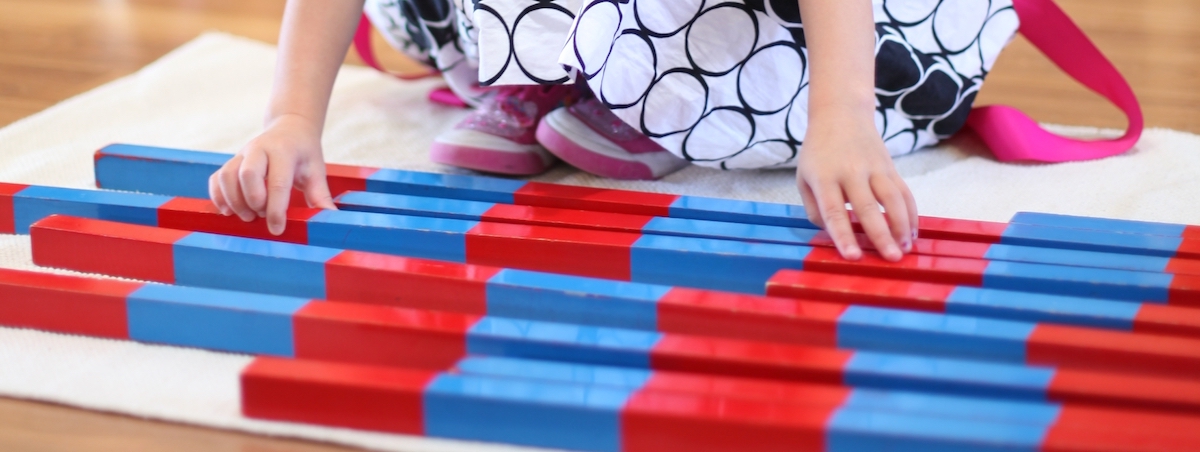
Even before a child is able to count, they experience the skill using materials like the number rods, a series of blue and red colored wooden rods that are arranged in a stair-like pattern.  Children learn how to count using a variety of materials.  The spindle box is an early material with which children place the correct amount of wooden spindles in compartments labeled 1-9.  Sandpaper numbers (just like their letter counterparts!) teach children how to correctly form each number to develop readiness for writing them on paper.

When a child is ready to learn about basic operations, there are plenty of materials to support them.  Montessori math uses the golden bead material; first to build numbers into the thousands.  For example a single golden bead represents 1, a group of 10 beads are strung together in a straight line for 10, and 100 beads are affixed into a flat square.  The thousand cube is as large as 1,000 of the original single ‘1’ bead.  Once a child is able to build a visual representation of a number, the beads are used to teach basic operations.  Young children are able to add, subtract, multiply, and divide numbers into the thousands using this material.  They first learn with static problems - that is, with no exchanges - and then move on to more complex, dynamic problems.  They quickly learn that ten 1s is equal to one 10, and they do this by holding those numbers in their hands.

Golden Beads

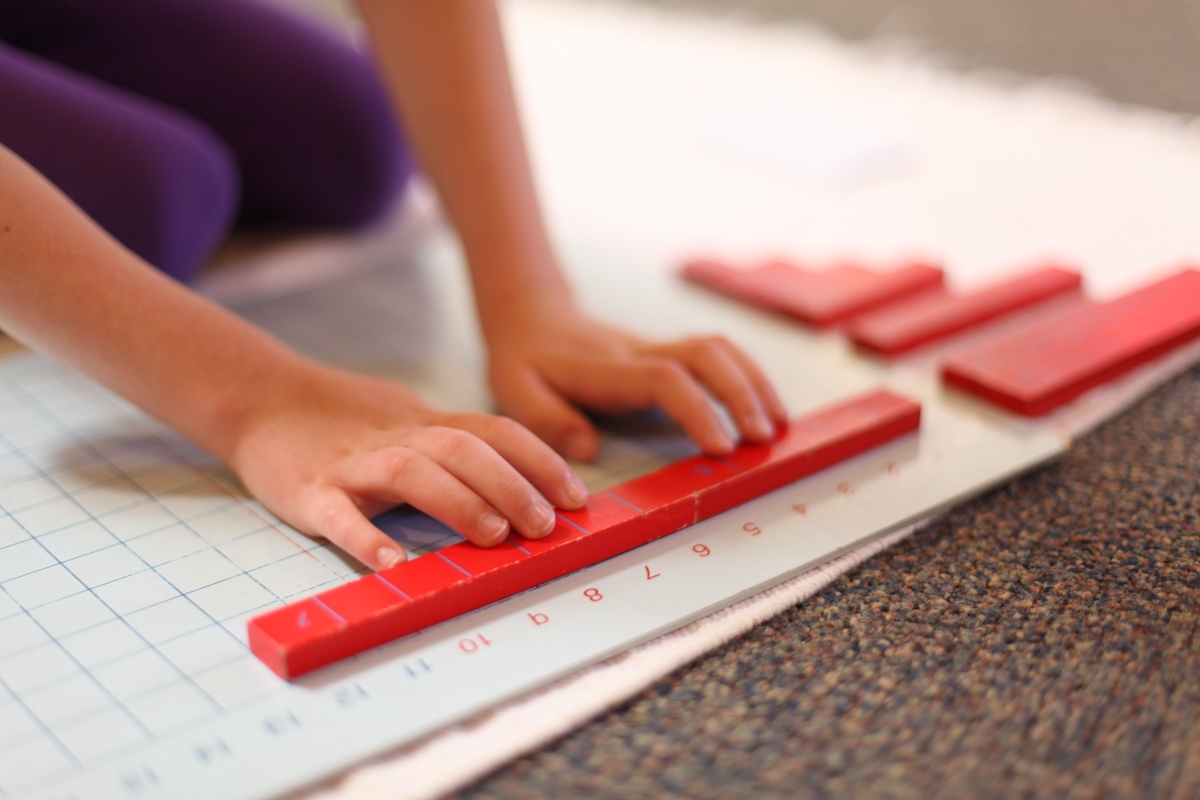
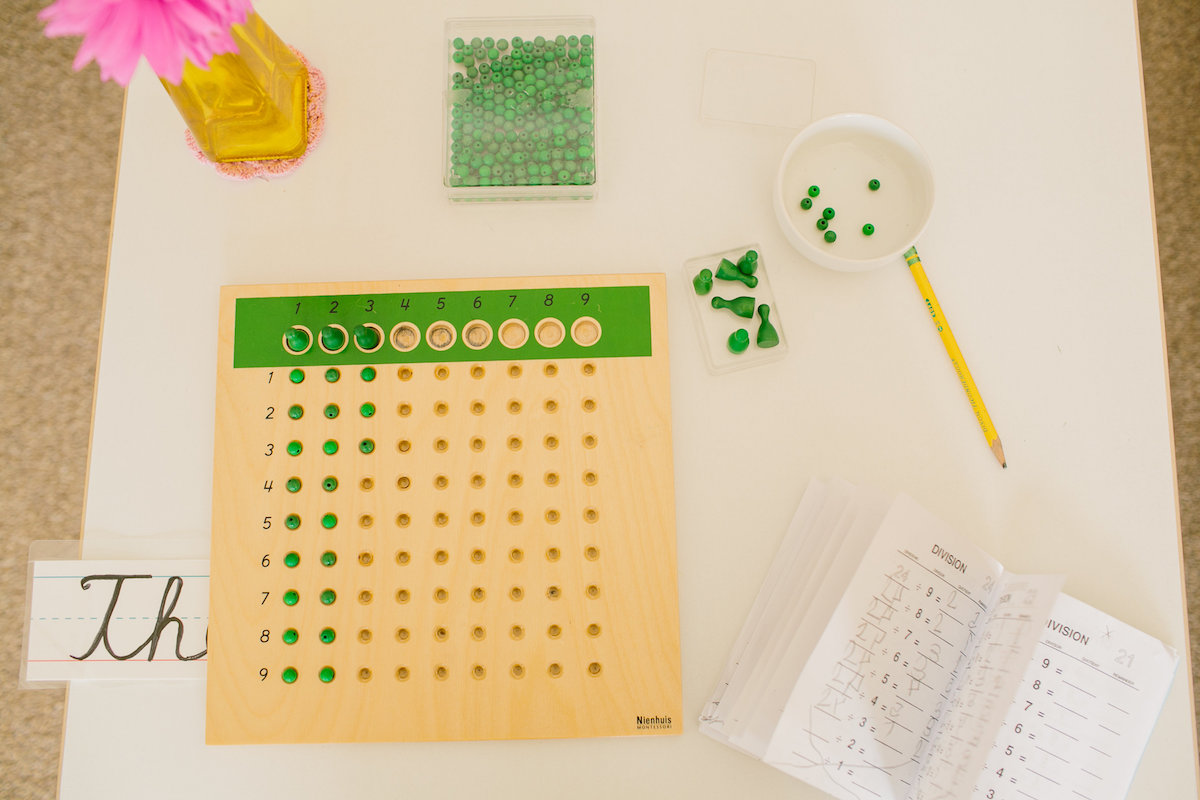
Montessori recognizes the importance of memorizing basic facts.  While when we were young we may have used flashcards to drill these facts into our heads, the Montessori approach begins by showing children why we manipulate numbers in different ways.  Young children appreciate the repetitive nature of the materials, which gives them plenty of opportunities to practice  (and memorize!) these facts.  The addition and subtraction strip boards show a child visually what is happening when we add numbers.  The same goes for the multiplication and division bead boards (which use small beads placed in divots on a wooden board to create an array).  

Division Board

A Period of Overlap

Somewhere between kindergarten and the first year of lower elementary, children are taught to use new math materials depending upon their individual readiness.  The stamp game is a classic example.  

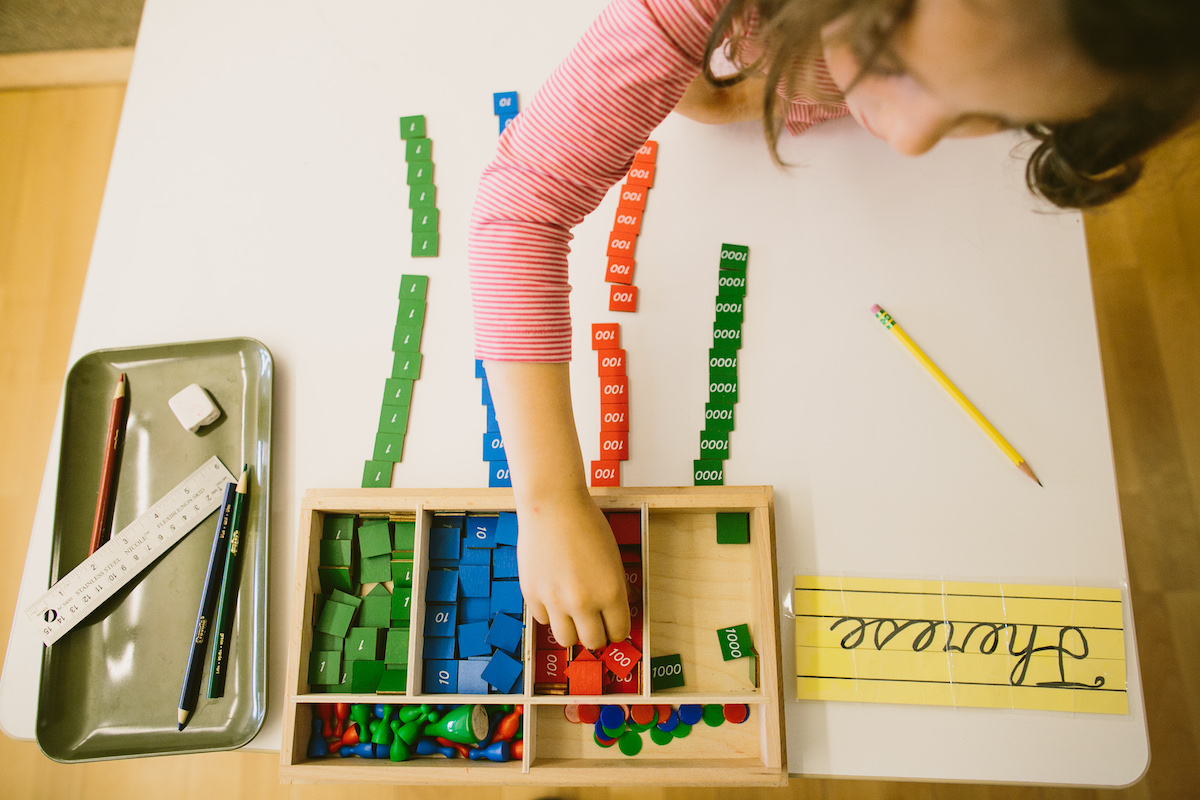
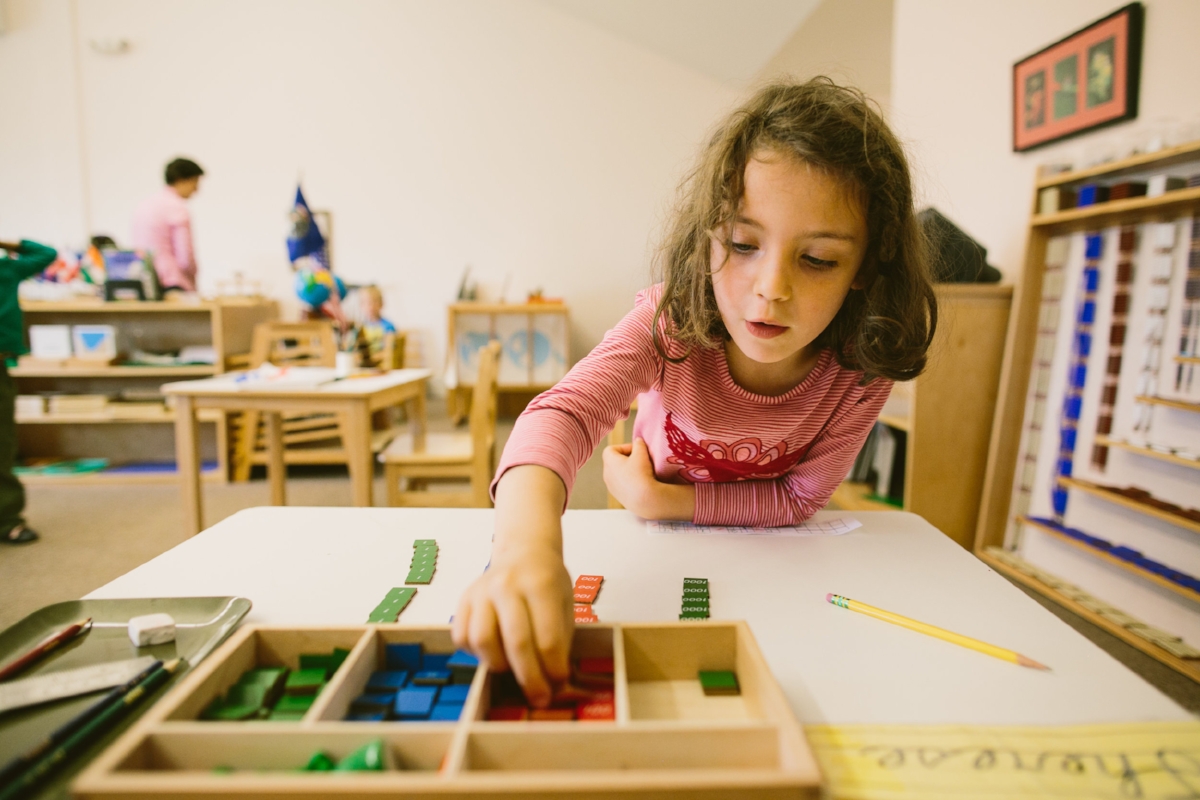
The stamp game material is a sectioned box with small colored tiles sorted inside.  There are labeled green, ‘one’ tiles, blue ‘ten’ tiles, red ‘hundred’ tiles, and green ‘thousand’ tiles.  Instead of holding a large cube that actually shows the relative size of one thousand as they did with the golden beads, they are now representing series of tiles that are all the same size, but are differentiated only by their color and number label.  Like the golden beads, the stamp game material is used to teach all four operations, with children adding, subtracting, multiplying, and dividing into the thousands.  Some children begin this work in their primary classroom and continue when they reach elementary, while others begin once they enter their lower elementary classroom.

Stamp Game

It may be interesting to note that there are some Montessori materials that children spiral back to, over and over again, from ages 3 to 12!  The bead chains are a colorful, quintessential Montessori material.  In the primary classroom, children use them to learn how to count, and perhaps how to skip count.  In a lower elementary classroom they are used for skip counting and to help memorize multiplication facts.  In upper elementary children use them to solidify concepts like squaring and cubing, although they were indirectly preparing for that work for years previously. 

Bead Chains

What Does Elementary Math Look Like?

Remember the green, blue, and red tiles of the stamp game?  Montessori refers to those as the hierarchical colors, and they are used to teach children about number series.  They first appear in the stamp game, but they continue to follow the child through lower elementary and into upper elementary until they have a firm grasp on the idea of the simple family of numbers (ones, tens, hundreds), the thousand family (thousands, ten thousands, hundred thousands), and so on.

After a child masters operations with the stamp game, they move on to use a material called the bead frame, which can teach addition, subtraction, and multiplication.  It looks a bit like an abacus, but with ten beads on each rod in the hierarchical colors.  After a child masters the bead frame, they are typically ready to add and subtract into the thousands (and beyond!) using just pencil and paper.

To learn larger multiplication problems, children use a material called the checkerboard.  They begin small, but eventually work their way up to problems that have three or four digit multipliers.  For long division, children use a material that goes by different names at different schools: the racks and tubes, aka the test tube material.  Once children master the checkerboard and racks and tubes, they are able to multiply and divide large numbers without materials.

Decimal Checkerboard

During the elementary years fact memorization continues.  In early lower elementary, many children continue to use the strip boards and bead boards of their primary years, but eventually move on to using finger boards and tables in which they place numbered tiles.  Children notice the patterns numbers make, giving them more tools to memorize their facts.

There’s More!

Of course, math isn’t just about operations.  Montessori students learn about geometry and fractions from an early age. 

Geometric Solids

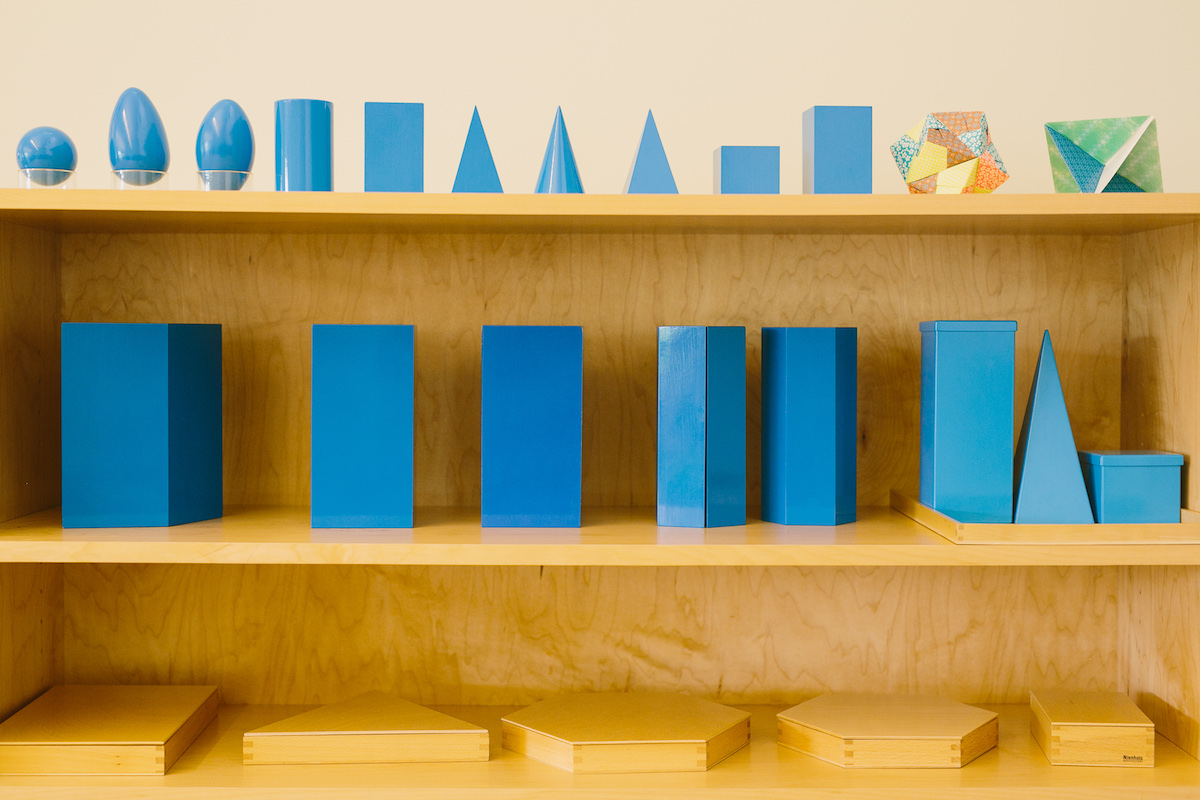
Did you know that primary children learn the names of geometric solids?  They can easily identify not just cubes and spheres, but square based pyramids, rectangular prisms, ellipsoids, and more.  As they move into elementary they learn about range of concepts, including studies of angles, triangles, polygons, and so much more.  A third grader can easily identify a right-angled, isosceles triangle.

Fraction Insets

When it comes to fractions, first graders start out simple with an impressionist lesson involving an apple and a definition of fractions that includes how they must always be fairly divided (the connections between fractions and division are impressed early on).  They next move on to using fraction insets, which look a lot like the metal insets they used for handwriting preparation in their primary classrooms.  Before you know it, many third graders are learning to multiply and divide fractions.

Still Curious?

The best way to really understand Montessori math is to see the materials in action.  Schedule a visit to watch children using them in the classroom, or join us for our upcoming parent education session on Monday, March 26, 2018, 6:00-7:30.  Contact us for more details!  

Check out the stamp game in action:

Bursting the Montessori Bubble

FAQmontessori.jpeg

What does "Bursting the Montessori Bubble" mean?

Our culture has long maintained the factory model of education and most of us were raised in that system. We experienced school in same-age classes and were taught the same subjects at the same time.

As children progress through the Montessori program, parents begin to feel the cultural pressures of traditional learning. Will my child be ready for testing? Will they be able to transition? They begin to feel that Montessori education is a protected bubble, not the ”real world” their child will be entering later on in their educational experience.

Have you ever had these same thoughts? Dr. Stephen Hughes, a Pediatric Neuropsychologist, has said in regards to this topic:

“Which is the real bubble? Because the truth is, success in life is not built on a foundation of standardized tests, but on the freedom to make difficult choices and experience their consequences. Success in life is not built on grades and percentages, but on self-awareness and self-improvement. Success in life is not built on artificial competition among same-aged peers, but on the genuine collaboration between generations. Success in life is not built on cheating the system, but on having the wisdom and courage to transform it.”
— Dr. Stephen Hughes

And Dr. Montessori said it herself:

“If education is always to be conceived along the same antiquated lines of a mere transmission of knowledge, there is little to be hoped from it in the bettering of man’s future. For what is the use of transmitting knowledge if the individual’s total development lags behind?”  ”
— Dr. Maria Montessori

She was ahead of her time!


Kari Headington is Head of School at Hollis Montessori School.

Montessori and Peace Education

Our world is often a tumultuous and scary place.  How can we help our children feel safe and cared for, while preparing them to lead the way as adults?  How can we cultivate empathy, kindness, gratitude, and the sense of community that helps people work together?

Montessori education has been addressing these issues for over a hundred years.  Sometimes the lessons are direct; at other times they are more subtle.  The mission is always clear: we want children to have a wide view of the world.  We want them to appreciate the diversity of others.  We want them to have the tools to navigate this world peacefully.

How do we approach this critical task?

Montessori schools teach peace both directly and indirectly.  Sure, we talk about peace and its importance openly and frequently.  We talk about what it means and what it looks like and what children can do to become peacekeepers.  But, perhaps more importantly, we model.  Through our words, the tone of our voices, and with our actions, we show children what it means to be peaceful.  They watch our everyday actions and learn so much from them, so why not create constant learning opportunities?

Teaching a Global Perspective

Even from a very young age, Montessori children are taught geography through the lens of the whole world.  They learn about the continents when they are as young as three years old.  These studies often include learning about biomes, instead of an emphasis on political boundaries.  Teaching about the world in this way gives children a sense of the natural world and people as a whole as primary to different countries.

Elementary aged Montessori children enjoy many lessons with timelines.  They learn about the origins of humanity, and studying ancient cultures is fascinating for them. 

Embracing a Variety of Cultures

One important series of lessons in the elementary years teaches the fundamental needs of humans.  Children explore how groups of people around the world and across the ages meet and have met their needs.  Physical needs, such as food, shelter, defense, and transportation are considered, as well as spiritual needs like art and religion.

Giving Them Tools

Montessori teachers are equipped to give children skills to resolve conflicts.  We give children tools such as micro-mediation, and give them the words and actions to express their needs and feelings while listening to those of others.

In Montessori classrooms, children often learn a variety of self-calming strategies.  This might include mindfulness meditation, yoga, breathing exercises, or the use of small hand-held tools such as a finger labyrinth or polished stone. 

Taking the Time

In Montessori classrooms the day is not structured with rigid timed intervals.  For example, there is no predetermined time for math, reading, etc.  This flexible schedule lends itself to shifting courses and having discussions in the moment.

For example, if a group of children are experiencing difficulty resolving a problem together, the teacher is able to stop and sit with them.  Without feeling rushed, they can take the time to figure out what went wrong and how to make it right.  Instead of an adult doling out consequences, we have the time to sit and work through conflict authentically.  

Giving to the Community

As Montessori children get older, they are encouraged to give back to their community.  These acts of charity will often be inspired by the children’s ideas.  Children may collect food and supplies for a local animal shelter, read stories and sing songs to residents of a nursing home, or make and sell baked goods to benefit a cause they believe in.  

By supporting children with logistics, we can encourage them to learn how to be active and supportive members of their communities at a young age.  They learn the importance of volunteering and contribution to others.

Giving back is just one way a child begins their active role as a peaceful member.

What Your Child Will Really Get Out of Montessori

blogmarch07.jpeg

Is it really worth it?

I mean, why should you spend the time, effort, and money to find an authentic Montessori program for your child? Wouldn’t it be easier to just find a good, basic preschool?

For me, the answer is easy - enrolling my children in a Montessori program was one of the best decisions I made as a parent. But, then again, I am a bit biased!

For most parents, however, the question remains: “What will my child really get out of attending a Montessori school?”

Why Your Background Matters

I’m going to go out on a limb - my guess is that you did not attend a Montessori school when you were a child.

This isn’t a problem, of course. You turned out just fine. But, as you consider early education options for your child, your own educational experiences can make the decision a bit difficult.

At first glance, Montessori classrooms don’t look familiar to most people. There are no rows of desks, no blackboards, and no teaching to the entire class. Parents are often intrigued by the peaceful, calm environment and the hum of activity, with young children choosing their own activities and concentrating deeply for long periods of time.

Montessori is so different, however, from traditional programs that it’s natural to leave a bit perplexed. I mean, what is really going on here?

How Other Preschools have it So Easy

I’ll admit it: When I was the Admissions Director I was a bit jealous that most preschools didn’t have to spend a lot of time explaining to parents what they do. The goal of the program is clear - to prepare children for a conventional kindergarten program. 

In a conventional school, your child will need basic academic skills, so they focus on “pre-reading and pre-math” with workbooks, flashcards, and rote memorization. Think ABC and 1-2-3.

In a conventional school, your child will need to adjust to the schedule of a traditional school, so they have activities where everyone does the same thing at the same time. Think group art projects where your child will learn to color within the lines.

In a conventional school, your child will need to learn how to pay attention to one teacher speaking to the group. Think circle times with one teacher talking to all the children together.

There is nothing wrong with this, of course. In a Montessori classroom, however, we believe your child deserves an education that focuses on all aspects of him as a human being.

How Montessori is Different: A Three Word Answer

Education for life.

Rather than just preparing your child for the next step in school, we seek to support his academic, social, emotional, intellectual, and spiritual development.  We want him to be successful at life in the future, not just in kindergarten.

Take a second to imagine your child twenty years from now. What skills will he need to be successful in college, his chosen profession, and in life in general?

Here is a primer. He will need to:

  • Know how to regulate his behavior

  • Control his impulses

  • Learn to plan and strategize

  • Hone the ability to problem solve

  • Learn to be flexible and course-correct when necessary

  • Learn to take initiative

  • Develop responsibility

  • Engage in depth-based thinking requiring long periods of concentration

  • Work collaboratively with peers on projects

Researchers who study the traits of successful adults coined the term for these skills: “executive functions”.

These executive function skills, which are so important to life’s success, must be continually developed, day in and day out, or else they will not materialize. They result from the way an activity is done and the time spent doing it – pushing oneself to do better and better.

The Link Between Montessori and Executive Functions

Research comparing children attending inner-city Montessori schools with those attending traditional schools was conducted by University of Virginia professor, Dr. Angeline Lillard, and was published in the prestigious journal, Science, in September 2006.  

The result?

Montessori students rated higher on “executive function skills”- skills like selective attention, self-control, problem-solving, reasoning and not getting into trouble.

On behavioral and social tests, 5-year-old Montessori children scored higher than their peers from conventional schools, showing that they had a greater sense of fairness and justice; out on the playground, they were more likely to engage more in emotionally positive play with their peers and less in roughhousing.

And, yes, your child will still be ready academically for elementary school, whether in Montessori or any other program. The same study found that among the 5-year-olds who were studied, Montessori children were better prepared to enter first grade with stronger reading and math skills than children in traditional schools.

The Choice is Yours

Is Montessori worth it? You decide. You, as the parent, are charged with raising your child in the best way you see fit. What do you value? What kind of adult do you want your child to become? There is a multitude of options available to you. Think carefully and choose well.


Camille Campbell is one of the founders and the former Admissions Director at Hollis Montessori School. Her two daughters are Hollis Montessori graduates and are now thriving in college.

Montessori Basics: What is the Montessori work period?

workcycle.jpg

You may already know a bit about the Montessori work period, also known as the work cycle.  What exactly is it, and why is it so important?

A Montessori work cycle is an uninterrupted block of time.  During this time children are able to explore the prepared environment and engage with materials of their own choosing.  The time is meant to give them opportunities to enjoy the work they love, while also cultivating basic life skills.

How long?

The length of a work cycle varies depending upon the age group and the school.  Most classes typically have a three hour morning work period most mornings.  Some other general guidelines to keep in mind for different age levels:

Toddler classrooms: 1-2 hours each day

Primary/early childhood classrooms: 2-3 hours most mornings, additional time in the afternoon for 4 and 5 year olds.

Elementary: 2-3 hours most mornings and another 2-3 hours most afternoons

What are the goals?

When we give children this time, we do so in an effort to assist their development.  The work cycle helps children:

  • Become more independent
  • Strengthen their ability to focus
  • Find joy with the materials
  • Feel deep satisfaction with their work

What exactly do children do during this time?

While it looks slightly different at different levels, there is always some combination of most students working independently while teachers give individual or small group lessons.  Great care is taken to not interrupt children while they are working, showing them the respect that this time and their exploration deserves.

In primary/early childhood classrooms, lessons are given mostly to individuals.  Children move around the classroom selecting work of their choosing.  They may work on a table or the floor, with a special rug laid out beneath them.  After selecting a work from the shelves, they bring it carefully to the workspace of their choosing, and use the material as they have previously been taught.  Children know they are responsible for putting the materials back neatly and selecting their next work independently.  At this age, children are typically focused on their own work and may engage in what is called ‘parallel play’.  This can be seen as defined working and playing beside one another while focused on their own individual work.

At the elementary level the basic structure is the same, but teachers honor the developmental need for more socialization in children of this age.  Lessons are more often given in small groups, and children prefer to work with one another.  While there is a great emphasis on choice and self-directed learning, children in elementary classrooms are expected to meet certain academic guidelines.  For example, a teacher may require that throughout the course of the day or week, a child must do work in all academic areas.  Teachers check in with students to make sure they are meeting these goals, and gently guide them with strategies to do so.

Regardless of the level, the work cycle gives children a chance to develop autonomy, make choices, and find genuine joy in their work.  Teachers hold this time as sacred, and it allows children to dive deeply into learning.

Check out this cool time lapse video that shows a four year old’s three hour work cycle in four minutes:

The Importance of the Kindergarten Year

HMSkindergarten.jpg

It’s that time of year again…

Schools and parents alike are planning for next school year.  If your child has been in a Montessori class for a year or two, you may be thinking ahead to kindergarten.  Many public school systems offer kindergarten, and many parents are curious about this transitional year.  This post is meant to highlight the important reasons why a child benefits from that final year in the primary (Children's House) classroom cycle.

Why should your child stay in Montessori for the kindergarten year?  Consider the following:

Montessori inspires children

Does your child love school?  The aim of Montessori education is not just to deliver information, but to encourage their existing curiosity and wonder.  All children are born ready and eager to learn; it is our job to show them how amazing our world is.  We want them to ask questions and search for the answers.  

If we can give children this gift at a young age we are setting them up for a lifetime of success and happiness.

They will get a chance to practice leadership skills

Most Montessori classrooms host an age span of three years.  During the first year or two of the cycle, children are familiarizing themselves with the materials while watching the older children who begin to master their environment.

The third year gives children the opportunity to be role models.  They are able to take on more responsibilities in the classroom and often help guide younger students.  Kindergartners even give lessons to younger students (which has the added benefit of displaying their mastery of skills.)

Children in Montessori get to work at their own pace

Montessori teachers strive to meet children right where they are, in every area.  We truly “follow the child”, giving lessons and guidance according to the individual’s needs, not the needs of the whole class.  

Perhaps your child is a strong reader and needs someone to provide them with advanced books that are still appropriate for their age.  Montessori teachers have the flexibility to do that.  Maybe your child needs a bit more guidance in math.  Montessori primary classrooms are structured to include lots of individual and small group lessons, so teachers use that time in whatever ways best meet the needs of each child they serve.

Montessori uses formative assessment, not standardized tests

Children in Montessori classrooms don’t have to worry about high-stakes standardized tests.  The english word assess is derived from the latin assidere, which literally means ‘to sit by’.  Montessori classrooms rely mainly on formative assessment, a style of gauging student understanding that reflects the original definition of the word.

Formative assessment is done continuously throughout the learning process - even mid-lesson!  This allows teachers to adjust instruction in the moment so that learning is constantly tailored to meet children’s needs.  

In conventional classrooms, lessons are often firmly defined prior to instruction.  The information is delivered to a group of children, and they may later be given a summative assessment to check for their understanding.  This data may be used to drive future instruction, or it may just be used to support a grade given on a report.

In classrooms that rely heavily on formative assessment, a teacher can change course while they are in the process teaching.  If students demonstrate prior knowledge or quick understanding, the lesson can be extended and additional information can be included.  If children appear to need more support, the teacher can repeat the material or give other supplemental information.  Montessori teachers take copious amounts of notes to constantly document these interactions.

The spiraling curriculum comes full cycle

The Montessori curriculum is forever spiraling back on itself.  Children are exposed to skills for the first time in very concrete ways, which is why the classrooms are stocked with so many beautiful materials.  These materials help the hand teach the mind, and learning first in this physical way helps make important connections in the brain.

The concrete lessons are repeated in new ways, each time moving further toward abstract concepts.  By the time the spring of the kindergarten year rolls around, children are finally solidifying so many of the ideas and skills they’ve been practicing for years.  

Come see for yourself!

One of the best ways to truly understand how a Montessori classroom works is to come in and observe.  We encourage you to make an appointment to sit in a classroom and watch the children in action.  Keep an eye on those kindergartners - you will be amazed at what you see!

Why Start at Age 3?

What is the ideal age to begin Montessori school? Age 2.9 to 3! The young child's ability to effortlessly absorb information from his environment is only possible during this window of time. Dr. Montessori observed that during these early months, which she called sensitive periods, a child's entire being is molded: his intelligence itself is being formed! 

The child from age birth to six years old passes through three significant sensitive periods; those for order, movement and language.

SUPPORTING A YOUNG CHILD'S NEED FOR ORDER

During the sensitive period for order, a young child needs her environment to be predictable and orderly. If her life has a rhythm and her routine is maintained, she begins to trust the environment. If her needs for food, sleep and bodily comfort are predictably met as they arise, she uses this satisfaction as the basis to feel secure and to explore her world. The three year-old is at the height of sensitivity to ritualistic order; she still needs routines and yet can begin to create her own order. This is the perfect time to model that activities have a beginning, a middle and an end. 

COORDINATION OF MOVEMENT

The sensitive period for movement is the time the child develops his coordination and fine and gross motor skills. Allowing your child safe yet challenging movement without interference develops this skill and his self confidence. It's time to jump, hop, skip, and climb, to carry heavy things, to balance objects on a tray. He needs to use a scissors, to pick up tiny objects and to refine his eye/hand coordination allowing his hand to truly become an instrument of his mind.

THE PRIME TIME FOR LANGUAGE DEVELOPMENT

During the sensitive period for language, the child can hear the individual sounds in words as she learns vocabulary— an ideal time to begin learning the sounds of letters. During this time she will expand her vocabulary immensely. She wants huge words and funny words and rhyming word and words in songs. Our Montessori environments, rich in vocabulary, meet her word hunger perfectly.

When the children's environment is based on and organized around the sensitive periods, the children work with an enthusiasm and sustained interest that is truly amazing. Their development is strong and steady.

Authentic Montessori preschool is a three-year cycle designed to engage children from age 3 to 6 (preschool through kindergarten). The activities in the first year lay an important foundation for future learning. Over the following two years the activities and lessons build upon themselves at the child's own pace. Parents are often amazed when a child "explodes" into reading, writing, and math during the final year. It might look like magic, but it is really the culmination of the first two years in the Primary classroom. By starting at 3 and remaining in the classroom community for three years, Montessori children have an inspiring educational experience.

-Kari