150 Years: Celebrating the Ordinary

CH classroom.jpeg

This article is part of a series that we will share throughout the 2020-2021 school year to celebrate the 150th birthday of Dr. Maria Montessori. Check back often for more posts that reflect on the past, present, and future of Montessori education.

The Glass Classroom

Seeing is believing when it comes to Montessori. It is quite rare to meet a person who has visited and observed in a high-fidelity Montessori school that is then critical of the methods. Since observation is such a core element of the work we do, we have welcomed outsiders from the very beginning to take a look for themselves.

In 1915 there was a world fair, The Panama-Pacific International Exposition, in San Francisco. The affair stretched out over many months, took over hundreds of acres, and was visited by more than 18,000,000 people.

Maria Montessori held an exhibit at the fair, which has gone down in history as a major stepping stone to informing Americans about Montessori education. The Glass Classroom, which visitors could see into, showed the public just what went on inside a Montessori school. Visitors were astounded by what they saw. 

A Day in the Life of a Primary Environment

The tradition of the Glass Classroom continues even today. Many Montessori schools have observation windows so that parents and visitors can take a peek inside without being noticed. All Montessori schools encourage adults to observe - window or not. We feel it’s the best way to fully understand what goes on, and we know every person who does so is amazed.

COVID has made this special opportunity a bit tricky. We thought it might be nice to take you on a written journey, just to get a sense of what the day is like. We hope, when the time is right, to see you back in our classrooms again! 

early morning, before the children arrive

The guide arrives, hangs their coat, changes their shoes, and admires the beautiful classroom environment upon entering. So much love and attention to detail has been put into the creation of this space, with small changes being made throughout the year to better serve the ever-evolving needs of the children.

The guide makes a cup of tea, puts on some relaxing music, flicks on the lamps, and gets to work reviewing the plans for the day. If any materials need to be prepared (or repaired!) this is done. Pencils are sharpened and chairs set down. As colleagues trickle in they take a moment or two to check in with one another.

drop-off time!

A flurry of cars descends upon the campus, and children hop out of back seats with bags and coats in tow. Independently, the children make their way to their classrooms, hang their own coats, and change their shoes. Their guide stands in the doorway, and they cheerfully (or sleepily) greet one another with a smile.

The child walks through the doorway, takes in the sight of the room, and prepares to work.

the morning work cycle

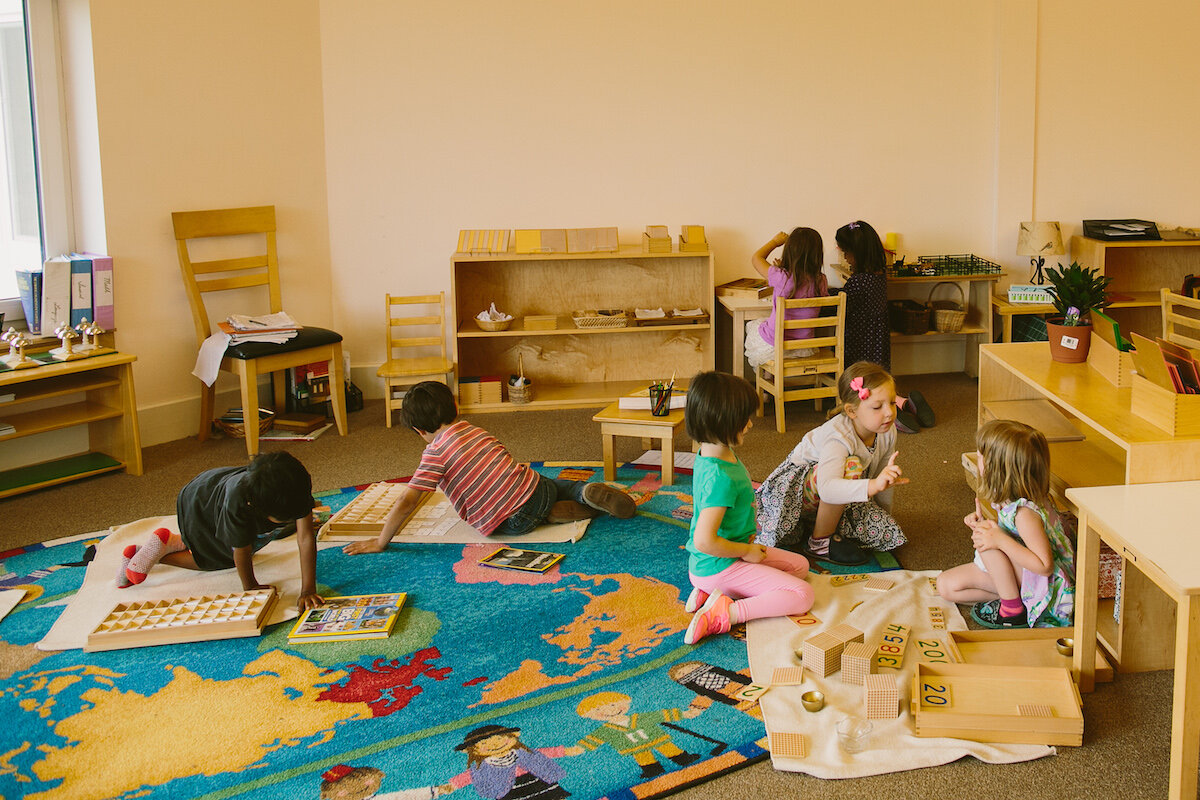
The first two and a half to three hours of each day is dedicated to the morning work cycle. This allows children to sink deeply into their work, and the flexible schedule means children will transition as they are ready and will work independently according to their own personal needs.

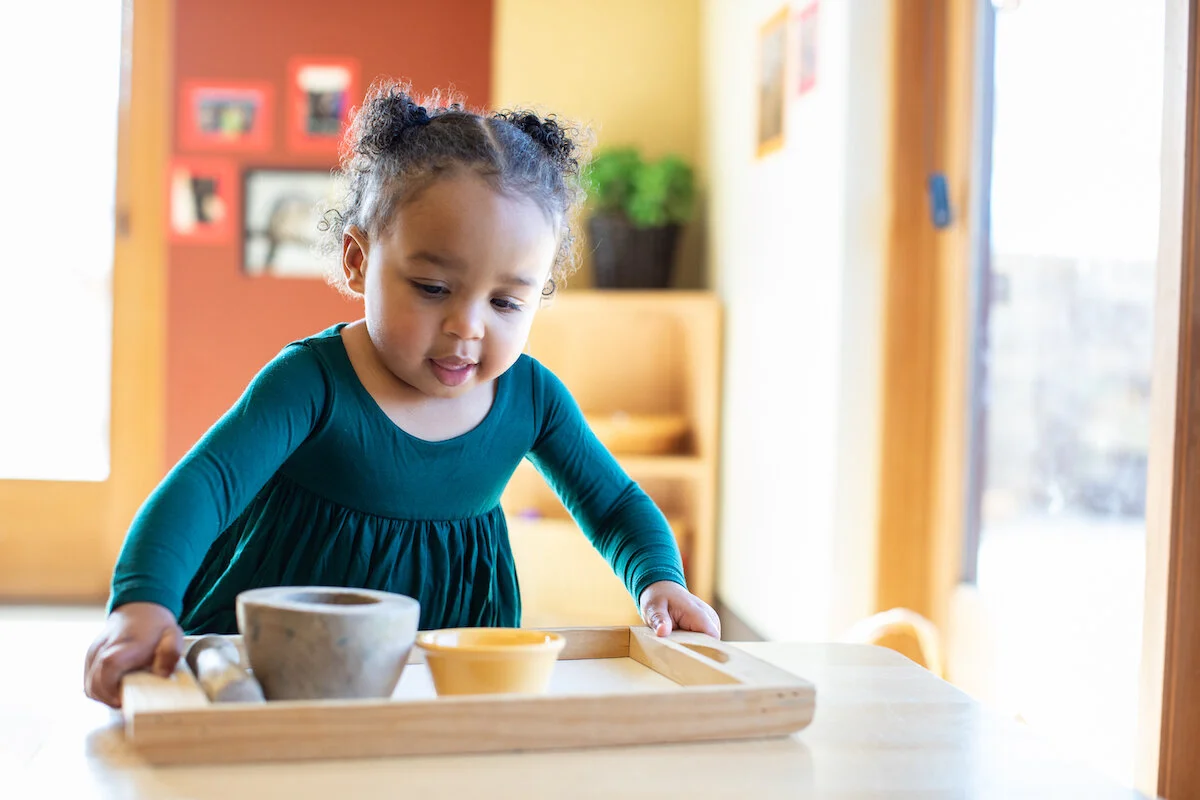
A three-year-old sits on a large area rug, with a work mat beneath the pink tower, which she is carefully stacking higher and higher. She carefully compares the sizes of the blocks, making adjustments as needed so that they become smaller as they ascend.

Several four-year-olds sit together at a table, working in silence to create maps. One uses a small tool to poke holes in colored paper, creating neat perforations in the shape of South America. Another uses watercolor paint to shape two blue spheres on a large piece of white paper. The third, who has previously completed the other two steps, is seen gluing their continents onto the painted hemispheres.

At the next table over, the guide is sitting with a five-year-old to give an initial lesson with the stamp game material. This particular child has an affinity for math and is ready to move on to more challenging work. Today they will begin adding larger numbers.

Two friends have decided they need a break. They have been enjoying a snack together at a designated table, and as they finish, they take their dishes to the sink and wash them in a prepared soapy bin of water. After a quick rinse they leave them in the rack to dry.

The classroom is not silent by any means. There is a gentle hum, with most working quietly. They all seem engaged in whatever they are doing - even the very youngest students. One small child is seen wandering around the room. They aren’t working, but they aren’t disturbing the work of anyone else, either. This goes on for about ten minutes or so, at which point they select a material from the shelf and get started. They were able to move around and take the time they needed to transition, and they were trusted to make their own decisions.

transition to midday

As the clock nears noon, the work cycle draws to a close. Children enrolled in a half-day program put their materials carefully on the shelves and get ready to head home.

As for the others, the next hour or so is generally spent eating and spending time outdoors. At lunch, the children sit together at tables and unpack their meals onto small cloth placemats. There is laughter, sweet conversation, and a chance to refuel after the hard work of the morning.

With some guidance and reminders, the children clean up their own space, wash the table, and sweep the floor beneath. 

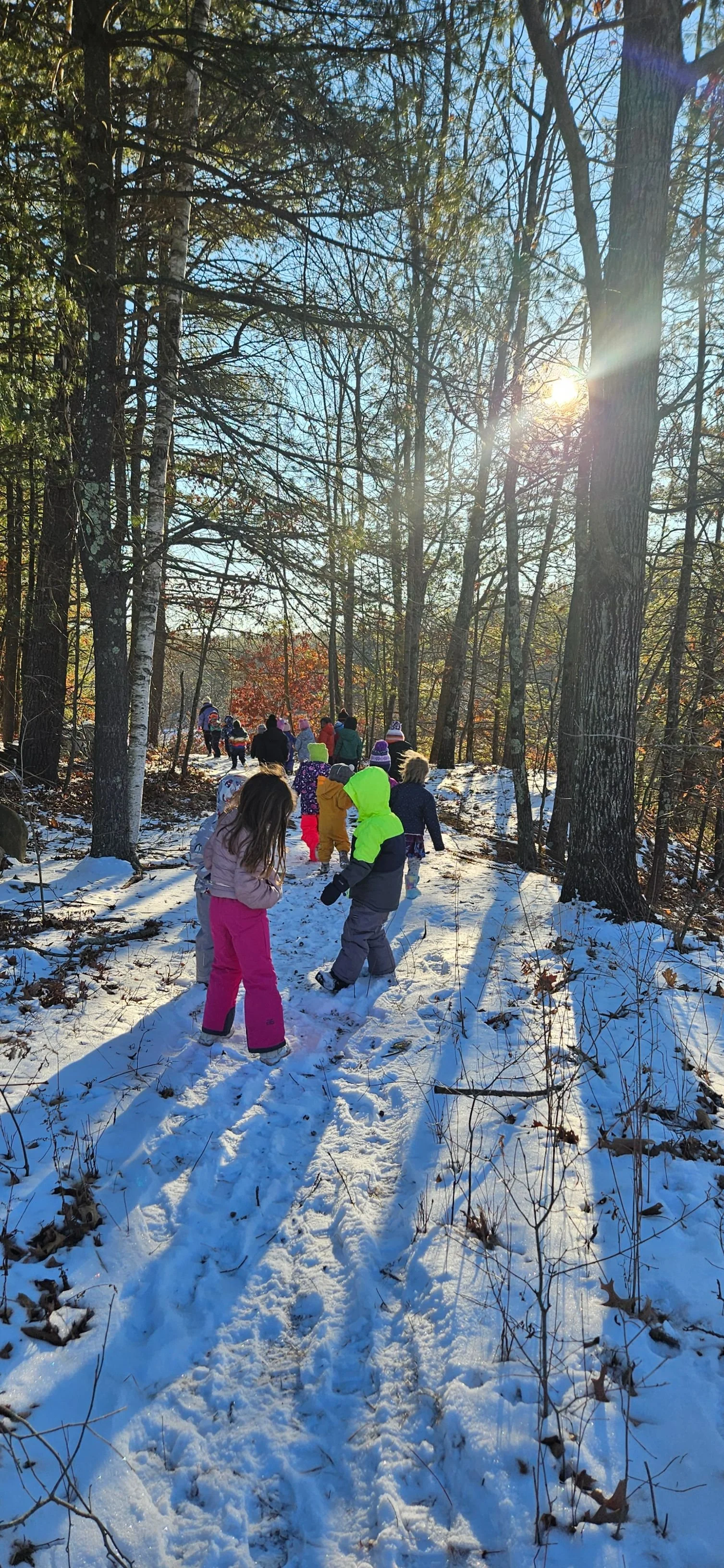
Outside, the children become lost in a different type of play. They run, skip, and balance. They navigate social situations. They are mostly independent, but there is always an adult nearby in case help is needed with a scraped knee or solving a misunderstanding with friends. 

the afternoon

For the youngest children, the early afternoon is the perfect time to rest. Whether they fall asleep for a nap or just lie quietly with a book, the time is set aside for them to do so. Lights are dimmed, and each child curls up with a favorite stuffed animal. 

Meanwhile, in the classroom, older children are back to work. When they first enter, they gather on the rug, seated and anxiously awaiting their teacher to join them with a book. They listen, enchanted, to a story read aloud. After several chapters, the teacher marks the page with a bookmark, and the group disperses.  

One small group gathers supplies and meets back on the rug for a lesson about vertebrates and invertebrates. They look at their class guinea pig and imagine his backbone lying just beneath the skin. Then they sort photos or different animals, deciding which have spines, and which do not.

At various tables, other children have taken out their journals and are writing (or drawing) stories. They put great care into their work, and flip back through the pages occasionally to look at old entries.

After a bit, the younger children filter back into the classroom from their rest time and find their own way into the work. This continues until it is time to go.

farewell to the children & preparation for tomorrow

A gentle bell chimes in the room, signaling to the children that it is time to clean up. Work mats are rolled, materials are placed on shelves. Some children can be seen sweeping, while others feed a few bits of lettuce to the guinea pig. One little boy waters a small plant in the corner, while a girl spends some time lining up drinking glasses in a neat and orderly row on the counter. 

One by one the children file into the hallway to gather their things. They head outside and wave a happy goodbye to their friends and teacher as they climb into the car to go home for the day.

Once the last child has skipped off, the guide returns to the classroom. The children have made great progress this year in cleaning up, so after tidying a few areas she can focus on planning for the next day. Shelves straightened, crayons returned to their proper place, and a single forgotten pretzel placed in the compost bin, and the room is restored.

Another great day, full of joyful learning.

6 Effective Ways to Be an Engaged Parent

familyinsnow.jpg

Research has shown time and time again that parent involvement is critical to children’s success. We all want to take an active role in our child’s education, but sometimes it can be a challenge to discern just where our efforts are best spent. Below we touch on six critical areas that all parents can focus on to make a big difference.

1. Make connections

Consider the whole school community and make connections with others whenever possible. This usually starts early, with your child’s teacher. Let them know who you are, reach out whenever you have questions or concerns, and ask them how you might best support their work in the classroom.

Connections can also be made with school administrators. You likely met these folks during the admissions process, but it’s always nice to say hello and touch base when you can offer support or have positive feedback.

Do you have a passion for art? Check in with your child’s art teacher just for conversation or to help out. Feeling social? Introduce yourself to other parents in the school community. Any time we connect with others we strengthen the community as a whole, which is a great thing for everything involved.

2. Volunteer

Schools always need help. Whether it be to organize a fundraiser, read to a class, offer your talents or services, or maybe even fill in as a substitute teacher, we would love to have you join us. We completely understand that most parents have busy schedules, and that not everyone is comfortable with every type of volunteering, but we encourage all families to contribute in whatever ways they can.

Looking for more ways to volunteer your time and efforts? We encourage you to join our parent teacher organization. This group is critical to the ongoing success and support of our students, classrooms, and the school as a whole.

3. Keep learning

As educators, we consider ourselves to be lifelong learners. We work hard to cultivate a joy of learning in the children we teach, so that they may carry that passion for knowledge with them throughout their lifetimes. We hope that the families we serve feel the same way.

Montessori education is unlike any other method of learning and teaching. In order to fully support your child’s growth and learning, it really helps if you as a parent prioritize learning what you can about Montessori. By understanding more about child development, our methods, and why Montessori does things differently, you will have a deeper understanding of what goes on during your child’s school day, and you will find more nuanced ways to support them at home.

“Keep learning” isn’t just about Montessori, either. We believe all humans should stay curious. If your child sees you nurturing your own passions and seeking out new information regularly, you are setting an example that will stick with them for a lifetime. So take time out to learn more about whatever interests you, and share your enthusiasm with the whole family when it strikes.

4. Support learning at home

Learning doesn’t just take place within the confines of a classroom; it happens everywhere. Children spend a huge portion of their time at home, and while the home is a multi-purpose environment, it can also support children’s learning. We don’t mean you should go out and purchase Montessori materials (in fact, we don’t advocate doing so without specialized training). There are plenty of simple and small ways to support learning. Our bet is you’re likely already doing many of these! A few ideas:

  • Keep plenty of books and magazines around. Source your local library and second-hand bookstore to keep things fresh! Trading with friends is another fun idea.

  • Play board games together. Not only does this give everyone a chance to connect, but many games have elements of learning embedded into the fun.

  • Spend time in the kitchen. There are so many important skills to be gained, from practical life to fractions.

  • Emphasize toys that make kids think. Instead of the flashing, battery-powered variety, think about more open-ended options. Art supplies, blocks, colorful scarves, and even sets like marble runs keep kids entertained and thinking.

  • Read together. Again, this is a great way to connect while building all sorts of literacy skills.

5. Consider different forms of advocacy

It won’t come as a surprise when we say that parents are their children’s strongest advocates. Whether your child is struggling in academic or social skills, when they’re young they count on you to convey this information to other adults. Open communication is key, and it helps to recognize that children often have very different experiences at home and school. If you have concerns about your child, address them with their teacher early, and stay connected to discuss progress.

It is very important for us to note that you will not be able to advocate for your child forever. One of the hallmarks of Montessori education is to nurture children’s independence, and we count on parents to help us in this endeavor. We want to teach our children to advocate for themselves, so as soon as they are able, we should encourage them and teach them how to speak up for themselves.

Do they wish they had more challenging math work? Talk them through how they might ask their teacher. Are they struggling with another child on the playground? Go over various options and scenarios with them so they know how they might try and solve the problem in the future.

Our children need us to stand up for them, but ultimately, they need us to teach them to stand up for themselves.

6. Attend events

Being an involved member of the community is one of the simplest and most effective ways to support your child and their school. We want to again acknowledge that families are busy and not everyone can attend every event, but we hope you will join us whenever possible. 

Some events are education, while others are meant to be just fun. Either way, they are a great way to build and strengthen connections.

We want to thank you for being a valued member of our community. Having different voices and perspectives is part of what makes our school strong, and we are grateful to all of you for everything you do to support us and your children!

Could Montessori Transform Early Childhood Education?

AML_Marketing2019-4.jpg

For those of us with children in a Montessori program, we understand fully just how powerful this approach to education can be. Not only do children have an advantage academically, but the whole child’s growth and development is valued and nurtured. Additionally, ripples of the work with children positively affect the greater community.

While Montessori’s early roots were in serving children of low-income families in Rome, over the past hundred years availability of Montessori schools has shifted to mainly affluent communities. While there are certainly public Montessori offerings, the vast majority are only available to middle- and upper-income families who are able to pay tuition at independent schools.

Recent research highlights the ability of a high-fidelity Montessori program to positively impact diverse communities. In areas that tend to be more racially, culturally, and socio-economically diverse, Montessori opportunities are rare, but could potentially provide a substantial positive impact.

One case study published this past spring was written by Mary D. Burbank, Melissa M. Goldsmith, and Koeun Park (all of the University of Utah), and Jennifer Spikner of Chicago, Illinois. Entitled Montessori Education and a Neighborhood School: A Case Study of Two Early Childhood Education Classrooms, it details the transformation of two classrooms within an urban school. 

The study was guided by Project SYNC (Systems, Yolked through Nuanced Collaboration) and the work of various stakeholders. Those involved in the project included a university, the public school district, an established elementary school, and a local private Montessori school. Each played a specific but different role in the implementation of the project.

In short, a public elementary school of over 500 students was already offering full-day preschool and kindergarten. It committed to transforming 2 of its 4 early childhood classrooms into fully implemented Montessori classrooms, along with two teachers that volunteered to become trained and certified. With the assistance of a paraeducator in each classroom and support from a local private Montessori school, the case study covered both the planning and implementation years.

 It is important to note that the elementary school already had a deep commitment to serving the diverse community in which it stood, including a focus on social justice and trauma-informed practices. The goal of the school was not only to educate the children, but to serve the families and community as whole.

The authors of the study noted several important motivations for the project’s existence:

“Montessori education offers an educational experience that creates opportunities for students to engage in learning opportunities that are self-directed, exploratory, and based upon individual learners. As such, Montessori education may be thought of as culturally responsive, as it is based upon classroom learners.”

“...the flexibility of Montessori experiences allows students, particularly students of color, to express themselves and be themselves without assimilating to the norm within more-typical classroom settings.”

As stated before, the teachers became fully credentialed. Both classrooms were outfitted with traditional Montessori materials and a 2½ hour work period was honored each morning. All family participants were voluntary, and while the demand met the need the first year, the success of the program led to waiting lists during subsequent years.

Evaluation of this case study included opinions of the stakeholders, classroom observations, and teacher participant attitudes. 

During the planning year, six of the stakeholders participated in in-depth interviews. While most were not overly familiar with Montessori education, all were excited by the prospect and inspired to bring new opportunities to an underserved community.  

During the course of the implementation phase, a number of data points were collected. Six stakeholders participated in a survey, the two teachers responded to open-ended questions, and 34-40 students were observed on numerous occasions.

The responses were overwhelmingly positive.

Data showed:

  • Family engagement had increased.

  • Montessori had a positive influence on the children’s learning.

  • The model had been successfully implemented within the larger conventional school.

  • Over time, students were able to more clearly express their individual selves.

  • Montessori grace and courtesy lessons helped build relationships within the classroom.

Moving forward, it would be interesting to see if this type of project could continue on a long-term basis and/or be replicated widely. Funding and support are typically the two most distinctive barriers. Those interested in creating similar opportunities for students in diverse communities might benefit from implementing a braided funding approach. A committee of supporters with the ability to educate stakeholders on the benefits of Montessori education would also be important for buy-in.

Thank You to the Illustrators

IGPost image 8Feb2021.jpg

Each year the Association for Library Services to Children awards a special honor, the Caldecott Award, to the illustrator of one picture book. This coveted award has recognized some amazing works over the years and is a great way to highlight the important fact that illustrators contribute significant meaning to the art of children’s literature.

This week we share the Caldecott winners for the past decade. (By the time this article is published there will have been a recently announced 2021 winner, so keep an eye out for a new title to explore!)

2020 The Undefeated,
illustrated by Kadir Nelson

Kadir Nelson illustrated this beautiful and often heart-wrenching love letter to black Americans, celebrating their achievements while honoring their traumatic history. Each page has gorgeous illustrations highlighting various points in history as well as individuals who have contributed to the world in magnificent ways. In addition to being a Caldecott winner, this book was also the recipient of a 2020 Newbery Honor and the 2020 Coretta Scott King Illustrator Award.

2019 Hello Lighthouse,
illustrated by Sophie Blackall

Sophie Blackall’s Hello Lighthouse has a fascinating way of blending the simplicity of daily life with a rare window into an interesting part of history. A lighthouse keeper and his wife live alone on the island, going about the task of maintaining the beacon. In time, their family grows, and the monotony of cooking, tending to the light, and enjoying moments together plays out visually for readers to enjoy. The pages show beautiful cutaways of the interior of the lighthouse, allowing us a peek back in time. 

2018 Wolf in the Snow,
illustrated by Matthew Cordell

In this charming wordless book, a child is on her way home from school when she comes across a lost wolf pup as a snowstorm begins. She hears the barks of the wolf’s family in the distance, and trudges through the snow to return it safely. Afterward, she finds herself turned around in the windy and white landscape, but her new friends find a way to return the favor.

2017 Radiant Child: The Story of Young Artist Jean-Michel Basquiat,
illustrated by Javaka Steptoe

Jean-Michel Basquiat grew up in Brooklyn, absorbed for hours in his own art and dreams of becoming a famous artist. His mother encouraged him and taught him that art was more than just pretty paintings. As he grew up, he explored various mediums, and became well-known first through his street art. His mother eventually became ill, but Jean-Michel always remembered her influence on him and showed his gratitude for her support. 

2016 Finding Winnie: The True Story of the World’s Most Famous Bear,
illustrated by Sophie Blackall

One evening, a little boy lies awake in bed asking his mother to tell him a true story. She obliges and tells the story of a veterinarian-turned-soldier who rescued a bear cub at a train station. The special bear is given the name Winnie, and eventually goes to live at the London Zoo, where she charms the heart of a little boy named Christopher Robin and his father, A. A. Milne. The veterinarian’s granddaughter turns out to be the mother telling the story, and it is, indeed, the story behind the inspiration for the famed character, Winnie the Pooh.

2015 The Adventures of Beekle: The Unimaginary Friend,
illustrated by Dan Santat

A small creature lives on an island with other fantastic creatures, where they all await the moment a child will choose each as their imaginary friend. The small creature becomes impatient, leaves the island, and searches throughout the land of humans for the friend he is destined to be with. It isn’t until one day, from high up in a tree, he looks down and spots her, and they both know it was meant to be.

2014 Locomotive,
illustrated by Brian Floca

This book is perfect for both train lovers and history buffs. The illustrations help readers understand what it was like in the early days of the locomotive in the United States, as its rails were laid down by hard working people and the cars snaked their way across the land. The roles of various people running the train itself are detailed, as are the journeys and lives of some of the early travelers.

2013 This Is Not My Hat,
illustrated by Jon Klassen

One small fish steals the hat of a sleeping and unsuspecting large fish. Though the small fish knows what it has done is wrong, it spends most of the book defending its decision and finding a way to hide itself. Undeterred, the large fish wakes up, realizes what has happened, and sets off to retrieve what is rightfully his.

2012 A Ball for Daisy,
illustrated by Chris Raschka

Sweet Daisy, a scrappy pup, adores her red ball. She plays with it, chases it, and cuddles on the couch with it. One day, her owner takes her and her ball to the park to play, where they meet a friend. Daisy and the other dog both run for the ball, but the other dog accidentally pops it. As you can imagine, Daisy is distraught, but there is a happy twist at the end. This beautifully illustrated book tells its story without any words at all.

2011 A Sick Day for Amos McGee,
illustrated by Philip C. Stead

Amos McGee is a morning person, and each day he swings his legs out of bed, makes breakfast, and heads off to work at the zoo. He takes great care to visit with each of his animal friends, spending time with them in the way each individual appreciates. One day Amos wakes up sick and realizes he must spend the day at home. Missing him dearly, the animals find their way to his house and repay all the kindness he has shared with them over the years.

150 Years: The Mixed-Age Classroom

Mixed Age copy.jpg

This article is part of a series that we will share throughout the 2020-2021 school year to celebrate the 150th birthday of Dr. Maria Montessori. Check back often for more posts that reflect on the past, present, and future of Montessori education.

There are many elements that make Montessori education stand apart from more conventional methods. One of the most obvious is our mixed-age classrooms. Rather than grouping children by a single chronological age, our classroom environments encompass children spanning across several ages.

We find this method to be a huge benefit. Read on to learn more.

But...why?

There are so many perks to having mixed-age classrooms. Some of the key points include:

Models and leaders

By having children of different ages together in one room, the younger children enter the environment with a variety of older children that serve as models to them. It is often the case that children learn best from one another, and when a 6-year-old watches an 8-year-old work, they quickly understand what is expected and what kind of work lies ahead in their future. As for the older children in the class, they have many opportunities to serve in leadership roles, cultivating skills that are critical as they become independent members of their communities.

Skill progression fluidity

Learning is not linear, for any of us. There are periods of rapid growth, periods of steady progress, and times spent in plateau. This is normal and will vary across subject areas for individual children. This is why we don’t believe it makes sense to deliver a prescribed curriculum to all students at the same time, ultimately leaving some children bored and others struggling. In our classrooms, kids can work and progress at their own rates. These lines are further blurred when we don’t rely on typical grade levels.

Strong relationships

When a child is in a class for three years, it allows the guide to really get to know them not just as a learner, but as a person. Rather than starting from scratch each September, the child-teacher-parent team is already established and can work together on a deeper level and with greater understanding of strengths and goals than they would be able to otherwise.

Enhanced social opportunities

Diversity is important on all levels, and that includes spending time with people of different ages. We have so much to learn from each other, and children gain all sorts of skills from their interactions in a mixed-age classroom, like empathy, patience, and open-mindedness.

Reflection of real life

We would be hard-pressed to find an example outside of conventional schools in which people are sorted into one-year age groups where they spend most of their day. Multi-age classrooms are a much better approximation of what life is really like, and we think children benefit from these early experiences.

What did Dr. Montessori have to say about it?

Maria Montessori had a way with words. While she was a woman of science who relied heavily on her observations, her descriptions and explanations often captured the heart of her audience. Her discussion of the multi-age classroom was no different.

“Our schools have shown how children of different ages help one another. The younger ones watch what the older ones are doing and ask all kinds of questions, and the older ones explain. This is really useful teaching, for the way that a five year old interprets and explains things is so much nearer than ours to the mind of a child of three that the little one learns easily, whereas we would scarcely be able to get through to him. There is harmony and communication between them that is not possible between an adult and such a young child. There is a natural mental osmosis between them. A child of three is also quite capable of taking an interest in the work of a five year old, because in fact the difference in their abilities is not that great.

People are concerned about whether a child of five who is always helping other children will make sufficient progress himself. But, firstly, he doesn’t spend his whole time teaching, but has his own freedom and knows how to use it. Secondly, teaching really allows him to consolidate and strengthen his own knowledge, which he must analyse and use anew each time, so that he comes to see everything with greater clarity. The older child also gains from this exchange.”

How we break it down

Obviously, a Montessori school doesn’t place a 3-year-old in the same classroom as a twelve-year-old (although we do love to find opportunities for children to work together from different periods of growth and development!). Generally speaking, the classrooms take on three-year age spans that roughly correspond with the planes of development.

  • Infant/Toddler - Sometimes divided into two separate environments, children aged 0-3 have specific (and similar) developmental needs.

  • Primary/Early Childhood - We combine what would be called preschool and kindergarten elsewhere, with children ages 3-6 working alongside one another.

  • Elementary - Many Montessori schools have a lower (ages 6-9) and upper (9-12) elementary environment, but others keep them combined.

  • Adolescent - As with several of the other age groups, teens aged 12-18 may be placed in separate middle and high school environments, or they may work together for all/part of their day.

Still have questions? Send an email or give us a call. We would love to chat with you about how Montessori serves children in a wide variety of ways.

Silver Linings: Moments of Joy Amidst the Challenges

Hollis Montessori - General Photos - December 2019-149.jpg

Growing up during a global pandemic is a challenge. For that matter, so is parenting and educating children during this time. How can we create an atmosphere of normal when our world is anything but?

Somehow, even with remote learning, safety precautions, separation from friends and family, and so much more, there are still glimmers of good. A global threat has somehow managed to connect us all while making our little worlds a bit smaller and a bit more cozy. We have been forced to slow down. Our perspectives have adjusted. And although we are still facing critical challenges, we can all agree that the moments of joy in between have been even sweeter.

After hearing from parents and teachers, we decided to share some of their words and the silver linings they have been experiencing. We would love to hear from you; please join the conversation and let us know how your family has found moments of joy throughout the past year.

Spending more time together as a family

Early last year it felt like the world came to a grinding halt. Like it or not, many of us suddenly found ourselves at home a whole lot more than we were used to. Schools turned to remote learning and offices had employees working from home. We all became well-versed in navigating zoom calls, simultaneously juggling parenting and working, finding a bit of grace when we couldn’t balance it all, and, perhaps unsurprisingly, we began to delight in the extra time together as a family.

Without commutes and social obligations, we have found ourselves gathering around the coffee table for board games. Family movie nights have been a regular occurrence, and who among us hasn’t stepped up their cooking and/or baking game?

Even as our schedules have slowly inched their way back toward some semblance of normality, the extra family time has remained a newly treasured value for many of us.

“Without after-school activities or weekend events, we have been more involved with each other and spending quality time together. Things that we may have done once a week and squeezed into busy schedules have become routine. Cooking as a family, game nights, Jenga before school, even raking leaves becomes a family project and a chance to be silly together. We have pulled in and around each other, becoming even better friends and companions as we realize how important it is to protect ourselves and our community. We have also come to treasure the family moments that we have with grandparents and cousins instead of taking their presence for granted as we did before.”

We have begun to more fully recognize the preciousness of our time together. We cannot control what happens in the larger world around us, but we can focus inward and relish in the beauty of spending more time with our children. 

“I feel guilty saying this, with all of the loss and hardship that so much of the world has experienced due to the pandemic, but these days have been a truly wonderful time for us.  We've never cared much for routines and schedules.  What feels like uncertainty, boredom, and loss of structure to some, feels like a gift to us.  A gift of freedom to chase whatever butterflies emerge from our imaginations.  And, with fewer places to be, fewer people to meet, a gift of time to chase our butterflies as far as we want.  We often wake up with ideas of things we want to create.” 

The admirable resilience of our children

“In a world where grown-ups complain and refuse to do the right thing, I watched our child and others easily adapt to wearing masks and taking safety precautions. I try to see the world through her eyes and enjoy the simplicity of doing the right thing without complaint or issue.”

While we are not in any way diminishing the challenges our children have faced, it has been pretty amazing to watch how well they have coped overall. Some folks have been taken aback by just how well their kids have adjusted. Many of our children have stepped up and shown a level of independence and maturity that surprises us. Other parents have admired the ease in which they have adapted to regulations designed for keeping us all safe.

“The growth that came with adjusting to remote learning. I’ve watched my 8-year-old behave like a college student - figuring out and tracking assignments, joining zoom meetings and taking on time management in a way many adults aren’t able to. I’m so proud of her! The independence fostered through Montessori methods has really shone brightly during this dark time.”

Celebrating the silliness

For teachers, the children continue to be a source of inspiration and this sometimes shines through in delightfully unexpected ways. One Montessori guide shared how new disinfecting guidelines led one of her primary students to encourage her in the cutest way possible.

“We are cleaning, now more than ever before, in the classroom. The day is broken by random spurts of spraying and cleaning and hand washing and cleaning and cleaning and cleaning! One day the youngest member of our class watched me spraying down a desk and said, “You are doing a great job!” His innocent comment made me laugh and calmed me in my rush of cleaning.” 

Getting Creative

For so many of us, more time at home has meant more time for creativity. As we mentioned earlier in the article, many families have taken to the kitchen. Some have created makeshift art studios. Some have created elaborate blanket forts or marble runs made out of toilet paper tubes taped to hallway walls.

Montessori often spoke about the need to give our children long periods of uninterrupted time so that they may delve deeply into areas of interest. While this is the basis for Montessori work periods, it has also found an unexpected application in our forced time at home. Our kids are showing us interests, talents, and skills that we may have never even known they had. It is amazing to watch their deep focus, and their joy in what they create.

“These days, we can make spy cases for all occasions (we now have the lady's handbag, art case, and toolbox models), with hidden compartments, handmade spy tools, and secret agent case files; fully engineered and illustrated card games and board games (that are actually fun to play!); and a hand-bound, hand-drawn nutshell library of original stories (a work in progress).  One morning, I had an "epiphany," as Paloma likes to call it. I said to her, "I have an idea.  It's just a small one."  And with a knowing (and complicit) smile, she replied, "You don't have small ideas."  She doesn't either.  And the time we've been given means that we don't have to make our ideas smaller.”

None of us know exactly when this pandemic will end. We still face so many serious challenges of many types, and we must work hard to support and protect one another. But let us take just a bit of time to notice the good, for there is much of that as well.

150 Years: The Preparation of the Teacher

BlogDec2120.jpeg

This article is part of a series that we will share throughout the 2020-2021 school year to celebrate the 150th birthday of Dr. Maria Montessori. Check back often for more posts that reflect on the past, present, and future of Montessori education.

There are so many ways in which Montessori education stands apart from other traditional methods. One of the most stark is the way in which our teachers (also known as guides) are prepared for their jobs. To get straight to the point, Montessori educators have the same credentials as their conventional education counterparts...and then some. In this article we highlight what Dr. Maria Montessori had envisioned, what teachers need to become certified today, and what it takes to become a modern Montessori educator.

What did Dr. Montessori have to say?

“An ordinary teacher cannot be transformed into a Montessori teacher, but must be created anew, having rid herself of pedagogical prejudices.” -Maria Montessori, Education for a New World

Montessori believed that the guides in her schools were so vastly different from those in other schools, that they must rid themselves of preconceived notions of education. This is a challenging task, for unless a teacher was a Montessori child themselves, we all hold onto ideas of what school and learning is supposed to be.

Taken at face value, it appears that Montessori is saying that a person who is already a teacher could not become a Montessori teacher. This is not the case. Many teachers enter education and quickly recognize that many schools operate in ways that do not fully serve the children in their care. It becomes obvious that long-held structures and practices were not created with child development in mind, nor do they encourage a love of learning. Sometimes these teachers go in search of alternative education models and are delighted to discover Montessori.

Regardless of one’s education history, a good Montessori teacher has to be able to be flexible in their thinking. They have to be able to confront their own bias. They must be willing to see education in an entirely new way. 

"The vision of the teacher should be at once precise like that of the scientist, and spiritual like that of the saint. The preparation for science and the preparation for sanctity should form a new soul, for the attitude of the teacher should be at once positive, scientific and spiritual.

Positive and scientific, because she has an exact task to perform, and it is necessary that she should put herself into immediate relation with the truth by means of rigorous observation…

Spiritual, because it is to man that his powers of observation are to be applied, and because the characteristics of the creature who is to be his particular subject of observation are spiritual." -Maria Montessori, The Advanced Montessori Method

Montessori based her educational methods on her scientific observations, and she expected her teachers to do the same. Today, Montessori educators rely heavily on their ability to observe children and take careful notes. This information is then used to inform their work in the coming days, weeks, and months. We believe the best way to assess a child is by watching them, unobtrusively, while they are at work. This method gives a clear picture of abilities, strengths, and challenges, and provides an important glimpse into who each child is as a person.

Typical teacher training

Most teachers in today’s conventional education settings must obtain a bachelor’s degree in their particular field. Some areas require teachers to take a standardized examination before obtaining licensure. Some areas require teachers to obtain a master’s degree within a set amount of time (usually a matter of years), while others do not.

All teachers spend some time in a practicum, or student teaching, phase. This allows them to work in a classroom with children without the responsibility of being the head teacher. Many schools and programs provide mentor teachers to new hires, allowing some sort of built-in guidance.

Modern Montessori training programs

Montessori teachers hoping to complete a reputable training program must have already obtained a bachelor’s degree. Many Montessori training programs today are done concurrently with master’s programs, so the educator will complete the program with a degree and their Montessori certificate. The training programs themselves entail many hours of work, often spanning several years. This includes:

  • Philosophical and subject area lectures

  • Detailed training on the Montessori materials

  • Extensive reading requirements

  • Written papers

  • Practical examinations

  • Practicum experience

  • Creation of the personal albums (collections of lessons on all subjects)

  • Creation of handmade learning materials

While there are many ways to learn about Montessori education, most reputable certifications are affiliated with either the American Montessori Society or the Association Montessori Internationale. While programs associated with these two organizations do vary, there are many commonalities and both are highly regarded. To learn more about each, visit the websites for AMS teacher training and AMI teacher training.

You may be interested to learn that many successful Montessori educators begin their training after having been inspired as Montessori parents. It is hard to see such an amazing model firsthand, through your own child’s experience, and not feel some deep connection with this type of work.

If you’d like to learn more about how our teachers continue their education, or what our school does to support professional development, please reach out! We love to have conversations with families about the work we do here at the school - and beyond.

Book List: We Could All Use a Little More Poetry

Hollis Montessori General Photos June 2016-26.jpg

Poetry. 

It may not be completely necessary for our survival, but can you imagine a world without it? Poetry helps us express our emotions, illuminate the beauty of the everyday, and document the human condition. It is a splendidly unique form of art, and the world is better for it.

Of course, our children may not be quite ready for Poe or Wordsworth, but it’s never too early for an introduction to poetry. Kids’ poems are often lyrical, silly, and completely appealing. Here is a brief list of some of our favorites, should you want to enjoy them at home!

Jabberwocky by Jennifer Adams (Lewis Carroll)

‘Twas brillig, in the slithy toves…  Many of us recall this nonsense poem from Carroll’s classic tale Through the Looking Glass. Adams has taken the best parts (and taken out the scariest parts) and reworked the words so that they are absolutely perfect in a board book for infants and toddlers. Bright, whimsical illustrations help make it even more fun!

A Beautiful Day in the Neighborhood: The Poetry of Mister Rogers
by Fred Rogers

Fred Rogers was an incredible individual who dedicated his life to bettering the lives of children and their families. Perhaps unsurprisingly, he was a staunch supporter of Montessori education. This lovely collection of his songs warms our hearts and inspires us to celebrate children just as they are.

Chickens Aren’t the Only Ones
by Ruth Heller

Heller has a way of making scientific information extra fun and interesting for children, and she does it lyrically through poetry. In this lovely example, she teaches children all about the various egg-laying animals and what makes them special. 

Chicken Soup with Rice
by Maurice Sendak

An absolute classic, Sendak created one poem for each month of the year. The silly spin is that each one celebrates the narrator’s deep affection for chicken soup with rice. This book is fun to read bit by bit throughout the year, or just to keep on the bookshelf for everyday reading.

Whiskers & Rhymes
by Arnold Lobel

Does your child love cats? Lobel is perhaps most famous for his Frog and Toad books, along with Mouse Soup, but Whiskers & Rhymes is just as good. Children and their adults will adore the ridiculously fabulous cats dressed in 1800s formalwear, as well as their seriously silly poems that deal with a range of emotions and topics.

Everybody Needs a Rock
by Byrd Baylor

What young child doesn’t occasionally come home with pockets full of stones? There is something so alluring about beautiful rocks, and our children have the sense to stop and appreciate them. Baylor’s poetry is always stunning, and this particular book celebrates the finding of a person’s perfect rock. The narrator shares specific rules for finding just the right one.

Stopping by Woods on a Snowy Evening
by Robert Frost

Gorgeously illustrated, this peaceful, timeless poem by Frost is perfect for families, especially this time of year. There is something truly magical about stepping out into nature when there is a chill in the air. Frost leads us to recall the importance of noticing and appreciating, all the while looking forward to getting back to the cozy indoors with the ones we love.

mammalabilia
by Douglas Florian

Florian has a fantastic way of blending unique art, scientific facts, and poetry into verses that really draw children in. Each page highlights a poem that celebrates a particular mammal, from well-known elephants and bears, to more curious creatures such as the ibex and the tapir. Florian also employs occasional examples of concrete poetry, a form in which the words take shape and help to literally illustrate their meaning. 

A Humble Life: Plain Poems
by Linda Oatman High

Plain people, or various groups of Mennonites and Amish, are highly religious people who intentionally live apart from the larger society. Their lives focus on their faith, but also on living with the land and following the seasons. This book of poems follows such people and their lives throughout the course of a year.

Poetry for Young People: Langston Hughs
edited by David Roessell and Arnold Rampersad

This book is one in a series that makes classic poetry more accessible to young people. Poems are carefully selected to appeal to children, and illustrated beautifully to enhance their appeal. Hughes’ powerful verses serve as a reflection of the African American experience and are important for all people to hear.

The Icing on the Cake: Why the Kindergarten Year is Critical

Hollis Montessori - General Photos - December 2019-77.jpg

It’s that time of year again - we are all beginning to think about enrollment for the 2021-2022 school year. We hope all the families in our special community will continue with us for another year, but this article is aimed at one specific group of you: the parents of next year’s kindergartners.

We find this tends to be a critical year for many families. Some folks turn to Montessori initially because they are looking for a daycare or preschool experience for their child before they become eligible to attend their local public schools. Once that time comes, it seems natural to make the transition.

We see things a bit differently (of course!).

What’s so different about the final year of the primary cycle?

Many parents want to know what is so special about the third year of the cycle. It is helpful to understand that Montessori programs are organized with the intention that a child will remain for the duration. We embrace the multiple years our guides get to spend with each individual child, and the way we teach reflects as much.

Our curriculum is one that spirals; this means that children are exposed to the same skills, but in very different ways, as they get older. This work begins with the very concrete, as that is what our youngest students are able to learn from. As children age, however, they become ready to learn skills in a more abstract way. So everything they have been practicing in their early primary years comes full circle and all the puzzle pieces begin to click into place.

Another very important element of the final year is the children’s opportunities for leadership. One of the greatest benefits of participating in a multi-age classroom is that when a child is younger they have plenty of older role models. When they are older, they have a chance to be a role model. Our kindergartners lead our younger children in so many ways. They even help teach some lessons, which is one way we as guides know that they have fully mastered academic material.

How will my child’s academics be affected?

There is no doubt that Montessori takes a different approach to academics than most conventional education settings. The irony is, while our primary goal is not to focus on academic rigor, but to honor it as one element of the developing child, in the long run our standards tend to be much higher and our students come away with a much deeper understanding of the content. 

Take our math program for example - many of us grew up learning to memorize the processes to complete various mathematical operations. Some of us struggled at times when things didn’t make sense. In a Montessori school, the materials allow children to understand what exactly is happening with the numbers, allowing them to form mental pictures that make the math make sense on a much deeper level.

This approach does take time, but in the long run children not only have a firm grasp on a wide variety of content, but they are able to think creatively and independently, to be self-driven or work cooperatively, and they have a passion and joy for learning and the world around them. School isn’t just about memorizing facts, it’s about education in a whole-child sense of the word.

But - our local public schools are free…

We understand that independent school tuition can be a burden for many families, and we want our programs to benefit as many children as possible. We don’t want finances to stand in the way of Montessori education for your child. If paying tuition is a challenge, please consider applying for financial aid; we do our very best to help families make it work.

Making the decision

Before you make your final decision, we encourage you to think about what you would ideally like your child’s educational experience to be like. Figure out what your values are and how you define them as a family. Once you do, we would love for you to sit and observe in one of our classrooms and do the same at any other school you are considering.

Our doors are open. If you still have questions or concerns, call us any time to chat.

https://www.youtube.com/watch?v=8euBZVO0p_E


Book List: To Read Before Family Movie Night

There are SO many incredible pieces of children’s literature that have eventually been made into movies. In this article, we’d like to share just a few of our favorites. With a bit of extra time at home together, you might enjoy reading one of these books together, then watching the movie. Children love noticing the similarities and differences, plus doing so is great for building reading comprehension skills.

Enjoy! 

A1Ee+Yjn92L.jpg

The Polar Express by Chris Van Allsburg

The classic Christmas tale is appealing to both children and adults. It’s hard to tell which is more magical - the story of a boy’s journey to the North Pole or the stunningly gorgeous illustrations. So many movies stray noticeably far from their original book inspiration, but this one does not. The movie evokes the same feel of the book’s plot and artwork.

Shrek! by William Steig

Many of us are familiar with the animated classic, but did you know that Shrek! originated as a hilariously disgusting children’s book? Shrek reaches an age at which his parents decide to kick him out of their swamp and out on his own. Shrek prides himself on his repulsiveness, and after meeting a fortune-telling witch on his journey, he sets out on a mission to find his princess.

Where the Wild Things Are by Maurice Sendak

Max, like most children, is replete with mischief. Unfortunately, one evening, his mother has had enough of his antics and sends him to bed with no supper. Whether Max slips into a dream or sets out on a journey is left for readers to wonder, but his travels take him across vast oceans to a land of mysterious beasts, of which he becomes the leader.

The BFG by Roald Dahl, illustrated by Quentin Blake

One evening Sophie peeks out her bedroom window, only to see a large creature. When the creature sees her, he packs her up with his things and takes her away to his distant home. Luckily, for Sophie, the creature is the BFG, or the Big Friendly Giant. They become fast friends on a mission to save the world from the other giants, who are even bigger and not the least bit friendly.

The Ramona series by Beverly Cleary

Children have loved this relatable series for generations. Romana and her big sister Beezus, their cat Picky-Picky, and their parents live on Klickitat Street. The books explore all sorts of phases and situations children understand, including sibling relationships, friendships, starting at a new school, negotiating with parents, having to spend time with a babysitter, mischief caused by pets, preparing for a new baby, and so much more.  

Because of Winn Dixie by Kate DiCamillo

Young Opal is new in town, and she and her father the preacher are all alone. Opal thinks about her mother, who left when she was three years old, and wishes she knew more about her. One day, while Opal was in the Winn Dixie grocery store, a stray dog snuck in and began running around the produce aisle. It was on that day Opal claimed him as her own, named him Winn Dixie, brought him home for a bath, and her life began to change.

Charlotte’s Web by E.B. White

Fern, a precocious child, begs and pleads with her father in an attempt to save the life of a young runt pig. Her father capitulates, and Fern cares for the growing pig (Wilbur) until he is too large and is sent to live at her uncle’s nearby farm. It is here that Wilbur meets a new friend - a spider named Charlotte. After learning about Wilbur’s unfortunate probable fate, he and Charlotte work together in an attempt to save him, securing his safety and cementing their friendship.

The Witches by Roald Dahl, illustrated by Quentin Blake

A young boy and his grandmother take a vacation together, during which they find themselves inadvertently amongst a convention of witches. Witches, in Dahl’s tale, look very much like ordinary women, but after a childhood mishap, the grandmother knows exactly how to spot one. She teaches her grandson all she knows, and the two work together in hopes of protecting children everywhere.

Bridge to Terabithia by Katherine Paterson

Be warned: this book is beautifully written, but terribly sad.  Jesse and Leslie are both in need of a friend. They’re neighbors, the same age, and seem to have a lot in common - even when they don’t. Near the creek by their homes they create an imaginary world that they both retreat to as often as possible. Their friendship grows, and Jesse’s life changes for the better. One day when Jesse is away, he returns to discover a horrible tragedy.

The Hobbit by J.R.R. Tolkien

Bilbo Baggins is a hobbit; and imaginary creature of Tolkien’s creation. This is a story of an epic journey which Baggins takes in hopes of winning a share of a treasure guarded by a dragon. Throughout his journey, he grows as a character in various ways. Another well-known book and sequel to The Hobbit is The Lord of the Rings.