5 Great Ways to Give This Spring

DSC_0801.JPG

Research has shown time and again that giving boosts our own positive wellbeing and feelings of happiness. Read more about that here and here. As spring approaches, we are often reminded of new beginnings and we are filled with a new sense of energy and possibility. That’s why we thought this would be a perfect time to inspire our community to tap into their spirit of generosity. We share 5 simple ways to give, and we hope these ideas will be easy to incorporate as a family!

Let’s make the early days of spring a time of joy and connection - for everyone.

1. Connect with your community

Think locally. What are some needs in your local neighborhood, town, or city? Are there already groups in place that are working to find solutions to problems? Are there organizations that support your community that could use some support themselves? Once you figure out who or what you’d like to help, find out what would be the most helpful action your family could take, and what would be a meaningful experience for both you and your child. Some ideas to consider:

  • Libraries

  • Animal shelters

  • Food pantries

  • Community supported agriculture

  • Nursing homes

  • Land stewardship organizations

Volunteering your time together as a family will not only nurture your own sense of well-being but will strengthen relationships and strengthen your community.

2. Find small ways to make someone smile

This tip is possibly the easiest and has some pretty big payback. The goal here is just to complete a random act of kindness for someone you know, or even a stranger. While this could be a one-time action, you and your child may enjoy it so much you might decide to do it more often! A few ideas:

  • Bake cookies for friends and family and leave them in their mailboxes

  • Help an elderly neighbor with yard work

  • Give a genuine compliment to a complete stranger

  • Write a thank-you note to someone who works hard for others

  • Pay for the person behind you in the drive-through

3. Give to the earth

This is the time of year many of us wake up to the incredible changes all around us. The grass is growing, flowers are blooming, and baby animals are being born everywhere. While the earth goes through its annual renewal, it’s a nice time for us to reflect on ways we might do work to help it along. Children are especially attuned to these efforts and there are many ways to get them involved.

The best part about this type of giving? You don’t even have to leave your own backyard. Simply participating in and taking a closer and more regular look at the ecosystem will be beneficial for everyone involved. Plant a garden, plant a tree, start composting, find ways to support pollinators, pick up trash in your neighborhood...the possibilities are endless.

If you have older children and are interested in expanding your horizons, you might participate in or organize a cleanup of a local park, greenspace, or waterway. Another option for teens might be to help with trail maintenance.

4. Create a list of worthy causes

Sometimes, a monetary gift is the best way to help an organization. We recognize that this is not an option that is available to everyone, and for those that are able to give financially, it might be $2 or $200. Consider what is possible for you and find ways to include your children! Some families encourage their children to give financially; others engage their children in the process of deciding who to give to.

There are many ways to go about this type of giving, but one idea might be to make a list of twelve organizations and give to one each month of the year. With the decision-making out of the way, you’ll get to look forward to each new month and the satisfaction we feel when contributing to a worthy cause.

5. Give to your school

We welcome any and all contributions. Some families are able to contribute financially, while others donate their time, talents, or resources.

There are also several ways for you to contribute just by doing your ordinary shopping and spending. Check out our Effortless Fundraising page for ideas.

We are always looking for volunteers. Perhaps you are interested in substitute teaching, organizing events, beautifying the campus, or helping our guides gather and create resources and learning materials? If this sounds appealing, check in with the Office or your child’s guide to learn more.

We are always looking for ways to form new partnerships that are helpful to everyone involved. Do you have a skill that might benefit the school? Contact the office to talk about ideas. Do you own a local business? Check out our Community Partnership program.

Giving might be as simple as an in-kind donation. Montessori families have given books for students, plants to beautify the campus, and building materials for special projects. We also happily accept donations for the auction at our annual Spring Gala. If you have a special idea or think you might be able to help out with any ongoing work around the school, please reach out and let us know. We would love to chat!

No matter how you decide to give of yourself, we hope you find ways to involve the whole family. By instilling a sense of altruism when our children are young, this important characteristic will carry them through well into adulthood. They will know the joy of helping others, and the effects will carry far beyond any single act.
What Kind of Learning Do We Value?

whymontessori.jpeg

Human beings are creatures of habit. Habits are comfortable, and it is generally easier to continue doing things the way they have always been done. Change is messy, confusing, and often pretty challenging.

At our school, we believe in the importance of examining our habits periodically. We think it’s critical to ask ourselves: “Why are things done this way?” “What is our motivation for taking this particular path?”

We think it’s vital to stop, recognize our values, and make sure that our actions align with those values.

So, this brings us to today’s question: What kind of learning do we value?

In many ways, our current conventional education system reflects one that was created long ago, and to satisfy the needs of a culture that has changed drastically since then.

Let us pause to consider what learning is, what our goals and values are, and what we might do to align the two.

Defining and categorizing education and learning

Let’s get right to the point:

learning: 1. the act or experience of one that learns 2. knowledge or skill acquired by instruction or study 3. modification of a behavioral tendency by experience

education: 1. a. the act or process of educating or being educated  b. the knowledge and development resulting from the process of being educated 2. the field of study that deals mainly with methods of teaching and learning in schools

Long ago, the original goals of schools were to provide children with the knowledge they would need to successfully enter the workforce. This is still largely the case, although as a society we have begun to recognize the importance of inspiring a love of learning and developing the child as a whole person. There are many schools and educators who have worked hard to develop new methods and adjust old ones to meet the needs of today’s students.

Have we come far enough?

What are our values?

What do we, as a society, consider to be important? As we have all realized in recent years, values can be highly personal and they also have the potential to be incredibly polarizing.

We believe there is a way to blend the desires of various groups and viewpoints. We think it’s not only possible, but critical for us to all consider the importance of both individual liberty as well as empathetic support of those around us. The following are some of our most important values; we encourage you to reflect and consider your own:

  • Equity

  • Justice

  • Freedom

  • Truth

  • Innovation

  • Empathy

  • Individuality

  • Environmental Stewardship

What do we hope our children will gain?

If our children are spending the bulk of their waking hours at school, of course we want that time to be valuable for them. In generations past the goal was to impart knowledge from adult to child. While that idea remains in a sense, the way we access and share knowledge has shifted dramatically. So what should we want from our children’s education?

Instead of memorizing dates and historical figures, could we instead draw lessons from our collective mistakes and triumphs? Could we honor the work of those who have come before us, while also acknowledging what hasn’t gone well?

Do we want to administer extensive amounts of predetermined courses, or might we ensure children have a solid understanding of basic information, as well as the motivation and skills to pursue deeper studies of their own interests?

Might we acknowledge that learning is not linear, nor does a room full of children progress at the same pace? Could we utilize a system of mathematics education that allows each individual child to progress incrementally as they master specific skills?

Are we prepared to teach our children how to differentiate between fact and fiction? Do they know what sources to look to and which ones they should question?

Are we directly teaching soft skills regularly and with as much reverence as we give academics?

Do we want school to prepare our children for the workforce, or do we want school to prepare our children for life?

Does our system of education reflect these goals and values?

We are sure you can see where we’re going with this. We believe Montessori does, indeed, meet our shared goals and values for children’s learning and education. Our approach is dramatically different from that of many of our conventional counterparts. Conventional schools are making changes, and we are hopeful that the pendulum will continue to swing away from rigid learning approaches and toward more modern ones.

Montessori is ready to tackle the challenges of today’s students and their learning needs, and we’re ready to do it right now.

We honor each child as an individual who deserves to be heard and respected.

We recognize that individuals move at different paces and have different interests, talents, and needs.

We believe in nurturing a society based in deep empathy - empathy for other humans, for other living things, and for the earth itself.

We know there needs to be a balance between solitude and cooperation.

We think it’s critical to help children master the basics. Still, at a certain point, they must learn how to find high-quality information, rather than memorization of endless facts deemed important by someone else.

We want children to find joy in their learning, to feel compelled to explore, and to regard their education as a foundation that will carry them throughout their lives. 

We hope this article, at the very least, gave you a chance to pause and consider. We would love to hear your thoughts.

7 Major Ways Montessori is Different

IGpost image 29March2021.jpg

There’s no doubt about it: Montessori is different. From the moment you step foot into our school, you know it’s unlike any conventional school.

We like it that way. We know what we’re offering is special, and the families who seek out our school are usually looking for something different.

What, exactly, makes Montessori special? Read on to learn just a few of the many ways.

1. Freedom Within Limits

One of the greatest Montessori misunderstandings is that either a) the children in our care run amok with no direction whatsoever, doing whatever they please, or b) our methods are so rigid they allow for little (if any) variation. 

As you may have guessed, neither is accurate, and we lie somewhere in between these two extremes. Generalizations tend to come from misinterpreted truths, however.

Montessori does value the child’s independence and choice. Children get to choose their work, where they sit, the order in which they get things done, when to have a snack, when to use the restroom, etc. To help them make these choices successfully, Montessori guides created carefully crafted boundaries for the choices to nestle within.

For example, children get to choose their work because the only options available to them are all work we want them to focus on. They can only select something off the shelf that we have put there in the first place. They are required to use the material correctly. And if they spend 3 days straight working on the same thing? Well, we believe if they’re doing that then they are getting something important out of the experience. When a child has learned everything they can from a material, they will become bored with it and happily move on to something else.

This doesn’t mean we never guide children who are resistant to try certain things or who avoid particular subjects. It just means we strike a balance between choice and limits.

2. Multi-Age Classrooms

It’s not very common elsewhere to find classrooms that serve children of more than one grade level. We think multi-age classrooms better serve the children, and we’ve been doing it that way for more than a century - successfully.

Multi-age classrooms allow us to blend the lines between skill levels. The older child who still needs extra help with reading won’t feel left out - there are plenty of others in the class who need the same help they do. The younger child who excels at math and craves more of a challenge can have that, because the structures to do so are already built into the environment.  

Our younger students have an abundance of role models and our older students have plenty of opportunity to practice leadership skills and display mastery of their own academic skills by showing the ability to teach others.

Our teachers, students, and families have three years to get to know each other. This allows a lengthy list of positive outcomes.

3. Teachers as Guides

In most places, the teachers are the focus of the classroom. They stand in the front, delivering information that is meant to be consumed. This is not the case in Montessori schools.

We believe the most impactful learning is that which involves self-discovery. We want to guide our students to ask and then answer the questions, rather than dictating a pre-scripted version of what we determine to be the most important.

Do we have a set curriculum? Absolutely! Do we ensure our students master core subjects and become well-versed in a wide variety of information about our world? Of course. We just do so in a way that is more about leading them to learn for themselves.

4. Individual Pacing

We have said it before and it is definitely worth repeating: learning is not linear. No child learns at the same pace and we all move in starts, stops, and plateaus.

We don’t believe it makes sense to teach to the whole group (in most instances). We think we should honor the individuality of learning, which means allowing each child to progress at his or her own pace.

We have developed helpful systems to support this work, so it’s not only possible, it’s built into the core of everything we do.

No child has to wait for the rest of the group to catch up, feeling bored and restless and wishing they had more. On the same note, no child needs to feel like they’re falling behind and not getting the support they need.

5. Emphasis on Formative Assessment

We don’t give grades in Montessori schools, but we do document progress. We don’t give tests but we absolutely keep records of where student understanding is. We would argue that our methods allow us to have an even deeper understanding of student progress.

Once a grade is on a report card, it’s a done deal. We don’t see the finality in learning, nor do we think comparisons between children are necessary or helpful. We want each child to reach certain goals, but we want them to be able to do so at their own pace.  

We carefully monitor progress on a daily basis, and our observational forms of assessment allow us to change our teaching strategies in the moment; we can adjust our teaching mid-lesson to make sure kids get what they need.

We look at assessment more as a means to review goals and make a plan moving forward.

6. Focus on Independence

As we mentioned earlier in this article, Montessori focuses heavily on the independence of children. We believe children, even very young children, are capable and eager to do much more than is typically expected of them.

It’s important to note that we are realists. No child will walk through the doors of our school being able to do everything for themselves. Our job is to give enough guidance and support to allow them to progress in that direction.

Infants in Montessori environments who are able to stand and support their own weight are able to help change their own diapers in that position. Toddlers learn to put on and fasten their own coats and shoes. Elementary children learn to solve math problems without materials and social conflicts without anger. Adolescents learn the basics of running their own business.

It’s a gradual progression, but each step is just as important as the before or the one that lies ahead. 

7. Development of Global Citizens

Montessori schools operate not just with the goal of educating children in academics, but we hope to create kind, creative, and passionate global citizens.

We want to nurture curiosity and a joyful approach to learning that isn’t just about school but about how they see the world. We want to teach kids to care about one another, to celebrate the differences between people, and to feel a deep sense of justice and service.

We want them to be successful members of their own local communities, but we also want to give them a broader picture and understanding of the whole world. Knowing how we are all interconnected creates a perspective that will help to create a better planet for everyone.

Are you curious? Want to learn more about Montessori? Reach out today to chat with someone from our school or to take a look at what we have to offer.

What is Cosmic Education?

IGpost image 22March2021.jpg

As your child nears the end of their early childhood years and edges toward elementary, you may begin hearing the term cosmic education. Ever wonder what Montessori folks are referring to when they say this? The short answer is that cosmic education is the term Maria Montessori gave to the elementary cultural curriculum (and by cultural, we mean history, science, and geography).

As you may have guessed, to truly understand cosmic education, it takes much more than a short answer. Read on to learn more!

Hallmark Traits of the Second Plane

Before we explain what cosmic education is, it will help if we explain why it was developed in the first place. As you know, Montessori education relies heavily on our knowledge of the developmental characteristics of children. As children grow and change, so should our approaches in how we serve their educational needs. Montessori organizes the stages of development into four planes, and children ages 6-12 fall within the second plane of development. Some of the most notable characteristics of children this age include:

  • A shift from concrete learning and understanding to more abstract concepts

  • A strong sense of justice and fairness

  • A desire to cultivate social relationships with peers

  • A tendency toward imagination

  • A deep interest in the world around them

  • A need for work that feels big and important

Montessori education takes these unique characteristics into account with the way we approach our work with children in both lower and upper elementary. We allow for more social work experiences, we give plentiful opportunities for cultural learning, and even the lessons and materials were created to appeal to the needs of school-aged children.

A Deeper Definition

When we think about cosmic education, we think about our aims to give children a bigger picture of the world, their place in it, and the interconnectedness of everything. It is during this time they begin seeking answers to questions related to these topics, and their desire to learn as much about the world as possible is satisfied by the large amount of information available in their classroom environments.

Each year during the elementary years begins with a study of the beginnings of the universe. From here, and throughout the year, the study trickles outward. Children may learn about our solar system, basic chemistry, or how science experiments are conducted.  

They learn about the evolution of life on earth, as well as in-depth unit studies in botany and zoology. There are opportunities for research (independent and alongside peers), presentations, and exploration.

The children learn about our ancient human ancestors, the civilizations of centuries past, and the origins of writing and mathematics. The latter are perfectly timed, considering elementary children are in the process of discovering reading, writing, and math for themselves.

Impactful Lessons and Materials

Have you heard of the Montessori Great Lessons? These five impressionistic lessons are considered the springboard into cosmic education. They are theatrical and make quite an impact on children. They are presented in a storytelling fashion, which appeals to children’s imagination, yet they are rooted in facts, which appeals to their desire to learn the truth. 

Each of these five lessons is given repeatedly throughout a child’s years in elementary, and each time they receive a lesson they will glean something new from it, and the follow-up studies may be different as well.

1. The Beginning of the Universe

The first great lesson is dramatic and exciting. Students enter a darkened room with soft music playing. After they are seated, the guide begins telling the story of when everything was darker and colder than they can imagine, and how a great flaring forth was the beginning of our universe. There are moments in the lesson when they are shown grains of sand in comparison to the number of stars, they learn about the attraction and repelling of particles, how weight and density affects matter, and what the three states of matter are on earth.  

Following this storytelling lesson, the class will launch into a different, related unit of study each year, giving children the ability to see things from a different perspective. 

Before the second great lesson, students are able to interact with a number of materials that put the vastness of time in perspective. The Clock of Eons reimagines Earth’s history and major periods of time on a 12-hour clock. The Long Black Strip illustrates how much time passed with an actual long black strip of fabric, before reaching a tiny section of white at the end, signifying human’s history on the planet.

2. The Coming of Life on Earth

Children love learning about animals, so this particular work is always approached with great enthusiasm. The main material used is called the Timeline of Life, and it colorfully and beautifully illustrates the evolution of life on our planet from the early Paleozoic Era through today. Being able to see how life has changed over time, and even the ways in which it has remained the same, always makes an impact on children. 

This work naturally lends itself to in-depth studies of both plants and animals, with various methods of classification.

3. The Study of Early Humans

Touched upon in lower elementary, but often emphasized in upper elementary, there is a timeline to support this study as well. We are all fascinated to learn about our ancestors, and it gives children a sense of gratitude for those that have come before us and for all the great work that has been done throughout history.

Not only do children have an opportunity to study early hominids, but as mentioned earlier they take a look at the early great civilizations and how they changed over time.  

4. The History of Writing

From the earliest cuneiform, hieroglyphs, and ancient scripts, to the various languages written around the world today, the history of writing is fascinating. To learn about such information while also learning to write for the first time in one’s life sparks a curiosity that is difficult to replicate.

5. The History of Mathematics

Math is a subject that grows in sequential building blocks, and so it was with the discoveries of various mathematical concepts. Over time, humans discovered more complex and abstract ways of expressing the numerical world. Just as with learning about the beginnings of writing, children are always excited to learn about how math has evolved throughout time and in various cultures.

Now that you have a basic understanding of cosmic education, we would love to hear what you think. Curious to learn more? The best way is to see it for yourself. Call us today to schedule a visit.

Does Montessori Support Creativity?

20141120-0006 copy 2.jpg

A study published in 2019 was one of a number that have aimed to determine whether Montessori education contributes to creativity in students. While continued research would be beneficial to learning more about whether or not it does, the findings were interesting and we thought you might want to learn about them.

What is creativity?

Creativity is a difficult concept to define, and even more difficult to measure. A general understanding of creativity is that it is the ability to generate independent and novel ideas that can be used to solve problems or create new contributions.

There are a number of traits of the Montessori environment that researchers identified as being potential contributing factors in terms of cultivating creativity. Many of the elements identified have been proven to be supporters of creativity in other studies as well. These factors include: 

  • Emphasis on independence and choice

  • Physical differences in the classroom environment

  • Flexibility in regards to time

  • Focus on intrinsic motivation

  • Opportunities for collaboration

  • A sense of control over one’s work and activities 

Study methods

The study, which took place over the course of the 2015-2016 school year, utilized data collected from two settings. 77 third graders at a public Montessori school in the United States and 71 third graders in a similar but traditional public school were participants.

There are a variety of evaluations that have been used in academic studies to measure creativity. Most of them focus on either divergent thinking (the ability to form novel ideas) or convergent thinking (the ability to synthesize and combine ideas). The researchers in this study decided to use an assessment that measures both divergent and convergent thinking (the Evaluation of Potential Creativity) in order to obtain a more complete collection of data. 

When a child participates in the test, there were three distinct steps:

  1. View eight unrelated, random, abstract shapes and create a drawing that combines them.

  2. View eight, unrelated, random, concrete pictures (such as a carrot) and create a drawing that combines them.

  3. Tell a story about each drawing created.

Students were tested and retested with new images two weeks later in order to obtain a full sample of data. 

How does Montessori measure up?

As the authors of this study state, this research adds to the body of existing research and leads us to ask even more questions that might be explored moving forward.

Students in the two settings performed similarly in some areas, but there were two categories that stood out. While the Montessori students performed better overall, it was notable that there were obvious benefits for the male Montessori students. Additionally, the Montessori students performed significantly better on the divergent thinking portion of the assessment.

What does this mean? While this study could be repeated and built upon, there were some indications that a Montessori learning environment does foster creativity, particularly in some areas and for some students. It does add to the overall body of research that suggests Montessori schools aid in supporting creativity in students.

To learn more about Montessori and creativity, please take a few minutes to watch this video. Award-winning Montessori educator Judi Bauerlein discusses the links between Montessori and creativity, highlighting thoughts from famous Montessori graduates and connections between Maria Montessori’s work and what we

John Newbery Award Winners

IGpost image 8March2021.jpg

Last month we shared a list of each book that has won the Caldecott Medal over the past decade. Today we extend the appreciation of quality children’s literature by sharing a list of the most recent winners of the Newbery Award. Named after a 1700s British bookseller, this award recognized the most distinguished contribution to children’s literature each year. While many of our book lists are targeted for younger children, this list has plenty for older elementary and adolescents. We hope you have a chance to explore some of these titles with your child!

2020 New Kid by Jerry Craft

Jordan is new at school, plus it’s middle school, which is hard enough! His mother has chosen a fancy private school, but Jordan has his heart set on art school. He is also keenly aware that there aren’t many people like him at the new school. Can he find a way to keep up with his love of art, and be a proud person of color in a world that seems so different? This graphic novel will appeal to all adolescents, as they struggle to define themselves during a period of life when fitting in feels so important.

2019 Merci Suárez Changes Gears by Meg Medina

Eleven-year-old Merci just started sixth grade. It’s her second year at a private school, where she and her brother attend with scholarships and Merci never quite feels like she fits in. There’s her mean “friend”, new classes, and uncomfortable assigned volunteer work to deal with. At home, where she lives next door to her grandparents in one house and her aunt and little twin cousins in another, she faces even more challenges. She feels like she’s expected to take on too much responsibility, and her beloved grandfather has been acting strangely lately, making her worried about him. This amazing novel deals not only with the types of challenges all children face as they begin to get older, but also tackles the difficulties we face when watching our loved ones age (in this case, as Alzheimer’s progresses). 

2018 Hello, Universe by Erin Entrada Kelly

Four middle schoolers’ lives are intertwined, even though they don’t know it yet. Virgil is a kind, introspective, and sensitive boy, who often feels lonely (although he loves the company of his wise grandmother and his pet guinea pig). Valencia is strong-willed and curious, but her differences have caused her heartache. Kaori is a confident girl who knows herself, and prides herself in her natural gifts and talents. And then there is Chet, the neighborhood bully, whose actions make us cringe but whose backstory makes us understand. As school lets out for summer vacation, one interesting day brings them all together.

2017 The Girl Who Drank the Moon by Kelly Barnhill

Luna is not like most girls. She was born in a village shrouded in darkness and under the control of what they believe is a witch that resides in the forest. Each year, the village leaves a baby in the woods so that the witch will leave them in peace. In reality, there is a kind witch who does not understand why babies are left each year, but she dutifully scoops them up and brings them to neighboring villages to be adopted by eagerly waiting families. Luna, however, tugged at her heart enough that the witch raised her as her own granddaughter. After drinking the light of the moon, the young girl becomes filled with magical powers herself, which are just what she needs for the adventurous life she is destined to live.

2016 Last Stop on Market Street by Matt de la Peña

CJ and his grandmother leave church every Sunday to catch a bus to a different part of their city. Along the way, he expresses his dismay to his grandmother. Why don’t we have a car like my friend? Why can’t I have nice headphones like that teenager? Why does this part of town look so different? CJ’s grandmother smiles and patiently delivers a multitude of valuable life lessons that all center on empathy and selflessness. As they arrive at the soup kitchen to volunteer, CJ remembers why the journey is important, and why he loves to help alongside her.

2015 The Crossover by Kwame Alexander

Josh and Jordan are twin 12-year-old brothers who have always been close. Their dad, a former NBA player, has helped them to become incredible on the court. Their mom, an assistant principal, has made sure school has always been equally as important. But growing up is tough, and one girl creates a rift in the boys’ relationship. This book, written in lyrical verse, is both strong and poetic.

2014 Flora & Ulysses: The Illuminated Adventures by Kate DiCamillo

Holy bagumba! Young Flora is a natural cynic who loves to read comic books about her favorite superhero. One day she sees her neighbor vacuuming the front yard (?!) and watches as an innocent squirrel gets sucked up. Upon rushing outside to help, she quickly realizes that the squirrel has undergone a transformation and is now a sort of superhero himself. Named Ulysses (after the vacuum cleaner), he has incredible strength and a penchant for writing poetry. Flora quickly declares herself his protector and mentor, and the two begin an unforgettable journey.

2013 The One and Only Ivan by Katherine Applegate

Ivan is a graceful silverback gorilla, who has the unfortunate fate of being an attraction in a mall. Alongside his other captive friends (a wise, older, female elephant, an innocent baby elephant, and a stray dog that has made the mall his home), Ivan undergoes a transformation. His love of painting, combined with a deep desire to protect those he loves, leads him to spark changes he had never imagined possible.  

2012 Dead End in Norvelt by Jack Gantos

A masterful work of semi-autobiographical and historical fiction leads readers through the small town of Norvelt and the life of main character Jack Gantos. Gantos mistakenly shoots his father’s old gun and is grounded for summer vacation. The only time he is allowed out is to help an elderly neighbor who happens to write local obituaries. Readers have hailed this book as hilarious while also highlighting themes of biased history and the importance of neighborliness. It should be noted that this book is part murder mystery; Amazon states it is for readers aged 10-14, while others recommend it for ages 12 and up.

2011 Moon Over Manifest by Clare Vanderpool

Another tale of mystery, murder, and the past, young Abilene is sent away for the summer while her father takes a railroad job. She stays with the pastor of a small town that has been ravaged by the Great Depression and a series of unfortunate events. After discovering a box of old letters, she and two friends begin working to uncover the town’s hidden secrets. They learn about two boys that once lived there, and how a town worked together to try and defeat the overpowering and over controlling mine owners.

150 Years: Celebrating the Ordinary

CH classroom.jpeg

This article is part of a series that we will share throughout the 2020-2021 school year to celebrate the 150th birthday of Dr. Maria Montessori. Check back often for more posts that reflect on the past, present, and future of Montessori education.

The Glass Classroom

Seeing is believing when it comes to Montessori. It is quite rare to meet a person who has visited and observed in a high-fidelity Montessori school that is then critical of the methods. Since observation is such a core element of the work we do, we have welcomed outsiders from the very beginning to take a look for themselves.

In 1915 there was a world fair, The Panama-Pacific International Exposition, in San Francisco. The affair stretched out over many months, took over hundreds of acres, and was visited by more than 18,000,000 people.

Maria Montessori held an exhibit at the fair, which has gone down in history as a major stepping stone to informing Americans about Montessori education. The Glass Classroom, which visitors could see into, showed the public just what went on inside a Montessori school. Visitors were astounded by what they saw. 

A Day in the Life of a Primary Environment

The tradition of the Glass Classroom continues even today. Many Montessori schools have observation windows so that parents and visitors can take a peek inside without being noticed. All Montessori schools encourage adults to observe - window or not. We feel it’s the best way to fully understand what goes on, and we know every person who does so is amazed.

COVID has made this special opportunity a bit tricky. We thought it might be nice to take you on a written journey, just to get a sense of what the day is like. We hope, when the time is right, to see you back in our classrooms again! 

early morning, before the children arrive

The guide arrives, hangs their coat, changes their shoes, and admires the beautiful classroom environment upon entering. So much love and attention to detail has been put into the creation of this space, with small changes being made throughout the year to better serve the ever-evolving needs of the children.

The guide makes a cup of tea, puts on some relaxing music, flicks on the lamps, and gets to work reviewing the plans for the day. If any materials need to be prepared (or repaired!) this is done. Pencils are sharpened and chairs set down. As colleagues trickle in they take a moment or two to check in with one another.

drop-off time!

A flurry of cars descends upon the campus, and children hop out of back seats with bags and coats in tow. Independently, the children make their way to their classrooms, hang their own coats, and change their shoes. Their guide stands in the doorway, and they cheerfully (or sleepily) greet one another with a smile.

The child walks through the doorway, takes in the sight of the room, and prepares to work.

the morning work cycle

The first two and a half to three hours of each day is dedicated to the morning work cycle. This allows children to sink deeply into their work, and the flexible schedule means children will transition as they are ready and will work independently according to their own personal needs.

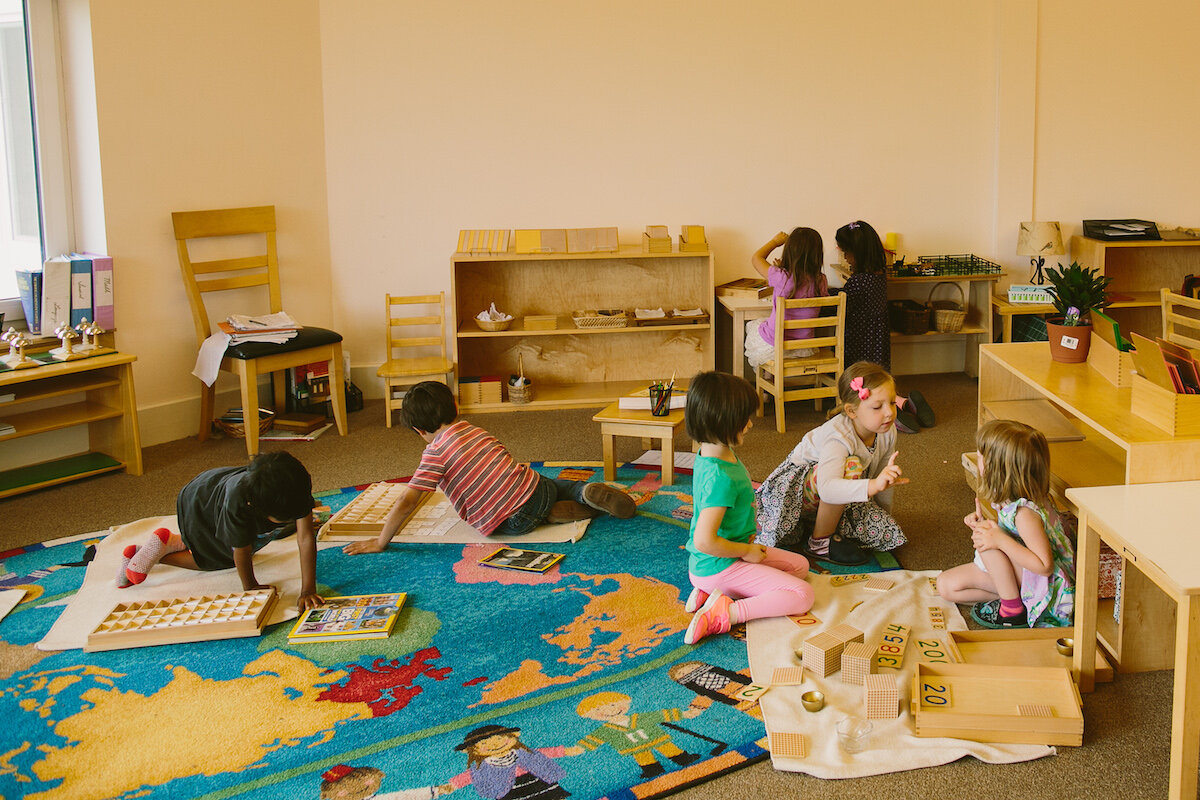
A three-year-old sits on a large area rug, with a work mat beneath the pink tower, which she is carefully stacking higher and higher. She carefully compares the sizes of the blocks, making adjustments as needed so that they become smaller as they ascend.

Several four-year-olds sit together at a table, working in silence to create maps. One uses a small tool to poke holes in colored paper, creating neat perforations in the shape of South America. Another uses watercolor paint to shape two blue spheres on a large piece of white paper. The third, who has previously completed the other two steps, is seen gluing their continents onto the painted hemispheres.

At the next table over, the guide is sitting with a five-year-old to give an initial lesson with the stamp game material. This particular child has an affinity for math and is ready to move on to more challenging work. Today they will begin adding larger numbers.

Two friends have decided they need a break. They have been enjoying a snack together at a designated table, and as they finish, they take their dishes to the sink and wash them in a prepared soapy bin of water. After a quick rinse they leave them in the rack to dry.

The classroom is not silent by any means. There is a gentle hum, with most working quietly. They all seem engaged in whatever they are doing - even the very youngest students. One small child is seen wandering around the room. They aren’t working, but they aren’t disturbing the work of anyone else, either. This goes on for about ten minutes or so, at which point they select a material from the shelf and get started. They were able to move around and take the time they needed to transition, and they were trusted to make their own decisions.

transition to midday

As the clock nears noon, the work cycle draws to a close. Children enrolled in a half-day program put their materials carefully on the shelves and get ready to head home.

As for the others, the next hour or so is generally spent eating and spending time outdoors. At lunch, the children sit together at tables and unpack their meals onto small cloth placemats. There is laughter, sweet conversation, and a chance to refuel after the hard work of the morning.

With some guidance and reminders, the children clean up their own space, wash the table, and sweep the floor beneath. 

Outside, the children become lost in a different type of play. They run, skip, and balance. They navigate social situations. They are mostly independent, but there is always an adult nearby in case help is needed with a scraped knee or solving a misunderstanding with friends. 

the afternoon

For the youngest children, the early afternoon is the perfect time to rest. Whether they fall asleep for a nap or just lie quietly with a book, the time is set aside for them to do so. Lights are dimmed, and each child curls up with a favorite stuffed animal. 

Meanwhile, in the classroom, older children are back to work. When they first enter, they gather on the rug, seated and anxiously awaiting their teacher to join them with a book. They listen, enchanted, to a story read aloud. After several chapters, the teacher marks the page with a bookmark, and the group disperses.  

One small group gathers supplies and meets back on the rug for a lesson about vertebrates and invertebrates. They look at their class guinea pig and imagine his backbone lying just beneath the skin. Then they sort photos or different animals, deciding which have spines, and which do not.

At various tables, other children have taken out their journals and are writing (or drawing) stories. They put great care into their work, and flip back through the pages occasionally to look at old entries.

After a bit, the younger children filter back into the classroom from their rest time and find their own way into the work. This continues until it is time to go.

farewell to the children & preparation for tomorrow

A gentle bell chimes in the room, signaling to the children that it is time to clean up. Work mats are rolled, materials are placed on shelves. Some children can be seen sweeping, while others feed a few bits of lettuce to the guinea pig. One little boy waters a small plant in the corner, while a girl spends some time lining up drinking glasses in a neat and orderly row on the counter. 

One by one the children file into the hallway to gather their things. They head outside and wave a happy goodbye to their friends and teacher as they climb into the car to go home for the day.

Once the last child has skipped off, the guide returns to the classroom. The children have made great progress this year in cleaning up, so after tidying a few areas she can focus on planning for the next day. Shelves straightened, crayons returned to their proper place, and a single forgotten pretzel placed in the compost bin, and the room is restored.

Another great day, full of joyful learning.

6 Effective Ways to Be an Engaged Parent

familyinsnow.jpg

Research has shown time and time again that parent involvement is critical to children’s success. We all want to take an active role in our child’s education, but sometimes it can be a challenge to discern just where our efforts are best spent. Below we touch on six critical areas that all parents can focus on to make a big difference.

1. Make connections

Consider the whole school community and make connections with others whenever possible. This usually starts early, with your child’s teacher. Let them know who you are, reach out whenever you have questions or concerns, and ask them how you might best support their work in the classroom.

Connections can also be made with school administrators. You likely met these folks during the admissions process, but it’s always nice to say hello and touch base when you can offer support or have positive feedback.

Do you have a passion for art? Check in with your child’s art teacher just for conversation or to help out. Feeling social? Introduce yourself to other parents in the school community. Any time we connect with others we strengthen the community as a whole, which is a great thing for everything involved.

2. Volunteer

Schools always need help. Whether it be to organize a fundraiser, read to a class, offer your talents or services, or maybe even fill in as a substitute teacher, we would love to have you join us. We completely understand that most parents have busy schedules, and that not everyone is comfortable with every type of volunteering, but we encourage all families to contribute in whatever ways they can.

Looking for more ways to volunteer your time and efforts? We encourage you to join our parent teacher organization. This group is critical to the ongoing success and support of our students, classrooms, and the school as a whole.

3. Keep learning

As educators, we consider ourselves to be lifelong learners. We work hard to cultivate a joy of learning in the children we teach, so that they may carry that passion for knowledge with them throughout their lifetimes. We hope that the families we serve feel the same way.

Montessori education is unlike any other method of learning and teaching. In order to fully support your child’s growth and learning, it really helps if you as a parent prioritize learning what you can about Montessori. By understanding more about child development, our methods, and why Montessori does things differently, you will have a deeper understanding of what goes on during your child’s school day, and you will find more nuanced ways to support them at home.

“Keep learning” isn’t just about Montessori, either. We believe all humans should stay curious. If your child sees you nurturing your own passions and seeking out new information regularly, you are setting an example that will stick with them for a lifetime. So take time out to learn more about whatever interests you, and share your enthusiasm with the whole family when it strikes.

4. Support learning at home

Learning doesn’t just take place within the confines of a classroom; it happens everywhere. Children spend a huge portion of their time at home, and while the home is a multi-purpose environment, it can also support children’s learning. We don’t mean you should go out and purchase Montessori materials (in fact, we don’t advocate doing so without specialized training). There are plenty of simple and small ways to support learning. Our bet is you’re likely already doing many of these! A few ideas:

  • Keep plenty of books and magazines around. Source your local library and second-hand bookstore to keep things fresh! Trading with friends is another fun idea.

  • Play board games together. Not only does this give everyone a chance to connect, but many games have elements of learning embedded into the fun.

  • Spend time in the kitchen. There are so many important skills to be gained, from practical life to fractions.

  • Emphasize toys that make kids think. Instead of the flashing, battery-powered variety, think about more open-ended options. Art supplies, blocks, colorful scarves, and even sets like marble runs keep kids entertained and thinking.

  • Read together. Again, this is a great way to connect while building all sorts of literacy skills.

5. Consider different forms of advocacy

It won’t come as a surprise when we say that parents are their children’s strongest advocates. Whether your child is struggling in academic or social skills, when they’re young they count on you to convey this information to other adults. Open communication is key, and it helps to recognize that children often have very different experiences at home and school. If you have concerns about your child, address them with their teacher early, and stay connected to discuss progress.

It is very important for us to note that you will not be able to advocate for your child forever. One of the hallmarks of Montessori education is to nurture children’s independence, and we count on parents to help us in this endeavor. We want to teach our children to advocate for themselves, so as soon as they are able, we should encourage them and teach them how to speak up for themselves.

Do they wish they had more challenging math work? Talk them through how they might ask their teacher. Are they struggling with another child on the playground? Go over various options and scenarios with them so they know how they might try and solve the problem in the future.

Our children need us to stand up for them, but ultimately, they need us to teach them to stand up for themselves.

6. Attend events

Being an involved member of the community is one of the simplest and most effective ways to support your child and their school. We want to again acknowledge that families are busy and not everyone can attend every event, but we hope you will join us whenever possible. 

Some events are education, while others are meant to be just fun. Either way, they are a great way to build and strengthen connections.

We want to thank you for being a valued member of our community. Having different voices and perspectives is part of what makes our school strong, and we are grateful to all of you for everything you do to support us and your children!

Could Montessori Transform Early Childhood Education?

AML_Marketing2019-4.jpg

For those of us with children in a Montessori program, we understand fully just how powerful this approach to education can be. Not only do children have an advantage academically, but the whole child’s growth and development is valued and nurtured. Additionally, ripples of the work with children positively affect the greater community.

While Montessori’s early roots were in serving children of low-income families in Rome, over the past hundred years availability of Montessori schools has shifted to mainly affluent communities. While there are certainly public Montessori offerings, the vast majority are only available to middle- and upper-income families who are able to pay tuition at independent schools.

Recent research highlights the ability of a high-fidelity Montessori program to positively impact diverse communities. In areas that tend to be more racially, culturally, and socio-economically diverse, Montessori opportunities are rare, but could potentially provide a substantial positive impact.

One case study published this past spring was written by Mary D. Burbank, Melissa M. Goldsmith, and Koeun Park (all of the University of Utah), and Jennifer Spikner of Chicago, Illinois. Entitled Montessori Education and a Neighborhood School: A Case Study of Two Early Childhood Education Classrooms, it details the transformation of two classrooms within an urban school. 

The study was guided by Project SYNC (Systems, Yolked through Nuanced Collaboration) and the work of various stakeholders. Those involved in the project included a university, the public school district, an established elementary school, and a local private Montessori school. Each played a specific but different role in the implementation of the project.

In short, a public elementary school of over 500 students was already offering full-day preschool and kindergarten. It committed to transforming 2 of its 4 early childhood classrooms into fully implemented Montessori classrooms, along with two teachers that volunteered to become trained and certified. With the assistance of a paraeducator in each classroom and support from a local private Montessori school, the case study covered both the planning and implementation years.

 It is important to note that the elementary school already had a deep commitment to serving the diverse community in which it stood, including a focus on social justice and trauma-informed practices. The goal of the school was not only to educate the children, but to serve the families and community as whole.

The authors of the study noted several important motivations for the project’s existence:

“Montessori education offers an educational experience that creates opportunities for students to engage in learning opportunities that are self-directed, exploratory, and based upon individual learners. As such, Montessori education may be thought of as culturally responsive, as it is based upon classroom learners.”

“...the flexibility of Montessori experiences allows students, particularly students of color, to express themselves and be themselves without assimilating to the norm within more-typical classroom settings.”

As stated before, the teachers became fully credentialed. Both classrooms were outfitted with traditional Montessori materials and a 2½ hour work period was honored each morning. All family participants were voluntary, and while the demand met the need the first year, the success of the program led to waiting lists during subsequent years.

Evaluation of this case study included opinions of the stakeholders, classroom observations, and teacher participant attitudes. 

During the planning year, six of the stakeholders participated in in-depth interviews. While most were not overly familiar with Montessori education, all were excited by the prospect and inspired to bring new opportunities to an underserved community.  

During the course of the implementation phase, a number of data points were collected. Six stakeholders participated in a survey, the two teachers responded to open-ended questions, and 34-40 students were observed on numerous occasions.

The responses were overwhelmingly positive.

Data showed:

  • Family engagement had increased.

  • Montessori had a positive influence on the children’s learning.

  • The model had been successfully implemented within the larger conventional school.

  • Over time, students were able to more clearly express their individual selves.

  • Montessori grace and courtesy lessons helped build relationships within the classroom.

Moving forward, it would be interesting to see if this type of project could continue on a long-term basis and/or be replicated widely. Funding and support are typically the two most distinctive barriers. Those interested in creating similar opportunities for students in diverse communities might benefit from implementing a braided funding approach. A committee of supporters with the ability to educate stakeholders on the benefits of Montessori education would also be important for buy-in.

Thank You to the Illustrators

IGPost image 8Feb2021.jpg

Each year the Association for Library Services to Children awards a special honor, the Caldecott Award, to the illustrator of one picture book. This coveted award has recognized some amazing works over the years and is a great way to highlight the important fact that illustrators contribute significant meaning to the art of children’s literature.

This week we share the Caldecott winners for the past decade. (By the time this article is published there will have been a recently announced 2021 winner, so keep an eye out for a new title to explore!)

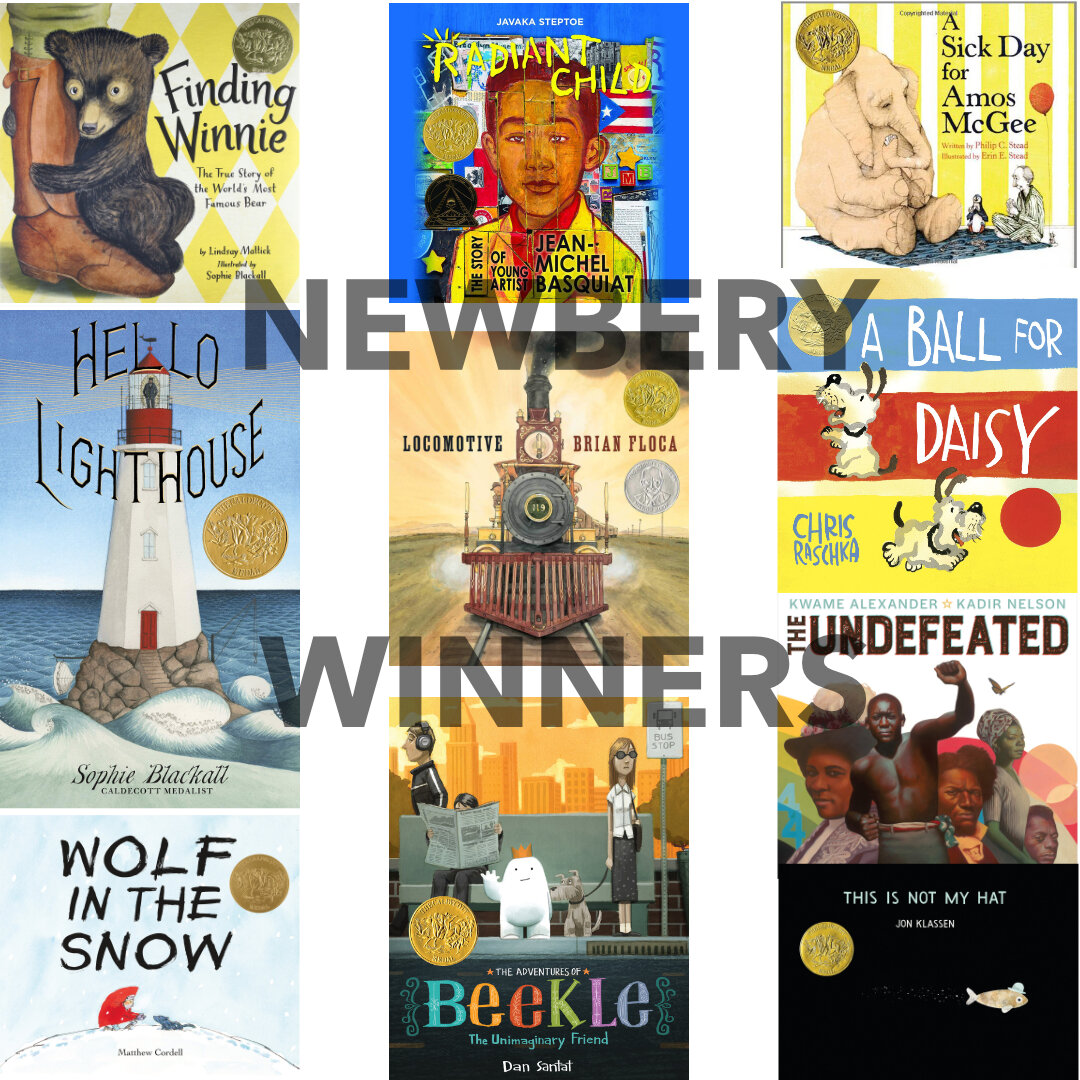
2020 The Undefeated,
illustrated by Kadir Nelson

Kadir Nelson illustrated this beautiful and often heart-wrenching love letter to black Americans, celebrating their achievements while honoring their traumatic history. Each page has gorgeous illustrations highlighting various points in history as well as individuals who have contributed to the world in magnificent ways. In addition to being a Caldecott winner, this book was also the recipient of a 2020 Newbery Honor and the 2020 Coretta Scott King Illustrator Award.

2019 Hello Lighthouse,
illustrated by Sophie Blackall

Sophie Blackall’s Hello Lighthouse has a fascinating way of blending the simplicity of daily life with a rare window into an interesting part of history. A lighthouse keeper and his wife live alone on the island, going about the task of maintaining the beacon. In time, their family grows, and the monotony of cooking, tending to the light, and enjoying moments together plays out visually for readers to enjoy. The pages show beautiful cutaways of the interior of the lighthouse, allowing us a peek back in time. 

2018 Wolf in the Snow,
illustrated by Matthew Cordell

In this charming wordless book, a child is on her way home from school when she comes across a lost wolf pup as a snowstorm begins. She hears the barks of the wolf’s family in the distance, and trudges through the snow to return it safely. Afterward, she finds herself turned around in the windy and white landscape, but her new friends find a way to return the favor.

2017 Radiant Child: The Story of Young Artist Jean-Michel Basquiat,
illustrated by Javaka Steptoe

Jean-Michel Basquiat grew up in Brooklyn, absorbed for hours in his own art and dreams of becoming a famous artist. His mother encouraged him and taught him that art was more than just pretty paintings. As he grew up, he explored various mediums, and became well-known first through his street art. His mother eventually became ill, but Jean-Michel always remembered her influence on him and showed his gratitude for her support. 

2016 Finding Winnie: The True Story of the World’s Most Famous Bear,
illustrated by Sophie Blackall

One evening, a little boy lies awake in bed asking his mother to tell him a true story. She obliges and tells the story of a veterinarian-turned-soldier who rescued a bear cub at a train station. The special bear is given the name Winnie, and eventually goes to live at the London Zoo, where she charms the heart of a little boy named Christopher Robin and his father, A. A. Milne. The veterinarian’s granddaughter turns out to be the mother telling the story, and it is, indeed, the story behind the inspiration for the famed character, Winnie the Pooh.

2015 The Adventures of Beekle: The Unimaginary Friend,
illustrated by Dan Santat

A small creature lives on an island with other fantastic creatures, where they all await the moment a child will choose each as their imaginary friend. The small creature becomes impatient, leaves the island, and searches throughout the land of humans for the friend he is destined to be with. It isn’t until one day, from high up in a tree, he looks down and spots her, and they both know it was meant to be.

2014 Locomotive,
illustrated by Brian Floca

This book is perfect for both train lovers and history buffs. The illustrations help readers understand what it was like in the early days of the locomotive in the United States, as its rails were laid down by hard working people and the cars snaked their way across the land. The roles of various people running the train itself are detailed, as are the journeys and lives of some of the early travelers.

2013 This Is Not My Hat,
illustrated by Jon Klassen

One small fish steals the hat of a sleeping and unsuspecting large fish. Though the small fish knows what it has done is wrong, it spends most of the book defending its decision and finding a way to hide itself. Undeterred, the large fish wakes up, realizes what has happened, and sets off to retrieve what is rightfully his.

2012 A Ball for Daisy,
illustrated by Chris Raschka

Sweet Daisy, a scrappy pup, adores her red ball. She plays with it, chases it, and cuddles on the couch with it. One day, her owner takes her and her ball to the park to play, where they meet a friend. Daisy and the other dog both run for the ball, but the other dog accidentally pops it. As you can imagine, Daisy is distraught, but there is a happy twist at the end. This beautifully illustrated book tells its story without any words at all.

2011 A Sick Day for Amos McGee,
illustrated by Philip C. Stead

Amos McGee is a morning person, and each day he swings his legs out of bed, makes breakfast, and heads off to work at the zoo. He takes great care to visit with each of his animal friends, spending time with them in the way each individual appreciates. One day Amos wakes up sick and realizes he must spend the day at home. Missing him dearly, the animals find their way to his house and repay all the kindness he has shared with them over the years.