Montessori

What is Cosmic Education?

IGpost image 22March2021.jpg

As your child nears the end of their early childhood years and edges toward elementary, you may begin hearing the term cosmic education. Ever wonder what Montessori folks are referring to when they say this? The short answer is that cosmic education is the term Maria Montessori gave to the elementary cultural curriculum (and by cultural, we mean history, science, and geography).

As you may have guessed, to truly understand cosmic education, it takes much more than a short answer. Read on to learn more!

Hallmark Traits of the Second Plane

Before we explain what cosmic education is, it will help if we explain why it was developed in the first place. As you know, Montessori education relies heavily on our knowledge of the developmental characteristics of children. As children grow and change, so should our approaches in how we serve their educational needs. Montessori organizes the stages of development into four planes, and children ages 6-12 fall within the second plane of development. Some of the most notable characteristics of children this age include:

  • A shift from concrete learning and understanding to more abstract concepts

  • A strong sense of justice and fairness

  • A desire to cultivate social relationships with peers

  • A tendency toward imagination

  • A deep interest in the world around them

  • A need for work that feels big and important

Montessori education takes these unique characteristics into account with the way we approach our work with children in both lower and upper elementary. We allow for more social work experiences, we give plentiful opportunities for cultural learning, and even the lessons and materials were created to appeal to the needs of school-aged children.

A Deeper Definition

When we think about cosmic education, we think about our aims to give children a bigger picture of the world, their place in it, and the interconnectedness of everything. It is during this time they begin seeking answers to questions related to these topics, and their desire to learn as much about the world as possible is satisfied by the large amount of information available in their classroom environments.

Each year during the elementary years begins with a study of the beginnings of the universe. From here, and throughout the year, the study trickles outward. Children may learn about our solar system, basic chemistry, or how science experiments are conducted.  

They learn about the evolution of life on earth, as well as in-depth unit studies in botany and zoology. There are opportunities for research (independent and alongside peers), presentations, and exploration.

The children learn about our ancient human ancestors, the civilizations of centuries past, and the origins of writing and mathematics. The latter are perfectly timed, considering elementary children are in the process of discovering reading, writing, and math for themselves.

Impactful Lessons and Materials

Have you heard of the Montessori Great Lessons? These five impressionistic lessons are considered the springboard into cosmic education. They are theatrical and make quite an impact on children. They are presented in a storytelling fashion, which appeals to children’s imagination, yet they are rooted in facts, which appeals to their desire to learn the truth. 

Each of these five lessons is given repeatedly throughout a child’s years in elementary, and each time they receive a lesson they will glean something new from it, and the follow-up studies may be different as well.

1. The Beginning of the Universe

The first great lesson is dramatic and exciting. Students enter a darkened room with soft music playing. After they are seated, the guide begins telling the story of when everything was darker and colder than they can imagine, and how a great flaring forth was the beginning of our universe. There are moments in the lesson when they are shown grains of sand in comparison to the number of stars, they learn about the attraction and repelling of particles, how weight and density affects matter, and what the three states of matter are on earth.  

Following this storytelling lesson, the class will launch into a different, related unit of study each year, giving children the ability to see things from a different perspective. 

Before the second great lesson, students are able to interact with a number of materials that put the vastness of time in perspective. The Clock of Eons reimagines Earth’s history and major periods of time on a 12-hour clock. The Long Black Strip illustrates how much time passed with an actual long black strip of fabric, before reaching a tiny section of white at the end, signifying human’s history on the planet.

2. The Coming of Life on Earth

Children love learning about animals, so this particular work is always approached with great enthusiasm. The main material used is called the Timeline of Life, and it colorfully and beautifully illustrates the evolution of life on our planet from the early Paleozoic Era through today. Being able to see how life has changed over time, and even the ways in which it has remained the same, always makes an impact on children. 

This work naturally lends itself to in-depth studies of both plants and animals, with various methods of classification.

3. The Study of Early Humans

Touched upon in lower elementary, but often emphasized in upper elementary, there is a timeline to support this study as well. We are all fascinated to learn about our ancestors, and it gives children a sense of gratitude for those that have come before us and for all the great work that has been done throughout history.

Not only do children have an opportunity to study early hominids, but as mentioned earlier they take a look at the early great civilizations and how they changed over time.  

4. The History of Writing

From the earliest cuneiform, hieroglyphs, and ancient scripts, to the various languages written around the world today, the history of writing is fascinating. To learn about such information while also learning to write for the first time in one’s life sparks a curiosity that is difficult to replicate.

5. The History of Mathematics

Math is a subject that grows in sequential building blocks, and so it was with the discoveries of various mathematical concepts. Over time, humans discovered more complex and abstract ways of expressing the numerical world. Just as with learning about the beginnings of writing, children are always excited to learn about how math has evolved throughout time and in various cultures.

Now that you have a basic understanding of cosmic education, we would love to hear what you think. Curious to learn more? The best way is to see it for yourself. Call us today to schedule a visit.

Does Montessori Support Creativity?

20141120-0006 copy 2.jpg

A study published in 2019 was one of a number that have aimed to determine whether Montessori education contributes to creativity in students. While continued research would be beneficial to learning more about whether or not it does, the findings were interesting and we thought you might want to learn about them.

What is creativity?

Creativity is a difficult concept to define, and even more difficult to measure. A general understanding of creativity is that it is the ability to generate independent and novel ideas that can be used to solve problems or create new contributions.

There are a number of traits of the Montessori environment that researchers identified as being potential contributing factors in terms of cultivating creativity. Many of the elements identified have been proven to be supporters of creativity in other studies as well. These factors include: 

  • Emphasis on independence and choice

  • Physical differences in the classroom environment

  • Flexibility in regards to time

  • Focus on intrinsic motivation

  • Opportunities for collaboration

  • A sense of control over one’s work and activities 

Study methods

The study, which took place over the course of the 2015-2016 school year, utilized data collected from two settings. 77 third graders at a public Montessori school in the United States and 71 third graders in a similar but traditional public school were participants.

There are a variety of evaluations that have been used in academic studies to measure creativity. Most of them focus on either divergent thinking (the ability to form novel ideas) or convergent thinking (the ability to synthesize and combine ideas). The researchers in this study decided to use an assessment that measures both divergent and convergent thinking (the Evaluation of Potential Creativity) in order to obtain a more complete collection of data. 

When a child participates in the test, there were three distinct steps:

  1. View eight unrelated, random, abstract shapes and create a drawing that combines them.

  2. View eight, unrelated, random, concrete pictures (such as a carrot) and create a drawing that combines them.

  3. Tell a story about each drawing created.

Students were tested and retested with new images two weeks later in order to obtain a full sample of data. 

How does Montessori measure up?

As the authors of this study state, this research adds to the body of existing research and leads us to ask even more questions that might be explored moving forward.

Students in the two settings performed similarly in some areas, but there were two categories that stood out. While the Montessori students performed better overall, it was notable that there were obvious benefits for the male Montessori students. Additionally, the Montessori students performed significantly better on the divergent thinking portion of the assessment.

What does this mean? While this study could be repeated and built upon, there were some indications that a Montessori learning environment does foster creativity, particularly in some areas and for some students. It does add to the overall body of research that suggests Montessori schools aid in supporting creativity in students.

To learn more about Montessori and creativity, please take a few minutes to watch this video. Award-winning Montessori educator Judi Bauerlein discusses the links between Montessori and creativity, highlighting thoughts from famous Montessori graduates and connections between Maria Montessori’s work and what we

150 Years: Celebrating the Ordinary

CH classroom.jpeg

This article is part of a series that we will share throughout the 2020-2021 school year to celebrate the 150th birthday of Dr. Maria Montessori. Check back often for more posts that reflect on the past, present, and future of Montessori education.

The Glass Classroom

Seeing is believing when it comes to Montessori. It is quite rare to meet a person who has visited and observed in a high-fidelity Montessori school that is then critical of the methods. Since observation is such a core element of the work we do, we have welcomed outsiders from the very beginning to take a look for themselves.

In 1915 there was a world fair, The Panama-Pacific International Exposition, in San Francisco. The affair stretched out over many months, took over hundreds of acres, and was visited by more than 18,000,000 people.

Maria Montessori held an exhibit at the fair, which has gone down in history as a major stepping stone to informing Americans about Montessori education. The Glass Classroom, which visitors could see into, showed the public just what went on inside a Montessori school. Visitors were astounded by what they saw. 

A Day in the Life of a Primary Environment

The tradition of the Glass Classroom continues even today. Many Montessori schools have observation windows so that parents and visitors can take a peek inside without being noticed. All Montessori schools encourage adults to observe - window or not. We feel it’s the best way to fully understand what goes on, and we know every person who does so is amazed.

COVID has made this special opportunity a bit tricky. We thought it might be nice to take you on a written journey, just to get a sense of what the day is like. We hope, when the time is right, to see you back in our classrooms again! 

early morning, before the children arrive

The guide arrives, hangs their coat, changes their shoes, and admires the beautiful classroom environment upon entering. So much love and attention to detail has been put into the creation of this space, with small changes being made throughout the year to better serve the ever-evolving needs of the children.

The guide makes a cup of tea, puts on some relaxing music, flicks on the lamps, and gets to work reviewing the plans for the day. If any materials need to be prepared (or repaired!) this is done. Pencils are sharpened and chairs set down. As colleagues trickle in they take a moment or two to check in with one another.

drop-off time!

A flurry of cars descends upon the campus, and children hop out of back seats with bags and coats in tow. Independently, the children make their way to their classrooms, hang their own coats, and change their shoes. Their guide stands in the doorway, and they cheerfully (or sleepily) greet one another with a smile.

The child walks through the doorway, takes in the sight of the room, and prepares to work.

the morning work cycle

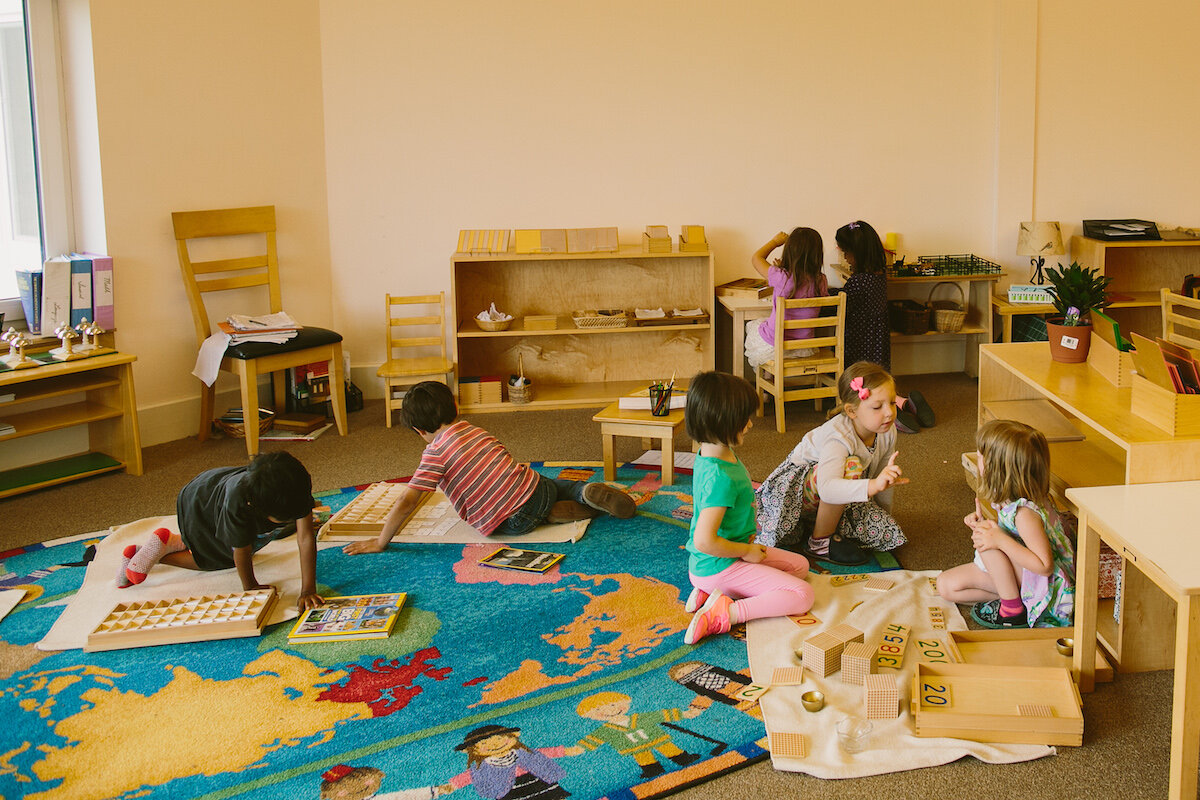
The first two and a half to three hours of each day is dedicated to the morning work cycle. This allows children to sink deeply into their work, and the flexible schedule means children will transition as they are ready and will work independently according to their own personal needs.

A three-year-old sits on a large area rug, with a work mat beneath the pink tower, which she is carefully stacking higher and higher. She carefully compares the sizes of the blocks, making adjustments as needed so that they become smaller as they ascend.

Several four-year-olds sit together at a table, working in silence to create maps. One uses a small tool to poke holes in colored paper, creating neat perforations in the shape of South America. Another uses watercolor paint to shape two blue spheres on a large piece of white paper. The third, who has previously completed the other two steps, is seen gluing their continents onto the painted hemispheres.

At the next table over, the guide is sitting with a five-year-old to give an initial lesson with the stamp game material. This particular child has an affinity for math and is ready to move on to more challenging work. Today they will begin adding larger numbers.

Two friends have decided they need a break. They have been enjoying a snack together at a designated table, and as they finish, they take their dishes to the sink and wash them in a prepared soapy bin of water. After a quick rinse they leave them in the rack to dry.

The classroom is not silent by any means. There is a gentle hum, with most working quietly. They all seem engaged in whatever they are doing - even the very youngest students. One small child is seen wandering around the room. They aren’t working, but they aren’t disturbing the work of anyone else, either. This goes on for about ten minutes or so, at which point they select a material from the shelf and get started. They were able to move around and take the time they needed to transition, and they were trusted to make their own decisions.

transition to midday

As the clock nears noon, the work cycle draws to a close. Children enrolled in a half-day program put their materials carefully on the shelves and get ready to head home.

As for the others, the next hour or so is generally spent eating and spending time outdoors. At lunch, the children sit together at tables and unpack their meals onto small cloth placemats. There is laughter, sweet conversation, and a chance to refuel after the hard work of the morning.

With some guidance and reminders, the children clean up their own space, wash the table, and sweep the floor beneath. 

Outside, the children become lost in a different type of play. They run, skip, and balance. They navigate social situations. They are mostly independent, but there is always an adult nearby in case help is needed with a scraped knee or solving a misunderstanding with friends. 

the afternoon

For the youngest children, the early afternoon is the perfect time to rest. Whether they fall asleep for a nap or just lie quietly with a book, the time is set aside for them to do so. Lights are dimmed, and each child curls up with a favorite stuffed animal. 

Meanwhile, in the classroom, older children are back to work. When they first enter, they gather on the rug, seated and anxiously awaiting their teacher to join them with a book. They listen, enchanted, to a story read aloud. After several chapters, the teacher marks the page with a bookmark, and the group disperses.  

One small group gathers supplies and meets back on the rug for a lesson about vertebrates and invertebrates. They look at their class guinea pig and imagine his backbone lying just beneath the skin. Then they sort photos or different animals, deciding which have spines, and which do not.

At various tables, other children have taken out their journals and are writing (or drawing) stories. They put great care into their work, and flip back through the pages occasionally to look at old entries.

After a bit, the younger children filter back into the classroom from their rest time and find their own way into the work. This continues until it is time to go.

farewell to the children & preparation for tomorrow

A gentle bell chimes in the room, signaling to the children that it is time to clean up. Work mats are rolled, materials are placed on shelves. Some children can be seen sweeping, while others feed a few bits of lettuce to the guinea pig. One little boy waters a small plant in the corner, while a girl spends some time lining up drinking glasses in a neat and orderly row on the counter. 

One by one the children file into the hallway to gather their things. They head outside and wave a happy goodbye to their friends and teacher as they climb into the car to go home for the day.

Once the last child has skipped off, the guide returns to the classroom. The children have made great progress this year in cleaning up, so after tidying a few areas she can focus on planning for the next day. Shelves straightened, crayons returned to their proper place, and a single forgotten pretzel placed in the compost bin, and the room is restored.

Another great day, full of joyful learning.

Could Montessori Transform Early Childhood Education?

AML_Marketing2019-4.jpg

For those of us with children in a Montessori program, we understand fully just how powerful this approach to education can be. Not only do children have an advantage academically, but the whole child’s growth and development is valued and nurtured. Additionally, ripples of the work with children positively affect the greater community.

While Montessori’s early roots were in serving children of low-income families in Rome, over the past hundred years availability of Montessori schools has shifted to mainly affluent communities. While there are certainly public Montessori offerings, the vast majority are only available to middle- and upper-income families who are able to pay tuition at independent schools.

Recent research highlights the ability of a high-fidelity Montessori program to positively impact diverse communities. In areas that tend to be more racially, culturally, and socio-economically diverse, Montessori opportunities are rare, but could potentially provide a substantial positive impact.

One case study published this past spring was written by Mary D. Burbank, Melissa M. Goldsmith, and Koeun Park (all of the University of Utah), and Jennifer Spikner of Chicago, Illinois. Entitled Montessori Education and a Neighborhood School: A Case Study of Two Early Childhood Education Classrooms, it details the transformation of two classrooms within an urban school. 

The study was guided by Project SYNC (Systems, Yolked through Nuanced Collaboration) and the work of various stakeholders. Those involved in the project included a university, the public school district, an established elementary school, and a local private Montessori school. Each played a specific but different role in the implementation of the project.

In short, a public elementary school of over 500 students was already offering full-day preschool and kindergarten. It committed to transforming 2 of its 4 early childhood classrooms into fully implemented Montessori classrooms, along with two teachers that volunteered to become trained and certified. With the assistance of a paraeducator in each classroom and support from a local private Montessori school, the case study covered both the planning and implementation years.

 It is important to note that the elementary school already had a deep commitment to serving the diverse community in which it stood, including a focus on social justice and trauma-informed practices. The goal of the school was not only to educate the children, but to serve the families and community as whole.

The authors of the study noted several important motivations for the project’s existence:

“Montessori education offers an educational experience that creates opportunities for students to engage in learning opportunities that are self-directed, exploratory, and based upon individual learners. As such, Montessori education may be thought of as culturally responsive, as it is based upon classroom learners.”

“...the flexibility of Montessori experiences allows students, particularly students of color, to express themselves and be themselves without assimilating to the norm within more-typical classroom settings.”

As stated before, the teachers became fully credentialed. Both classrooms were outfitted with traditional Montessori materials and a 2½ hour work period was honored each morning. All family participants were voluntary, and while the demand met the need the first year, the success of the program led to waiting lists during subsequent years.

Evaluation of this case study included opinions of the stakeholders, classroom observations, and teacher participant attitudes. 

During the planning year, six of the stakeholders participated in in-depth interviews. While most were not overly familiar with Montessori education, all were excited by the prospect and inspired to bring new opportunities to an underserved community.  

During the course of the implementation phase, a number of data points were collected. Six stakeholders participated in a survey, the two teachers responded to open-ended questions, and 34-40 students were observed on numerous occasions.

The responses were overwhelmingly positive.

Data showed:

  • Family engagement had increased.

  • Montessori had a positive influence on the children’s learning.

  • The model had been successfully implemented within the larger conventional school.

  • Over time, students were able to more clearly express their individual selves.

  • Montessori grace and courtesy lessons helped build relationships within the classroom.

Moving forward, it would be interesting to see if this type of project could continue on a long-term basis and/or be replicated widely. Funding and support are typically the two most distinctive barriers. Those interested in creating similar opportunities for students in diverse communities might benefit from implementing a braided funding approach. A committee of supporters with the ability to educate stakeholders on the benefits of Montessori education would also be important for buy-in.

150 Years: The Mixed-Age Classroom

Mixed Age copy.jpg

This article is part of a series that we will share throughout the 2020-2021 school year to celebrate the 150th birthday of Dr. Maria Montessori. Check back often for more posts that reflect on the past, present, and future of Montessori education.

There are many elements that make Montessori education stand apart from more conventional methods. One of the most obvious is our mixed-age classrooms. Rather than grouping children by a single chronological age, our classroom environments encompass children spanning across several ages.

We find this method to be a huge benefit. Read on to learn more.

But...why?

There are so many perks to having mixed-age classrooms. Some of the key points include:

Models and leaders

By having children of different ages together in one room, the younger children enter the environment with a variety of older children that serve as models to them. It is often the case that children learn best from one another, and when a 6-year-old watches an 8-year-old work, they quickly understand what is expected and what kind of work lies ahead in their future. As for the older children in the class, they have many opportunities to serve in leadership roles, cultivating skills that are critical as they become independent members of their communities.

Skill progression fluidity

Learning is not linear, for any of us. There are periods of rapid growth, periods of steady progress, and times spent in plateau. This is normal and will vary across subject areas for individual children. This is why we don’t believe it makes sense to deliver a prescribed curriculum to all students at the same time, ultimately leaving some children bored and others struggling. In our classrooms, kids can work and progress at their own rates. These lines are further blurred when we don’t rely on typical grade levels.

Strong relationships

When a child is in a class for three years, it allows the guide to really get to know them not just as a learner, but as a person. Rather than starting from scratch each September, the child-teacher-parent team is already established and can work together on a deeper level and with greater understanding of strengths and goals than they would be able to otherwise.

Enhanced social opportunities

Diversity is important on all levels, and that includes spending time with people of different ages. We have so much to learn from each other, and children gain all sorts of skills from their interactions in a mixed-age classroom, like empathy, patience, and open-mindedness.

Reflection of real life

We would be hard-pressed to find an example outside of conventional schools in which people are sorted into one-year age groups where they spend most of their day. Multi-age classrooms are a much better approximation of what life is really like, and we think children benefit from these early experiences.

What did Dr. Montessori have to say about it?

Maria Montessori had a way with words. While she was a woman of science who relied heavily on her observations, her descriptions and explanations often captured the heart of her audience. Her discussion of the multi-age classroom was no different.

“Our schools have shown how children of different ages help one another. The younger ones watch what the older ones are doing and ask all kinds of questions, and the older ones explain. This is really useful teaching, for the way that a five year old interprets and explains things is so much nearer than ours to the mind of a child of three that the little one learns easily, whereas we would scarcely be able to get through to him. There is harmony and communication between them that is not possible between an adult and such a young child. There is a natural mental osmosis between them. A child of three is also quite capable of taking an interest in the work of a five year old, because in fact the difference in their abilities is not that great.

People are concerned about whether a child of five who is always helping other children will make sufficient progress himself. But, firstly, he doesn’t spend his whole time teaching, but has his own freedom and knows how to use it. Secondly, teaching really allows him to consolidate and strengthen his own knowledge, which he must analyse and use anew each time, so that he comes to see everything with greater clarity. The older child also gains from this exchange.”

How we break it down

Obviously, a Montessori school doesn’t place a 3-year-old in the same classroom as a twelve-year-old (although we do love to find opportunities for children to work together from different periods of growth and development!). Generally speaking, the classrooms take on three-year age spans that roughly correspond with the planes of development.

  • Infant/Toddler - Sometimes divided into two separate environments, children aged 0-3 have specific (and similar) developmental needs.

  • Primary/Early Childhood - We combine what would be called preschool and kindergarten elsewhere, with children ages 3-6 working alongside one another.

  • Elementary - Many Montessori schools have a lower (ages 6-9) and upper (9-12) elementary environment, but others keep them combined.

  • Adolescent - As with several of the other age groups, teens aged 12-18 may be placed in separate middle and high school environments, or they may work together for all/part of their day.

Still have questions? Send an email or give us a call. We would love to chat with you about how Montessori serves children in a wide variety of ways.

150 Years: The Preparation of the Teacher

BlogDec2120.jpeg

This article is part of a series that we will share throughout the 2020-2021 school year to celebrate the 150th birthday of Dr. Maria Montessori. Check back often for more posts that reflect on the past, present, and future of Montessori education.

There are so many ways in which Montessori education stands apart from other traditional methods. One of the most stark is the way in which our teachers (also known as guides) are prepared for their jobs. To get straight to the point, Montessori educators have the same credentials as their conventional education counterparts...and then some. In this article we highlight what Dr. Maria Montessori had envisioned, what teachers need to become certified today, and what it takes to become a modern Montessori educator.

What did Dr. Montessori have to say?

“An ordinary teacher cannot be transformed into a Montessori teacher, but must be created anew, having rid herself of pedagogical prejudices.” -Maria Montessori, Education for a New World

Montessori believed that the guides in her schools were so vastly different from those in other schools, that they must rid themselves of preconceived notions of education. This is a challenging task, for unless a teacher was a Montessori child themselves, we all hold onto ideas of what school and learning is supposed to be.

Taken at face value, it appears that Montessori is saying that a person who is already a teacher could not become a Montessori teacher. This is not the case. Many teachers enter education and quickly recognize that many schools operate in ways that do not fully serve the children in their care. It becomes obvious that long-held structures and practices were not created with child development in mind, nor do they encourage a love of learning. Sometimes these teachers go in search of alternative education models and are delighted to discover Montessori.

Regardless of one’s education history, a good Montessori teacher has to be able to be flexible in their thinking. They have to be able to confront their own bias. They must be willing to see education in an entirely new way. 

"The vision of the teacher should be at once precise like that of the scientist, and spiritual like that of the saint. The preparation for science and the preparation for sanctity should form a new soul, for the attitude of the teacher should be at once positive, scientific and spiritual.

Positive and scientific, because she has an exact task to perform, and it is necessary that she should put herself into immediate relation with the truth by means of rigorous observation…

Spiritual, because it is to man that his powers of observation are to be applied, and because the characteristics of the creature who is to be his particular subject of observation are spiritual." -Maria Montessori, The Advanced Montessori Method

Montessori based her educational methods on her scientific observations, and she expected her teachers to do the same. Today, Montessori educators rely heavily on their ability to observe children and take careful notes. This information is then used to inform their work in the coming days, weeks, and months. We believe the best way to assess a child is by watching them, unobtrusively, while they are at work. This method gives a clear picture of abilities, strengths, and challenges, and provides an important glimpse into who each child is as a person.

Typical teacher training

Most teachers in today’s conventional education settings must obtain a bachelor’s degree in their particular field. Some areas require teachers to take a standardized examination before obtaining licensure. Some areas require teachers to obtain a master’s degree within a set amount of time (usually a matter of years), while others do not.

All teachers spend some time in a practicum, or student teaching, phase. This allows them to work in a classroom with children without the responsibility of being the head teacher. Many schools and programs provide mentor teachers to new hires, allowing some sort of built-in guidance.

Modern Montessori training programs

Montessori teachers hoping to complete a reputable training program must have already obtained a bachelor’s degree. Many Montessori training programs today are done concurrently with master’s programs, so the educator will complete the program with a degree and their Montessori certificate. The training programs themselves entail many hours of work, often spanning several years. This includes:

  • Philosophical and subject area lectures

  • Detailed training on the Montessori materials

  • Extensive reading requirements

  • Written papers

  • Practical examinations

  • Practicum experience

  • Creation of the personal albums (collections of lessons on all subjects)

  • Creation of handmade learning materials

While there are many ways to learn about Montessori education, most reputable certifications are affiliated with either the American Montessori Society or the Association Montessori Internationale. While programs associated with these two organizations do vary, there are many commonalities and both are highly regarded. To learn more about each, visit the websites for AMS teacher training and AMI teacher training.

You may be interested to learn that many successful Montessori educators begin their training after having been inspired as Montessori parents. It is hard to see such an amazing model firsthand, through your own child’s experience, and not feel some deep connection with this type of work.

If you’d like to learn more about how our teachers continue their education, or what our school does to support professional development, please reach out! We love to have conversations with families about the work we do here at the school - and beyond.

The Icing on the Cake: Why the Kindergarten Year is Critical

Hollis Montessori - General Photos - December 2019-77.jpg

It’s that time of year again - we are all beginning to think about enrollment for the 2021-2022 school year. We hope all the families in our special community will continue with us for another year, but this article is aimed at one specific group of you: the parents of next year’s kindergartners.

We find this tends to be a critical year for many families. Some folks turn to Montessori initially because they are looking for a daycare or preschool experience for their child before they become eligible to attend their local public schools. Once that time comes, it seems natural to make the transition.

We see things a bit differently (of course!).

What’s so different about the final year of the primary cycle?

Many parents want to know what is so special about the third year of the cycle. It is helpful to understand that Montessori programs are organized with the intention that a child will remain for the duration. We embrace the multiple years our guides get to spend with each individual child, and the way we teach reflects as much.

Our curriculum is one that spirals; this means that children are exposed to the same skills, but in very different ways, as they get older. This work begins with the very concrete, as that is what our youngest students are able to learn from. As children age, however, they become ready to learn skills in a more abstract way. So everything they have been practicing in their early primary years comes full circle and all the puzzle pieces begin to click into place.

Another very important element of the final year is the children’s opportunities for leadership. One of the greatest benefits of participating in a multi-age classroom is that when a child is younger they have plenty of older role models. When they are older, they have a chance to be a role model. Our kindergartners lead our younger children in so many ways. They even help teach some lessons, which is one way we as guides know that they have fully mastered academic material.

How will my child’s academics be affected?

There is no doubt that Montessori takes a different approach to academics than most conventional education settings. The irony is, while our primary goal is not to focus on academic rigor, but to honor it as one element of the developing child, in the long run our standards tend to be much higher and our students come away with a much deeper understanding of the content. 

Take our math program for example - many of us grew up learning to memorize the processes to complete various mathematical operations. Some of us struggled at times when things didn’t make sense. In a Montessori school, the materials allow children to understand what exactly is happening with the numbers, allowing them to form mental pictures that make the math make sense on a much deeper level.

This approach does take time, but in the long run children not only have a firm grasp on a wide variety of content, but they are able to think creatively and independently, to be self-driven or work cooperatively, and they have a passion and joy for learning and the world around them. School isn’t just about memorizing facts, it’s about education in a whole-child sense of the word.

But - our local public schools are free…

We understand that independent school tuition can be a burden for many families, and we want our programs to benefit as many children as possible. We don’t want finances to stand in the way of Montessori education for your child. If paying tuition is a challenge, please consider applying for financial aid; we do our very best to help families make it work.

Making the decision

Before you make your final decision, we encourage you to think about what you would ideally like your child’s educational experience to be like. Figure out what your values are and how you define them as a family. Once you do, we would love for you to sit and observe in one of our classrooms and do the same at any other school you are considering.

Our doors are open. If you still have questions or concerns, call us any time to chat.

https://www.youtube.com/watch?v=8euBZVO0p_E


150 Years: The Observations That Drive the Work

This article is part of a series that we will share throughout the 2020-2021 school year to celebrate the 150th birthday of Dr. Maria Montessori. Check back often for more posts that reflect on the past, present, and future of Montessori education.

The entire foundation of Montessori education is built on a legacy of scientific observation. As you likely already know, Dr. Montessori began her career as a physician with absolutely no intention of working in the field of education. Her earliest work in a psychiatric clinic led her down the beginnings of a path that would guide her work for the rest of her life.

She watched, she noticed, and she reserved judgement. From that first clinic, to the various other placements in Rome, to the first Casa dei Bambini, and all the other schools she helped inspire and create throughout her lifetime, she observed. As a scientist, she knew the value of approaching her work without bias, and with intent to collect meaningful data.

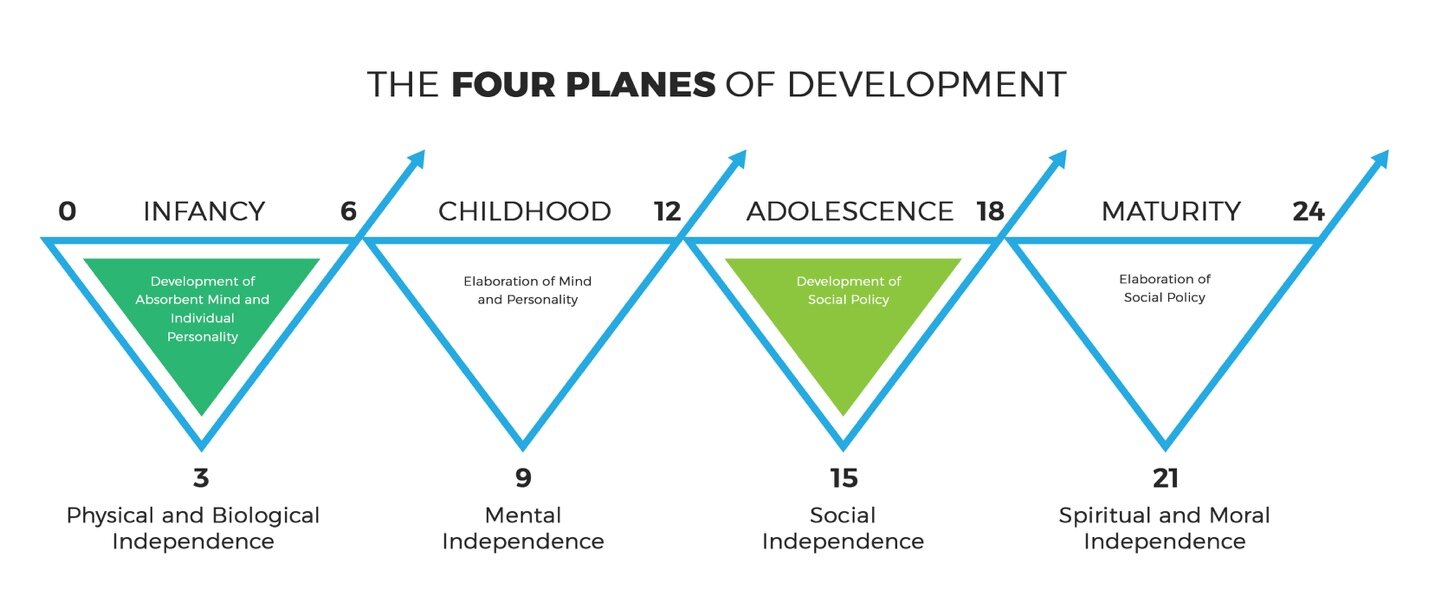
Over the years, Montessori began to notice patterns. Just like any one of us, she acknowledged that it is impossible to expect all children to fit into the same parameters, but she realized that there are very distinct characteristics that children of different ages tend to display. Regardless of location, culture, or language, she noticed commonalities emerging, and she used this information to lay forth the planes of development.

The general idea is that learning and development is not linear, but rather flows in cycles.

image001.jpg

These planes of development are what guided the original groundwork for the various environments in Montessori schools. From the way we organize our classrooms to the way we present lessons, it’s important that everything we do is meeting the child exactly where they are. As Montessori guides, we use the planes as a guide while we plan, as well as how we approach children with their everyday work. We know that when families first learn about this information, it tends to resonate deeply as they recognize their own child and form a clearer vision for their child’s future.  

The First Plane

Birth-6 years

“Help me do it myself.”

Montessori noted that there were distinct differences between the first and second half of the first plane. She called the child aged 0-3 the spiritual embryo, a concept that is not very dissimilar to what some people today refer to as the fourth trimester. Humans, unlike other organisms, need a significant amount of time after they are born to become fully developed. During these first three years, children’s bodies and minds grow in ways that allow them freedom of movement, as well as critical language skills.

How can we support infants and toddlers?

  • Create an environment that encourages rolling, crawling, standing, and walking.

  • When a child is old enough to walk, we allow them to do so (even if this means we slow down to meet their pace).

  • When your infant babbles, mimic their sounds in a conversation format. This will help them learn how humans communicate.

  • As our children develop more sophisticated language skills, engage in regular conversation.

  • Read and sing songs together frequently.

  • Support their practical life work. This means finding ways for them to independently meet their self-care needs, such as eating, drinking, toileting, and dressing. Of course, they will need full support as infants, but you can gradually nurture their growing independence as time goes on.

Montessori referred to the child aged 3-6 as the conscious worker. Children of this stage want to become masters of their environment, and their play(work) becomes a critical part of their development. The skills they developed during the first three years of life are refined and applied to their continuing development. Children of this age begin to develop their personalities. The way we support them is really continued work:

  • Allow young children to be as independent as possible.

  • Find ways for them to engage meaningfully and authentically in ‘adult’ tasks, like household chores.

  • Create an environment that allows for independent dressing, snacking, etc.

  • Continue to read and sing together as they refine their language development.  

To learn more about the first plane specifically, visit Aid to Life.  

The Second Plane

6-12 years

“Help me to think for myself.”

The second plane of development is a time of abstract ideas, great imagination, a deep sense of justice and fairness, and a strong desire to socialize with peers. Children of this age have an enormous capacity to learn about their world and universe, and their curiosity to do so is boundless. One of our greatest tasks is to provide extensive learning opportunities in the cultural areas of study (science, history, & geography) in order to meet these needs. They begin to think outside of themselves and are curious about the world and their place in it. How might we support children during these years?

  • Understand their desire to be with their peers and build social opportunities into each day.

  • Acknowledge that social skills are still being developed, and children will need guidance when solving conflicts.

  • Utilize this social time to create structures in which children can learn to work together cooperatively.

  • Provide plenty of books and other sources of information about areas of interest.

  • Note that children in the second plane have lost the sense of order they once had when they were younger. While we still need to teach them responsibility and cleanliness, it is completely normal for them to pay less attention to these things and become messier than they once were.

  • The second plane is a period of physical growth in which children sometimes become temporarily unaware of where their limbs are. This can lead to periods of general clumsiness, bumping into furniture or people, knocking items over, etc. Just knowing this can be a helpful reminder that it will pass.

  • It is important that we remember the great strides and capabilities children have in the areas of math and language during this time as well, and that each child will move at their own individual pace in these subjects.

  • We should continue reading with our children as long as they enjoy it (for many children this is into the early third plane) as we can model good reading while also dedicating time to connect with them. 

To read more about the second plane, click here.

The Third Plane

12-18 years

“I can stand on my own.”

The third plane, in many ways, mirrors the first plane. True - adolescent children are much older and independent than young children, but they are on the cusp of transforming into adults. This is one of the greatest shifts during the course of a human life. While teens are going through big physical changes, they are simultaneously experiencing great internal changes. They have a deep drive to push away from their parents and become independent, yet they are not actually able to fully do so. These are important characteristics to keep in mind while we search for ways to support them.

  • Make yourself available. Even when it seems like your teen doesn’t want you around, they need to know you are there for them when they do.

  • Keep the lines of communication open. Your adolescent is able to discuss much more mature topics, and likely does with their friends. As adults, we can be the people they trust for facts, and we can teach them how to discern conflicting pieces of information on their own.

  • Encourage teens to follow their passions. This is a time in their lives when they will begin to discover their future paths. Our task is to support what they choose, even if that involves exploration of many options.

  • Support their emotional growth and changes. There will be times of upheaval, but there will also be times of great joy. They will need you there to listen.

  • Consider providing opportunities for teens to help out in their community. They will be searching for ways to connect and contribute, and they have the capacity to understand many of the struggles our society faces.

  • Allow adolescents to pursue authentic work whenever possible; this could be creating art, fixing old cars, getting a job or apprenticeship, or even starting a business. If a child is motivated and interested, we can guide them on their way.

What does this look like in Montessori schools? Click here to learn more.  

The Fourth Plane

18-24 years

“I can achieve independently.”

As an adult, the early years are a time in which most of us develop a sense of purpose in a deeper sense than we had previously. We refine our goals, further develop our interests, and consider what we might do to contribute to our society. This often comes in the form of a career, but it can take on many other forms as well.

People in this stage are often working toward achieving financial independence - an increasingly challenging task in today’s economy. Luckily, young people are creative, and they find ways to meet their needs within the environment they find themselves in.

For more on what Dr. Montessori had to say on the planes of development, click here.

Practical Life: From Hand Washing to Entrepreneurship

BlogDec1420.jpg

Practical life is one of Montessori education's core components, and it’s one of the vital elements that make it stand out from other models. The work comes in a variety of forms, too. Guides give direct lessons, children are afforded time and space to practice, and much of the learning is built authentically into the daily routine.

What practical life looks like throughout the different stages of childhood is where things get interesting. Read on to learn a bit about the skills we teach at various ages and how you might implement the practice at home with your own child. 

Toddler Environments

  • Food tasting - In lieu of a traditional snack time, many toddler classrooms include tasting opportunities. This includes a formal sit down with all the children at a table and incorporates teaching children how to pass serving dishes or serve one another. The fun and routine of regular food tasting allows toddlers to try a variety of foods and flavors that they may not have otherwise.

  • Table setting - To prepare for food tasting, children take turns helping to set the table. This is a skill that toddlers are fully capable of (with a bit of guidance) and allows them to contribute to the group while building a sense of confidence.

  • Window washing - The funny thing about young children is they love to clean. For adults, a task like washing windows is just one more tedious item to check off the list; for kids it’s an exciting new adventure that makes them feel grown-up. Toddler guides provide children with the necessary tools, they give a brief lesson, and allow the children to practice.

  • Sweeping - As you might imagine, there are plenty of spills in any classroom! One of the first ways many Montessori guides teach children to sweep is to tape off a small square on the floor. Children are meant to sweep debris into the square to make it easier to then collect with a dustpan and brush. This is something you can try at home, too.

  • Folding napkins - Folding laundry may seem like an endless task, but when your toddlers want to help, let them! Small, square items, like napkins, washcloths, and dish towels, are perfect for small hands to practice with. Demonstrate wordlessly with one or two, then give them a pile to work on. You will be amazed at their intense focus and ability.

  • Handwashing - There are specific Montessori lessons to teach a child to wash their hands. This is an especially important skill for them to master now, and parents can easily demonstrate and guide children through the steps at home as well.

  • Pouring activities - The opportunities for pouring are endless. Montessori environments may provide children with small trays complete with prepared pouring activities. This may include a small pitcher and a bowl that water can be transferred between.

  • Plant care - With guidance, toddlers may begin to learn about basic plant care, including watering.

  • Basic organization - We believe it’s important to teach children organization right from the start, and children in the first plane of development have finely tuned sense of order, which makes this great timing. When a child arrives in the morning, they are responsible for hanging their coat on their designated hook. If a child takes a work off a shelf, we teach them how to return it to its proper spot.

  • Putting on and taking off one’s coat and shoes - Basic self care is important, and another great opportunity to nurture independence. It may take some time and practice, but toddler guides teach and encourage children to put on and take off their own shoes and coats. Want to try this at home? Check out this great video of the “Montessori coat flip.”

Primary Environments

  • Controlled walking - Refinement of gross motor skills is one important area primary children work on throughout the course of their three-year cycle. Montessori guides may tape a circle onto the floor for children to walk on. As a challenging extension, students may hold a bell while walking, with the goal of not allowing it to ring.

  • Carrying items - It’s important to teach children how to carry items properly, whether that be a tray of work, a glass of water, or even a chair safely across the room.

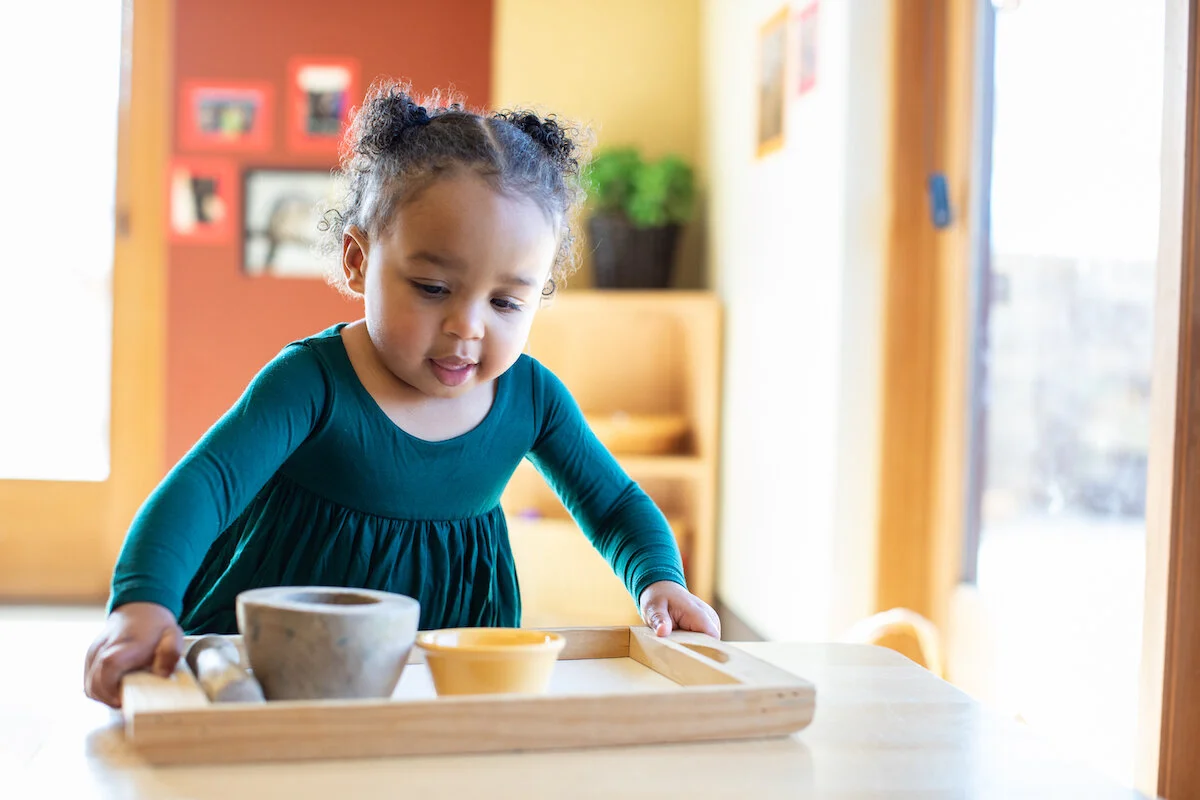
  • Transfer work - Small trays of transfer work can be found on the shelves of any primary classroom. Children work on their fine motor skills by moving small objects (pom poms, beads, stones) from one bowl or container to another using various tools (tongs, spoons, etc.).

  • Using tools - From kitchen tools like whisks and apple slicers, to handy tools like screwdrivers and hammers, primary-aged children have the opportunity to try out and master a wide variety.

  • Pouring activities - Much like in the toddler environment, primary children work with pouring activities. Rice is often used, as well as water, and cleaning up spills is a part of the work.

  • Rolling mats - Montessori children use work mats to define their space (both for themselves and their classmates). Learning how to properly roll and store these mats makes them neat and available to the next child.

  • Plant care - A continuation of the toddler work, children in the primary classroom learn how to water plants, as well as dust their leaves and ensure proper sunlight. They may even have opportunities to garden with their class.

  • Cleaning the classroom environment - Children aged 3-6 are still primed with a sense of order, and they delight in assisting in cleaning the classroom environment. Using real mops, brooms, and sponges, they are given lessons and ample time to practice.

  • Handwashing - Again, a continuation of the work in the toddler classroom, primary students are taught how to carefully and effectively wash their hands.

  • Dressing frames - These lovely Montessori materials consist of a wooden frame with fabric and various types of fasteners. One frame teaches children to button, while another allows for practice zippering, using hooks and eyes, buckling, lacing, tying, and more.

  • Food preparation - There are so many skills to be taught in the kitchen (and classroom!). Children typically start with cutting and slicing, then move on to spreading, stirring and mixing, peeling, juicing, and preparing basic multi-step snacks.

  • Grace and courtesy - We believe that caring for one another is a big part of our basic practical life skillset. We teach our students how to greet one another, how to have appropriate conversations, and how to welcome a guest into the classroom.

Elementary Environments

  • Food preparation - Food prep is often seen as a staple of the primary environment, but it should (and does) continue well beyond. Different schools and teachers approach this work differently, however, and it can take on so many forms. Some classes make a treat for each child’s birthday, while others prepare meals for special occasions, or even weekly.

  • Meal preparation - Beyond the act of chopping and cooking, many Montessori elementary students are able to experience the work that comes beforehand, including recipe selection and shopping for ingredients within a budget.

  • Cleaning the classroom environment - The glorious sense of order that graces the first plane quickly dissolves when children enter their elementary years. This means there are plenty of messes to clean up, and lots of opportunities to teach children how to do so. Working clean-up time into the regular routine is one way we foster a sense of responsibility in our students.

  • Plant and animal care - Elementary children continue to assist with plant care as they did in the primary years, yet this is often extended to assisting the guides with caring for any class pets. This is often done on a rotating basis, as most children are enamored with animals and jobs that involve their care are quite coveted!

  • Handwork - It is during the elementary years that children discover the calming nature of handwork. What often begins with simple finger knitting can take on a wide variety of forms. Children in a Montessori class can often be seen engaging in these types of activities during read alouds, when they complete their work, or when they need a moment to calm and/or center themselves.

  • Community service - During the second plane of development children are able to see the world beyond themselves. They begin to contemplate society and their role within it, while also harboring a deep sense of justice and fairness. This makes it the perfect time to introduce service learning. Service projects are best formulated by allowing the students to drive the mission with adults serving as guides who help out with logistics.

  • Grace and courtesy - As children age, grace and courtesy becomes more about how to interact with others on a deeper level. School-aged children have a strong desire to socialize, but they still have a lot to learn about how to do so with grace. We can help - by teaching skills like conflict resolution, and by reading stories about children who encounter typical social situations, priming them for discussions that create solutions.

  • Going out - Elementary children are ready to engage with the larger community. By allowing them to plan trips that are related to their studies or areas of interests, a whole host of skills can be taught, including phone etiquette, taking public transportation, and how to behave in different settings and speak with different people. Beyond the scope of the traditional ‘field trip’, going out involves the development of critical life skills.

Adolescent Environments

  • Business management - The Montessori adolescent environment is centered on the students working together to run a business. Their multiple years in the community mean they have opportunities to try out a wide variety of roles, too. While the traditional business is a working farm, many Montessori schools have adapted the concept to meet their own local needs.

  • Financial responsibility - Running a business includes making purchasing decisions, setting cost prices, and creating enough revenue to stay afloat. Montessori adolescents are able to have valuable practice making financial decisions before they ever leave for college.

  • Independent interactions with community members - Teens are social creatures, and Montessori programs allow them to develop connections with their larger community. Their work includes reaching out to and planning with other adults and businesses in the local community, giving them experience that will help them succeed in the future and be contributing members of their communities.

  • Meal planning, preparation, and food service - Whether this work is a part of their business or simply regular preparation of meals for one another, middle- and high-school Montessori students are able to have hands-on experience creating and serving meals to others. This will prepare them to learn healthy eating habits and nurture an appreciation for culinary arts.

  • Agricultural skills - Whether a Montessori adolescent program runs a full farm or a CSA for micro-greens, their work incorporates botany and an understanding of local agriculture. At the very least, this gives them an understanding and new connection to their larger food system.

Please note that the skills we have listed for each age group are far from exhaustive. These are just a few of the highlights! We hope you have found this article informative, and maybe even inspiring.  

Recent Research: How Montessori Students Benefit from the Findings

pexels-lukas-590022.jpg

There have been a host of fascinating published research findings in recent years in regard to learning and education. In this article we’ll take a look at just a few of them and explain what the findings mean in relation to Montessori environments.

The demotivating effect (and unintended message) of awards

It is common practice in conventional schools across the nation to give students awards for good attendance records. The hope is that by honoring the hard work of children who physically get to school each day, it will motivate other children to do the same and earn the award. Unfortunately, this study determined that not only was the goal not met, the practice ends up causing a negative effect and actually increases student absences.

It all boils down to motivation.

The study included 15,000 middle and high school students and found that giving students awards for good attendance had the unfortunate effect of decreasing attendance. Researchers believe that the existence of an award creates the idea that good attendance exceeds expectations. Not only does this not motivate most students to ensure their own attendance, but those who receive the award are often not motivated to keep up the habit in the future.

So, what does this mean for Montessori schools? It may be obvious, but you would be hard pressed to find a Montessori school that utilizes attendance awards in the first place. This study is yet another example of why intrinsic motivation is a far more positive tool than extrinsic motivation. In Montessori environments, the cultivation of intrinsic motivation is the backbone of everything we do. This extends far beyond attendance awards to include things like assessments, addressing negative behaviors, and mastering academic skills. So, Montessori community, let’s keep doing what we’re doing.

Gender similarities in the brain during mathematics development

Many folks have long held the belief that girls tend to be more masterful in the areas of language and arts, while boys find ease in the studies of math and science. Not only is this outdated and sexist thinking, it’s scientifically incorrect. Still, so much of what we believe about our world is engrained due to biased learning in our past. Academic studies can help break down our misconceptions in an effort to make progress. 

In this study of children aged 3-10 years old, MRI technology was used while children watched educational math videos. Researchers noted that boys and girls showed similar neural functioning during testing, leading them to the conclusion that there is no noticeable difference in the way children’s brains process mathematical information.

In Montessori classrooms, mathematics learning is highly individualized. Children are able to progress at their own pace, without needing to feel rushed or held back by group lessons or social pressures. In this way, Montessori environments support the findings of this study; children are children - they learn at their own individual rate and variables such as gender should not factor into their work or progress.

Is Summer Learning Loss Real?

Short answer: it’s not. In the 1980s a study revealed what many of us now know as the Summer Slide, a phenomenon in which children who spend their summers playing and not studying show skill regression come the fall. For decades this idea was accepted as fact, that is, until a group of researchers recently attempted to recreate the study and were unable to do so.

Modern researchers attribute this finding to the fact that we now have more advanced, efficient, and effective means of collecting and analyzing data. By clicking the link above, you can see comparative charts showing the original data as well as more recent findings. It’s apparent that with the very rare exception, children tend to plateau or even make gains during the summer months.

Why did we include this in our article? While our students have recently returned from summer vacation, they have also returned from the completely unanticipated and unplanned spring of 2020. Teachers, administrators, families, and children all worked hard and made the best of a very challenging situation, but many of us have been concerned about the long-term negative effects this past spring may have had on our children’s academic progress. The findings of the study give us hope that a temporary pause in regular instruction may not necessarily lead to a loss in skills. We will surely learn more in time, but are encouraged by the findings.

Are you interested in learning more about the ways current research supports the work we do in Montessori schools? We will be sure to share more in the future as more findings become available, but in the meantime, Montessori: The Science Behind the Genius is a great read.