Montessori

Plant Care: Practical Life Meets Science

Montessori students begin studying biology at a young age, usually around age three during their first year in the primary environment. This work continues throughout the course of their time with us. They explore information with more depth than you might imagine, so they end up with a strong base of understanding about living organisms.

Along with zoology, botany is one of the earliest subjects explored. We give our students lessons about plant life and there are supplemental materials on the shelves for them to explore. The learning doesn’t stop there. When it comes to biology, we believe having living examples present whenever possible is one of the best ways to spark genuine interest and increase understanding. Plants are one of the easiest ways to do this, and within our classrooms and throughout the building you will find many beautiful examples of this type of life.

It’s important to note that the plants we keep are not just for display and observation. Our students - even our very youngest students - take an active role in caring for the plants.

The Practical Life Angle

When we think of practical life, all that we teach generally falls under the umbrella of three categories: care of oneself, care of others, and care of the environment. The more we participate in this type of work, the more we realize how connected the categories are.

Plants are one of the best teachers of practical life skills. We keep living specimens in our classrooms intentionally - and for many good reasons. Studies have shown the presence of plants to have a positive effect on peoples’ moods, they are helpful in filtering the air, and they contribute to the natural beauty of our classroom environments.

But - rather than just letting a bunch of pretty plants sit there and be cared for by the teachers, we engage our students in the important work of plant care. The children in our classrooms learn how to properly water living plants. They learn to dust their leaves. They learn to recognize that some plants need more sunlight than others, and that it is up to us to ensure we place them in proximity to windows accordingly.

Beyond the potted plant, our students learn to appreciate the art of arranging flowers to beautify the classroom. They plant gardens, tend to their seedlings, and harvest their own vegetables. They take on a sense of responsibility for living things that are reliant on them. The original Montessori Erdkinder model for adolescents is based in part on students running their own active farm. This still happens in some schools, but others (where an actual farm is not practical or possible) find ways to engage similar types of experiences.

We believe teaching students how to care for plants has numerous benefits. Well-cared-for plants beautify the learning environment, bringing a sort of energized calm into the atmosphere. Plants are also a wonderful introduction into learning to care for something beyond yourself; they have the ability to teach both empathy and responsibility.

The Science Angle

Starting in Montessori primary classrooms and continuing on throughout their school career, our students study botany each year. The skills start simply and are often accompanied by gorgeous wooden puzzles, but our study of plants is always rooted (don’t mind the pun) in living examples.

The content covered is wide-ranging and often intertwines with other subject areas. Here is a general idea of the scope and sequence of our botany curriculum:

  • Parts of… (a plant, a tree, a flower, a seed, etc.)

  • Identification of various leaf shapes

  • Evolution of plants on Earth

  • Types of plants

  • Plant reproduction

  • Plant respiration

  • Categories with the plant kingdom

  • Botany experiments

  • In-depth studies of types of plants and parts of plants

  • Native and invasive species

  • Plants’ roles with ecosystems

  • Interactions between people and plants

  • Plants’ roles in economies

There are opportunities throughout your child’s time at our school to engage in “research projects” about plants. Sometimes young children may choose to write or draw about what they’ve learned, while older children might take an interest in a particular species, looking up information and writing reports to be shared with classmates.

Exposure to botany beginning at such a young age, coupled with an understanding of how plant life has evolved over the course of Earth’s history, leads Montessori children to appreciate and understand more about this kingdom than many of their peers. They are encouraged to explore their own interests more as they get older, and it’s often amazing how many of them choose independent exploration of this particular subject.

Bringing It Home

Parents often ask us how they can support the Montessori curriculum in their own homes. While we do not advise families to purchase Montessori materials, as they can only be used correctly after receiving specific training, caring for plants in your home is a wonderful way to bring your child’s school experience into your home.

Start simply! This might even be just picking up a bouquet of flowers at the store, or gathering wildflowers near your home, then asking your child to show you how they learned to arrange them at school. Provide your child with a pair of scissors, a vase or two (or even just empty glass jars!), and access to a sink. If they are still learning, you might guide them in making sure they trim stems at an angle, and explain how this allows the cut flowers to absorb more water. Allow your child to display the flower arrangements inside your home.

If you’re ready for more, engage your child in the care of your existing houseplants, or perhaps purchase one or two for them to take charge of. Teach them to recognize that different types of plants have different light and watering needs. Remind them to mist or dust leaves occasionally, not only to make the plants look nice, but to help them be more efficient in their photosynthesis.

If you’re feeling really ambitious... spring will be here before you know it! January is a time when gardeners delight in huddling inside their warm homes, thumbing through seed catalogs and planning out what they will do during the upcoming seasons.

We hope this article has provided you with both helpful information and maybe a little bit of inspiration. As always, we would love to hear from you! If you have questions or want to see what this looks like in our schools, please reach out and let us know.

Life After Montessori

One of the most frequently asked questions parents have for Montessori schools, especially after their child has been enrolled for a year or two is:

How will my child transition into other schools once their Montessori career is complete?

Some families are just curious about what the transition is like. Others worry that their child won’t be prepared for “the real world”. Either way, we love this question, because our answer is straightforward and definitely puts parents’ minds at ease.

Staying the Course

First and foremost, we would like to emphasize that every year you give your child in a Montessori environment is a gift. We fully acknowledge the sacrifices our families make to ensure their children are able to experience this very special type of education. There is the obvious financial component, but we know parents often drive out of their way to get to our school. We know participating in our community sometimes means an extra time commitment. We know our parents spend quite a bit of time learning about their child’s education.

We are deeply grateful and recognize all your time and efforts.

We know that sometimes there are factors that make re-enrollment decisions difficult for families. That being said, we do want to express that the longer your child is able to stay in a Montessori environment, the stronger the benefits will be for them.

Most critical perhaps, is allowing a child to complete the cycle they are in. For example, some public school districts begin offering free education starting in kindergarten. If a child attends a Montessori primary program for the first and second year, but leaves before they have a chance to experience their third, they are unfortunately missing a very substantial benefit of the model. Our three-year cycles are intentional; the first year is about looking up to models and grazing new information, the second year is about practice (both in regard to academic skills and mentorship), and the third year gives children the opportunity to achieve academic skill mastery and serve as leaders for the younger children in the class.

Missing out on the kindergarten year is like cake without the icing.

The same goes for the other levels, where Montessori education is carefully structured to support the child through their specific developmental phases. They are respected and honored for who they are, their teachers are able to grow with them long-term, and they continue to experience a genuine joy of learning.

But What About Grades? Tests? Differently-Structured Learning Environments?

Since Montessori schools are structured so that children learn to focus on self-improvement and development, as well as fuel their motivation internally, things like grades and tests don’t make sense. Neither does having a teacher stand at the front of a class lecturing the same prescribed information to everyone at the same time.

When a student is college-aged and chooses their own course of study, it makes perfect sense to employ some of these strategies. The student is at a different developmental phase in their life, they have decided what they would like to focus their efforts on, and they have had sufficient time and practice to develop time management skills, internal motivation, and a strong sense of self.

As for the in-between time, when a student leaves a Montessori school and experiences another learning environment for the first time? Academically, they are typically very prepared. We often hear about our graduates feeling very comfortable with the content and rigor of their classes. Their experiences with our math materials, in particular, tend to resonate deeply as they engage in higher-level courses. As for other areas of study, our students tend to have strong reading skills, solid understanding of effective research strategies, and a general delight and excitement for learning about science and the world (and universe) around them. These attributes make for a smooth academic transition.

“As we head into Semester Two [in high school], it has become so evident that his time at HMS has put him into position to deal with whatever comes his way. Academically, socially and in virtually every aspect of his teenage life, the toolkit that was forged at HMS has provided him with such confidence and poise. We are so grateful for the dedication and commitment of the entire HMS community. What you are cultivating is truly extraordinary.”
— Parent of an Upper School Graduate

How Do Montessori Alumni Fare Socially?

Moving into any new school environment presents a transitionary period for all children. What we typically hear from most families as their child settles in elsewhere:

  • The child notices differences in the way people behave in different settings.

  • The child, who has a firmly-developed sense of who they are, is able to find a friend group that is supportive and like-minded.

  • The child has a deep sense of empathy, which helps them navigate their way through this different environment.

  • After a bit of time, Montessori alumni often tend toward leadership and mentoring roles in their new schools.

  • The child becomes an active member in the new school community, taking advantage of experiences, classes, or clubs that speak to their personal interests.

Are There Long-Term Benefits?

The types of skills Montessori children gain are exactly the types of skills that set one up for a life of success. They are passionate about their work. They treat others with fairness and kindness. They care about the connections in their communities. They are independent thinkers who are capable of sorting through the information we are all bombarded with on a daily basis.

In fact, some of the most well-known and influential people in the world credit their Montessori education for their success. You’ve likely seen lists and read about many of these folks already, but if you haven’t you can here, here, and here...among so many others. 

We know our families are dedicated to Montessori education, but it’s only natural to wonder, “What’s next?”. Hopefully we have shed a little light on the subject, but if you still have questions, as always, we encourage you to reach out. We love talking to our families and are always here to learn along with you.

“We couldn’t be happier with our choice to enroll our daughters at Hollis Montessori. In addition to a very solid academic preparation, they learned how to be independent, organized, the value of friendships, a love for the outdoors, and a desire to contribute to the greater good. Now they are thriving in college and graduate school. We feel that Montessori gave them an incredible foundation for their lives.
”
— Parent of Upper School Graduates

What is Montessori? 5 Main Points

Girl with Montessori Pink Tower

Pretty much anyone reading this article knows the answer to that question is not a simple one.

Are you new to Montessori? Have you found that anytime you ask the question you are amazed by the utter depth of the answers?

Have you had a child enrolled in Montessori for several years? Do people ask you to describe it and you find yourself unable to summarize it into a brief conversation?

You’re not alone. It’s challenging to squeeze an entire philosophy into a five-minute conversation.

Today, we’re giving it a try anyway, with what we feel are five main points that summarize the essence of Montessori education.

Montessori considers human development and aims to meet people where they are.

Human development lies at the core of Montessori. Dr. Montessori spent years observing children and their behaviors, noted their individuality and variety, then categorized and summarized typical growth patterns. She called these the planes of development, and they span across the first 24 years of life.

Does everyone develop at different rates? Of course. Are there patterns that are seen in the development of most children? Absolutely. By developing a deep understanding of human development Montessori was able to create an entire educational system that honored children’s needs at different times in their lives. From the age groupings to the materials used, the physical environment and the very manner in which lessons are presented: everything is intentional. Everything is about meeting the child where they are in order to best support their needs. 

Instead of delivering standardized information, Montessori hopes to guide students as they travel their path themselves.

You will never see a Montessori guide standing at a chalkboard at the front of a classroom lecturing students sitting in rows of desks.

In fact, you’ll never see a Montessori guide lecturing at all.

Is there a Montessori curriculum? Absolutely. Do modern Montessori schools take the time to ensure the curriculum continues to cover skills necessary for today’s students? They sure do. The major differences lie in the delivery of this curriculum.

Our youngest students (0-6) are taught almost exclusively via individual lessons. They each progress at their own pace, and while they are all working their way through the same materials and lessons, they don’t have the pressure of doing that at the same time as their peers. They also have the benefit of leaning into areas that interest them more deeply.

As our students get older, they do receive more group lessons, although the main driving factor for this approach is the older child’s need for peer connection. They still get to move at their individual pace, and they still get to explore areas that they feel particularly connected to.

Education should never be one-size-fits-all or even fits most. Our guides understand the importance of mastering critical skills, but they also know that there cannot be a forced timeline when it comes to getting the job done.

Independence, from the start, leads to confidence and excellence.

That subheading really says it all. Infants in Montessori programs are allowed and encouraged to move freely; they aren’t confined to cribs but rather lie safely on floor beds. Toddlers learn to dress themselves, take an active role in their toileting progress, and begin to learn how to care for their environment. The gradual release of independence continues through adolescence, with Montessori teens learning to run their own businesses.

We believe in the capabilities of young people. We honor and respect their abilities to do things by and for themselves. We support them as they work toward independence, and the results are astounding.

When you are trusted to be independent, you feel respected and confident. That sense of confidence builds on itself with each experience and develops children into adults who are not afraid to take appropriate risks because they know that they can achieve what they set out to do.

Social interactions are a critical part of our growth, and social learning deserves as much attention as academics.

‘Educating the whole child’ is a phrase that gets thrown around a lot. It’s an admirable goal - critical, even. The problem is, most modern educational systems don’t actually support teachers in achieving this goal.

Montessori does. We know that’s a bold claim. We wouldn’t make it if we didn’t believe it was absolutely true.

When educators or families transition from a conventional school to a Montessori school, one of the most stark differences is that of the daily schedule. Montessori school days are not rigid or organized by subject matter. They have long blocks of time that are flexible and able to be used for all kinds of learning. Sometimes this means a child spends an hour working on large multiplication problems. Other times it means they sit with a friend and a teacher and talk about mediation skills.

Social learning is not taught in isolation in our classrooms; it’s an underlying theme that runs throughout. We have the benefit of being able to truly teach in the moment, so when conflict arises, it can be approached as a learning opportunity.

Society stands to benefit from a system of education that teaches students about the universe as a whole, as well as the interconnectedness of everything on Earth.

The Montessori curriculum was very intentionally created to nurture compassionate and active community citizens. When we teach children, our goal isn’t to prepare them for the workforce (although we do that as well). Our goal is to prepare them for life.

We teach our students about the universe, about how life has changed on Earth over time, about how each individual organism plays a part in the delicate balance of our ecosystems. We teach children about the ancient history of early humans, with a focus on how they developed skills like writing and systems of mathematics. This appeals to their own development of the same skills, and gives them a reverence for the people who came before them. It also allows them to feel a deeper sense of where they fit into the big picture.

To close, we will leave you with one of our favorite quotes by Dr. Maria Montessori herself. This idea is one that drives us to do what we do each day, and a hope we know we share with all of you.

“The child is both a hope and a promise for mankind.”
— Dr. Maria Montessori

Developing Fine Motor Skills

Developing fine motor skills is critical for everyday activities. There are many ways to help children along this process, and Montessori classrooms have specifically designed materials that are intended to strengthen the small muscles in the hands and wrists. The strengthening of these muscles allows us to make more precise movements and perform detailed tasks, as opposed to the large muscles required for gross motor activities like jumping and walking.

While fine motor development is supported at various levels in Montessori environments, we can observe the bulk of this work occurring during the primary years, when a child is between the ages of 3 and 6. Three areas of the classroom play particularly important roles: the sensorial, practical life, and language work. In this article we highlight some of the ways Montessori materials in these areas help children strengthen their hand and wrist muscles. Interestingly, these materials have other purposes as well, teaching a wide range of skills.

Sensorial Materials

The Pink Tower

A series of pink cubes are meant to be stacked vertically from largest to smallest, with the top block measuring 1cm cubed. Using this material requires a child to use their focus and carefully balance each block, using precise movements as the blocks get smaller.

Knobbed Cylinders

Wooden cylinders of varying sizes fit into a block designed for this purpose. Each cylinder has a tiny knob for children to hold onto, and there is only one way to fit the cylinders correctly. In addition to developing fine motor skills and their pincer grip, this is one of many materials that aid in developing visual discrimination.

Mystery Bags

A small cloth bag containing tiny objects and miniatures, a child is meant to feel inside, hold the objects, and determine what they are without seeing them.

Practical Life Materials

Clothespins

Montessori students learn to wash clothes or linens used in the classroom. One step in the process is, of course, hanging the cloth to dry using clothespins.

Spray Bottles

Spray bottles are used for a variety of practical life activities in the classroom, including window washing and plant care. The repeated action of squeezing the trigger on the bottle is great for strengthening hand muscles.

Crumbers and Dustpans/Brushes

Again, with a focus on precision and careful use, there are several practical life materials used for cleaning up the classroom that are also fantastic fine motor tools. Dustpans and brushes are used for cleaning up messes on the floor, while crumbers are similar sets meant for picking up on the surface of a table - after eating but before washing the table.

Cooking Utensils

A major part of Montessori practical life work is food preparation. There are countless kitchen tools that are used in this learning, and so many of them require the development of fine motor skills. Just a few of these include: vegetable peelers, knives for chopping, apple slicers, whisks, and spatulas.

Dressing Frames

One of the most direct fine motor materials, the dressing frames teach children to fasten clothing in a variety of ways. A wood frame with two cloth panels is attached in the center; children practice lacing, buttoning, buckling, snapping, zipping, pinning, and more.

Language

Sandpaper Letters

Perhaps one of the most famous Montessori materials, the sandpaper letters are small wooden tiles with textured letters in the surface. Indirect preparation for handwriting and reading, children use their index finger to trace the shape of the letter while saying the sound it makes aloud.

Moveable Alphabet

When learning how to write, children are ready to share their ideas before they are ready to grip a pencil. The moveable alphabet is a set of tiny wooden letters that children lay out on a work rug to spell words, phrases, and sentences. Organizing these small letters takes plenty of hand control.

Metal Insets

Another material that is meant to indirectly prepare the child for handwriting, The metal insets are like a stencil that children are meant to use colored pencils and trace, create lined patterns within, and follow a series of directions to recreate the shapes on paper. This is often a child’s first real experience with learning how to hold a pencil properly, and aids in developing the critical pincer grasp. Some Montessori environments even provide triangle-shaped pencils to aid in this process.

Bonus: Pin Punch

A small wooden or plastic stylus with a sharp metal tip is used to make perforations. Children will often trace a shape onto a piece of construction paper, place the paper onto a specific soft surface, and use the pin punch tool to make a series of holes along the drawn line. If they take their time and do this correctly, they are able to punch out their shape upon completion.


Want to learn more? Curious to discover ways you can support your child’s fine motor growth at home? We welcome questions and love to talk about children’s development. Contact us today.

Elementary History: A Scope and Sequence

Think back to your grade school days: what do you remember learning about history? Whatever you did learn was probably focused on your country’s history, didn’t take up very much of your total learning time, and may have even contained some “facts” that you began to question as you got older. For the majority of us, in-depth history instruction didn’t take place until perhaps high school, and even then, it wasn’t all that comprehensive.

As with all subjects, Montessori schools begin with the big picture and gradually focus in on the details. That’s why when we teach history, we start at the very beginning. We give students an understanding of the start of the universe. Over the course of the year/years, we give progressively more detailed lessons that zoom in eventually to the various cultures that have existed on Earth throughout history. We find this approach helps give kids a frame of reference in which everything makes just a bit more sense - and is a whole lot more interesting.

It all starts in the first grade. History is one of the few areas of learning in the Montessori classroom in which students receive group lessons — sometimes even the whole class at a time. This is because all of the children within a three-year age span are developmentally prepared to engage with the information being presented, and when they participate in these big, impressionistic lessons each year they’re in a class, they gain something new each time. 

What do we teach and where do we start? We present an overview of what the Montessori history curriculum looks like in grades 1-6:

The Creation of the Universe

Early in the school year — sometimes even the very first week — lower elementary Montessori guides present a fantastic lesson about the beginnings of our universe. It’s all very dramatic and presented in a darkened room and delivered in a story-telling format, although there are a number of ‘science experiments’ sprinkled throughout. From the Big Bang/Great Flaring Forth, to the formation of the first particles, the first elements, states of matter, density, and the sheer vastness of space, there is a LOT of information included. The whole thing ends with the unveiling of a model volcano into which vinegar is poured to cause an ‘eruption’, much to the delight of 6-9 year old children. This lesson ends with an explanation of Earth’s early geological history, and children walk away excited and in awe.

The Concept of Time

At some point during the year, and likely toward the beginning, children learn a bit more about the mechanics of how humans observe the passing of time. They look at how the year is divided with the help of their fraction materials, they explore years by making their own timelines, and they learn to tell time on the clock. This section of study concludes by intersecting with grammar and learning the three fundamental tenses: past, present, and future.

The Long Black Strip

This lesson is literally so big it has to be done outdoors or in a *very* long hallway. While children stand to the sides, the guide carries out a large, rolled up strip of black felt. The outer end is weighted down, and as she unrolls it they tell the story of Earth’s history. From the formation of our planet itself, to the earliest one-celled organisms, through the evolution of all living things, and so on. The strip is 30 meters long, and each centimeter is meant to represent a million years. By the time the very end is revealed, the children can see a tiny slice of white. This represents the amount of time humans have inhabited the earth. You can imagine what children are feeling when they walk away from such a powerful visual.

The Clock of Eras

As you can tell by now, we like to give children impressionistic lessons, and visual aids that help them develop a frame of reference. The Clock of Eras imagines Earth’s history as if it were encompassed within a twelve hour clock. This circular, laminated cardboard material breaks down the major eras and allows children to see a visual percentage of the total history each section takes up. They are able to see the large chunk of time during which there was no, or nearly no life at all. This is followed by another imposingly long stretch of time during which Earth was host to just one-celled organisms. As life became more complex, the slices of the pie become smaller and smaller, until a minuscule strip of red again shows all of humanity.

The Time Line of Life

The time line of life is exactly what it sounds like: a large and gorgeously illustrated wall hanging that shows how life has evolved from the beginning of the Paleozoic Era. Children are fascinated to learn about the seemingly strange earlier life forms, and how over time they changed and paved the way for others. It’s also neat to see how there are several organisms that have withstood the test of time and developed ways to adapt regardless of an ever-changing planet.

Fundamental Needs of Humans

What do people need to survive? Children learn about our basic needs, consider how they meet those needs today, and explore how various cultures met those needs throughout history.

The Study of Early Humans

We believe it is critical to teach children about where their ancestors came from. Having an understanding of human history allows us all to respect the enormous progress that has been made in countless ways since the existence of the first humans. We teach students how the earliest humans survived and met their needs, and how their eventual movement around the planet changed the course of history.

Stages in the Progress of Civilization

This area of study is of particular interest to upper elementary-aged children, and their newly-acquired research skills allow them to spend extensive amounts of time reading and discovering for themselves about how civilizations have functioned throughout history. Students dive deep into learning about ancient and more recent cultures and societies across the globe, discovering the many similarities and differences they have both to one another and to humans today. 

Once children complete the elementary program, they have a solid understanding of basic history. This allows them to more deeply understand and appreciate whatever history courses they take in the future.

4 Montessori Quotes That Give Us Perspective

montessoriquote.jpg

Dr. Maria Montessori was a scientist and physician, first and foremost. She stumbled her way into education when she observed the mistreatment of children put into her care. She recognized that adults (especially at the time) did not give children the credit and respect they deserved, and this launched her work that eventually became Montessori education.

Dr. Montessori was all of those things, but she was also a prolific writer and speaker. Her words have been translated into countless languages around the world and have been reread by innumerable people since they were written. A century later, the language can sometimes show its age, but it’s often beautiful, poetic, and inspiring. And that’s not to mention the brilliant ideas behind the words.

People love to quote Montessori, and for good reason. Here we share four excerpts from Dr. Montessori’s writing that we find particularly interesting, and thought you might, too!

“This is education, understood as a help to life; an education from birth, which feeds a peaceful revolution and unites all in a common aim, attracting them as to a single centre. Mothers, fathers, politicians: all must combine in their respect and help for this delicate work of formation, which the little child carries on in the depth of a profound psychological mystery, under the tutelage of an inner guide. This is the bright new hope for mankind.”
— Dr. Maria Montessori, The Absorbent Mind

Education is a profoundly important venture, on behalf of the individual as well as society as a whole. The way we choose to educate our children is perhaps the single greatest action we can take to pave the way for a better future for humanity.

And we can’t do it alone.

Education is a partnership. It takes well-trained instructors, inspirational leaders, participatory family members, and engaged communities to work alongside one another in support of the children. To know that all these parties can join together and work toward the common good is a pretty amazing concept, and incredibly powerful to see in action.

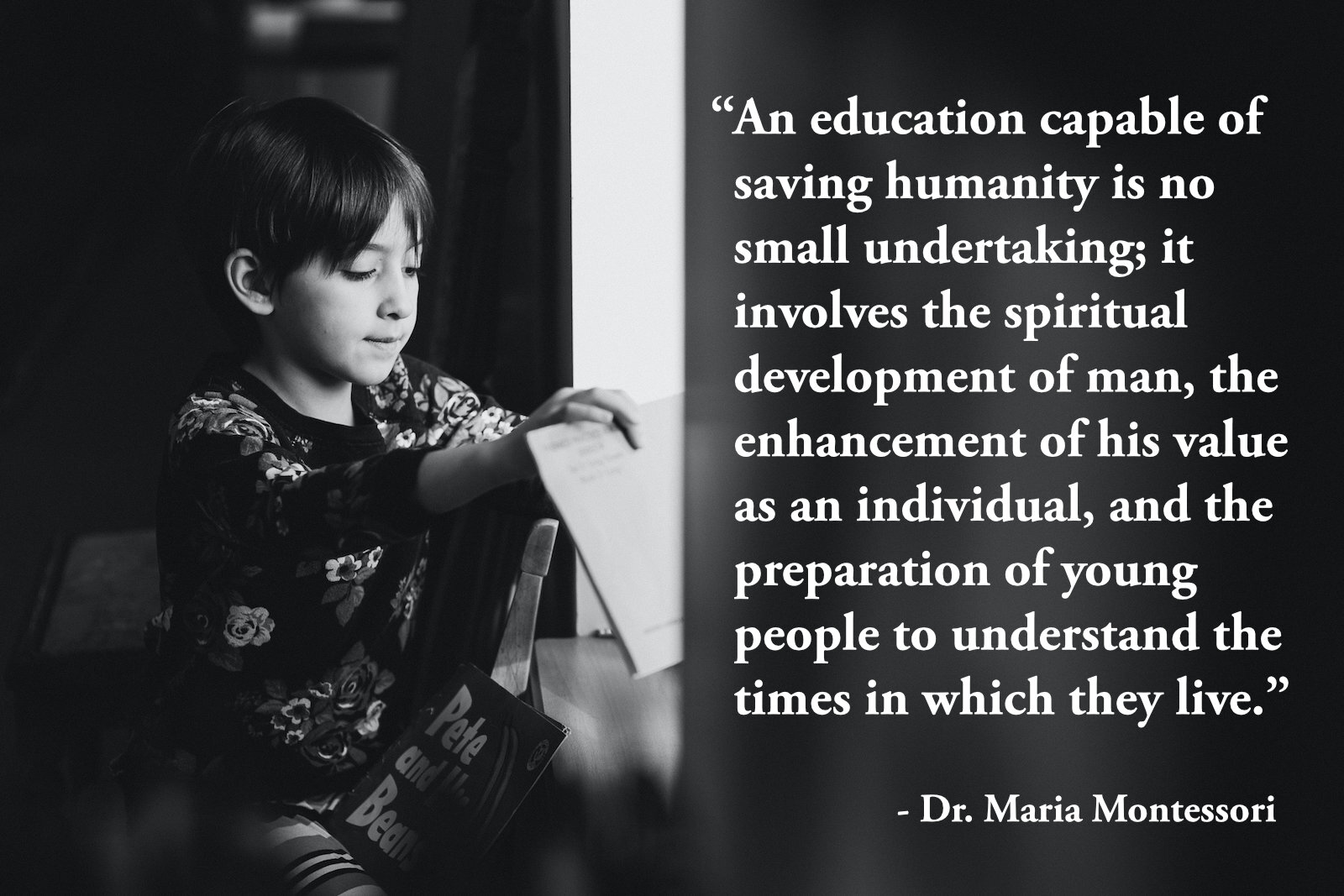
“An education capable of saving humanity is no small undertaking; it involves the spiritual development of man, the enhancement of his value as an individual, and the preparation of young people to understand the times in which they live.”
— Dr. Maria Montessori, Education and Peace

Individuality and flexibility are two critical components of any successful education. Human beings are not photocopies and we cannot treat them as such. To develop a curriculum that is delivered unwaveringly to a diverse group of children without any deviation from the predetermined path does not serve the child.

To employ an educational process that supports the individual development of the child not only honors their own unique path, but it stands to be timeless. Human development, with all its variations, remains fairly similar throughout the generations. Even as the world changes around us, and we look toward an unpredictable future, Montessori education prepares children for what lies ahead.

We teach children to ask their own questions and seek their own answers. We guide children to listen to their inner passions. We explicitly show them how to interact with other people around them so that they may honor their individuality while working cooperatively. To do these things is to prepare them for anything.

“The mind takes some time to develop interest, to be set in motion, to get warmed up into a subject, to attain a state of profitable work.  If at this time there is interruption, not only is a period of profitable work lost, but the interruption, produces an unpleasant sensation which is identical to fatigue.

Fatigue also is caused by work unsuitable to the individual.  Suitable work reduces fatigue on account of the pleasure derived from the work itself.  Thus the two causes of fatigue are unsuitable work and premature interruption of work.”
— Dr. Maria Montessori, What You Should Know About Your Child

Adults traditionally have a habit of inserting themselves too frequently into the work of the child. We feel duty-bound to teach and to guide, when in reality it’s our job to clear the path and stand back while they take the journey themselves. Getting in the way is rarely done with ill intent; it’s simply what we learned when we were children. We want to be helpful. And it can take a lot of unlearning to allow our children to truly learn for themselves.

There is a very delicate balance, and it takes a lot of observation to get things right. We learn to sit back, notice what the child is doing, take a pause, and notice some more. We fight the urge to jump in and correct things for them, for those are precisely the moments when learning happens. If a child is allowed to make mistakes and then to fix those mistakes, they gain not only skill knowledge, but the confidence to repeat the process in the future.

That’s not to say we should never step in. The careful observation we mentioned also helps adults ensure that a child is not faced with a challenge they are not yet prepared to face alone. The key is to understand basic child development while simultaneously paying close attention to the individual’s needs.

“To let the child do as he likes when he has not yet developed any powers of control, is to betray the idea of freedom ... Real freedom, instead, is a consequence of development; it is the development of latent guides, aided by education.”
— Dr. Maria Montessori, The Absorbent Mind

Taking the last point a step further, Montessori educators and parents need to understand what freedom with limits really means.

Should a child be permitted to eat candy for breakfast every day? Should they be expected to eat every meal that is placed before them without opinion? No, on both counts. What lies in the middle can vary from time to time, but perhaps the child is allowed to serve themselves an amount they know they can eat, or perhaps they get to have a say in what they would like to eat some of the time. The same principle can (and should) be applied to almost everything.

We must give children limited, developmentally appropriate choices.

As they gain new skills, we give new choices. It’s an ever-evolving dance between choice and structure, but it’s one of the most important things we can do for our children.


Hopefully we’ve sent a little inspiration your way. Want to read more? Let us know and we can recommend (and maybe even lend) some great books.

Inclusivity in the Montessori Classroom

montessori-inclusivity.jpg

Montessori is a method of education as well as a general philosophy on human development. If we could summarize it into one sentence it might be something like this: A deep understanding of typical human development, coupled with careful observations of the individual and a meticulously prepared environment, can allow each human being the freedom to explore their world to the best of their ability.

Wouldn’t it be amazing if we could do that for everyone?

Montessori schools do their very best to make this goal a reality for all who become a part of the community. Below are just a few of the variables we take into consideration.

Age

As you already know, our classrooms are multi-age. This may not be typical when compared to most conventional educational settings, but it’s very intentional and an integral part of what we do. We believe children of varied ages have much to offer one another, and having a span of a few years in one classroom allows for the blending and blurring of different abilities, so everyone always has a buddy to work with. Multi-age classrooms give children opportunities they wouldn’t have elsewhere, such as older models for the young children, and a chance for older kids to explore leadership roles.

Beyond the typical three-year age span, we like to take every opportunity for children to interact between the levels. In the same way we see within the walls of a single classroom, the younger children at our school are able to look to the older children as models, and the oldest children have chances to lead in new ways.

Did you know that Montessori can be for adults as well? Some adults read about Montessori and learn to incorporate the principles into their own lives. Others go on to obtain Montessori teaching credentials or explore Montessori higher education. There have even been studies regarding the benefits of applying the Montessori approach to dementia care.  

Gender

Montessori schools aim to honor children as they are. We acknowledge that society places certain expectations on children according to their gender, and that it can be a challenge for children whose identity does not conform according to these expectations. This can take form across a wide spectrum; whether a child prefers certain toys and colors that our society has attached gender to, to being transgendered, and everything in between.

Our goal is to acknowledge these differences, to work hard to eliminate expectations that do not serve the children, and to create a nurturing environment where all children feel supported and accepted.

More on this topic here.  

Race

To fully educate a child, a school must acknowledge that child and family’s experience. We believe that “colorblindness” is harmful; race is an important part of a person’s identity and must be recognized. We want our students to be proud of who they are, and we also want to recognize the struggles that some face due to the color of their skin.

While people of color have known and felt these struggles for centuries, society as a whole is beginning to recognize their reality in recent years. There is still so much work ahead of us, but we are hopeful that we may be on the verge of a shift in cultural awareness. 

In our classrooms, we do what we can to support this work. We include families of all backgrounds. We ensure there is literature in our classrooms that is representative not only of the children who are in the room, but of all types of people. As educators, we aim to keep learning, keep supporting, and keep moving forward.

We’re not the only ones. To learn more about the important work that is being done, check out Montessori for Social Justice.  

Cultural Heritage

In Montessori classrooms, different cultures are something to be celebrated. We may not celebrate holidays in the same way many other schools do, but we do enjoy exploring different cultural celebrations from around the world. We believe that learning about each other’s unique traditions helps bring us closer together.

We encourage parents to come into our classrooms to share cultural traditions. This might be making latkes with the children for Hanukkah, creating a Nowruz table in the lobby for Persian New Year, or making clay lamps with students for Diwali.

Children love to learn about (and taste, and make) things from other cultures. If your family has something special to share, we encourage you to get in touch with your child’s teacher and see if there’s a way to incorporate something into the school year! These experiences are enriching for everyone involved.

Different Abilities

By design, Montessori education is supportive of children with different abilities. The two most obvious examples of this are our multi-age classrooms and individually-paced learning. No two children are alike, and we believe teaching a single, rigid curriculum to a whole room full of children actually serves very few. Differentiation is a popular buzzword in education; we believe true differentiation is about individualizing the curriculum so that it meets the specific needs of each and every child.

Because Montessori honors the child as they are, and aims to guide them on their own path, it makes sense that it’s the perfect environment for many children with special needs. Some needs are more visible than others, but we believe that every child has the right to be a valued member of our community. To learn more about how Montessori environments are supportive, check out this video:

Freedom Within Limits: What Does It Look Like?

One of the most common misunderstandings about Montessori education surrounds the freedom we give the children in our care. Generally speaking, once folks actually step inside a classroom and observe what really goes on, there is no doubt and all misconceptions are quickly cleared up.

Montessori isn’t a trademarked concept though. Anyone (school or individual) can claim to be “Montessori” but that doesn’t necessarily make it so. This is why specific, high-quality teacher training programs, along with affiliation or accreditation with a major Montessori organization (such as AMI or AMS) is critical to ensuring a high fidelity program.

All that aside, yes, it’s true: Montessori philosophy relies heavily on freedom of choice. We also rely heavily on appropriate limits. There is a critical balance, and achieving this balance is what gives children the sense of dignity, empowerment, and success they deserve. Children are no less human than adults, and they deserve respect, albeit in developmentally appropriate ways that support their growth.

What does this look like in our learning environments, and how might parents utilize these strategies in the home? Read on to learn more.

The physical boundaries of the environment

Montessori schools and guides are very intentional in the ways they structure the physical classroom environment. We want our students to be able to move freely around the space, but we don’t want that movement to inspire behaviors that are distracting to others or unsafe. The good news is there are plenty of things we can do to ensure choice, safety, and learning, all at the same time.

In classrooms for younger children, we avoid having wide open spaces that invite running indoors. The wooden shelves that house learning materials are strategically placed to block paths that children may otherwise utilize in such a way. Instead, we provide indoor-appropriate movement opportunities, we teach children how to use them, and we make sure they are located in spaces that don’t disrupt the work of others. We also make sure there is time and space built into the day that allows for running outside.

Dr. Montessori valued the opportunities available to children outdoors and in nature, so our schools work hard to provide appropriate and safe space for children to explore. This looks vastly different depending on the child. A four-year-old might enjoy a fenced-in area with raised garden beds, trees, and grassy fields. An 11-year-old might walk to an adjacent wooded area under the supervision of an adult where they independently gather materials with peers to make forts and other structures.

Choosing what to work on

As adults, we don’t like to be micromanaged. Neither do children. Even a small degree of autonomy allows a person to feel like their decision-making is valued and trusted. This overarching idea is kept in the forefront of our minds, but it does look different at different levels.

During the first plane of development (newborn - age 6) children are given presentations on how to use various materials and complete various tasks. During their independent work cycle they are generally permitted to choose which of these tasks they would like to repeat and in what order. This allows them to follow their interests and develop skills they are internally primed to master without being tethered to a prescribed one-size-fits-all program. As they enter the final year or this period, their guide may start to implement some of the structures seen in the second plane to ease their transition and provide for evolving developmental needs.

During the elementary years, there are certain academic expectations. Children in Montessori environments are given regular lessons on topics of interest as well as to teach basic math and language skills. They are still able to choose their work, as well as make choices about what they would like to spend more time on and study in depth. Our guides are watching closely, however, to make sure children do not avoid subjects. (More on that later in this article)

Honoring personal health needs

We don’t believe children should have to ask permission to address their own basic needs. Whether it be using the toilet, getting a drink of water, or having a snack, all people (children included) should be able to listen to their own bodies and care for those needs on demand.

When children are very young, they need more assistance, but we teach them to listen to their bodies’ cues and guide them through the processes. As they get older and more independent, we build structures into the environment that allow them to meet their needs independently. Even as young as age three, children serve themselves a snack if a seat is available at the snack table. They know where their water cup is located and how to clean up a spill if it happens. The restroom is located in the classroom or nearby so that they can use it without the help of an adult.

Multiple winning options

Want to give kids choice while still achieving specific goals? Give win-win options. We use this strategy in the classroom, but parents can use it at home as well. Some examples:

“Would you rather get dressed or eat breakfast first?”

“I need help with some of the chores. Are you in the mood for washing dishes or doing laundry?”

“It’s almost bedtime. Please go get into your pajamas and brush your teeth, and any time you have leftover before 8:00 we can use to read together.”

“You need to pack some more protein in your lunch for tomorrow. Would you like sliced turkey or some hummus?”

Keep in mind that fewer options make decision-making easier. This is especially important to consider when a child is younger or if the decision is causing any kind of stress. 

Guidance and discussion

As children get older, it’s important to be transparent in the process of offering increasing freedom. We tell children that we value their input, that we want them to blaze their own trails, and that we are here to support them on the journey.

Remember above when we talked about addressing when a child avoids a particular subject? There are many reasons why they might do so, but it’s usually because the skill is too challenging or too easy. By observing the child at work we can often get an idea of what’s going on, but with children elementary-aged and older, a conversation can be incredibly enlightening.

Once we find out why the avoidance is occurring, we can help develop a plan. The child may need to be introduced to time management strategies. They may need a refresher lesson. They may need to be challenged in a whole new way. Montessori schools are structured so that opportunities for these quick but important check-in meetings are frequent. Long blocks of time dedicated to learning and working independently, coupled with a variety of goals that extend far beyond academics, allow students and guides to work together toward productive independence.


Questions? Comments? We love to hear from parents. Reach out any time!

A Note of Gratitude on Montessori’s Birthday

IG image 30August2021.jpg

Dear Dr. Montessori,

Tomorrow, August 31, 2021, marks 151 years since you were born.

The world is a very different place today than it was then. I wonder if you ever contemplated your own early days and how your world shaped you. You once said: “The greatness of the human personality begins at the hour of birth.” Would anyone have guessed that baby Maria would eventually become one of the most influential educators of all time?

Your own life stands as an example of what a person can achieve under the right circumstances. Your work created a foundation on which others have been able to support generations of children finding their own unique paths through life.

So this is a letter of gratitude.

Thank you for having the courage to do what your heart pulled you to, even if it meant being the first and traveling down an uncomfortable and challenging road. During a time when women were largely expected to stay at home, and were certainly not permitted to attend medical school, your persistence changed the system.

Thank you for having the wisdom to blend your scientific perspective with the empathy that all humans deserve. You noticed that children discarded by society had far more potential than they were given credit for, and you worked tirelessly to prove your theories and change yet another system.

Thank you for investing in communities that had high needs. Your very first school was opened in a poor neighborhood in Rome, and your work with the children and families there had amazing ripple effects that no one would have predicted.

Thank you for showing children the respect they so deeply deserve. It was completely novel at the time, and still is in many communities. But your ideas spread quickly and effectively, especially once people saw what life could be like if we just shifted our perspectives a bit.

The sole purpose of the teacher used to be to stand before their students with a definite air of authority, lecturing prescribed information that the students were meant to memorize. You changed all that. Your teachers are not enforcers and information dispensers, they are guides. They stand beside children and lay a path out before them that the child may willfully wander down and gather information for themselves. You created a system of empowerment for children, and a more meaningful (and much more effective) way of learning.

You were not a perfect human being (as none of us are). Your flaws lie in the memories of the people who knew you as well as in the pages of biographies about you. They are a good reminder that even the most positively influential people can make mistakes. We can all make mistakes, and hopefully, we will grow and change with time and experience. This is a lesson we must all share with our children.

You taught us to observe and to stay curious. We encourage children to do this with the world around them, but as adults it’s our responsibility as well. Learning should never end, and we should observe to learn about the children in our lives, but also continue to stay curious about the world ourselves. It takes a lot to unlearn previous assumptions we have gained over a lifetime, but it’s a worthwhile endeavor.

In Education and Peace, you said: “An education capable of saving humanity is no small undertaking; it involves the spiritual development of man, the enhancement of his value as an individual, and the preparation of young people to understand the times in which they live.” The timelessness of this idea is just as applicable today as it was then.

It seems fitting that your birthday happens to fall right around the beginning of a new school year. Right around the time when we all find ourselves reflecting on what we have learned in the past and also on what lies ahead. Just as with the history lessons we teach our elementary students, it’s helpful to honor those who have paved the way for the work we are doing now.

So once again, thank you. Your work continues on, touching the lives of people all around the world, generation after generation. We imagine it will continue to do so long into the future.

With deep gratitude,

The Montessori community

22 Important Montessori Terms

montessori-glossary.jpg

Montessori education can feel like a whole separate world of its own sometimes. The classrooms look different, the methods are definitely different, and even the language is a whole lot different from what you might hear elsewhere.

We decided it might be helpful to highlight some terms that may sound foreign to folks who aren’t very familiar with Montessori. Some of the terms are completely unique to us, and some are just used in unique ways in the context of Montessori. Are there any you think we’ve missed? Let us know!

albums: A series of binders filled with lessons and illustrations that are created by Montessori guides during their training. They are typically organized by subject and contain all of the specifically-prescribed steps and methods for presenting materials and lessons to children. Even the most experienced guide refers back to these, and they are invaluable.

Casa dei Bambini: In Italian, this translates to Children’s House. This was the name of Dr. Maria Montessori’s first school which opened in Rome in 1907. Casa is also the name sometimes used to describe the Montessori program of education for children aged 3-6 years.

concrete (versus abstract): This refers to a type of learning and thinking experienced by younger children. When a child explores a skill by using specially designed materials, they are likely understanding the skill concretely. As they deepen their understanding and are able to comprehend the skill without the use of materials we refer to this as abstract. For example, a six-year-old using the stamp game to add numbers into the thousands is working concretely, but an eight-year-old who completes the same calculation on paper without materials is working abstractly.

control of error: Montessori materials are usually autodidactic, meaning the child is able to teach themselves. Most materials are designed with a control of error, or some type of mechanism that allows the child to recognize on their own whether they have made a mistake. This allows for immediate correction and a sense of empowerment for the child. Your child’s guide can show you many examples of this.

 cosmic education: The Montessori elementary curriculum is based on the concept of cosmic education. Based on the developmental needs of children aged 6-12 years, as well as the Montessori aim to develop citizens that are more deeply connected with the earth, many of the lessons and units of study teach the interconnectedness of all things. This allows children to have a framework in which they may discover themselves and their place in the universe.

cultural subjects: This refers to the studies of science, history, and geography.

Erdkinder: A German word meaning children of the land, Dr. Maria Montessori coined this term as a name for the adolescent program, as she recognized their need to engage in physical work and envisioned the program taking place on a working farm.

false fatigue: While anyone observing a Montessori classroom during the morning work cycle (see work cycle for more) will notice deep engagement by the children, there is often a noticeable shift around 10:30. At this time it appears that the children have lost all focus and the room becomes a bit more noisy. Rather than redirecting the children, if the adults allow this period to occur, the children are usually able to independently re-engage after a short time.

grace and courtesy: A specific area of study during the primary (ages 3-6) years, this aims to teach children how to appropriately interact with others. While they receive formal lessons during these years, the work is continued (although utilizing a more flexible format) throughout their Montessori education.

guide: the term used for a Montessori educator, as it more accurately describes their role.

indirect (versus direct) preparation: Learning activities that lay a foundation for future skills without explicitly teaching them are considered indirect preparation. For example, three- and four-year olds in our programs use a small tool for pin punching (perforating pieces of paper into specific shapes) that allows them to develop their fine motor skills and finger grip in preparation for the physical act of writing.

isolation: Isolation of a skill means that the child is meant to focus solely on one specific goal. If a five-year-old is asked to write a story, the guide’s focus would not be on correcting for conventional spelling, but rather to encourage their expression of ideas in written form.

Nido: In Italian this means nest, and it is the traditional Montessori name given to an infant program.

normalization: Once a child has had time to adjust to a Montessori environment, they begin to joyfully select their own work, stay engaged, and interact peacefully with others. When they achieve this state we refer to the child as normalized.

parallel play: Children under the age of six tend to be more focused on their environment than on their peers (which shifts dramatically during the elementary years). When young children work or play beside one another while actually focusing on their individual pursuits, we call this parallel play.

planes of development: After years of observing children with the perspective of a scientist, Dr. Maria Montessori noticed clear patterns and characteristics. While acknowledging the definite variation between individuals, she organized her findings into four planes of development, and based her educational methods on them.

practical life: This subject is given just as much weight in Montessori schools as we give to traditional academic subjects like math and language. Practical life can include teaching children to care for their environment, others, and themselves. Lessons are wide ranging; our students nurture plants, wash dishes, practice greeting others, sweep spills, and prepare food.

prepared environment: The term we often use in lieu of “classroom”, our guides dedicate hours of careful and intentional adjustments so that the space serves as a teacher for children. In Montessori education, one way independence is achieved is by preparing an environment in which the children are able to care for and learn by themselves, with less direct dictation from adults.

sensitive period: Dr. Montessori noticed and theorized that there are certain periods during a child’s development during which they are primed to engage in specific skills. Once that time has passed, learning such skills is not impossible, but the natural drive to do so declines, making mastery much more challenging.

sensorial: An area of study during the first plane of development (newborn to age six), in which children work to refine a wide variety of senses. There are Montessori materials that have been specifically developed to aid in this process.

work: In Montessori environments, the lines between play and work are blurred. We tend to view a child’s actions through the lens of development and learning, so that even the most seemingly mundane of tasks serves an important purpose and is considered work.

work period/work cycle: This is the term given to a dedicated period of time during which Montessori students work independently and receive individual and/or small group lessons with a guide. Depending upon the school and the age of the children, it can range anywhere from two to three hours. Dr. Montessori believed such a lengthy stretch of time was critical to allowing children to become deeply engaged in their work.