Montessori

Sensorial Superpowers

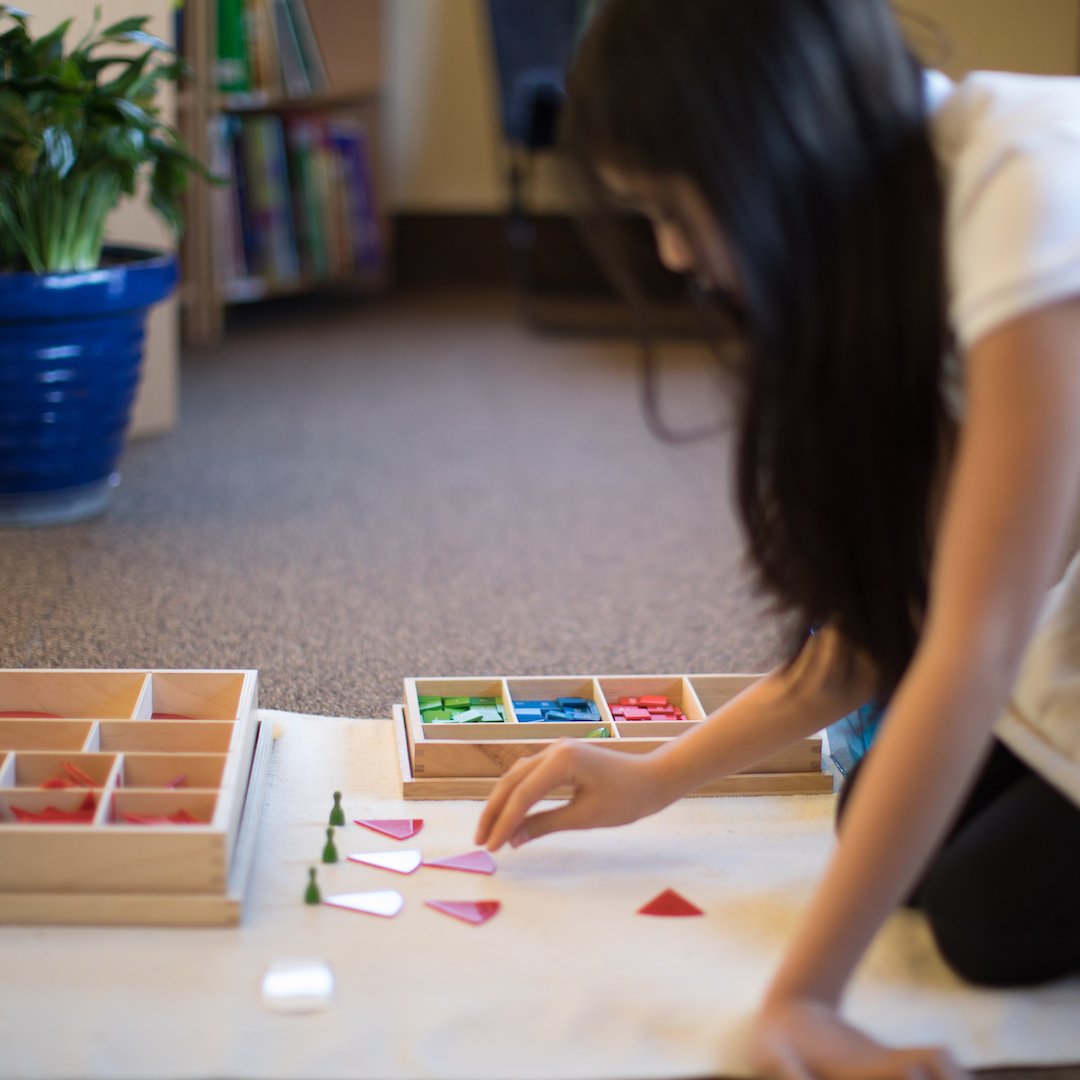
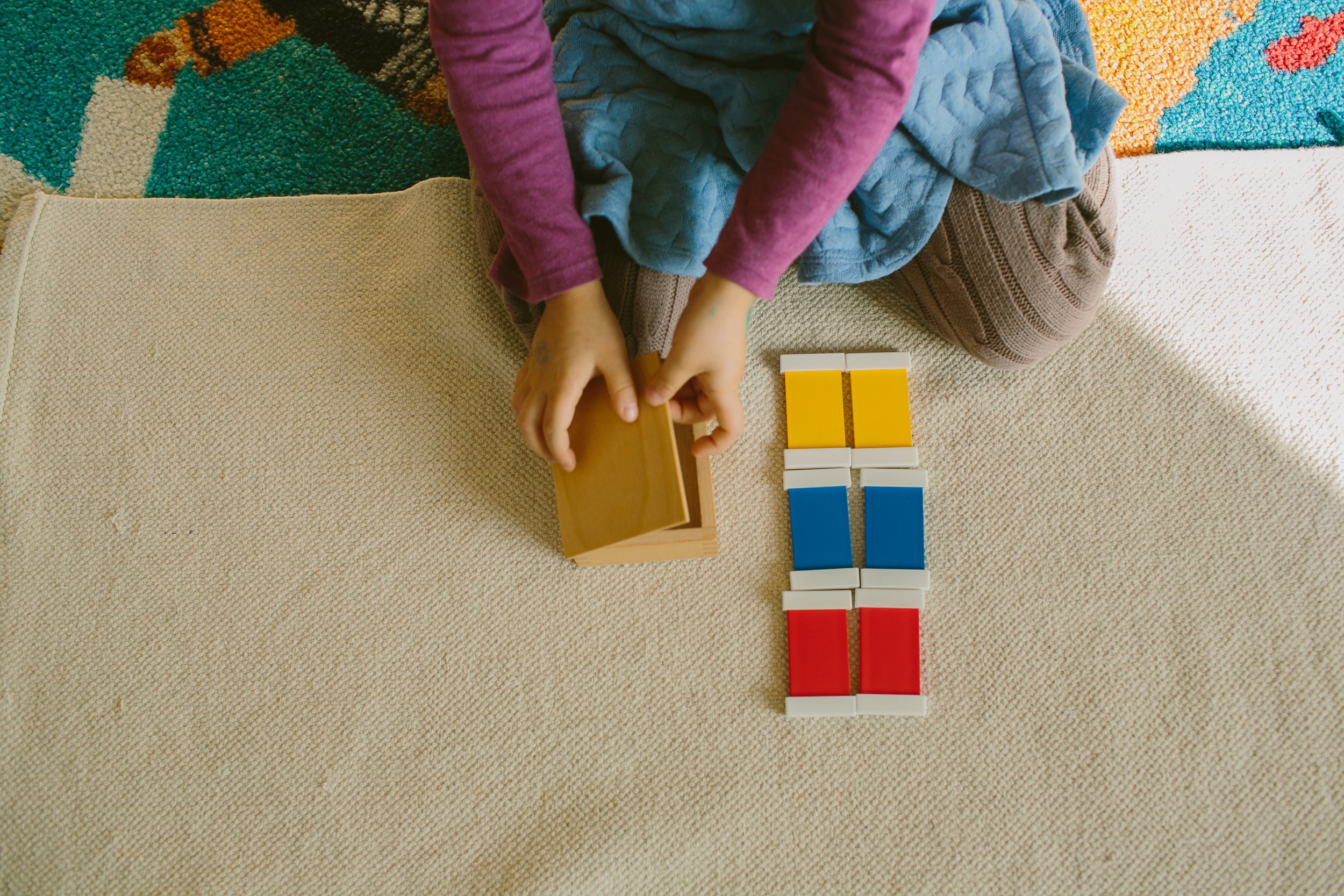
montessori color tablets

Young children are in a powerful process of creating an understanding of their world and where they fit in. To do this, they rely upon their senses as an interface to the world. Everything that comes into young children’s minds comes through their senses.

During the first few years of life, children are absorbing sensory input without any discrimination. Then around age two-and-a-half to age three, children begin to bring images from their subconscious into their consciousness. They begin to work with these images and in the process embark on an important journey of building their intelligence.

The Sensorial Materials

To support this development, Montessori programs offer carefully designed sensorial materials.

that follow a formal, systematic approach. The materials isolate each sensorial quality and offer children what Dr. Maria Montessori called the “keys to the world.” In addition, the sensorial materials support children’s classification of impressions and lead to clear levels of conscious discrimination. If children have these experiences in the formative period of brain development, they establish a foundation for a lifetime of order and precision, as well as logical, reasoned thinking.

How do sensorial materials accomplish all of this? Well, they have some really significant purposes!

Sensorial materials support children’s classification and categorization of sensorial impressions.

For young children, the first three years are like collecting impressions and throwing them into a closet. The images or concepts are a bit of a hodge-podge jumble, thus to go in and access what is needed from this unorganized collection can be a challenge. Because this warehouse of impressions doesn’t have order or classification, children need to develop mental organization so their collection of impressions becomes useful.

The sensorial materials help children to classify and categorize all of the impressions they have absorbed and unconsciously stored since birth. When children interact with the sensorial materials, images come out of their unconscious memory and come into working memory. As children use the materials, these impressions become part of their conscious memory. When children become accurate in distinguishing sensorial differences, we give language for the images, which then helps the concepts become fixed in children’s minds.

Children aren’t born with organized brains that have predetermined categories, so this neural organization has to be built up through experience.

Sensorial materials support children’s refinement of their sensorial perceptions.

It’s important to understand that sensorial exercises don’t make children’s ears hear better, eyes see better, or tongue taste better. Rather, the materials help children develop powers of discrimination so that they can analyze smaller and smaller degrees of difference.

When we take in sensorial input, everything goes into our brain. Then the brain has to make discriminations, a skill which develops through experience and the process of making finer and finer discernments. The materials offer children a clear means for starting to classify and to increase their perceptive powers, both of which are important mental abilities.

Sensorial materials support children in the development of abstractions.

 What do we mean by abstractions? An example of an abstraction is the notion of “red.” Red as a quality does not exist in nature. Red can be represented in physical things, but we cannot bring “red” to a person. Red is a quality. It is an abstraction.

Children may have some abstractions already in place, but when they are young the number is limited purely due to the fact that they haven’t had a sufficient amount of experience to develop the abstraction. Furthermore, children don’t typically get to experience sensorial qualities in isolation. The Montessori sensorial materials isolate each quality and give children the opportunity to have enough experience to develop abstractions.

Because we, as adults, have a lot of experience in the world, it can be hard for us to understand what children need to create abstractions. To better understand the significance of abstractions, imagine being told about a quince. If you haven’t had a quince before, it is hard to pull up the image in your mind, much less what it tastes like. If you hear a description that a quince is a fruit, you are able to pull up an idea of what a fruit is. Then if you hear that a quince is in the same family as an apple and pear, you can pull up an image that brings you closer to imagining the fruit and perhaps even the type of skin it has.

But without these experiences and the organization of images, children can’t pull up the same level of abstraction. Imagination helps us, as adults, to be able to do this: pull up images in our minds of something haven’t experienced before based on abstractions. In order to imagine, we must have abstractions. This area is most related to the development of intelligence.

Sensorial materials support children’s development of accurate and discriminating recall of perceptions.

The materials engage children’s memory, help them access information from their memory, and support them in using their intelligence. Memory is a tool of the intelligence, but because children aren’t born with memory, they need support with developing it. While children do have an unconscious memory, they have to take the impressions they have absorbed and build memory from them. The sensorial materials help this process.

Memory needs practice and experience to become stronger; it is only increased through activity. We want children’s memory to be strong and thus we provide lots of experience with the materials and variations with the materials. With each sensorial material, there are many ways to extend the activity and help children with recall.

One significant strategy is giving language to each perception. The language is based on what is isolated in the materials–thick/thin, large/small, long/short, right-angled isosceles triangle/right-angled scale triangle, rough/smooth, heavy/light, ovoid/ellipsoid, bitter/sweet. The vocabulary is extensive and rich, and ultimately fixes the perception in children’s memory.

The second strategy we use is playing games which challenge children to hold the perception in mind for longer and longer periods of time. They might put each of the pink tower cubes scattered about the room so that in rebuilding the tower of cubes from largest to smallest, they have to remember the size of the previous piece in searching for the next largest cube. Some of the sensorial games also help children notice particular qualities in the environment, rather than just in the materials. One favorite is searching for items in the classroom that have exactly the same shade of each of the color tablets. 

Through repeated experience with the sensorial materials, children develop clearer and more accurate perceptions and create reference points that they can use throughout life. Dr. Montessori talks about the possibility for children to develop touchstones, a sort of fixed, accurate reference by which this quality can be accessed. These points of reference can provide a lifetime tendency for order, precision, and recall, for example hearing the note of G without any other reference or being able to look at a pane of glass and know if it will fit into the window frame.

Sensorial materials help children develop life-long tendencies towards order and precision.

We don’t know what touchstones might develop for each child, but Dr. Montessori says that touchstones developed during these early years will remain with children throughout their whole life. If children can get accurate discriminations while in this time of sensitivity to sensorial input, this precision will remain with them into adulthood. Of course, children’s unique interests will also lead them to their own level of proficiency.

Functionally, this tendency toward order and precision will be important as children move into more academic work in language and math. They will be able to access powers of discrimination that will aid them in future endeavors.

Sensorial materials also provide indirect preparation for further study.

This indirect preparation means that we are taking advantage of children’s spontaneous interest and activity and thus planting the seeds for other areas that children will explore as they get older. When we introduce shapes–from a decagon to an ellipse to a quatrefoil–through the geometry cabinet, children visually discriminate the shapes while also tactilely experiencing the shapes by tracing around them. Multisensory input is stronger than input through just one sense. Tracing the shape also helps to prepare children’s hands for writing. To write, our hands have to be able to follow a form. This is how the sensorial materials provide indirect preparation for further academic study.

Sensorial materials support the development of children’s memory and intelligence.

Dr. Montessori talks about the sensorial area as being most strongly related to the development of intelligence. Working with sensorial materials requires a very different engagement from the practical life work of washing hands or scrubbing a table. Practical life activities help children with coordinating movement and following a sequence with a logical beginning, middle, and end. Sensorial materials don’t have the same kind of logical sequence. They are open-ended and exploratory. Children have to consider each piece and how it works in relation to the other pieces. In working with the red rods, for example, children have to examine each rod’s length in relation to the other rods. Thus, children have to make a reasoned distinction every time they move a piece of material. This process engages the intelligence and elevates children’s level of awareness. In addition, children then have to hold the images in their mind, which helps their memory.

Having an ordered, classified mind is also the foundation for intelligence. When children struggle in more academic areas like language and math, we take time to consider how to better support their mental order and classification. When the mind isn’t prepared well, academic work can be difficult to do. However, if children can recognize and distinguish between a trapezoid and a parallelogram, they will be more likely to be able to distinguish two other shapes like “g” and “q.”  When children have a lot of experience recognizing shapes through sensorial materials, they are more able to recognize the shapes they encounter in letters. Sometimes we go back and explore if perhaps children recognize the shapes but don’t have a strong memory. We then use sensorial games specifically designed to help different forms of memory (auditory, visual, etc.).

The sensorial area serves as an important foundation for more academic work because language and math are completely based on abstractions. Words represent concrete things but the words themselves are abstractions. The sensorial area is critical for providing the foundation for abstract thinking.

Outcomes

Although the sensorial materials may look relatively simple, they provide so much! When children use these materials, they are refining their powers of discrimination, creating an ordered mind, enhancing their memory and recall, categorizing their impressions, and building a foundation for rational thinking and intelligence.

As children achieve these skills, they experience life with an increased level of richness, becoming aware of the lovely details of their world. With a prepared mind, children can see things in a new light and with new enthusiasm. This is perhaps one of the most delightful outcomes of children’s work with the sensorial materials: they develop a whole new appreciation of the life around them–dimensions, shapes, smells, sounds, textures, tastes–which is what gives life value and beauty.

We hope you can come visit our school, experience the sensorial materials, and see how children get to develop their sensorial superpowers!
Grasping the World: Geography for Young Children

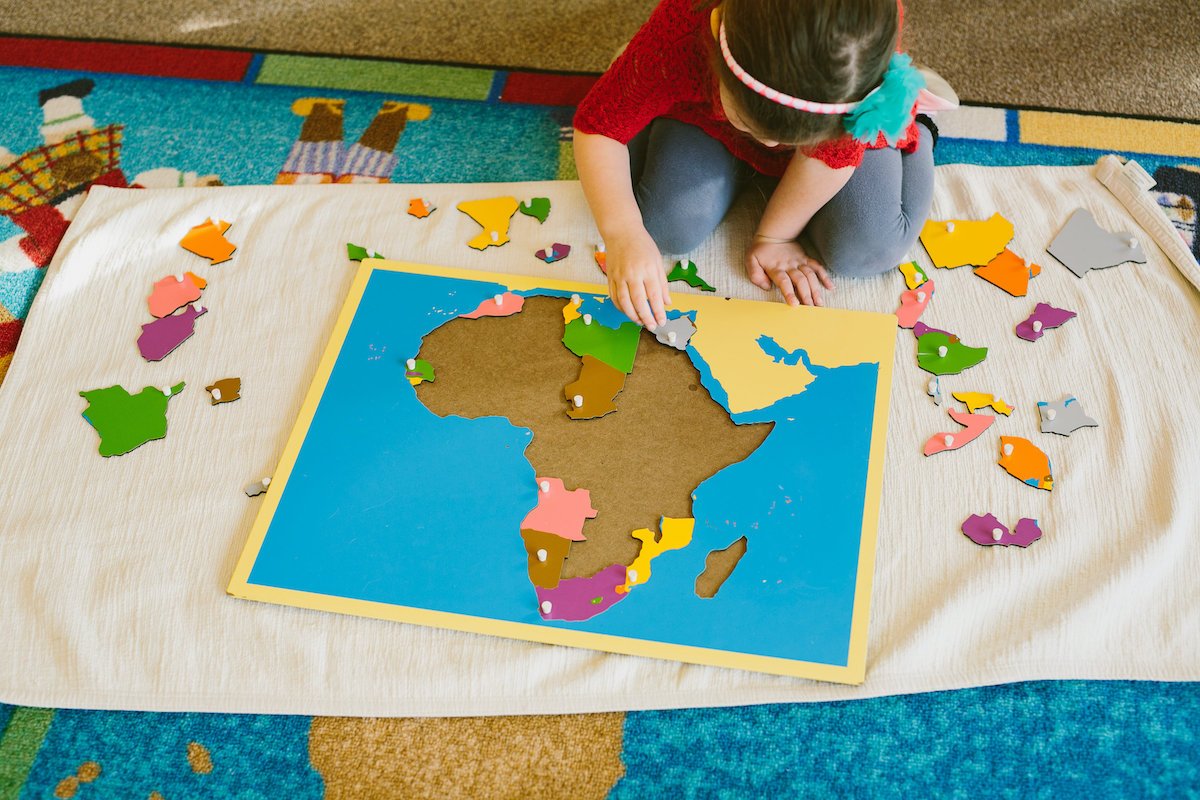
montessori child using puzzle map

Between mass media and family travel, young children are exposed to all sorts of language about their planet. They may hear phrases like “going around the world,” “as the world turns,” or “the other side of the world.” Young children absorb this information yet still need concrete experiences to help make sense of what “the world” even means!

Over 100 years ago, Dr. Maria Montessori observed how younger children were drawn to the globes that older children were using. Through careful observation, Dr. Montessori came to understand how young children crave a concrete understanding of concepts like the world, the earth, and the globe.

Concrete Materials

In Montessori, we offer concrete materials so children can experience accurate representations of these abstract concepts. We start by providing a small globe. The land surfaces are covered with fine sandpaper and the water surfaces are covered with smooth blue paint, so children can tactically explore the distribution of land and water surfaces over planet earth. With the globe, children get to literally grasp the shape of the planet and have a richer understanding of phrases like “going around the world.”

We also have a set of materials so children can learn about different kinds of land and water forms. Children can pour water into beautifully created models of an island, lake, peninsula, gulf, isthmus, strait, cape, bay, archipelago, or system of lakes. The water flows into the water area (painted blue) and moves around the land area (painted brown). As children learn the names of these land and water forms, they also explore folders with photographs of actual land and water forms from around the world. 

Montessori classrooms also have a second globe to show how the land surfaces are divided into continents. Each continent is painted a different color (green for Africa, red for Europe, orange for North America, pink for South America, brown for Oceania, and white for Antarctica). The color coding of the continents stays consistent throughout all the materials, which helps with association and retention.

Once children have grasped this concept of the land and water distinctions on the globe, we show them a flat puzzle map divided by the Eastern and Western hemispheres with each continent (color-coded as above) as a separate puzzle piece. This continent puzzle map gives children the chance to see all of the continents at once as they look on a two-dimensional map. 

We also offer maps of each continent to show the political partitions formed by countries. Each puzzle piece is a country, with the knob for picking up the piece located at the country’s capital. Children initially use these puzzle maps in a very sensorial way, taking the maps apart and putting them back together. As children engage with this experience, we begin introducing the names of the continents and then the countries. Young children absorb this vocabulary effortlessly and delight in learning the names of all the countries. As children get older, they also enjoy taking on additional challenges, sometimes even closing their eyes, feeling all the way around the puzzle piece, and then naming the country!

Cultivating Appreciation

Although this is all rather impressive, it’s important to remember that our purpose is not to turn children into walking encyclopedias. Even when children may come to rather astonishing intellectual skills, these abilities are a by-product. Our purpose is to offer young children activities to help them understand their place in the world, become aware of the oneness of humanity, and appreciate the incredible variation among people that results from physical geography and humans’ creative efforts and inventions.

To help in this effort, we share collections of pictures of human life organized by continent. These pictures offer impressions of different modern cultures, lifestyles, and traditions. The pictures reflect commonalities of human needs and the great variety of ways humans fulfill these needs. The photographs highlight regional food, farming, shelter, transportation, daily life, traditions, and the physical geography represented in landmarks, climate, flora, and fauna.

As children develop a relationship with the world around them, they may also explore more about the different places in the world, including climates, plants, and animals. Often children love to begin creating their own maps by carefully tracing the puzzle map pieces and coloring and labeling the continents and countries.

In Montessori education, children absorb a great deal of geography skill knowledge! But our focus is on giving children the opportunity to develop a constructive and creative relationship with the whole world, as well as a love for how our planet offers a diverse home to the whole of humanity. Schedule a virtual tour to learn more about this love of geography!

From Independence to Interdependence

In Montessori, we talk a lot about independence. However, one of the lesser known or understood aspects of Montessori is that independence isn’t the end goal.

As humans, we are each wonderful, unique individuals. But we don’t exist in isolation. We live amongst other wonderful, unique individuals! In order to effectively live in community with other people, though, we need to be able to function independently. Said another way, before we can offer help to others or make ourselves useful, we need to be able to meet our own needs.

How can we be independent and interdependent at the same time?

We all want to make choices for ourselves, exercise our liberty, and be responsible for our own lives. At the same time, we also want to be part of something. We are designed to be both independent and be in community. These two needs are not mutually exclusive, but in fact, operate in relationship to each other. We have an innate desire to be autonomous and to belong.

When we develop the ability to act for ourselves, make choices, control ourselves, and accept responsibility, we are able to be functioning, contributing members of society. We can see what needs doing and do it because we have the skills to do so. We can work with others to create solutions or produce goods and services. We can be part of a community by acting and taking responsibility for our actions, each able to contribute because we all have the skills to do so.

What does this have to do with children and Montessori education?

From a very young age, children are trying to exert control over their lives. Children are trying to gain functional independence from birth to about age three. In Montessori classrooms, we offer all sorts of opportunities for young children to develop skills that help them take care of their basic needs. But we don’t stop there! We also provide so many ways children can care for others and for their surroundings.

Once children have mastered pouring from one pitcher to another, they are able to pour water into a vase and arrange flowers to beautify the classroom. After they learn how to sweep, they are quick to notice a spill and rush to get the dustpan and dust brush so they can help. When someone is struggling to zip their jacket, they take pride in sharing their newfound skill in service to someone else’s need.

As children move into the elementary years, this service to others often takes on a slightly different form, in part because elementary-age children are developing their intellectual independence. Thus, their contribution often involves applying these newfound intellectual skills. They might notice a classmate struggling to figure out the steps in a math problem and offer support. Or when friends are in conflict, they might provide some mediation to help each party listen to the others’ perspective.

In adolescence, young adults are ready to work toward being socially and economically independent. They want to figure out their place in society, grapple with real problems, and contribute in a useful way. Thus, Montessori adolescent programs offer teens the chance to develop and feel secure in their own abilities while also collaborating in real and meaningful social endeavors. In the process of running a small business, for example, adolescents are applying their intellectual skills from marketing to mathematics, while also navigating how to communicate with customers and collaborate with classmates.

Why is this important?

As humans, we want to achieve independence and belonging. Being independent is about learning the skills to be able to contribute in a meaningful way. All the little conquests of independence–throughout each age and stage of development–matter! When our infant reaches to grasp an object, our two-year-old demands to put their shirt on themselves, our eight-year-old argues about just and fair rules of a game, or our adolescent insists they can solve a problem with their peers, we can remember that these acts of independence are laying a foundation for our children to become part of an interdependent, harmonious society.


Independence is just a step. Interdependence is the ultimate goal.

The Legacy of Dr. Maria Montessori

Maria Montessori with children

To honor Dr. Maria Montessori’s birthday on August 31, we want to reflect back on her life and her profound influence on how we see and honor children’s potential. 

Many educational systems start with adults having an idea of what is best for children. The Montessori approach, however, began with Dr. Montessori being intensely curious and observing children’s growth and development. 

It’s worth remembering that Dr. Montessori was first and foremost a scientist. In fact, Dr. Montessori was one of the first female physicians in Italy in the late 19th century. Specializing in pediatrics and psychiatry, she had regular contact with working-class and poor children through free clinics at the University of Rome’s medical school. Through these initial experiences, Dr. Montessori theorized that children are born with incredible learning potential and an intrinsic desire to explore, discover, and learn about their world.  

In 1900, she was appointed director of a University of Rome program for developmentally delayed children considered uneducable. After observing the drab conditions of the institution and the children’s attempts to find anything of sensory interest, Dr. Montessori began studying the importance of sensory experiences in cognitive development.

She then spent two years teaching the children and directing the work of teachers in the institute. Eventually, Dr. Montessori’s developmentally delayed students were able to pass the standard tests of Italian schools. Her response? She stated that if children with developmental challenges could pass the tests, the traditional schools of the time should be able to get dramatically better results with typically developing children!

This experience caused Dr. Montessori to want to examine how education could support, rather than stifle or repress, children’s development.

In 1907, Dr. Montessori had her opportunity. She was invited to coordinate daycare in the slums of San Lorenzo for working-class children too young for public school. Dr. Montessori began by teaching the older children how to help with everyday tasks. She also introduced practical skills of everyday living, including hygiene and self-care. Gradually, Dr. Montessori incorporated manipulative puzzles and activities to assist children with learning different skills and concepts. The children were drawn to the materials and reveled in the process of beautifying themselves and their surroundings. Each day the children’s behavior improved, and they eventually begged her to show them more, including how to read and write.

As she prepared the space and the adults supporting these previously unkempt, unruly, and uneducated children, Dr. Montessori saw an incredible and seemingly spontaneous kind of learning and work happen. The children became calm and peaceful. They took care of themselves and their surroundings. And they developed concentration and a love of learning.

Dr. Montessori was fascinated. Building upon her previous work, she continued to experiment and design unique learning materials that nurtured children’s natural desire to learn. News of this success in San Lorenzo soon spread through Italy and eventually dignitaries from other countries began visiting to see this miracle firsthand. 

Around age 40, Dr. Montessori left a doctor’s career and a professorship at the University of Rome to continue her work for children. Throughout the rest of her life, she offered courses and lectures, wrote books, and trained educators, all the while insisting that the focus be on children, rather than on her. 

Through scientific investigation, the study of available research, trial and error, and observation, Dr. Montessori saw that children across cultures and countries flourish in a setting that provides just the right support at critical times of development. 

Because Montessori education is focused on the science of human development, the approach has withstood the test of time and culture. Today the Montessori approach has been implemented in approximately 20,000 Montessori schools around the world, with more than 3,000 in the U.S. alone. With over 100 years of practice, Montessori has worldwide recognition as an educational approach that helps children achieve their fullest potential.

We invite you to come to see this legacy in action!

What is Practical Life?

young boy washing dish

When you visit a Montessori school, you’ll likely hear the phrase “practical life.” We thought it might be helpful to provide a little more context so we can share why practical life is so important to what we do.

First, let’s break apart the phrase. “Practical” can mean the actual doing or use of something. The term “life" can be described as living things and their activity. So, when we combine the two terms, we can think of “practical life” as activity that is focused on doing something useful. 

In Montessori, we offer young children useful activities that serve a real purpose. Children have beautiful child-sized materials that allow them to wash tables, dust shelves, polish silver, prepare food, and so much more. Although most traditional early childhood programs have a play area that includes cleaning items or kitchen toys, these items are for pretend, imitation, and play rather than for actually cleaning or cooking.

But why does a toddler need to polish their shoes or do laundry with a scrub board? Are the tasks drudgery? Isn’t childhood an age for play? To answer these questions, we need to look at what is happening during childhood, which is what Dr. Maria Montessori did over 100 years ago. 

Origins of Practical Life Exercises

The exercises of practical life began in order to serve a very practical need. Dr. Montessori had responsibility for children who were being destructive in a building in the slums of Rome. The proprietors needed to take care of the building, yet the children were rather wild and unkempt. As a physician, Dr. Montessori knew the importance of hygiene in preventing illness. Thus, one of the first things she did was to offer basins of water and cakes of soap. Then Dr. Montessori showed the children how to wash their hands and faces.

What happened was unexpected. Once the children washed their hands and faces, they didn’t stop. They kept washing. They did it again and again. Dr. Montessori said the children repeated the activity as if driven by some kind of imperceptible force. Instead of stopping them, like adults are apt to do, Dr. Montessori watched. She wanted to see what would happen. With curiosity, patience, and powers of scientific observation, she observed a need that went way beyond washing hands. From these practical beginnings, came a very significant discovery for Dr. Montessori. 

Montessori’s Discovery about Children and Work

Dr. Montessori discovered the fundamental difference between work as adults experience it and work as children experience it. Often, as adults, we think of work as bringing on fatigue. However, Dr. Montessori observed how work for children is energizing.

Young children have an intense urge to do things! Think about the crawling infant who is completely compelled to try to get up the stairs, so matter how many times we bring them back down or try to block the steps. 

Typically we, as adults, stop children from doing certain activities because we think the action is too tiring, too difficult, too dangerous, too messy, or because it will be more efficient and faster for us to do it ourselves.

Yet young children have a compulsion to engage in activities with a huge amount of effort. In fact, young children will become quite distressed when their activity is interrupted.

Understanding Children’s Motivation 

Young children’s goals for doing activities are not practical ones. They aren’t motivated by having clean hands or a polished candlestick. Dr. Montessori discovered that young children’s motivation to work and gain independence is part of their process of constructing themselves. They are motivated to interact with their surroundings in order to create who they are as humans. Children are working to coordinate and refine movements, gain independence, master sequences of activity, and essentially create their future personalities. It’s easy to tell when children are in this stage because they will do an activity repeatedly, even in one day or in one sitting. This is what Dr. Montessori observed when she offered basins of water and cakes of soap to the children in San Lorenzo.

Gradually, around the ages of four and five, children become fueled by a love and appreciation of their surroundings and their community. They want to put their skills to use! While the youngest children will wash a clean table ten times, slightly older children will wash a table once because it is dirty. Often older children will notice a something that needs attending to, like a lot of dirty cloths in the laundry basket and want to wash the items to make sure everything is clean for the next day. 

Making Activities Accessible

In Montessori settings, we make sure that the processes of everyday living are accessible to children. Items are sized for the children because it’s hard to sweep when the broom is larger than one’s body! Children also get to see and participate in steps that are often not visible to them, like what happens in the dishwasher. Thus, when we offer children the steps of washing dishes, we are gifting them with the awareness of each step involved: how we go from dirty dishes to clean dishes includes wetting the dishes, scrubbing them with soap, rinsing the dishes, and finally drying them. 

We also slow down the movements involved so that children can see, absorb, and practice each necessary skill. When children can practice each step slowly and intentionally, they learn how to do things like unbuttoning or buttoning their sweater or tying their shoes. Having time and space to practice the activities allows children to be active participants in taking care of themselves and their community.

Some Outcomes of Practical Life Activities

How can getting oneself dressed or scrubbing a table help with children’s development? Practical life activities help children develop critical skills like intelligence and memory, concentration and focus, awareness and self-confidence, self-control and self-discipline, and the ability to problem-solve and think rationally.

When even the youngest children are following a complex series of steps in order to accomplish something like washing a cloth, they are developing their memory and intelligence. They see how to set up the basins of water, wet the cloth, get the soap, scrub, rinse, hang the cloth the dry, repeat, and then clean everything up when finished. Then they hold that sequence in their minds in order to do the activity themselves. In the process, they are also developing their capacity for logical ordered thinking. 

In addition, when working on practical life activities, children strengthen their ability to reason. They have to consider things like whether they need to apply more polish or if the table is completely dry. As such, children begin to develop an awareness of their impact which also creates self-confidence. When they see that the table is dirty after pitting cherries and get the table scrubbing activity out, they have taken a step along the path of becoming logical problem-solvers. 

Through the exercises of practical life, children also increase their self-control and self-discipline. Some of this self-control comes from the ability to put the needs of the community ahead of their own needs. A toddler who scoops avocado to make guacamole to share at snack may want to eat the avocado right away. However, they delay gratification in order to serve friends during snack time. Children also learn to put things away when they are finished using them, which helps establish a life-long habit of self-discipline.

We also offer challenges that help children develop skills that will lead to more concentration and focus. We might pose these suggestions as questions: Do you think you could wash this table without spilling a drop of water anywhere? How many times can you spoon the beans back and forth without spilling any? Offering these little points of consciousness provides children with a challenge that helps them strengthen their ability to concentrate and persevere, while also helping them refine their fine and gross motor skills.

From their very humble beginnings, the exercises of practical life provide children with so many benefits! In addition to developing the foundation for executive functioning skills (like task initiation, self-control, organization, planning and prioritizing, and holding information in working memory) practical life activities help children develop a deep love and appreciation for their surroundings and for those who live in their community.

Practical life activities are the cornerstone of Montessori classrooms. We invite you to come to see this remarkable work in action! 

Movement Matters!

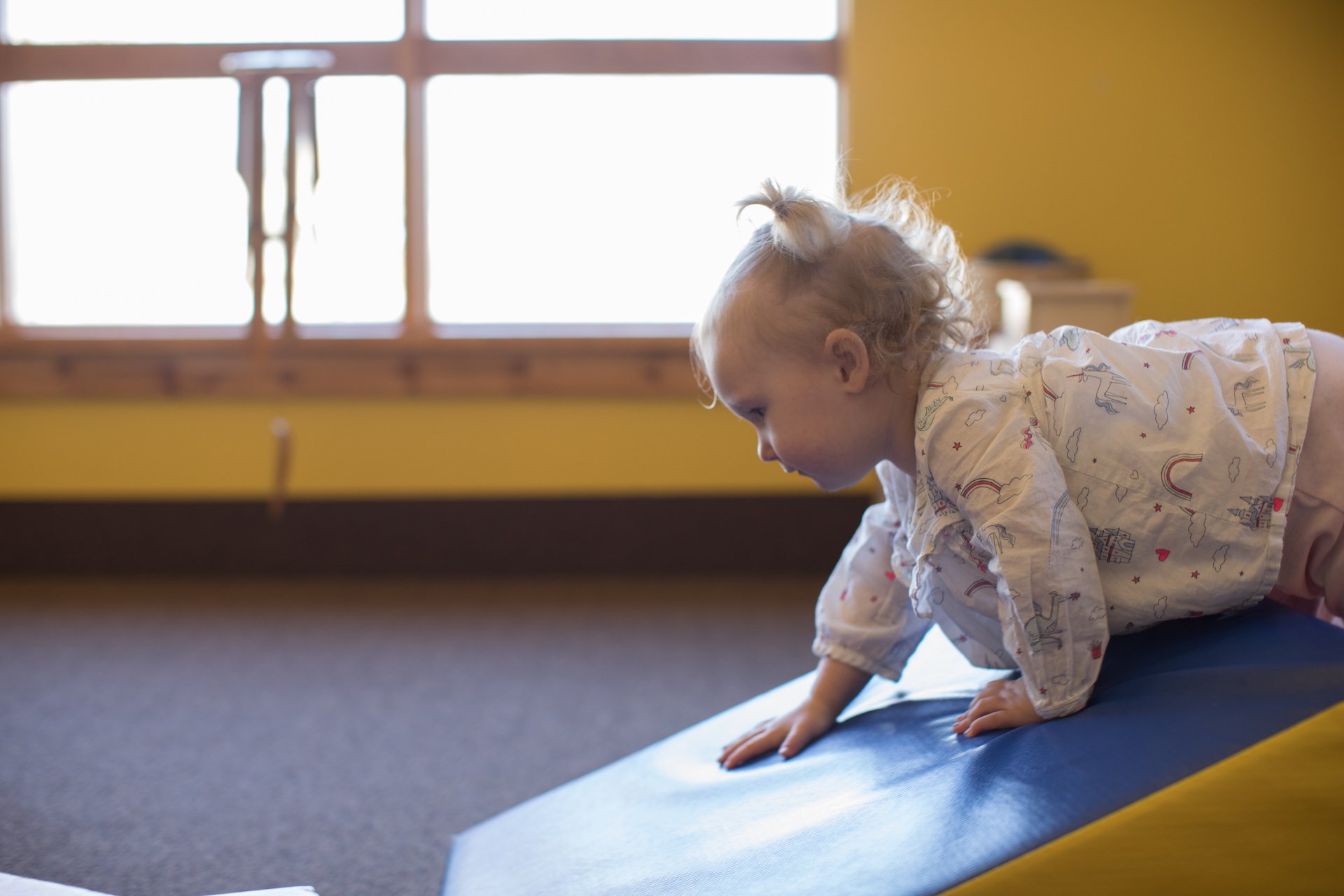
Montessori child crawling

In Montessori, we honor children’s movement, even from birth! One reason why we focus so much on movement for young children is that healthy movement development in the first two years of life can provide our children with considerable benefits in the years to come. 

So, let’s take a quick look at the science to better understand how to support our infants and toddlers during this critical time. 

Movement & Myelination

At birth, movements are spontaneous and reflexive, like sucking and swallowing which are essential for survival. These early reflexive movements originate from the spinal cord and brain stem, but soon movement matures from the head down. 

Our brains depend upon our sensory nervous system to share information about the surrounding world. This information actually shapes our brains’ connections and neural pathways.

For infants, these neural connections are just forming. As electrical signals move from one area of the brain to another, as well as down through the spinal cord to the rest of the body, they need smooth passage along what are called axons. Axons basically act like electrical wires conducting electrical signals. 

Those signals need to be transmitted quickly and efficiently. Just like electrical wires need insulation so the electricity isn’t dissipated, axons need insulation, too! For more rapid passage of these electrical messages, axons become insulated by a layer of lipids and proteins, a process called myelination.

Babies are born without much myelin, which explains why their reaction times are so slow and movements so effortful. But with each experience and repetition, the myelin sheaths around axons get thicker. Myelin essentially greases the wires and allows signals to travel along the axons faster and more effectively.

More myelination in infants’ motor systems allows them to lift their heads, reach out, roll over, crawl, and eventually walk and run.

Mobiles for Movement

Within the first weeks of life after birth, babies begin to learn to control their eyes which means some of the first myelination happens with infants’ eye muscles. 

To support this development, we provide carefully designed and placed mobiles, which help babies develop their visual capacities for focus and tracking. Changed as developmentally appropriate, mobiles offer newborns the opportunity to focus on an object, track it, perceive sensory details, and eventually attempt to reach for it.  

When infants begin to reach for the mobile, we begin to offer something slightly different, like a bell hanging from a ribbon. Babies will try and try again, with great concentration and focus, to move their arms so as to make contact with the object and cause it to move or make a sound. They thus discover the relationship between sight and touch. 

At first, physical contact with a hanging bell or ball may appear haphazard. Yet infants are seeing the item and making a muscular effort to connect with what they see. With repeated practice, infants are actually developing the myelin coating that will make their future efforts to reach and eventually grasp more efficient and successful.

Safe Space for Movement

For similar reasons, infants need space for movement. Often, we’re more apt to hold our infants or keep them in carriers. However, babies benefit from having space to move, and almost slither, their bodies on the floor. When you create the time and space for these slow whole-body movements, you’ll see that infants will often slither their bodies around in a clockwise direction!

When infants attempt to slither and move, they are very focused. This concentration allows them to start connecting how the mind and body work together. In Your Child’s Growing Mind: Brain Development and Learning from Birth to Adolescence, Dr. Jane Healy offers an important reminder: “After birth, physical activities are one of the child’s main means of advancing physical, intellectual, and emotional growth, so you should encourage many forms of body movement.”

Clothing also matters. In order to safely move their bodies, babies need clothing that doesn’t restrict their movements. Comfortable fabrics with forgiving elastics are best. Light clothing around the arms and legs offers more opportunities for movement and exploration. It’s also best to allow babies to have bare feet so they can have more sensory input and more traction as they begin to move.

Hands Send Information to the Brain

In addition to gross motor development, which will eventually progress from slithering to crawling to walking, infants are taking in information about the world through their hands. 

In this process, babies develop an awareness of the connection between what they observe and what they touch. Sensory experiences begin to be linked to their mental development. Although little mitts are adorable and seem useful to keep infants from scratching themselves, it’s much more beneficial for babies’ development to have their hands uncovered. 

Eventually, children begin to use their hands to not only take in information about the world but also to begin manipulating things in their surroundings. To help this development of hand movements, our little ones need purposeful activities that allow for exploration and the development of different types of hand grasps.

Children’s development of their hands is directly connected to the development of their brains. The brain sends a signal to the hand, and the hand moves and sends a sensory message back to the brain. With this new information, the brain can guide the hand in new ways, thus allowing the hand to discover more information by performing the new direction. And the feedback loop continues!

Gross Motor Skills Start with Tummy Time

While infants are developing these fine motor skills through coordination of their hands, they are also developing gross motor abilities. Early on babies need sufficient opportunities to develop large muscles, in particular their truck and neck. Thus, time lying on their belly is important, as this provides the opportunity for infants to push up with their arms and develop a stronger torso and neck. 

Tummy time “push-ups” with the arms while in the stomach position are key in forming needed coordination and strength for all of their subsequent large-muscle development. Then, as infants develop enough torso and neck control to push themselves into a seated position, they free their hands for further exploration and development.  

A similar process occurs when toddlers are able to move from cruising while holding on to objects for support, to walking without assistance. Suddenly they are able to move through their environment and use their hands for purposeful endeavors. 

From “tummy-time” to rolling, to sitting up, to scooting, to crawling, and eventually, to cruising and walking, our young children are beginning to explore their world and develop their sense of self. 

Developing Purposeful Movements

Dr. Maria Montessori explains that, as children gain strength through these activities, they begin to look toward those around them to imitate our actions and learn how to be a member of society. Children are interested in what we do and how we do it. They want to use their bodies in new and purposeful ways. 

From the first days after birth, when a newborn can only control their eyes to see a mobile to when they move their hand and make contact with a bell hanging on a ribbon, these experiences help children recognize that they can control their movements. The sensory feedback helps strengthen an impulse within children to look or to try to move. Every experience involves movement. The more infants move, the more myelin they form, and the stronger their ability to act according to their own volition.

Movement Matters!

Sensorial experiences are vital for the development of movement and children use their movements to extend their understanding of the world. They see, hear, touch, and taste. The more they use parts of their body to explore their world, the more their movements become refined and the more they are able to make sense of their surroundings.  

Children need the opportunity to explore, practice, and repeat movements through simulating and purposeful activity in a safe and supportive setting. Through these repeated experiences, our infants and toddlers develop their muscles, perfect their movements, and ultimately perfect themselves.

Although every child follows a typical timetable in terms of developing motor skills, their surroundings can either hinder or promote the acquisition and mastery of these abilities. Providing appropriate opportunities offers our children the chance for repeated practice and thus speeds the myelination process. Ultimately, as children develop their motor abilities, they come to recognize themselves as competent, capable, and unique individuals.

Want to see some competent, capable, and unique children moving through well-designed learning environments? Contact us today to schedule a visit! 

Why Do Families Make the Switch?

There are many different reasons why families choose Montessori for their child. Some enroll when their child is young and stay the course. Others discover it a bit later on. Others, still, leave their Montessori school and end up returning a year or two later.

Why do parents gravitate toward this unique method of education? Here are a few of the main reasons we have seen frequently in recent years.

They’re Wary of High-Stakes Testing

Many educators like to think of the field as a pendulum that swings back and forth over the decades. Sometimes regulations and trends tend toward restrictive measures, while other times everything is more flexible.

Right now in the public sector, the focus is on standardization and testing. The results of high-stakes tests given to students can affect school funding, oversight, and the way teachers are made to educate their students. As for the children, they feel the pressure of these tests, and this often gets in the way of joyful learning.

When we hear about teachers feeling forced to “teach to the test”, it’s not a myth. This might not happen everywhere, but it absolutely happens. Many parents, understandably, want a different experience for their children.

They Value Recess and the Outdoors

With the abovementioned emphasis on standards and pressures of state oversight, certain elements of the school day have fallen to the wayside in some places. It is not uncommon in recent years for a school to discontinue programs in the arts, or to drastically reduce the amount of time dedicated to children’s time outdoors. Many kids have a shocking fifteen minutes of recess time each day.

Research has shown that frequent breaks and adequate access to outdoor green spaces dramatically increases children’s ability to concentrate and engage deeply with their work. Private Montessori schools aren’t typically bound to the same pressures as public schools, so we are able to continue offering our students opportunities we know are best for their development.

They’re Looking for a Different Social Environment

“Social Emotional Learning” has - shockingly - become a negative concept in some areas, with districts outright banning even the mention of this type of work.

To us, learning shouldn’t just be about math and reading. Academics are absolutely important, but so is learning how to be a kind and empathetic human being. Montessori schools are able to take time out of the day to teach in the moment when conflict occurs, as well as include regular, planned lessons that teach children how to care for their emotions and interact with their peers in a healthy manner.

A big part of being successful involves how you interact with others. Our children will grow up to work with people at their jobs, in their communities, and even in their personal relationships. It takes a lot of practice to build the skills needed to handle various relationships in a manner that serves everyone involved.

The elementary years, in particular, can be a tumultuous time for some kids; they gravitate toward their peers, but they don’t always know how to manage conflict. That’s where we come in. We read stories, use role-playing strategies, and teach conflict resolution skills so that our students have all the tools they need to use when something comes up on the playground or in the classroom.

They Want Their Child to Love Learning

School shouldn’t be a necessary evil. It shouldn’t be something children have to endure. It should be a place where adults help children cultivate a deep and passionate joy for learning about the world around them. Children should be encouraged, inspired, and celebrated as they learn at their own pace.

Montessori schools aren’t about forcing children to memorize facts. We want them to feel in awe of the world around them and have the skills to search out information they need or want. We teach the basics in fun ways that kids can’t resist, and we give them a wide variety of science, history, and geographical information. Montessori schools honor the fact that as human beings, we have unique talents and interests, and we make time for each of our students to further explore areas they are drawn to.

The Traditional Classroom Structure Isn’t Working for Their Child

Although many schools are beginning to change, there is still a long way to go. Sitting in rows of desks and listening to a teacher lecture the whole group at a single pace isn’t a model that works for most kids.

Kids need to be able to move around. They need to be able to get help when they’re struggling, and zip ahead when they need more challenges. Education should never be a one-size-fits-all approach, because in reality, one-size fits very few.

In Montessori environments, children are free to sit where they like. This may be at a table, on the floor, by themselves, or with a group of others. Their needs may change from one minute to the next, and that’s perfectly okay.

We believe children - even very young children - should have autonomy over their own bodies and basic needs. If they’re hungry, they should have a snack without having to wait another hour for the scheduled lunch time. If they’re thirsty, they should be able to get themselves a cup and some water. If they need to use the toilet, they shouldn’t need the permission of an adult. We believe there are ways to create structures that allow for children to attend to these basic needs independently and safely. We don’t feel the need to exercise control over these types of things.

Are there other reasons families choose Montessori? Absolutely. These are just a handful of what we hear from parents. If you’re considering Montessori for your child, we encourage you to come to our school and take a look. We would be happy to give you a tour or meet to discuss your situation and answer any questions you may have.

Choosing a path for your child’s education is deeply personal. Know that we are here to support your family.

Montessori vs. Daycare: 5 Key Differences

Many families rely on childcare while their children are still young. Figuring out the best place to drop your little one off every day is a big decision. Parents want to ensure their child spends their days safe, comfortable, and happy, and under the watchful eye of well-trained and competent adults.

Daycare is the obvious choice for many folks…that is, until they become aware of other options.

If you’re reading this article, it’s likely you are one of those parents who is trying to figure out the best possible placement for your child. Allow us to highlight five key differences between a typical daycare center and a Montessori school.

1. An Emphasis on Education

Montessori goes beyond the reaches of a typical daycare facility. While daycares focus on watching and caring for children, Montessori schools do this and more by creating an environment focused on children’s learning.

We believe education starts at birth. Children’s days should be filled with play, as that is how they learn, but we create space for them to play in ways that enrich their development.

We don’t fill our classroom with whatever toys look fun; we carefully prepare an environment with materials that have been developed after careful scientific observation and used for over 100 successful years. These materials are still games and toys from the perspective of the child, but they tend to have much different effects on them from a learning perspective.

2. A Natural Environment

Most daycare environments are filled with bright colors, plastic toys, and maybe even a cartoon character or two.

Montessori environments eschew any type of commercialism or characters. They utilize natural materials like wood, plant fibers, and even glass. Natural tones are favored over bright and loud colors, and soft and natural lighting is evident.

Montessori classrooms intentionally bring the natural world inside, with plants, found objects, and pets. Children are directly involved with the care of living things in the classroom.

Daycares may have bright posters on the wall, whereas Montessori environments favor a minimalist approach and examples of art displayed at the level of the child’s viewpoint.

3. Specially-Trained Guides

The training of a Montessori guide goes far beyond the training of a typical daycare worker. To care for young children, both must meet certain requirements such as first aid training, passing a background check, and some knowledge of working with children.

Montessori guides, however, continue far beyond the basics. Most have college degrees, with many obtaining advanced degrees. They have completed rigorous Montessori credential training, which includes comprehensive instruction on child development, intensive lessons to help them present Montessori materials correctly, work in Montessori philosophy, and so much more.

We encourage you to ask your local daycare facility about their teacher training requirements and compare them to Montessori requirements while you explore your options.

4. The Sense of Community

When your child is enrolled at a Montessori school, it’s so much more than a place to drop them off each morning. The whole family is welcomed as a part of the school community, and special events and traditions work to solidify this sense of community.

Montessori parents are often eager to connect with one another; we all seem to have a sense that a strong community contributes greatly to the wellbeing of our children. It’s helpful to have other parents to ask questions, hear about experiences, and even socialize with.

Montessori schools are also unique in that we welcome parents into the classroom. In fact, we encourage regular observation. The children are used to adults sitting quietly in a corner of the room, so the practice is unobtrusive, and really gives adults a clear picture of the type of work we do. Many parents walk away from observations in awe of the engagement of the children and the depth of the work/play they show.

5. Development of Practical Life Skills

We believe that learning is so much more than academics, which is why Montessori environments intentionally include practical life lessons. Practical life learning is incredibly appealing to young children as well, as they look to adults in their lives and want to emulate the work they see them doing. Some of the types of skills they develop in our environments include:

  • Toilet learning (for infants and toddlers)

  • Food preparation

  • Care of the environment (cleaning skills)

  • Plant and pet care

  • Fastening various types of clothing

  • Tying and lacing

  • Care of self (washing, brushing, etc.)

  • Grace and courtesy lessons: interacting appropriately and politely with others

We hope this article has been helpful and informative. To learn more, we encourage you to visit various types of settings in person and ask to observe in the different classrooms. Not only will you notice stark differences, we think you’ll find yourself impressed with the scope of skills covered in a Montessori class (as well as the absolute joy of the children who you see there).

Please reach out to us if you have any questions or would like to schedule a visit. We would love to meet you and your child.

Beyond the Classroom: Montessori Extending Into Adulthood

Montessori for Adults

Montessori: it’s not just for children. What was originally created as an educational model for preschoolers in Italy has expanded significantly over time. Today, more and more adults are noticing there is potential for application far beyond the Casa dei Bambini. Whether you’re interested in learning more for yourself, or learning more about how Montessori education is trickling into various parts of our society, plenty of interesting changes are happening around the globe.

Training and Degrees

It may surprise you to learn that many people first hear about Montessori education through the lens of being a Montessori parent. The more people discover about the method, the more they become curious about the model, and this leads to many seeking their own Montessori credentials and eventually becoming guides.

Have you thought about Montessori education for yourself? If so, there are a number of options.

To become a Montessori-credentialed guide, it’s important to enroll in a training program recognized by a major Montessori organization. Two of the most respected are AMI (Association Montessori Internationale) and AMS (American Montessori Society). To learn more about affiliated training programs, visit their sites directly:

About AMS-Affiliated Teacher Education Programs

AMI Teacher Training | Association Montessori Internationale

Are you more interested in higher education? There are a number of programs offering master’s degrees in Montessori Education, and many include online options. Here is a great list for exploring education options for adults.

Montessori in the Workplace

People all over the world are beginning to recognize that the general philosophy of Montessori is extremely applicable in the workplace. If a model works well, why can’t it be applied elsewhere? Montessori schools are effective. They create an atmosphere of joyful learners that contribute to their communities. What if we modeled our workplaces to reflect these successful classroom environments?

Digital marketing professional (and Montessori mom) Amanda Shelley has some thoughts on what effective modern workplaces look like. Perhaps unsurprisingly, she draws comparisons from the different types of schools available to our children. She shares these ideas in this article.

Sophie Bryan, another Montessori parent and award-winning HR consultant, advocates for bringing Montessori principles into the workplace in order to drive innovation and employee freedoms. She believes this benefits both employees and the organizations they work for. Bryan explains these ideas in her TEDx talk and gives her thoughts on how we might make changes in our workplaces.

Shelley and Bryan are just two of many leaders currently advocating for a shift toward more Montessori-inspired work environments for adults.

Montessori in Prisons

Brian Walsh leads education programs in two prisons in Washington State. He and his wife also own and operate a school together. This diverse experience led him to draw conclusions about the similarities between the two environments, and use those experiences to create innovative solutions.

In this TEDx Talk Walsh shares the ways in which education in prisons is a smart investment, but also how we can make it effective by implementing some of the same principles as we do in children’s Montessori schools. The whole video is compelling, but jump to minute 8:14 if you’re short on time.

What might we consider when developing educational programs for incarcerated individuals? How can we create safe and appropriate tools and environments, while giving students control of their learning? Walsh has found solutions to these questions, and has found them to be highly successful.

Montessori for People with Dementia

The application of Montessori principles to care for people with dementia is becoming more and more extensive.

There have been numerous studies and academic papers published indicating Montessori principles are effective when applied to dementia care.

AMI even has a division of their organization dedicated to this emerging branch of study.

If you are the caretaker of an individual experiencing dementia, considering basic Montessori principles will help make your life easier as well as giving the individual an increased sense of joy and independence. Strategies will naturally change depending on the development and stage of memory loss. Some thoughts:

  • What needs are not being met in the environment? How might small changes create a sense of independence?

    • Label doors throughout the house with words written on index cards or sticky notes.

    • Lay out necessary items to complete a task: clean clothes to change into after a shower or items to put together and eat a simple no-cook breakfast.

  • What are the individual’s interests? How might those be incorporated into the environment?

    • Leave out books and activities around the home for the person to notice and engage with. This might include puzzles, magazines, or even a broken alarm clock with simple tools to tinker with. If the person was creative earlier in life, leave out art supplies. If they loved music, make the songs they enjoyed available for them to listen to.

  • What changes can be made to the home to create a built-in structure of safety? Are there simple ways to prevent potentially harmful situations? This is the application of ‘freedom within limits’. Once dementia progresses to a certain point, it’s not safe for a person to be completely independent. The key is to consider how to create an appropriate level of freedom.

What’s a Work Period? Your Questions Answered

Montessori Work Period
“The mind takes some time to develop interest, to be set in motion, to get warmed up into a subject, to attain a state of profitable work. If at this time there is interruption, not only is a period of profitable work lost, but the interruption produces an unpleasant sensation which is identical to fatigue.”
— Dr. Maria Montessori, What You Should Know About Your Child

Consider, as an adult, what it takes for you to do your best work. What must your environment look like? What do you need from others? What constraints do you need to be removed in order to meet your goals?

Dr. Montessori spent years observing children as they played. She quickly recognized that immense learning takes place during play, leaving it reasonable to call it the child’s work. Left without interruptions, she witnessed pure magic.

Children, even very young children, have the capacity for intense concentration. They have the innate ability to work through problems and develop solutions all on their own. They want to do these things. And what’s even better? They do it with a sense of self-satisfaction, not because they feel pressure or expectation to.

What Montessori realized is that we, as adults, sometimes need to get out of kids’ way. We often imagine they require more help than they actually do, or that we must offer rewards or incentives to ensure they do their schoolwork, but those assumptions are misguided. What children really need is time, respect, and an environment in which they may focus deeply on their work.

Thus, the work period was born. Generally spanning about three hours long in the morning, this precious time is a cornerstone of Montessori education.

How does it begin?

The start of the work period varies, but typically it begins as children arrive in the morning. For some classes, on some days, and during some parts of the year, there may be a whole class morning meeting or circle time at the start or end of the work cycle.

A typical day begins with the child hanging their belongings on a designated hook, changing their shoes, and greeting their teacher as they walk into the room. They may say hello to a friend or two, take a moment to transition, and then select a work from the shelf. Others may be so eager to begin, they waste no time at all and go straight to the material they have been thinking about since the day before.

Prior to age six the child will likely work by themselves, but near their peers, most of the time. They may lay out a work rug, set up their material, and delve into a deeply concentrated state. They use the materials in the way they have been taught, then clean up and replace everything when they are done. 

As children older than six, due to their development and desire for social connection, the start of the day can be a bit noisier and more chaotic. They still get to work rather quickly, although it’s often in the form of group or partner work.

What do the adults do?

A Montessori classroom typically has two adults present: the guide and an assistant. The assistant busies themselves with ensuring the room stays neat and orderly and that everything the children need is available to them. If children need help or redirection, the assistant is quick to engage while still allowing the child to maintain an appropriate level of independence.

This allows the guide to focus on two main tasks: observation and presenting lessons. During the work period lessons are not given to the whole group; individuals or small groups of children work with the guide to learn or review skills and materials. This is done as unobtrusively as possible. Adults in a Montessori classroom do their best not to interrupt the work of a child. If they need to speak with a student, there is often a non-verbal structure in place, such as leaving a name tag beside the child as they are working. This alerts the child to check in with the guide whenever they complete the task they are focused on.

Do children really focus the entire time?

Not usually! Can any of us truly focus for three hours straight without breaks? We definitely don’t expect our students to, either. This is one of the reasons our environments are designed for students to meet their own needs independently, when the time is right for them. If they feel hungry, they are welcome to have a snack. If they need to use the restroom, they don’t need to ask permission. Even if they just need to get up and stretch their legs or look out a window - we do not prevent children from doing these things. Allowing for breaks lets us all focus better in the long run anyway.

There is one interesting phenomenon worth mentioning here. Sometime around 10:00-10:30 in the morning, toward the end of the work cycle, classroom communities often experience what we refer to as false fatigue. Like clockwork, the volume of the children’s voices will rise, there is noticeably less engagement with the materials, and fewer children are sitting in one place - rather they seem to be wandering around the room. The adult instinct is to ring a bell or clap and make a plea for re-engagement, but we have learned to hold back. False fatigue is a normal part of the flow of the day. If we pause, observe, and wait even two or three minutes, we will see the children find their way back into their work. It can be pretty amazing to observe.

What might one work period look like for an individual child?

This article has probably already given you a fairly good idea of what this might look like. Once the child completes their first work of the day, they begin another. This repeats for the duration of the morning, but is fractured by any number of other activities. The child will likely have a lesson or two with their guide while the rest of their classmates continue working independently. At some point, the child will get hungry, have a snack, and clean up after themselves. They may take several water breaks, socialize with friends, or even spend some time watching a squirrel climb a tree outside.

In short, the work period is a way to honor the child’s way to balance focused learning with meeting one’s own needs, on one’s own timetable. It’s a way to show the child we trust them, and our students absolutely rise to the occasion.

Curious to see what a morning work period looks like in action? We would love to have you visit. Reach out today to schedule a tour.