independence

The First Six Years: Conquests of Independence

As caregivers and parents, we have a bit of a bittersweet role. While we want to keep our children close, we ultimately need to support their path toward independence. 

We expect dependence at the beginning. Yet our newborns take their very first step toward independence at birth. Once born, they have to breathe on their own. And rather than get nutrition through the umbilical cord, they use effort to begin latching on or suckling. 

Throughout their first six years of life, our children achieve so many milestones of independence. Let’s take a look at some of these conquests of independence. You can use this framework as a guide and reminder of how we can support our children as they grow and develop. 

Birth to One Year

  • The first conquest of independence is birth which comes with the cutting of the umbilical cord. At this point, infants must breathe and gain nutrition on their own. Even our expression “It’s time to cut the cord” indicates the shift to increased independence.

  • Movement is another acquisition of independence in the first year as children begin to use their arms and legs, sit up and crawl, and move from one place to another. With this increased locomotion children no longer need to be held or carried.

  • Our children also begin to feed themselves. Even in the beginning when babies are nursing, we want them to indicate hunger. The weaning process and shift to using the weaning table supports this path to independence. As our children begin to eat and drink on their own, it is important to have foods and tools they can use independently (e.g. a shot glass for water, finger foods, etc.) rather than having an adult putting a utensil or bottle in their mouth. 

  • Children can also start to practice basic use of utensils. Having utensils that are child-sized and functional is key to independent use. 

  • In addition, our children need the opportunity to develop the ability to be by themselves. To become independent, they need to practice separating from their caregiver(s). Healthy separation depends upon healthy attachment, and our children need the chance to have some time without adult engagement.

  • Around the end of the first year, children begin to develop language to communicate their needs. Prior to this time, they are able to use other methods to communicate: crying, cooing, smiling, etc. This communication is the beginning of social skills and children’s ability to relate socially to others.

One to Three Years

  • During this time children can walk confidently and begin to run and climb. Once children can walk, they can begin the process of becoming independent in toileting. 

  • They become more independent with the use of their hands, which become tools for exploration. Because of this, children no longer need to rely on others to hold and carry items.

  • Language use allows children to begin to express themselves independently.

  • Children can start to become independent in dressing themselves. 

  • They begin to be able to use simple tools (crayons, sticks, cups, utensils, etc.).

  • They become more capable of caring for their own personal hygiene (brushing their teeth, washing their face, brushing their hair, etc.).

  • Children become more proficient with and capable of carrying their own items. 

  • They have the capacity to clean up after themselves (putting away belongings, folding clothing, wiping spills, sweeping crumbs, etc.).

 As children get older, they need opportunities to develop their will. Thus, during this stage of independence, it is really important that children can make choices. Making a choice means they are acting for themselves and exercising their will.

From Three to Four and a Half

  • If it hasn't happened already, children experience separation from the family (e.g. going to school). To be able to separate from one’s family is a new skill of independence. For children who haven’t been able to be by themselves, this is a harder process. During this time, children realize they can survive and trust others, which is a significant step in independence.

  • Children develop a wider range of social skills.

  • Children’s motor and visual skills become more developed and refined.

  • They are able to engage in more games (e.g. catching and throwing a ball).

  • They have finer manual dexterity (using individual fingers) as well as refined fine motor skills (when all fingers are working in unison).

  • Children begin to develop the ability to use language to express their emotions. They can learn a multitude of words to be able to express feelings. 

  • They can use utensils and tools to prepare their own food (which ideally happens prior to age three). Research shows that children involved in preparing their own food are more likely to try diverse foods.

  • Children learn to master fasteners (zippers, buckles, bows, etc.) and thus the self-care involved with dressing and undressing.

  • They can contribute to their community and care not only for themselves but also for the environment through simple responsibilities like setting the table, folding towels, etc.

  • They are more independent in caring for their own hygiene needs.

  • Because their vocabulary is expanding, children can use words to express emotions, as well as to better express their thoughts.

Four and a Half to Six

  • Children have more social independence and can not only do for themselves but can also use acquired skills to help others.

  • They become more independent in their social skills so they can internalize and apply the social norms of their community (e.g. pushing in chairs, greeting visitors, communicating that they need space, etc.).

  • Children become proficient in dressing themselves and can help younger peers with the dressing and undressing process (e.g. getting dressed for going outdoors).

  • They acquire the capacity to have empathy and compassion.

  • They have a basic understanding of quantities and how they are represented, instead of just mimicking or rote counting.

  • Children begin to recognize and use the symbols of our language (e.g. expressing themselves through writing or interpreting the thoughts of others through reading).

These conquests of independence are ultimately about becoming functionally independent. Young children are in a process of mastering different aspects of their lives and they need us, their caregivers, to support them in this process. 

Our children are so capable and they benefit when allowed to move toward increasing independence. If you’d like to see how our Montessori environments set children up for success, please schedule a tour!

Independence: The Foundation of Freedom

In order to be truly free, we need to be able to make our own choices, which means having the skills and abilities to then act upon our choices. Without independence, we can’t truly be free. 

As children’s independence grows, so does their opportunity for freedom. They have more choices available and more to consider. The freedom children experience in our prepared learning environments is directly related to their independence. Over multiple years in their classrooms, children feel like masters of their environment and younger children look up to them as if they have superpowers.

In order for children to develop this freedom and independence, we make sure that the following opportunities are present in our classrooms:

To Choose Their Own Activity 

Even at a young age, children have ideas of what they want and don’t want to do. This independence will only increase when children have opportunities to make decisions. In Montessori classrooms, we provide opportunities to make choices, but it is not a free-for-all!

The classroom is set up with a variety of activities designed to meet developmental needs. Children are free to choose any material they have been shown or that they have the ability to do. Thus, children must have the skill before being able to choose.

To build this ability to make a choice, we start by offering children choices about very simple things. When an activity has two parts, we might ask: “Would you like to carry the box or the tray?” Then we give another opportunity to make a choice: “Lovely! You may carry the tray to any table that you choose.”

Over time children develop the ability to make increasingly more complex choices and they build the skills that allow them more options in their learning environment.

To Work Without Interruption

Once children choose an activity, they are free to do it for as long as they like without anyone else (adult or child) interfering with their work. In this way, we protect children’s focus and concentration. As a bonus, because the materials are self-correcting, children don’t need an adult for validation. 

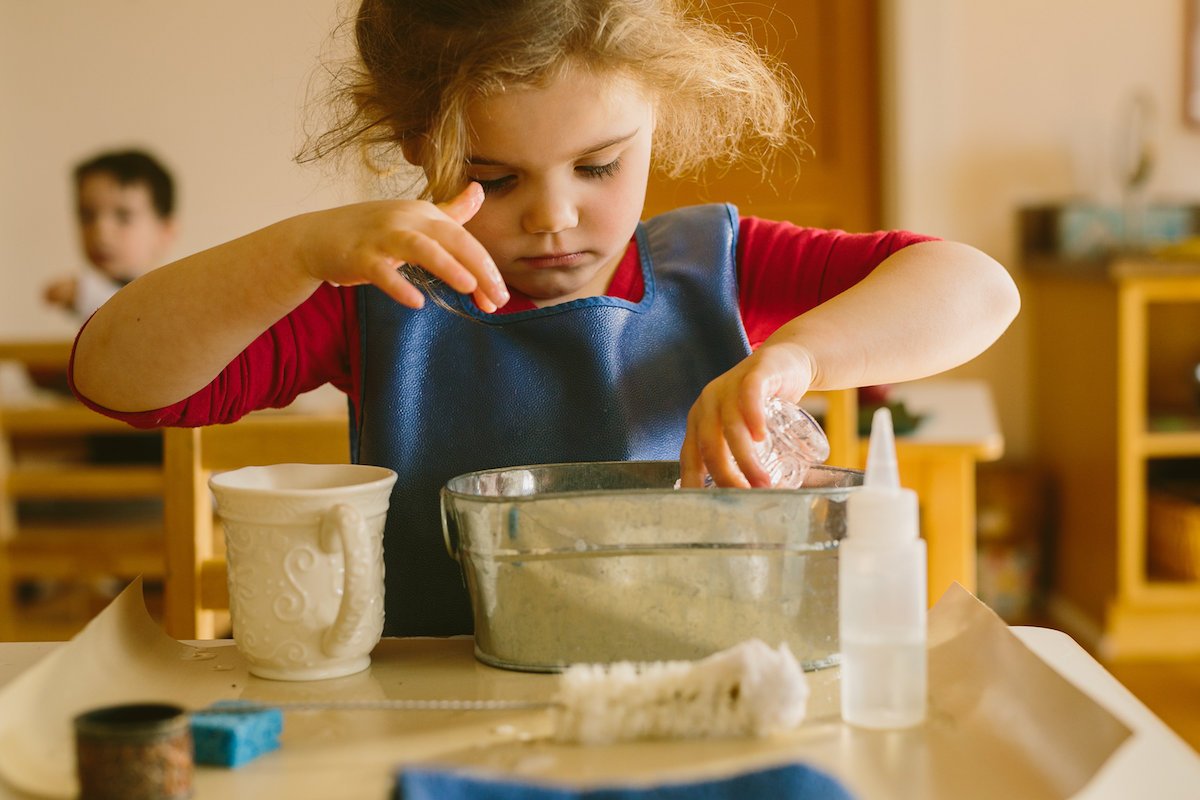
The adults in Montessori classrooms work to protect children who are actively engaged in purposeful activity from interruption (even if this is a three-year-old washing a table and water is pouring off the table!). If children get interrupted a lot, their concentration becomes broken which can result in them not wanting to take risks or engage with challenging learning material.

The experience of being interrupted can happen a lot to children. They try to start doing something and someone comes along and stops them or finishes it for them. Yet children need to be able to deeply dive into activity in order to develop concentration and focus.

To Move Freely

Children are free to move about the classroom. Rather than having an assigned table or workspace, they can choose to work where they want and also with whom they want. They have the liberty to get up and move, get a drink when thirsty, or go to the bathroom when needed. If there is a group activity in the classroom, children are even free to choose whether or not they want to participate. 

To Communicate With Others

Children also have the freedom to communicate. They can speak to whomever they want and when they want, as long as it is not disturbing their own or others’ work. This freedom is a gift to children who are often asked to be quiet and not to talk. Children in our learning environments have the freedom to speak and the ability to be heard, which means that the adults in the classroom make it a priority to be respectful when children want to communicate something. 

To Work at Their Own Pace

Unlike in traditional environments where children move together along the same path (this half hour is story time, this is math time, etc.), Montessori children have the freedom to work at their own pace. To facilitate this, our schedule is specifically designed to offer large blocks of uninterrupted time so children have the freedom to spend the time they need on the activities they choose. 

Working with learning materials is how children are developing themselves. They need time to reflect and integrate what they are learning. Therefore, children also need to be able to repeat an action as often and as long as they would like to do so. When children are new to Montessori classrooms, we sometimes need to let them know about the opportunity to work at their own pace and rhythm by reminding them, “You can do this for as long as you like!”

Limits

In order to support this foundation of freedom, Montessori classrooms have a few basic limits that support independence. In addition to ensuring that children aren’t distracted or interrupted in their work, we help children learn that materials can only be taken off the shelf and must be returned to their proper place on the shelf. These basic rules are clear social signals to children as to when a material is available for use: when a material is on the shelf it is available, and when the material is not on the shelf, it is not available. 

Children are also part of restoring materials so that they are ready in their proper place. In the process of making the activity beautiful for the next person, children learn how to replace wet towels with dry towels, how to dry drips of water off a tray, or how to replace anything that was consumable. When the materials are restored and returned to their proper place on the shelf, then children can access the materials independently.

Development of Independence & Freedom

As children gain skills and abilities, their independence increases and so do their choices. Activities are available and ready for use so that children are not dependent upon anyone to get things for them. Children can choose where they do their work. The lessons we offer are designed to provide just enough information for children to continue the activity independently. We offer these liberties in harmony with children’s skills, abilities, and level of independence so they can experience a variety of freedoms in their learning community. 

Curious about how this all works? Schedule a tour to see how independence and freedom are interconnected!

Achieving Economic Independence

Adolescents exist between two worlds: they are no longer children but they aren’t yet adults. On this bridge to adulthood, adolescents need opportunities to develop real, meaningful, adult-level skills. They aspire to do what adults do. They are curious about how to make their own way in the adult world.

As adults, we are part of an economic system. Even if we aren't using money to buy something, through our work or our hobbies we produce or consume aspects of culture. In this way, economics is about the web of interdependence we have with other people. We all depend upon the work and activity of others.

Economics and Interactions

If we look at economics as how people offer value in their interactions, as well as the production, distribution, and consumption of services and goods, we can really think about economics as how we organize ourselves in society. Because adolescents are building the skills for stepping into the adult world, it’s important to consider how they are developing their ability to navigate this economic aspect of adult life.

How many of us had the opportunity, as adolescents, to develop the skills necessary for economic independence? How would our lives be different if, as adolescents, we had a support system so we could figure out a fair and reasonable cost for goods we produced, faced the reality of a profit and loss statement, or found our way in navigating the paths of spending, saving, and sharing?

Road to Achieving Economic Independence

Dr. Maria Montessori realized the importance of adolescents developing these kinds of skills. In From Childhood to Adolescence, Dr. Montessori made a bold statement about our approach to education and its impact on the greater society. She stated it clearly: “The essential reform is this: to put the adolescent on the road to achieving economic independence.”

So in Montessori adolescent programs, we offer our emerging young adults the opportunity to learn key skills of production and exchange. We sometimes call this “microeconomy.” The basic idea is that adolescents need opportunities to produce goods and services, and work with money and monetary systems, so they can develop an understanding and appreciation for how economies work and their own role in economic systems.

Real, Meaningful, and Purposeful Work

This experience can take many different forms depending upon the community. Whether running a farm stand or a holiday marketplace, adolescents get to learn key skills. They learn to balance profit and loss. They discuss and determine how much money should be reinvested into the business to help it grow or how much money should be reinvested in the greater community. They respectfully listen to their customers’ needs and concerns and incorporate that feedback in useful ways.

In order to have these learning experiences, adolescents need real, meaningful, and purposeful work. Just like young children need to actually prepare food rather than play with a pretend kitchen set, adolescents need actual experiences in creating a business plan, keeping track of income on a spreadsheet, and balancing a budget. They need to practice accounting work so they can build the skills for their own economic independence. They need to have the thrill of handfuls of cash and then face the responsibility of keeping track of those earnings. They need the experience of paying for replacement materials when they have overused key supplies. If they have developed some savings and want to invest the money, they need to find opportunities that align with their values.

Preparing for Adult Life

Too many of our young people enter the world of adult lives without having experienced their role in an economy (perhaps other than being consumers!). Economic independence is a key part of preparing for adult life. We want our adolescents to step into maturity with confidence that they can independently navigate their new responsibilities and roles. If we give adolescents the opportunity to learn how to have a sound basis for their economic decisions, imagine where they will be when they are adults and making decisions that affect broader aspects of society!

From Independence to Interdependence

In Montessori, we talk a lot about independence. However, one of the lesser known or understood aspects of Montessori is that independence isn’t the end goal.

As humans, we are each wonderful, unique individuals. But we don’t exist in isolation. We live amongst other wonderful, unique individuals! In order to effectively live in community with other people, though, we need to be able to function independently. Said another way, before we can offer help to others or make ourselves useful, we need to be able to meet our own needs.

How can we be independent and interdependent at the same time?

We all want to make choices for ourselves, exercise our liberty, and be responsible for our own lives. At the same time, we also want to be part of something. We are designed to be both independent and be in community. These two needs are not mutually exclusive, but in fact, operate in relationship to each other. We have an innate desire to be autonomous and to belong.

When we develop the ability to act for ourselves, make choices, control ourselves, and accept responsibility, we are able to be functioning, contributing members of society. We can see what needs doing and do it because we have the skills to do so. We can work with others to create solutions or produce goods and services. We can be part of a community by acting and taking responsibility for our actions, each able to contribute because we all have the skills to do so.

What does this have to do with children and Montessori education?

From a very young age, children are trying to exert control over their lives. Children are trying to gain functional independence from birth to about age three. In Montessori classrooms, we offer all sorts of opportunities for young children to develop skills that help them take care of their basic needs. But we don’t stop there! We also provide so many ways children can care for others and for their surroundings.

Once children have mastered pouring from one pitcher to another, they are able to pour water into a vase and arrange flowers to beautify the classroom. After they learn how to sweep, they are quick to notice a spill and rush to get the dustpan and dust brush so they can help. When someone is struggling to zip their jacket, they take pride in sharing their newfound skill in service to someone else’s need.

As children move into the elementary years, this service to others often takes on a slightly different form, in part because elementary-age children are developing their intellectual independence. Thus, their contribution often involves applying these newfound intellectual skills. They might notice a classmate struggling to figure out the steps in a math problem and offer support. Or when friends are in conflict, they might provide some mediation to help each party listen to the others’ perspective.

In adolescence, young adults are ready to work toward being socially and economically independent. They want to figure out their place in society, grapple with real problems, and contribute in a useful way. Thus, Montessori adolescent programs offer teens the chance to develop and feel secure in their own abilities while also collaborating in real and meaningful social endeavors. In the process of running a small business, for example, adolescents are applying their intellectual skills from marketing to mathematics, while also navigating how to communicate with customers and collaborate with classmates.

Why is this important?

As humans, we want to achieve independence and belonging. Being independent is about learning the skills to be able to contribute in a meaningful way. All the little conquests of independence–throughout each age and stage of development–matter! When our infant reaches to grasp an object, our two-year-old demands to put their shirt on themselves, our eight-year-old argues about just and fair rules of a game, or our adolescent insists they can solve a problem with their peers, we can remember that these acts of independence are laying a foundation for our children to become part of an interdependent, harmonious society.


Independence is just a step. Interdependence is the ultimate goal.

5 Ways to Support Independence as They Grow

montessori-independence.jpg
The child’s development follows a path of successive stages of independence, and our knowledge of this must guide us in our behaviour towards him. We have to help the child to act, will and think for himself. This is the art of serving the spirit, an art which can be practised to perfection only when working among children.
— Dr. Maria Montessori

It’s nothing new to hear us advocating for children’s independence. After all, it’s a cornerstone of our Montessori practice, and we believe one of the most important keys to fully educating a child.

It’s also no surprise to consider that independence looks vastly different depending on your child’s developmental stage. When we meet a child where they are and offer them opportunities to do things for themselves, it’s simply amazing to encounter what they are capable of.

Here are a few ideas that parents can consider when aiming to support their child’s independence.

Infants: Freedom of Movement

Our sweet newborn babies don’t ever stay little for long. Before long they are working to roll over, scoot, sit, crawl, stand, and even walk. These milestones are so exciting as they happen, but in hindsight, they seem to zip by in a flash.

Figuring out how to move independently is one of your baby’s most important tasks. They are driven to do so instinctually, and as adults we can be there to support this work. 

One choice that some parents make (please know we understand it’s not a perfect choice for every family) is to give their infant a floor bed. Rather than being confined to a crib, this allows your growing baby an opportunity to independently explore their environment when they wake in the morning. Using a floor bed means creating a bedroom environment that is completely safe and developmentally appropriate for your baby to explore independently; consider laying soft carpet on the floor and having a low shelf with simple toys they can access. Many parents find that rather than awaiting their child’s cries to be lifted from a crib in the morning, the child instead spends quite a bit of time moving and playing quietly.

Another big tip we have for parents of infants: when your child is learning to walk, they’re not very good at it. The only way for them to get better is to practice, and they have a strong drive to do so as much as possible. Although it may force us as parents to slow down and plan extra time into our schedules, consider relying a little less on carrying and strollers (although they certainly have their place in our routines) and a little more on giving your child time to use their own developing skills.

Toddlers: Dressing

This section is perhaps the most fun in this entire article. Toddlers learning to dress themselves is not only an important skill, but it is, frankly, adorable.

Start simple and give limited choice. Let your child choose between two different shirts, then show them how to go about putting it on. In the beginning, they will need lots of help, but as time goes on resist the urge to insert their tiny hands into the sleeves and give them a chance to figure it out. They will. It will take some time and many unsuccessful attempts, but each time they try they will get closer to being able to do it themselves.

As time goes on, your child might select their whole outfit. Another practical tip is to choose (or have them help you choose) a week’s worth of outfits ahead of time. Hang enough low hooks on your child’s bedroom wall and allow them to choose their clothing and get dressed each day. As with everything, this will be slow going in the beginning, but in the long run the independence gained will not only save time but instill critical feelings of confidence.

After taking the above mentioned steps, all that’s left to do is sit back and enjoy the interestingly paired items of clothing and the smile on your child’s face.

Primary-aged: Helping Tasks

Shocking but true: between the ages of 3 and 6, kids LOVE chores. By helping them learn and engage in important daily tasks while they are young, you are instilling habits that will last a lifetime.

Our children watch us go about our daily lives and they want to be a part of what we do. They want to be like us, so when they see you sweeping the floor, they want to help. From dusting, to laundry, from cooking to caring for pets and plants, your child wants in on the fun. Let them!

There are countless tasks that young children are fully capable of completing (or at the very least, assisting with). Rather than list them here, we share some general guidelines to help the process along. 

  • Follow your child’s interests. They will let you know, whether by actions or words, what they want to try.

  • Carve out time to slow down and let this work happen. Will it take them ten times longer to sweep up their own spill than if you did it for them? Absolutely. But putting the time in now is well worth it in the long run.

  • Embrace mistakes. Teach them to embrace mistakes. Mistakes are how we learn.

  • Learn to view chores as contributions we all make to our families. By working together (children included), everyone is part of a team. With this mindset, your child will take great pride in their work.

Elementary-aged: Trust Moments

This step varies significantly from child to child and in each family. Your family’s values and comfort level, combined with your child’s individual development and abilities should be carefully considered.

During the elementary years, your child is ready to start setting off on their own in tiny ways. Letting them do so can feel thrilling for them, yet completely nerve-wracking for us. Take it slow and talk a lot about what each added freedom entails.

Basically, you’re finding small ways you can give your child opportunities to be safe, trustworthy, and independent. Some examples: 

  • Playing alone in the backyard - Discuss clear boundaries and expectations. In the beginning, you may be watching like a hawk from the kitchen window, but in time this will become a great option for your child as well as for you.

  • Retrieving items at the grocery store - Start small by asking them to grab something within your line of sight, but gradually ask them to retrieve an item from one or two aisles over. As a bonus, this will speed up your shopping trip!

  • Walking the dog/getting the mail - Similar to playing alone in the yard, set clear safety rules and talk about “what ifs”. What will your child do if they hear a car coming? What if the dog tries to chase a squirrel? Ask these questions repeatedly until you feel confident they fully understand.

  • Going to a friend’s house - This may not be something new, but as they get older children will want to spend more time with their friends. Again, talk about how they might handle various situations, but also discuss how they might contact you if they need to.

  • Babysitting - In the beginning, this might mean your 8-year-old reads to their 4-year-old sibling while you cook dinner. By the end of the elementary years, however, your child might actually be ready to take on some real babysitting jobs.

Adolescents: Exploring Interests

As your child leaves their younger years behind and inches toward adulthood, they will naturally begin to explore different interests as they figure out who they are and what they like. All they really need from us is to support this exploration. This will range significantly, from hobbies to potential careers.

We spend many years caring for our children when they are young and giving them every advantage possible so that they may grow to become successful and happy adults. Nothing can quite prepare us for this eventuality, though. And what we imagine our child blossoming into can be very different from the future they imagine for themselves. In these moments, we like to remind ourselves that we have worked hard to guide our child’s independence. They are individual human beings capable of making hard decisions. They will make mistakes, but they will also surprise us.

Our children often turn to us for guidance and support throughout adulthood. Perhaps the greatest feeling of all is to step back and appreciate that this unique human being, who steps out to make their mark on the world, let us hold their hand for a few years while they figure out how to do it.


Book List: Help Me Do It Myself

IGimage 26April2021.jpg
Never help a child with a task at which he feels he can succeed.
— Dr. Maria Montessori

One of the most critical values of Montessori education is the fostering of independence. Our children need our support, but we are tasked with the gradual release of this support. Doing so is a challenge, for no two children are exactly alike and we are required to observe carefully and be flexible in each moment.

Today, we share some books that may help parents in their journey to foster their children’s ever-expanding independence. We hope you (and your children) will enjoy them!

For toilet learning: Potty by Leslie Patricelli

Simple text, colorful, sweet illustrations, and a clear message: everybody has bodily waste, and there is a time to start using the toilet instead of going in a diaper. In this book, the child observes what their pets do, then decides to try and use the potty. After a long time of sitting and waiting, they finally find success! The story ends with a proud baby and parents, and the introduction of many fun pairs of undies.

For brushing teeth: Brush, Brush, Brush by Alicia Padron

Ideal for reading to infants and toddlers who are just learning about brushing for the first time, this book covers the basics using few words that get straight to the point. The illustrations are charming and children will appreciate them; we love the diversity represented.

For tying shoes: Red Lace, Yellow Lace by Mike Casey

We love this book in part because it mirrors a classic Montessori material in a way that makes it accessible for the home. Our primary classrooms have dressing frames that teach children how to complete all sorts of clothing fastening techniques. This book, written in a catchy rhyming style, includes actual colored laces for children to practice on.

For cleaning the house: Dust Everywhere by Robert Rosen, illustrated by Chiara Fiorentino

Zoe and Zak attempt to clean the house, but in the beginning, Zak makes more mess than they started with. A frustrated but patient Zoe helps him vacuum, sweep, and mop, and they work together until the house is sparkling.

For doing laundry: Henry Helps with Laundry by Beth Bracken, illustrated by Ailie Busby

Henry lives with his mom, dad, and little sister Penny. They all wear clothes, and those clothes tend to get dirty. One day, Henry’s mom asks him for help with the laundry, he happily agrees. He gets to work sorting, putting the clothes in the washing machine, and rescuing a nearly-forgotten pair of pajamas.

For cooking: Cooking Class by Deanna F. Cook

Ideal for elementary-aged children, this book contains lots of appealing recipes with step-by-step directions and photographs. Winner of the Parent’s Choice Award, this book also teaches children about how to safely use kitchen tools and the importance of cleaning up.

For woodworking: Wonderful Woodworking for Children by Susan Scheibenzuber

Scheibenzuber is a Montessori teacher, so this book was created with Montessori children specifically in mind. She emphasizes the use of real tools, child-appropriate projects, and uses photos to illustrate each step of the process. Can you imagine the pride and self-confidence a child might feel after making their own table and chair?

For caring for pets: Dog Training for Kids by Vanessa Estrada Marin, illustrated by Alisa Harris and Complete Cat Care Manual by Dr. Andrew Edney

Caring for pets is a big responsibility, and many parents have agreed to take one on only to discover themselves doing most of the work several months later. If your child shows genuine interest in getting a cat or a dog (or any other pet for that matter), this wonderful opportunity should be taken seriously, and a book or two can help them learn the basics. While they will still need help, children can do so much in terms of feeding, walking, grooming, training, and cleaning up after their furry friends.

For managing money: Finance 101 for Kids: Money Lessons Children Cannot Afford to Miss by Walter Andal

During their younger years, practical life activities consist of tasks like learning to sweep and dress oneself. While we may stop using the term practical life as children age, it never really goes away and just continues to morph into different skills. This book teaches older children everything they need to know about money and finances, from how the concept of money originated to how to make money, save money, invest money, and how credit works.

For learning to drive: The Driving Book: Everything New Drivers Need to Know but Don’t Know to Ask by Karen Gravell, illustrated by Helen Flook

While nothing can replace the hours of practice behind the wheel, having a book or two to learn all the important nuances about being a driver can be helpful, too! This book isn’t so much a how-to drive guide as it is a great reference. It includes information about caring for a car, getting gas, driving in various types of weather, what it means to be driving impaired, and what to do in case of accidents and breakdowns.

On the Topic of Competition

competition.jpg

You may have noticed that in Montessori schools, we do not typically encourage competition between children.  Our lack of traditional grading is one obvious marker of this approach, but you will notice that the lack of peer competition threads itself pretty much throughout the entire program.  This is quite intentional, and we work hard to give children a foundation built on competition with oneself, rather than with others.  

It is important to note, however, that a Montessori education does not leave children unprepared for “the real world”.  We recognize that competition is a part of life for many, and we work hard to cultivate characteristics that will allow children to engage in healthy, fulfilling competitive experiences.

Curious to learn more about what we do?  In this post we not only explain why we favor internal motivation, but what we do to help nurture well-rounded and adaptable children.

Internal versus External Motivation

One of our core values as Montessorians is that we believe intrinsic motivation is far more powerful than external rewards.  This has been the foundation of our educational model for over a century.  In recent years, studies have backed the theory that we are most successful when we are driven by our own internal motivations, not perceived rewards (like prizes, grades, or money).  Information on one such study can be found here.

How We Prepare Children for Healthy, Real-World Competition

Montessori schools can sometimes feel like a bit of a protective bubble.  As educators, we need to recognize this and make sure we are preparing children for what comes next.  Montessori students tend to be highly successful when they eventually move on to more traditional schools, regardless of when that might be.  The following character traits are cultivated throughout a child’s time with us, and we believe this is part of what it takes to create successful and fulfilled people in the long run.

Self Confidence

We all like having the ability to believe in ourselves, and we do whatever we can to guide our children toward feeling the same way.  From a very young age, Montessori children learn to do things for themselves.  They are respected by the adults in their lives and their personal autonomy is honored. 

When a toddler sweeps up her own crumbs, she feels it.  When a four-year-old makes his own sandwich for the first time, he feels it.  When an eight-year-old solves a challenging long division problem, they feel it.  

We build routines and structures that allow children to accomplish big things, and to revel in the feelings of self-accomplishment.  After many, many of these experiences, children develop a strong sense of self, and an “I can do it” attitude.

Resiliency

In Montessori classrooms, we know what children are capable of.  We know that traditional settings often expect less than what is developmentally appropriate for them.  When our students feel driven to work hard on challenging tasks, failure becomes an early and welcome part of their experience.  

As adults, we often equate failure with negative outcomes.  In reality, failure is nothing more than a learning experience, and we can use that experience to guide us toward mastery.  When following an internal desire to learn about or accomplish something, children welcome these necessary building blocks.  They see them for what they are: another motivator to keep pushing forward. 

Independence

If it’s not already obvious, our students are encouraged to be as independent as they are able to be, both according to their age and their individual needs.  This means they do not need to rely on others to get started on or execute tasks; they have plenty of experience confronting challenges independently.

Having a strong sense of independence allows us to take on leadership roles.  It brings us towards self-awareness and trusting our own abilities.  Our independence can encourage us to block out unimportant details and distractions, leading us to focus clearly on the task at hand.

Cooperation

While independence is critical to our success, it is equally valuable to be able to work cooperatively with others.  Many competitive situations involve teams of people working together toward a common goal, and this is something Montessori children get lots of practice in.

We recognize that one of the hallmarks of the elementary age (6-12) is that children are highly motivated by social interactions.  To this end, we carefully craft the classroom environment to support this need.  Children are given lessons in small groups, and even the furniture is arranged for a variety of seating options. If you were to observe in an elementary classroom, you would notice most of the children clustered in small groups working together, and this inevitably leads to many opportunities to practice important skills like compromise, flexibility, and advocacy. 

Self Advocacy

Montessori classrooms have a bit more flexibility in terms of daily scheduling than most settings.  One critical element that must remain is the three-hour work cycle in the morning.  Beyond that, our guides are able to schedule class meetings regularly, or any time conflict arises.  We teach our students skills they need to navigate all sorts of interpersonal situations, including how to advocate for themselves.  

Another interesting aspect of a Montessori classroom is that even young children have frequent opportunities to present their work and ideas to their classmates.  Being able to stand up and speak in front of a group of people from the time one is six years old seems to have a profoundly powerful effect on how we are able to convey, with confidence, our ideas and feelings.  

Did you know that there are a number of well-known figures who attribute their Montessori education at least partially to their success?  In this video, NBA MVP Stephen Curry shares how his own Montessori education gave him the confidence necessary to become the successful adult he is today.

7 Ways to Encourage Independence

independence.jpg

You probably know that encouraging independence is a hallmark of Montessori education and parenting.  The best way to teach our children to do things for themselves is to create supportive structures in which they can gradually depend on us less and less.  You may be wondering exactly how to do this, and we are here to help!  Try these ten handy tips to get started:

1. Allow your child to dress themselves.

As soon as they are ready, young children should physically dress themselves, even if it means allowing extra time for them to do so.  Even toddlers can begin making choices in regards to their clothing.  Start simple with your littlest ones.  For example, you might ask if they would rather wear their yellow shirt or their pink shirt.  Another option might be setting out five outfits for the school week and letting them pick which one they will wear on any particular morning.  As children get older, it’s okay to give them general guidelines before stepping back and admiring their unique self expression.  You may let them know that pants are a must on a cold day, but be sure to respect their desire to pair zebra-print leggings with a plaid dress.  Enjoy those adorable moments while allowing them to feel empowered by their own decision-making.

2. Teach your child skills they show interest in.

Does your child like to watch as you fix the fence and build shelves?  Figure out a simple woodworking project you could do together, and let them learn how to measure, saw, and hammer nails.  The same idea goes for crafts like knitting and sewing, outdoor activities like hiking and geocaching, electronics repair and computer programming, sports, and just about any other activity you can imagine.  Their first interests will likely be based on what they observe at home, but eventually they will branch out and want to try learning more skills.  As adults all we need to do is shed our preconceived notions of what young children are capable of; we are often surprised when they achieve much more than we expected!

3. Let them care for a living thing.

The simplest way to do this is to purchase a small, low-maintenance plant.  Keep it on a sunny windowsill and teach your child how to water it.  Some Montessori teachers use a clothespin method; whenever the plant needs watering, the adult places a clothespin on the rim of the pot as a signal to the child that they should water it.  As kids get older, we can teach them to feel the soil itself for dryness.

Already have a pet at home?  Find age-appropriate ways for your child to help out.  They might assist with brushing, feeding, watering, or walking, depending on their age and the particular pet.

4. Include them in household chores.

All children, even toddlers, should help out around the house.  This may actually make our jobs a little more challenging in the beginning, but they payoff will be well worth it.  Start with something simple, like teaching your two-year-old to fold washcloths.  Before you know it, your eight-year-old will be loading the dishwasher and your twelve-year-old will be mowing the lawn.  Participating in family chores gives children a sense of purpose in their (home) community.  If they start young, the concept of chores is boring or tedious, it’s a meaningful way to contribute “like a grownup”.

5. Give them opportunities in the kitchen.

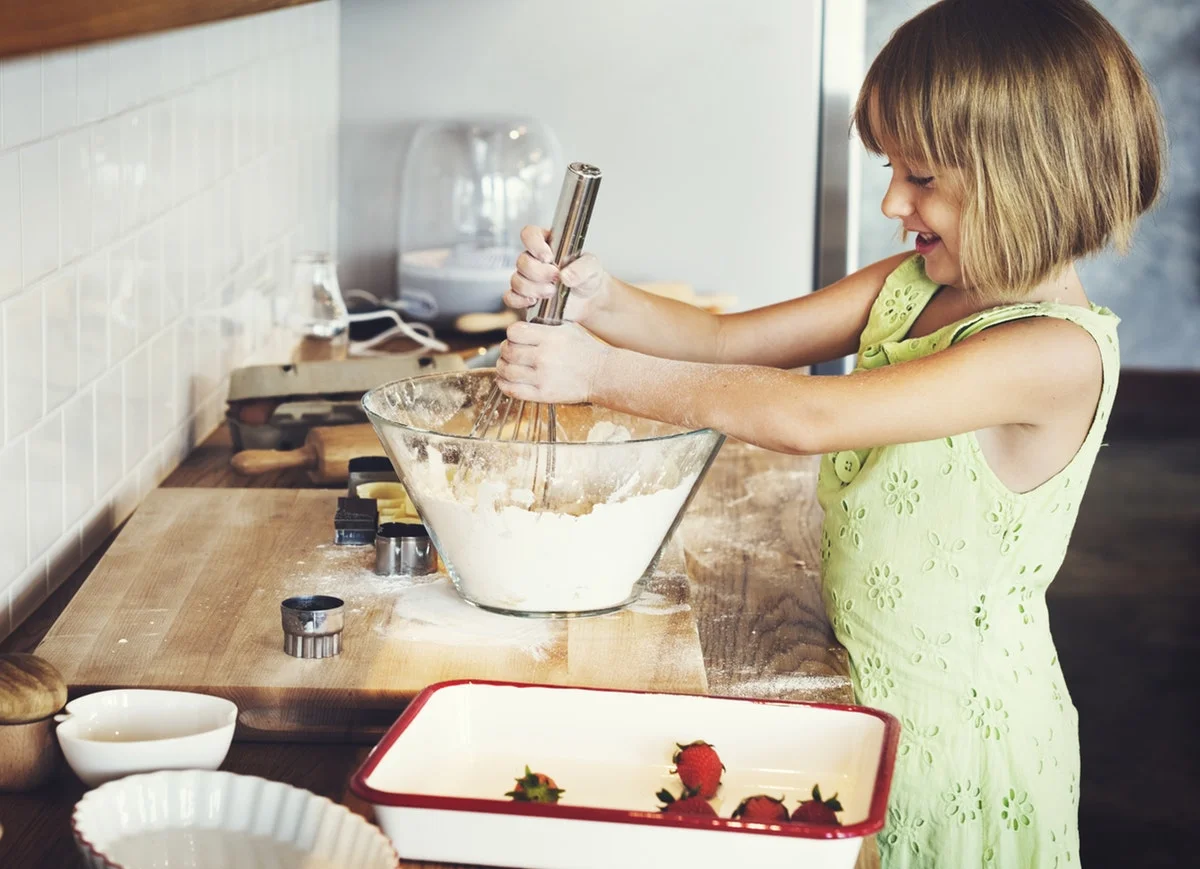
Making dinner?  Baking for a holiday?  Packing lunches for tomorrow?  Get your kids involved.  If they have already been attending a Montessori school, they may surprise you with their spreading, cutting, and mixing skills, as these are taught and practiced regularly in primary classrooms.  

The act of preparing food for our families is an act of love.  Teaching children how to do this not only gives them skills they will need to be self-sufficient one day, but allows them to help give to their family members.  The benefits are endless:

  • Kids who cook learn a variety of math skills.

  • A child is more likely to try new foods if they have helped prepare them.

  • Cooking something challenging will impart a sense of pride and self-confidence.

  • Cooking together is quality time spent together.

  • Regular time in the kitchen may create happy memories.

6. Encourage bodily autonomy.

One critical and powerful mantra to repeat to your child early and often: “You are in charge of your body.”  This means we don’t force them to hug their grandparents or accept kisses from a pushy aunt.  This even means if they don’t feel like cuddling with us, their parents, they don’t have to.

Having power of decision over one’s own body is an important lesson to teach, and extends to others as well.  We teach our children that while they get to make their own bodily choices, everyone else does as well.  A good time to bring this up is when they are perhaps playing too rough and you need a break.  You can say, “I don’t want you to wrestle me right now, and it’s my body so I get to choose.”

7. Offer desirable choices.

This is where the all-important concept of freedom within limits comes in.  Montessori, and giving children choice, doesn’t mean that children get to make all the decisions.  It just means that we provide our children with a range of desirable options they get to pick from.  Some examples:

  • You need to get dressed and brush your teeth. Which would you like to do first?

  • Would you like strawberry or grape jelly on your sandwich?

  • Your room needs to be cleaned today. What time will you start?

  • Do you want to walk or skip to the car?

By giving choices within parameters, you can increase the chances of success for both you and your child.  This gives kids safe boundaries within which they can practice doing things for themselves.

We hope this post has been helpful!  If you have any questions or would like to observe how independence is encouraged in our classrooms, please give us a call today.

Book List: Inspiring Independent Thinkers

backtoschool.jpeg

As parents and educators, we want the best for our children.  We want them to be happy, to feel the joy of learning, and to live rich lives.  Many of us value creativity and innovation, and we admire the great thinkers throughout history.  This often leads us to wonder how we might instill similar values in our own children.  How do we cultivate independent thought?  One way to start is by teaching them about people who have changed the world for the better.  Read on for a list of books you might enjoy together. (Click on the book image to go to the book’s page on Amazon)


Timeless Thomas: How Thomas Edison Changed Our Lives, by Gene Barretta

Thomas Edison was arguably one of the influential inventors of modern times.  Often credited with inventing a refined, marketable version of the incandescent light bulb, he also worked to create batteries, movie cameras, and record players.  This book is geared toward elementary children but could be enjoyed by both younger and older students as well.


Darwin and Evolution for Kids, by Kristan Lawson

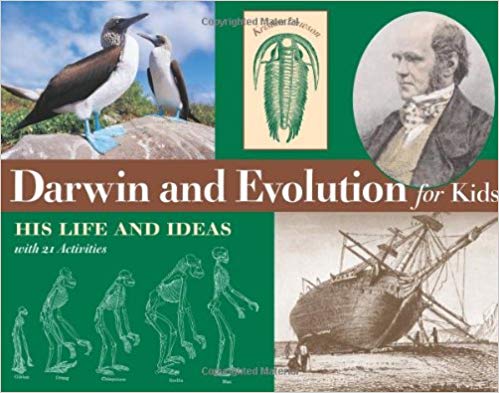
This multifaceted book covers biographical information related to Darwin beginning with his childhood, but also touches on a variety of content areas including botany, geography, history, and genetics.  This book gives information while also detailing 21 fun explorative activities for kids. 


Leonardo da Vinci: A Nonfiction Companion to Magic Tree House Merlin Mission #10: Monday with a Mad Genius, by Mary Pope Osborne and Natalie Pope Boyce, illustrated by Sal Murdocca (fact tracker series)

The Magic Tree House series is wildly popular with older primary and elementary aged students.  While the original series has elements of history blended with fantasy, the fact tracker series is completely nonfiction.  For extra fun, pair this book with Monday with a Mad Genius!  Learn all about the fascinating man that was Leonardo da Vinci.


William Shakespeare & the Globe, by Aliki

Beloved author and illustrator Aliki brings us a book to learn about one of the world’s most famous playwrights.  Recommended for children in kindergarten through elementary, this book details the life of Shakespeare through the building of the modern Globe.  This gorgeous book will entertain kids and the adults who read with them.


Abe Lincoln: The Boy Who Loved Books, by Kay Winters, illustrated by Nancy Carpenter

It’s not often that biographies take the time to revel in the childhood of a famous figure.  This book does just that, giving kids a chance to relate to one of the greatest political figures in the history of our nation.  Parents will love that Abe loved books!  The books he read shaped him into the courageous man he became and led him to make decisions that would prove to change the course of history.


Who Was Gandhi? by Dana Meachen Rau, illustrated by Jerry Hoare

Long after his death, Gandhi remains a symbol of peace around the world.  Children will learn about his fight against discrimination and attempts to dismantle India’s caste system.  This book is part of a large series of popular biographies for kids, so if your family likes Who Was Gandhi? know that there are plenty more to explore!


Marie Curie (Little People, Big Dreams), by Isabel Sanchez Vegara, illustrated by Frau Isa

Available in hardcover and board book versions, this book appeals to toddlers as much as it does to second graders.  Charming illustrations accompany simple yet informative sentences, with the aim to inspire youngsters to break boundaries and follow their dreams.


Nelson Mandela, by Kadir Nelson

Kadir Nelson’s book has received the Coretta Scott King Honor award.  It tells the story of an inspired boy who worked his whole life to create a more just and equitable world for all people.  This is a tale that clearly illustrates the difference one person can make.  We may have to work hard and endure sacrifices, but Mandela persevered and stood firm in his convictions, leaving the world a better place.


What’s Your Angle, Pythagoras? by Julie Ellis, illustrated by Phyllis Hornung

Is your child enamored with math, geometry, and solving problems?  This cute book might be just the one for them.  Join young Pythagoras as he considers different ways to solve real problems, and how math can be applied to help the process along.


The Remarkable Benjamin Franklin, by Cheryl Harness

Not many people can be expert candle makers, printers, and political activists simultaneously.  Introduce your child to the marvelous Ben Franklin with this factual book that is perfect for kids in grades 2-5.


What other famous independent thinkers should be on this list?  Happy reading!

Montessori Basics: Freedom Within Limits

017-IMG_4369.jpg

“Freedom within limits” is a phrase often used by Montessorians.  What do they mean and what does that look like?  Read on to find out...

The Myth: Montessori schools let children do whatever they want.  The children just play all day and the teachers don’t really teach.  It’s complete chaos.

These types of statements are typically made by people who don’t really know a whole lot about Montessori and haven’t spent time in the schools.  Montessori is very different from traditional and conventional education methods, so it’s natural to draw those assumptions based on limited information.  People who are familiar with the philosophy tend to have a very different take.

The Environment

Preparation of the environment is one of the most important things a Montessori teacher can focus on.  We believe that it is possible to create an environment full of materials that entice children to learn.  These materials are organized very carefully on wooden shelves so that children may access them independently.  As the needs of the children evolve, the offerings on the shelves evolve, too.  

In short, we think about the desired learning outcomes and create an environment that will allow children to achieve them with a certain level of independence.  We want them to satisfy their own learning curiosities and feel empowered by their own education.  We give lessons and we stand back and watch the children practice.

Care of Self

At a very young age children begin to feel a desire to do things for themselves.  Isn’t that what we all want for them?  Sometimes out of habit, and sometimes when we are in a hurry, it can be easy to jump in and do things for our children.  If we are careful to build in the time and structures that allow for independent self-care, it is amazing to see what kids are capable of.

This begins in the toddler class when they are learning to use the toilet independently.  In primary classrooms we actively teach children how to prepare their own snacks, and even encourage them to listen to their bodies’ needs and have a snack when they decide they need it, not when we decide it’s snack time.  Whenever possible, we don’t have our students ask for permission to use the restroom.  We trust them to take care of themselves when they need to.

Have you ever thought about your own attention span?  When we focus on challenging work for long periods of time we need to stop and take breaks occasionally.  This is healthy and makes us more productive in the long run.  We trust children to do the same, but we are right there to guide them back on track whenever they might need a reminder.

Work and Learning

It is true that Montessori children are free to choose their own work.  We want them to learn to follow their interests but we also want to give them opportunities to learn time management skills and responsibility in an authentic way.  While toddlers and primary aged children have lots of choice, older children are expected to follow a general academic framework.  While an elementary teacher is giving small group lessons, the rest of the class is working independently.  Some children might have a written work plan, others might have internalized the need to cover the major academic areas, and still others may need more direct teacher guidance.  Our goal is to meet regularly with each child to check in with their work and have a conversation about how that independence is going.  Children may choose the order in which they do their work, where they sit, and who they work with, but they know that ultimately it’s their responsibility to get it all done.

Parents often ask, “What if my child wants to avoid a particular work?”  This happens with many kids, as we all have things we like and things we don’t!  Montessori teachers give children strategies to address the avoidance.  When a child is younger, we may find a way to tie a personal interest into the work (for example, dinosaur counters in math).  Older children are open to learning work ethic strategies.  We may gently say, “I notice you’ve been avoiding grammar.  Sometimes we save the things that are hard or that we don’t enjoy so much for last, but completing that work first is helpful.  Why don’t you try that today and see how it feels?”  Acknowledging the struggles we all face and providing helpful feedback gives kids the support they need to grow as learners.  

Social Growth

One of the great things about Montessori classrooms is the flexibility we have in regards to time and structure.  Because we don’t ask children to sit at desks (we allow them to make their own seating choices and their own work buddy choices) they are free to have more authentic social interactions.  Kids under six often engage in what we call ‘parallel play’.  That is, they tend to be more apt to work individually beside their friends.  These younger children receive lots of lessons in grace and courtesy and their teachers are nearby to help guide them through any challenging social situations.

Once the elementary years begin, children become very social people.  This is a time in which they are learning all about friendships and how to interact socially with their peers.  They often delight in these interactions, but sometimes they are confronted with conflict.  Montessori teachers have the time to specifically teach conflict resolutions skills and peer mediation.  We are able to sit with children and guide them through the process in such a way that children feel heard, respected, and empowered with the skills necessary to resolve their problems independently in the future.

A Gradual Release

It’s important to remember that while Montessori schools do place great value in the development of independence we recognize it’s not something that happens overnight.  Luckily, when teachers work with children for a three year cycle, they become so tuned in to each child’s needs and progress that their learning experience is truly tailored to the individual.  

We don’t simply expect children to be independent and make great choices right away.  We slowly foster and encourage those values over time.  While paying close attention to each developmental phase and each student’s needs, we can intervene only when necessary.

We all appreciate being able to make our own choices when it comes to ourselves, our work, and our friendships.  Montessori just makes this possible for kids, too.