Montessori

150 Years: A Legacy to Celebrate

Dr. Maria Montessori

Dr. Maria Montessori

This article is part of a series that we will share throughout the 2020-2021 school year to celebrate the 150th birthday of Dr. Maria Montessori. Check back often for more posts that reflect on the past, present, and future of Montessori education.

August 31 marks the 150th birthday of Dr. Maria Montessori. Throughout the upcoming school year we will be bringing you articles in celebration of this milestone, kicking it off with a month full of articles this September.

First off, we would like to share a little bit about the woman herself, the course this remarkable educational movement has taken, and where we are today.

Education, Service, and Drive, From the Start

In a seaside town in Italy, Maria Montessori was born in August of 1870. At the time, education was not always readily available for girls and women, and was certainly not emphasized. Her father Alessandro was a man with fairly conservative views, but Montessori’s mother Renilde was rather well educated herself. Well into her young adulthood, Maria’s father often disapproved of her life decisions, while her mother encouraged them. (He did, fortunately, seem to have a change of heart later on.)

Even as a child, a deep sense of service was instilled in Maria by her parents. She knitted for and spent time with those in her community that were less fortunate. She was tasked with cleaning the floor of her family home, a chore which she likely took great pride in. 

Maria’s family moved when she was young due to her father’s work, and they eventually ended up in Rome, where she began the first grade. Schools in Rome at the time were far superior to those elsewhere in Italy, so her educational advantages began early.

At a certain point, school and learning became much more important to Maria. It is said (and referenced in a biography by Rita Kramer) that she once took a math book with her to the theater so she could study during the performance. One thing she was certain of: she would never become a teacher.

For a while, young Maria aspired to be an engineer, but later decided she would rather attend medical school. At the time (unfortunately but perhaps unsurprisingly) women were not permitted in the university program. Not to be dissuaded but an initial rejection, Montessori took and passed the entrance exams and continued to ask for admittance until she received ‘yes’ for an answer.

During her years at the university, Montessori faced constant discrimination due to her gender. She was not permitted to enter lecture halls at the same time as her male counterparts or study cadavers alongside the other medical students. (They felt it improper to be in the presence of a dead, naked body with a woman.) She wasn’t even allowed to walk to school without a male chaperone, who was, of course, her disapproving father.

Despite it all, Maria Montessori did become Dr. Montessori. Over the years she gained the respect of many of her university peers, faculty, and family members.

A Winding Path to a Visionary Model

Early in her career, Montessori was assigned to work in a psychiatric hospital. Children were treated there alongside adults, and Montessori was struck by the sheer lack of stimulation available to the children. She began working with the children and soon realized their cognitive capabilities far exceeded what they were assumed to be able to accomplish.

Not long after, Montessori was asked to start a school in an impoverished neighborhood in Rome. In an apartment complex, the parents were forced to go to work each day and leave behind their children who were too young to be in school yet themselves. This led to a natural progression of unruly behavior, thus leading the apartment manager to seek a solution. 

Montessori opened her school on the first floor of one of the apartment buildings. It was called Casa dei Bambini (Children’s House) and provided a place for the little ones to use their time productively, while also allowing Dr. Montessori an opportunity to develop her now infamous materials and methods. She believed that young children learned first through the senses, and her materials were created specifically to allow children independence in the journey to refining them.

Not only were the children of this first Casa privy to the materials; they also were the first to experience Montessori practical life lessons. They helped to prepare and serve their own meals. They polished the silver and cut and arranged the flowers. They learned polite social norms through intentional modeling and lessons in grace and courtesy. They began to take pride in their work, their community, and their home. Montessori recruited a woman who was a resident of the complex to become the teacher, and the children’s mothers met with her regularly to discuss progress.

The results were astounding. This work done with the children slowly trickled outward so that it positively affected the entire neighborhood. Visitors came to the school and were amazed at how focused and engaged the children were with their work. No one had ever seen anything quite like it before.

Observing, Refining, and Sharing

Montessori’s work and ideas spread quickly as more and more people visited Casa dei Bambini. Requests were made to open new schools elsewhere, and Montessori soon found herself training teachers, producing copies of her materials, and giving lectures around the world.

Throughout her life, Dr. Montessori’s work never ended. Though she began with a focus on children aged 3-6, during different times in her life she focused on developing methods and materials for elementary aged children, infants and toddlers, and adolescents. She was a fierce advocate for the preservation of the methods she had worked tirelessly to create. She was, after all, a woman of science. Each material, each lesson, each approach - they were all a result of many hours of careful testing, observation, analyzation, and refining. It was understandably important to her that the movement that bore her name moved forward in a way that honored her high standards.

Montessori Education: Where It Stands Today

Today, there are tens of thousands of Montessori schools across the globe. In the United States alone, there are more than 2,000 private and more than 500 public Montessori schools.

Efforts are being made to advance Montessori into mainstream education while retaining high fidelity methods. Current scientific research in areas of learning, brain development, and human development are repeatedly confirming what has already been known by over a century of Montessori education.

What might the next decade bring? Shifts in our common goals for education and what developing children need just may be the push our society needs to fully embrace what’s been working for so many families for such a long time.

We’re glad to have you on this journey with us.
Montessori Basics: Geography

google ad 2.jpeg

Geography: a science that deals with the description, distribution, and interaction of the diverse physical, biological, and cultural features of the earth's surface

Geography is a commonly taught subject in most schools, with children learning about maps, the globe, and various countries and land features. Montessori schools do this as well, but as with most subjects, we tend to take things a bit deeper (even for our younger students). This article highlights the scope of our geography curriculum.

One point to note: Montessori teaches children beginning with a ‘big picture’ view, while slowly narrowing in on details. We believe this makes information more developmentally appropriate as well as giving children a sense of the interconnectedness of all things. This approach also leads to some overlap with other subject areas, which is a good thing!

Globes, Maps, and Physical Features of the Earth

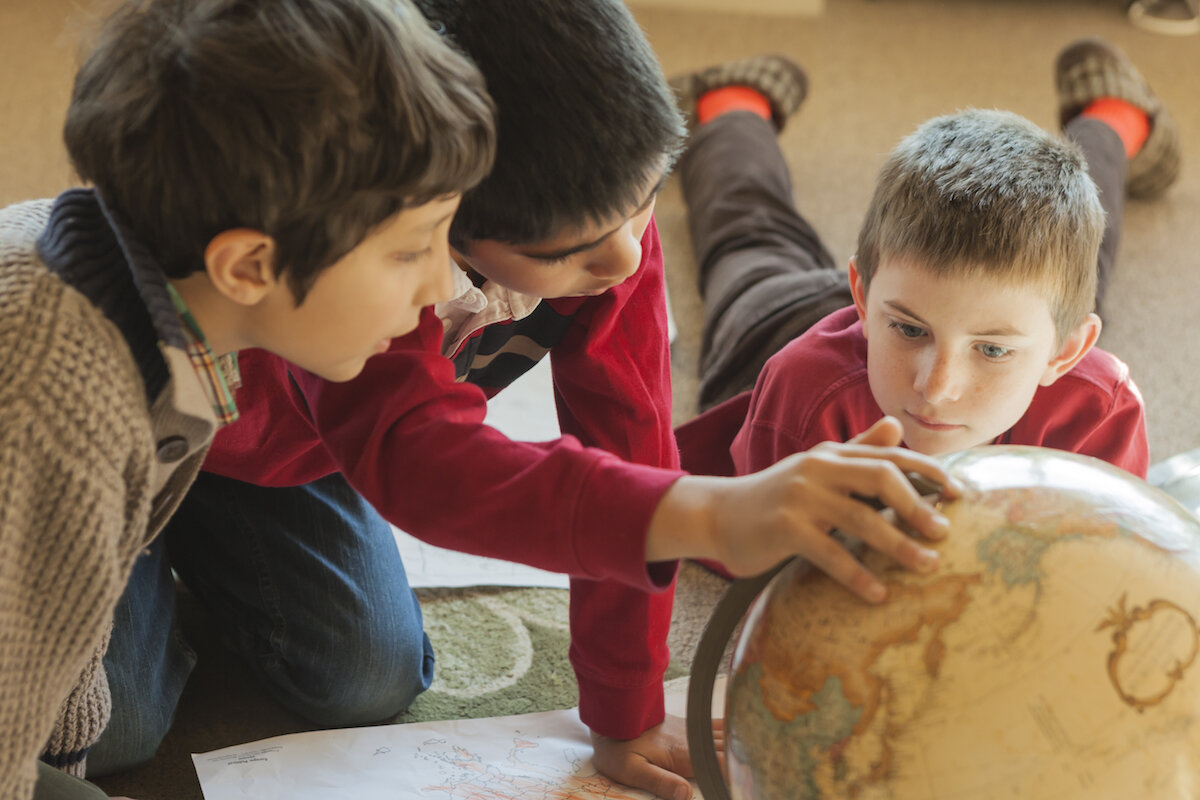
Geography work starts early in our primary classes. Children begin with an introduction to three different globes; one is blue with sandpaper continents, the next is blue with smooth white continents, and the third is blue with colorful continents. Montessori materials have specific colors designated for each continent: Africa is green, Asia is yellow, Australia is brown, Antarctica is white, South America is pink, North America is orange, and Europe is red. These early globe experiences help give children a sense of the roundness of Earth and the differences between major areas of land and water.

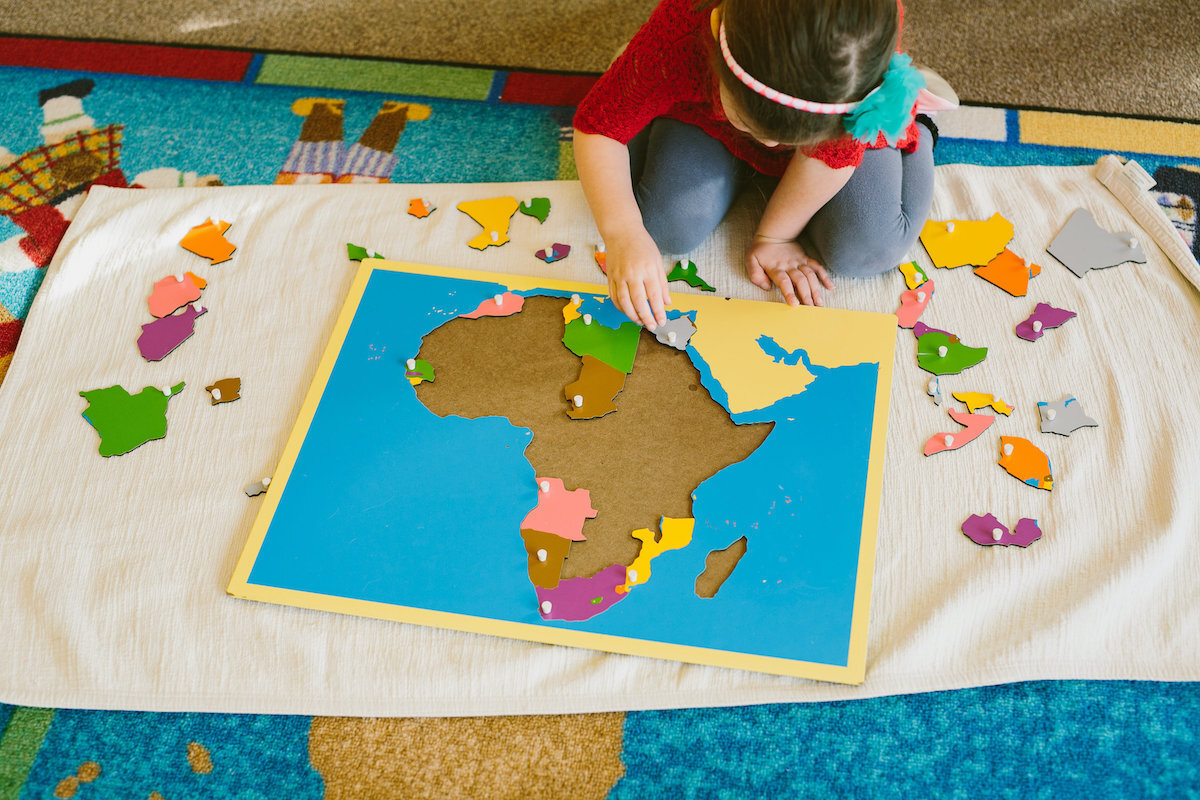
Children then move on to using the puzzle maps; a classic Montessori material. They begin with a map of the continents that utilizes the same colors they learned on the early globe, and then explore puzzles for each continent of the world. There are also more specialized puzzles available, including one of the fifty states, the provinces of Canada, etc. These are first used in the primary class but continue through lower elementary.

The last set of specifically created maps - the pin maps - are used in elementary, and children are encouraged to use an atlas as a control of error while they work. This material incorporates wooden maps with predrilled holes in each country. Children use small label flags that are meant to be inserted into the correct spot.

Also beginning during the primary years and continuing through the early elementary years, children learn about land and water forms. This includes the parts of a mountain, the parts of a river, and the names of a wide variety of land and water formations.

Creation Stories

As part of the science and history curriculum, elementary children are told the creation of the universe story once per year. This important lesson is based on today’s scientific evidence, but we feel it’s important to honor the many other creation stories throughout history. That’s why we also take the time to read tales that span a wide variety of cultures. There are many learning extensions that can be applied, such as discussing the similarities and differences between cultures, having children create artwork to represent the stories, or even having small groups of children act them out.

Laws of Attraction and States of Matter

When we tell children the story of the creation of the universe, we do it with a series of props laid out before them. When we talk about the behavior of particles, we show them a visual example. When we talk about the formation of the planets, we touch upon the three states of matter on Earth. We teach them how temperature and force affect these states, and how ultimately this has an impact on the formation and continuous changing of our planet.

This introduction segues into a series of experiments that children are able to complete independently (after an introduction and safety rules, of course!). Materials for the experiments are set upon the shelves, along with instructions. While most people would consider this science - as it is - we consider it part of our geography curriculum even though this is one of the most obvious points of overlap.

The Sun and the Earth

The elementary geography curriculum is complimented by a series of charts that visually illustrate important information. Some are diagrams while others are impressionistic drawings. These charts are particularly helpful when teaching about the sun and the earth.

We start simply, by teaching children about Earth’s orbit around the sun as well as its rotation on its own axis. This leads into many lessons about concepts like day and night, the seasons, the zones of the earth, and even time zones.

A good deal of time is spent teaching children about the composition of the earth. This includes the different layers, but also the formation of mountains, faults, and volcanoes.

The Work of Wind

Wind is a powerful force. We think it’s important to teach children about the behavior of air in our atmosphere and the effects it has on the planet. We cover how temperature affects the movement of air, air pressure, the relationships between winds, seasons and weather, and ocean currents.

The Work of Water

Water, as liquid water or solid ice, has a tremendous impact on our planet. We discuss concepts such as erosion, sediments, the effects of rain, and the effects of ice on the landscape. We also cover water vapor when teaching children about the water cycle on our planet.

Vegetation, People, and Economy

After some basic botany lessons, it can be fascinating for children to learn about the variety of vegetation found in different biomes of the world. This leads into the study of the people in various biomes and how climate can change the way we live. Lastly, we teach children about economic geography; our economies have always been tied, in part, to the variations in resources available in different regions. We encourage children to analyze and question concepts like production and consumption. 

Interested in learning more? We hope you’ll consider reaching out for a tour. This gives families - new and current - an opportunity to learn more about what we do and how we strive to provide children with an education that will guide them for the rest of their lives.


Considering Montessori? Here’s What to Look For

mformontessori.jpg

If you find yourself considering Montessori education as an option for your family, you undoubtedly have plenty of questions. If you take one thought away from this article let it be this: anyone can call their school “Montessori”. There is no regulation on use of the name. If you have read articles and heard stories from other families about the incredible benefits of this method of education, they are absolutely the result of a high fidelity Montessori program. Read on to learn more about what to look for. 

What’s in a name?

Throughout her life, Dr. Maria Montessori strove to retain a certain level of control over the course the Montessori movement took. It was, after all, her life’s work and bore her name. She wanted to be sure that guides were trained correctly, methods were applied as she intended, and a complete set of authentic materials graced the shelves of classrooms. Today, there are two major organizations that carry on her work and are generally regarded as the standard for Montessori education. They are AMI (Association Montessori International), which was created by Dr. Montessori herself, and AMS (American Montessori Society), which branched off from AMI in 1960. Today the two organizations maintain a positive working relationship and mutual respect for the work they both do, which is to carry on the legacy of Dr. Montessori and ensure visionary, high-quality education for children.

Recognition, Affiliation, and Accreditation

If you are looking for a high fidelity Montessori program (which is critical if you want your child to reap the benefits!), it’s important to find a school that is connected to either AMI or AMS. There are different levels of connection, depending on how closely a school aligns their work with what is considered ideal. Hollis Montessori School is recognized by AMI.

To obtain Recognition Status through AMI, a school must undertake a rigorous multi-year process that begins with a self-study and culminates with an in-person visit by an AMI consultant. A specific set of criteria must be met, including having 100% of lead teachers being trained through an AMI sponsored teacher training program. If a school meets all criteria, but has a lower percentage of AMI trained teachers, the school may be considered AMI Affiliated or AMI Associated. Schools must reapply for recognition status on an annual basis with an AMI consultant visit every three years.

To become accredited through AMS a school must undertake a similar self-study process with a three day in-person site visit by AMS representatives. Schools must go through the accreditation process at least once every seven years.

Specifically Trained Educators

Montessori guides (the term we often use for our teachers) are specially trained. In addition to college degrees they have obtained, they have also earned special Montessori credentials from recognized training programs. Many of these programs run for several years, include many hours of lectures and reading, practical examinations, written papers, material making assignments, and multiple observations in classroom settings. Many people consider the level of work required for obtaining such a credential to be similar to that required for earning a master’s degree.

Multi-Age Groupings

One of the most important elements of a Montessori school is that the classes are organized not by single chronological year classes, but into multi-age mixed groups. This approach is intentional and critical to higher levels of learning. Children ages three to five (preschool and kindergarten) are grouped together, as are elementary-aged children. Some schools break the elementary years up into lower (grades 1-3) and upper (grades 4-6) while others keep them all together. Infants, toddlers, and adolescents are also placed into similarly mixed groups.

Why do we do this? There are many reasons. For one, younger children have no shortage of models to surround themselves with. They can see what is expected of them as they grow, both socially and academically, and they work to emulate what they see older children doing. As for the older children, they are given the unique opportunity to practice leadership skills and cultivate empathy for younger children. In addition, they often help teach, which reinforces their own mastery of subjects.

The Classroom Environment

There is much to be said for the Montessori classroom environment - more than we could possibly summarize in a paragraph or two here. That said, we can certainly highlight the most critical features you should look for in a well-run program.

  • Classrooms will feature ample natural light and children will have access to the outdoors.

  • Furniture will be sized for the children who are meant to use it, and there will be a variety of different furniture options. This means in lieu of desks in rows, you should see group  work areas, independent work areas, and space to work comfortably on the floor.

  • Natural materials like wood, glass, and woven baskets should take the place of plastics.

  • Specialized Montessori materials should be well organized and adorn shelves at the children’s height.

  • The room may be decorated with living plants and carefully hung works of art. You should not see walls covered with posters or busy color schemes.

  • It should be apparent that the guide is not the center of the room, but rather serves as an element of support for the children who work there.

  • Children should have free access to take care of their own personal needs, such as using the restroom, serving themselves snacks, having drinks of water, and retrieving all materials necessary to explore and work.

We hope this article has been a helpful guide as you embark on your journey into Montessori education. If you have any questions or would like any guidance, please feel free to contact us.

New Research: Music in Montessori Classrooms

music2.jpg

Montessori-based research is a fairly new field of study, but interest is increasing. The following is a summary of a recent published study that addressed concerns in the area of Montessori music education in primary classrooms. We found it fascinating, and we thought you might, too!

The Research Study

Click here to read the full published article.

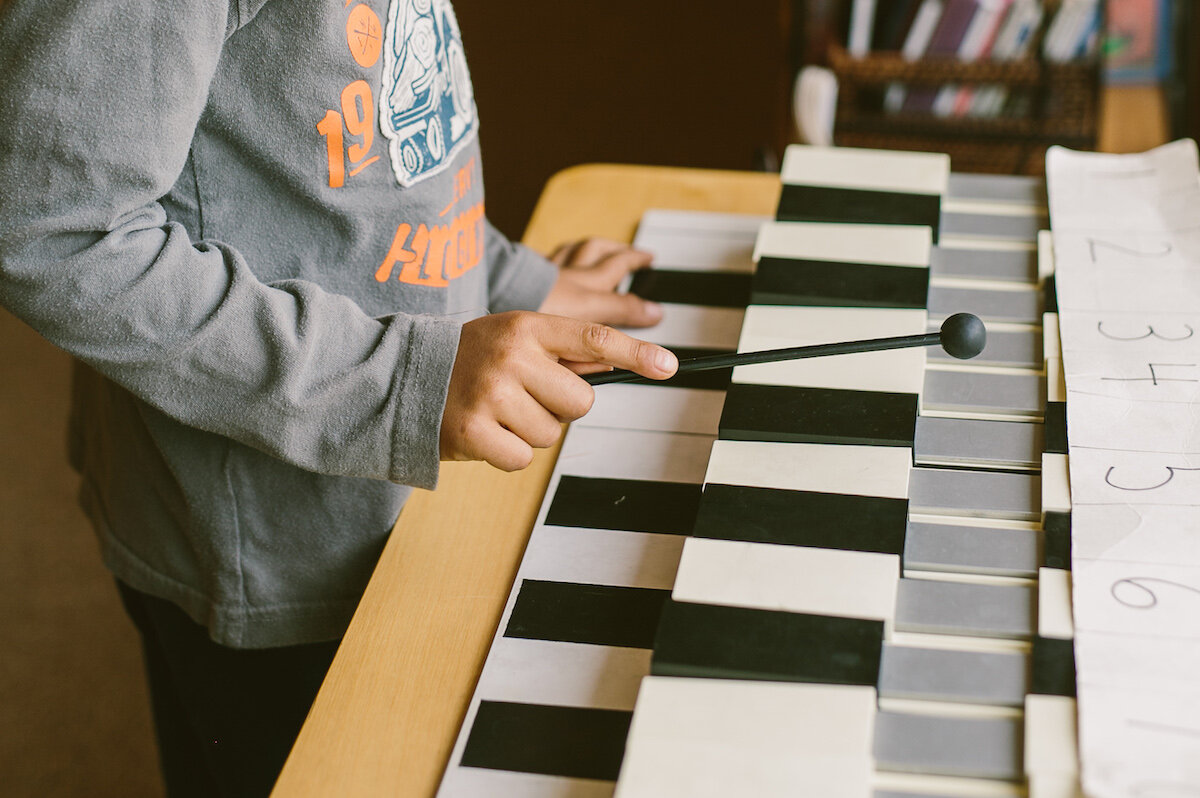
Diana R. Dansereau of Boston University and Brooke M. Wyman of Bristol, Rhode Island published their article entitled: A Child-Directed Music Curriculum in the Montessori Classroom this past spring. They wanted to address a perceived disparity in the types of sensory materials offered to children in Montessori primary classrooms. More specifically, they gathered data suggesting that over time, modern Montessori classrooms have come to rely more heavily on visual sensory materials than materials that teach children to refine their other senses (including discrimination for sound).

Numerous studies, along with the work of Dr. Montessori herself, have indicated that early childhood exposure to music education and auditory sensory discrimination education have overwhelmingly positive and powerful impacts on children. Just as with other areas of study and skills that must be mastered, it appears that there is a sensitive period for learning music that ends prior to age 7. This means that while of course children have an ability to learn music after that age, they are in a prime position to master those skills earlier.

The researchers noted that Dr. Montessori herself had concerns about the application of her music materials in the classroom. For example, only one set of sound-based materials could be used at a time, and to identify variations in sound one would need to work in relative silence. This was certainly challenging during her time, and seemingly impossible now. Dansereau and Wyman set out to create and test a solution.

“...we sought to answer the question “How is a curriculum of music- and sound-based works developed, implemented, and received in a Montessori classroom?”
— Dansereau and Wyman

Dansereau, being a music teacher, early childhood music education researcher, and Montessori parent, and Wyman, being a Montessori primary guide, were in a perfect position to conduct the study. Their initial conversations included Wyman’s students, other primary teachers, and the head of school. Six shelf works were designed and tested. They included the use of a small plastic box with a battery, power switch, headphone jack, and a series of visually identical plastic discs. A child wears the headphones and replaces the discs one at a time to hear different sounds. The materials are briefly described below:

  1. For working memory and audiation (sound memory) - A wooden tree with spaces for removable discs. Children would listen to the sounds on each disc, then place them in order according to pitch. The material contained a built-in control of error so that children could independently check for accuracy.

  2. For pitch direction - Children listened to discs that played sliding pitches, then matched what they heard to visual pictures with lines drawn accordingly.

  3. For pitch direction - Similar to the second work, children replaced the two-dimensional pictures with a three-dimensional manipulative.

  4. For melodic direction - While listening to a recording of a piano, children used a small toy kangaroo to travel across a three-dimensional path along with the music.

  5. For melodic direction - Similar to the previous work, children listened to trombone music instead.

Wyman presented each material to the group using traditional Montessori methods, after which they were placed on the shelves for independent use. Students were observed and data was collected in six cycles over a period of two years.

During the course of the work Wyman noted: “What I have witnessed so far with the two materials we have piloted is an overwhelming need for more of this type of work. The children in my current class have demonstrated a deeper level of concentration with this work. In part, I am sure [it is] because of the use of their auditory sense: if they are distracted by others in the classroom, listening to their friends, or carrying on a conversation, they will miss the very essence of the work. What I find fascinating is that this work must be fulfilling an essential need, because even my most social children go to the material and tune everything else out.”

Overall, the researchers noted their data indicated positive findings. The children became more engaged with music education, they interacted positively with the materials, their confidence increased, and there were obvious signs of deep concentration. They did note some limitations, such as the inability to record all interactions with the materials due to the nature of a Montessori classroom environment, as well as the children’s understanding that the materials were somewhat novel in nature. They felt that some of the materials were more beneficial than others, or that adjustments may need to be made with one or two of the materials.

Dansereau and Wyman felt the study was a positive initial step in addressing the disparity in sensory materials in the Montessori primary classroom. They were encouraged by the results and believe more research should be done in this area, including with classrooms that serve children of varied demographics. 

We are curious to hear your thoughts on this topic. What might next steps be in individual Montessori classrooms? Could the materials be replicated? Could others be introduced? How might we, as educators, ensure we are providing more balanced sensory instruction?

Why Choose Montessori?

whymontessori.jpeg

We know parents have choices when it comes to their children’s education. We know these choices are not easy. There are many factors to weigh, but we hope this article will help you make an informed decision at least as far as Montessori is concerned. Montessori education has been successfully serving children and families around the world for over a century. The basics remain - and for good reason. Our methods are consistently backed by current research in education and human development. As we move forward into a new future, we believe Montessori has what it takes to prepare children.

Montessori Meets Children Where They Are, Without Judgement

Conventional methods of education were developed specifically to prepare large numbers of children to enter the workforce. Traditionally, little thought has been given to differentiating instruction or catering to the needs of individual children. That has been changing in recent years, but many schools are still in the early years of personalizing education.

Montessori schools are specifically designed to allow each child to move at their own pace. We know that learning is not linear, and that children are not ready to learn specific skills according to an adult-prepared timeline, or in perfect harmony with their peers. Kids who need more support with certain skills get that support, and those who are ready to move ahead are able to find the challenges they crave. We do not teach a whole class of children the same skill at the same time; that may seem more efficient from the perspective of an adult tasked with teaching, but it’s not necessarily what serves the children the best. No two people should be expected to grow at the same rate, and it’s our job as educators to meet children where they are and give them the support they need to get where they want to be.

Montessori Emphasizes More Than Just Academics

Lots of people use the phrase ‘teaching to the whole child’ but in Montessori schools we mean that on a very deep level. We do not teach just to convey academic information. In fact, academics share equal emphasis with our efforts to develop other aspects of the child, including emotional, social, sensorial, and practical life development. We integrate the arts and movement into everything our children do, rather than isolating these areas of study into a separate class. We intentionally teach children how to navigate and resolve conflict and how to adhere to grace and courtesy social norms. 

Our greatest task is, we believe, to give children a global view of the world. We want them to understand the interconnectedness of all things so that they may be fully integrated members of their greater community as they grow and mature.

...But The Academics Are a Huge Strength 

The above mentioned being said, Montessori academics are often hailed as some of the highest standards there are. It is not uncommon to see four-year-olds in our schools reading, six-year-olds completing long division problems, and nine-year-olds classifying botanical specimens. These tasks are completed joyfully, in part because we present information in such a way that children discover it for themselves rather than passively taking in facts given by an adult.

Another reason Montessori students seem to work at an advanced academic level is because of what we call sensitive periods. Through years of observation, Dr. Maria Montessori noticed that young children seemed primed and particularly interested and ready to develop certain skills during very specific time periods. While, of course, there is variation between individual children, she noticed some general patterns that have helped us develop our curriculum. One interesting example is that of the study of geometry. Many of us were first exposed to the subject during our high school years, when it turns out that primary- and elementary-aged children are not only interested in geometry, but have a great capacity to learn far more than we typically give them credit for. This is why you may hear your five-year-old talking about rectangular prisms, or your seven-year-old discussing the differences between isosceles, right, and scalene triangles.

Our Schools Cultivate Community

A Montessori school is more than just a school. First and foremost we are there for our students, but we believe schools have the capacity to be so much more. We aim to make meaningful connections between everyone involved. Some of the ways we do this include:

  • Giving our guides opportunities to connect with one another for development

  • Encouraging our guides to form connections within the larger Montessori network

  • Making sure parents and guides have ample time to discuss the child’s growth and needs

  • Providing opportunities for parents to form relationships with one another

  • Supporting families via parent education offerings

  • Gathering as a whole school periodically

  • Forming bonds between children at different levels

  • Reaching out to make connections with the local community

  • Giving our educators and families a voice in school decision making

We also believe that it is our job to take the guesswork out of making these types of connections. We aim to build in structures that make it simple for everyone to find commonalities and open streams of communication seamlessly.

Montessori Aims to Lift Up Humanity

We know. This is quite the lofty goal. From the very beginning, Dr. Montessori saw it as her mission to improve the world through education. She believed that by giving children the honor and respect they deserved, the benefits would trickle through to families, the community, and society in general. She believed in equality of all people, and saw that education has the potential to be a great leveler. 

Montessori schools aim for peace. This starts between individuals, and teaching our youngest students how to be kind and gracious toward one another. A great respect for the environment and other living beings is another important aspect of our work, as is a reverence for the wide diversity of cultures around the globe. Combined, these elements are meant to cultivate within the child a respect for themselves and others, as well as a desire to ensure connection and fairness for all.

We hope this article has been helpful. To continue the conversation, connect with us for a chat or to schedule a tour. We look forward to meeting you.

How Do Montessori Guides Address Avoidance?

avoidance.jpg

One of the top questions parents ask about Montessori is: How do teachers deal with children avoiding work they don’t want to do? This is a really important concern, and becomes increasingly so as children get older. Most families know Montessori centers on student choice, and it can be hard to envision that value working in conjunction with accountability. The good news is it’s something we take very seriously. In fact, our entire approach is based on the idea that we must teach children to develop strong work habits and encourage them to be driven by internal motivation rather than reacting to external factors. This takes time, but Montessori guides are there to support children as they navigate the journey.

Give Them Choice

Having choice is actually a powerful tool in combating avoidance. When children (or people of any age) have freedom to make their own decisions, it’s empowering. Knowing that others trust in us to do the right thing is often all it takes to do the right thing. No one likes to feel micromanaged. We allow our students to choose the order of their work; some like to start the day off reading, while others prefer math. We also let children have autonomy in other ways. They get to decide when they need to use the toilet, have a snack, and move their bodies. There are, of course, procedures to follow in order to keep everyone safe, but we don’t believe kids should have to ask permission to address their basic needs, nor should they have to do so on a schedule that is convenient for adults.

The big picture: comfortable children that feel respected and trusted are much more likely to work hard and meet expectations.

Quietly Observe

If there is one statement that can help us reframe our perspectives with empathy it’s this: Each child is the way they are for a reason. There is a reason a child is avoiding something. As adults, it’s our task to discover what that reason is, and find gentle ways to address it. Montessori teaches us to think like scientists and use observation as a way to learn and make more informed decisions. Some questions we make ask ourselves as we observe a child who is struggling:

  • Is the work too challenging?

  • Is the work too easy/is the child bored?

  • Is the child experiencing emotional upheaval in their life?

  • Are the child’s basic needs being met?

  • Is the physical classroom environment supportive of the child’s work?

When Montessori teachers are trained, they learn to first look to the environment, then examine themselves and their own actions. Only after considering the first two possibilities do they look to the child themselves as a potential source of the issue.

Appeal to Their Interests

Sometimes all children need is a ‘hook’. Although Montessori materials in the classroom are meant to be used in a very specific way, and deviation distracts from authenticity and effectiveness, there is some room for flexibility. This can be very helpful in modifying work so that it will best meet an individual child’s needs. A guide may consider a child’s favorite color when setting out pouring or scooping materials, favorite animals when presenting zoology lessons, or other interests when gathering reading materials. The key is to consider what a child is avoiding, then find a way to make it more enticing.

Hold Them Accountable

While Montessori doesn’t utilize punitive measures, that doesn’t mean we don’t hold children accountable. If we expect children to do certain things, it’s our job to make sure they follow through. The following are critical in making this happen:

  • Clearly explain the expectations.

  • Provide an environment and time that allows for expectations to be met.

  • Observe children to ensure they meet expectations.

  • Guide when necessary. This may include redirection, suggestions, or working together to create a plan.

As children get older and academics become more of a focus, getting work done becomes much more important. Beginning in the kindergarten year or lower elementary, Montessori guides typically begin to utilize work plans. These can take on a variety of forms, but they are generally a visual schedule, created in collaboration between the guide and the child, of what must be done. Students can typically choose the order in which tasks are completed, but adults check in to make sure there is follow through. In the event the child is not meeting the expectations, a guide will typically meet with the child to discuss new strategies. They may help the child develop time management strategies, give suggestions as to seating, or provide tips for effective work habits. The child leaves the meeting with concrete strategies to try, and the adult and child reconnect at some point to evaluate progress.

It helps to remember that learning to work is part of the child’s work. Rather than forcing children to do what we want when we want them to, we take a more long-term approach. Our goal is not just to share information, but to help children become joyful learners. We want them to walk away from Montessori being able to feel confident in their abilities and ready to take on challenges. We all want to avoid certain tasks from time to time. Our job is to teach children how to manage their time well and accomplish whatever it is they need to get done.

Perhaps unsurprisingly, this work can be carried over into the home as well. The more parents learn about Montessori, the more the concepts become part of parenting and the life of the child. We hope you will reach out to us if you have any questions or would like to discuss this topic further.

Montessori: A Woman Who Flourished in the Face of Adversity

maria-montessor-with-kids.png

Dr. Maria Montessori: You probably know her as the woman who created a unique method of educating children. You may know she was from Italy and was one of the nation’s first female physicians. What you may not know is she was a woman who consistently faced adversity throughout her life and still managed to cultivate incredible progress.

During Dr. Montessori’s childhood, literacy rates were very low across Italy. She was fortunate, however, and received a more advanced primary education than most. Still, women of her time were expected to focus on domestic work. Those that went on to professional careers were often in the field of teaching, a job she ironically said she would never pursue. She originally had an interest in becoming an engineer, but eventually decided to pursue medicine.

Montessori’s father made it clear that he was not in support of her decision, which was a sentiment echoed by other male figures in her life. Upon meeting with a professor of medicine at the University of Rome to discuss her plan, she was denied the opportunity to apply to the program. She enrolled at the university anyway to study math, science, and physics, and after several years worked hard to take and pass the entrance exams necessary to enter the medical program. Women were not allowed, and her enrollment was denied.

Not one to take no for an answer, Montessori persisted. Her efforts even garnered the support of Pope Leo XIII, and she was eventually granted admission to the medical program.

Throughout her time studying medicine at the university, Montessori faced discriminatory standards that would frustrate any one of us. As a woman, she was not even allowed to walk to school by herself, so her disapproving father walked with her each day. She could not enter lecture halls alongside her male peers and was made to wait outside until everyone else was seated. The idea of her standing alongside men during dissections of naked human cadavers was considered highly inappropriate, so she was forced to do her own dissection work alone in the evenings. 

Despite everything, Montessori went on to graduate in 1896. Her accomplishments were recognized and she was asked to represent Italy at an international women’s conference. At the conference, scores of protesting women gathered outside, frustrated with the privileged bourgeois women of the conference whose ideas of feminist reform were not enough in their eyes. The women outside believed in revolution, and felt that the slow pace of reform would get in their way.

Montessori was chosen to address the crowds. She spoke passionately about the movement of feminism and how it was not bound to a specific social class. Her words were uniting, and she was well received not just by the women outside, but by the press and the other international delegates as well.

Montessori’s feminist ideals were radical for her time. She believed in equal pay for women. She believed that women who wanted to study in the areas of math and science should be allowed to, but she thought that did not excuse them from being proficient in the areas of domestic life as well. To that end, she believed that boys should be taught practical life skills in the home just as well as girls, and these beliefs carried over into her eventual development of the Montessori primary program.

Several times during her early career, Montessori was charged with overseeing children who were not deemed competent by the standards of society. Each time, she used her scientific background and approaches to develop new ways of working with the children and guiding them to exceed the expectations of others. This first happened in a psychiatric ward where she noted young children housed alongside mentally ill adults. They were forced to exist in plain rooms with nothing to entertain themselves. Gathering ideas from educators who came before her, she began to develop methods and materials to help these children learn. They did, and before long she became the director of a new school in Rome that was to educate children that typical schools were unable to, as well as to train other teachers to do so. Unsurprisingly, this venture was a huge success. On standardized tests, the children at the school were even able to perform as well as or better than their peers in typical schools.

The next phase of her life and career was a natural progression. San Lorenzo, Rome, was a very poor area in which parents who had to work during the day were forced to leave their young children at home. The children ran amok and caused general mischief and destruction. Thus was the creation of the famous Casa dei Bambini, the first Montessori school; a school within the apartment complex of the children it served. It opened in 1907 and welcomed children ages 2-6.

It was at Casa dei Bambini that Montessori developed many of her founding principles and materials for what would become the primary program. The school was such a huge success that for the remainder of its existence welcomed people from around the world who would come to see it for themselves. Countless people would visit to observe and leave astounded and inspired.

Decades later, after the Montessori method had begun to spread around the world and find enthusiastic supporters in many countries, a political shift began to take place globally. In Montessori’s own Italy, Mussolini rose to power and brought the country into a fascist regime. Somehow, the two came to an understanding: Mussolini wanted Montessori to further develop her work in Italy, and she, denying allegiance to politics of any kind, accepted the support. She felt that her work would bring about peace in the long run, while he was more focused on the fact that Montessori students presented as well-behaved and compliant. When it eventually became evident that he intended to use her schools as a vehicle to train a nation of young fascists, Montessori schools across Italy quickly closed and she fled the country.

For the next twenty years she lived in Spain and cultivated a vibrant and strong extension of the Montessori movement. Sadly, in 1936, the country found itself in a civil war and Montessori and her family quickly escaped to England.

At one point, after having lived in so many different places, she was asked about her nationality. Her response? “My country is a star which turns around the sun and is called Earth.”

Dr. Montessori was a woman who never let others stand in the way of her own progress and success. She lived through two world wars, was a staunch supporter of the early feminist movement, proved her abilities academically, and went on to dedicate her life to enriching the lives of others. She did not allow others to hold her down, and used her own success as an example of what we are all capable of.

Montessori stood, and continues to stand, as a beacon of hope for humanity. She was nominated for the Nobel Peace prize in 1949, 1950, and 1951. She died in 1952 in the Netherlands, yet her legacy carries on.

Montessori Basics: The Cultural Subjects

culture.jpeg

Montessori is known for fostering academic excellence. While most people think of how we teach children reading, writing, and mathematics, you might be amazed to learn how we teach other subjects!

In Montessori classrooms (particularly elementary classrooms) the following subjects are referred to as cultural areas of study. They often overlap, as they do in the real world, and guides are adept at weaving language and math work into lessons as well.

It is important to note that while we do have a standardized cultural curriculum, our guides are specially trained to honor and support the personal interests of their students. This means some areas may be studied more deeply than originally intended, or they may end up branching off into other related areas of study in addition to typical lessons and materials. Doing this allows us to continually foster curiosity and internal motivation as young children grow and develop.

Science

When it comes to science in Montessori classrooms, biology is the main event. With work that spans basic biology as well as botany and zoology, we provide authentic points of interest by keeping living things in our environments. Our classrooms are home to both plants and animals, both of which are cared for by the children. When teaching various lessons in biology, guides often utilize living samples to increase interest and engagement.

Children in our primary classrooms begin this work by way of nomenclature. Card materials that double as reading practice help them learn the names of body parts of different animals. For example, one set of cards might include a picture of a horse with label, along with cards highlighting and labeling hoof, mane, tail, eye, ears, etc. Primary-aged children also get plenty of hands-on experience with botany learning; they cut and arrange flowers, they prepare various fruits and vegetables to eat, and many get a chance to garden and/or compost. They also learn the basic parts of plants, as well as the different shapes of leaves.

The learning continues into the elementary years, where students study the kingdoms of life on earth, differentiate between invertebrates and vertebrates, and study the external features and body functions of the five classes of vertebrates. Their understanding of botany expands and deepens, as they learn in greater detail how plants are formed, how they reproduce, and how they interact within their broader ecosystems.

In addition to their work in biology, Montessori students study a wide variety of other subjects in science. They learn about the scientific method, how to conduct experiments, and topics such as the solar system, chemistry, physics, and more. They attend lessons with guides, explore topics independently and with peers, and learn how to conduct research.

Geography

Montessori children learn to view geography as an interesting and multi-faceted area of study. Primary-aged children learn about the continents and biomes of the world using specialized globes, wooden puzzle maps, and other materials. During the elementary years this work is expanded significantly. Children learn about the different countries around the world, the cultures of the people who live there, and the animals who inhabit the various biomes. They also learn about landforms and bodies of water.

Beyond the surface of our earth today, our students learn about how it has changed over time. They are taught about the beginnings of our universe and how our planet was formed. They learn about the layers of our atmosphere and the layers of the earth itself. They explore the mechanics and functions of various natural occurrences around the planet, including how water (in all three states of matter) and wind can contribute to significant change over time.

Our hope is to give children a view of the whole world, and our work in geography serves as an impressionistic platform to inform them of the interconnectedness of everything on our planet.

History

While the bulk of the history curriculum begins in the elementary years, primary children often have an opportunity to reflect on their own lives during our traditional birthday celebrations, as well as gaining an initial sense of the passing of time. They learn about the days of the week, the months of the year, and start to use a calendar together as a group.

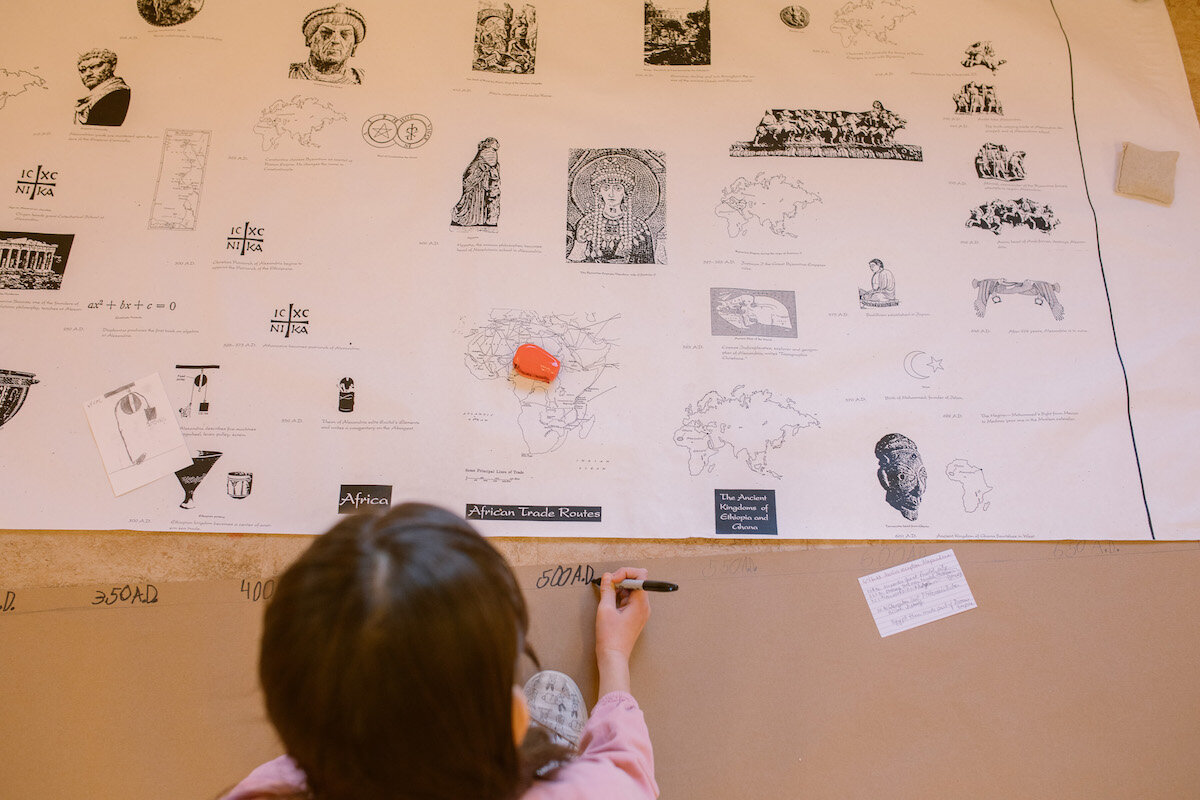
Beginning in the first grade, we know that children are developmentally ready (and eager) to explore the concepts of history. As mentioned in our summary of the geography curriculum, we give our students a look at the history of our universe. This leads to a study of the evolution of organisms on Earth, as well as a look at early humans.

Our study of the history of humans branches off into many directions. After learning about the earliest humans, children learn about ancient cultures, the fundamental needs of humans, and how people in different societies have (and continue to) meet those needs. We explore the origins and history of mathematics and language, which children at the elementary level find particularly relevant and interesting.

Perhaps unsurprisingly, these three subjects tend to overlap and connect quite a bit. Sometimes we guide children to discover these connections, and other times they recognize connections on their own.

Want to learn more? We believe the best way to discover Montessori education (or just to expand your understanding) is to visit our school. We welcome you to schedule a virtual tour. Today, we leave you with a quote from Dr. Montessori’s book, To Educate the Human Potential:

"…to give the whole of modern culture has become an impossibility and so a need arises for a special method, whereby all factors of culture may be introduced to the six-year-old; not in a syllabus to be imposed on him, or with exactitude of detail, but in the broadcasting of the maximum number of seeds of interest.  These will be held lightly in the mind, but will be capable of later germination, as the will becomes more directive, and thus he may become an individual suited to these expansive times."

Montessori Basics: Cosmic Work

Last month we shared an article about Montessori’s elementary curriculum: coined cosmic education. This month we dive a bit deeper to share an interesting concept Dr. Montessori wrote about and considered when developing her work for elementary children.

A definition

Cosmic work, or a cosmic task, is that which anything in the universe does to contribute to the greater good, most often unknowingly. Dr. Montessori felt that teaching elementary-aged children about cosmic work throughout Earth’s history would serve as inspiration for them as they define their own cosmic work over the course of their lives. Cosmic work serves as an idea to support the symbiosis of all things.

“They (children of the first plane) have already absorbed the immediate environment and the restricted society they and their families have dealings with. You must try to give the child what he now longs for: the understanding of the world, how it functions and how it affects the life and behavior of humanity.” -Maria Montessori, To Educate the Human Potential

Examples

Cosmic tasks can be found wherever you look. A small sampling of examples: 

  • Bees collect nectar and pollen from flowers to feed themselves and their colonies. At the same time, they unknowingly pollinate the flowers, allowing plants to reproduce.

  • Flowers rely on birds, bees, and other insects to pollinate them. They are, at the same time, providing food for many organisms.

  • Ancient plant and animal life died and chemically transformed into coal and oil. Though these creatures were just experiencing their natural life cycle, they inadvertently created materials that have been used by humans as energy.

  • More than 2 billion years ago, photosynthetic microbes began to appear in our oceans, thus creating oxygen in our atmosphere that would later support the respiration of a wide variety of life.

  • Even inorganic entities can have a cosmic task. For example, the sun is just burning because of its natural nuclear fusion. As a result, it gives warmth, light, and energy to countless organisms on our planet.

In the materials

There are a wide variety of ways Montessori guides support this learning in the elementary classroom environment. One of the most evident and impressionistic is via the Timeline of Life material. Mentioned in our previous cosmic education post, this gorgeous color-illustrated wall hanging teaches children about the evolution of life on our planet. Through many lessons and discussions they learn about various organisms and the impact each has made on the development of Earth and other living things.

Montessori elementary science curriculum focuses largely on biology, including a general overview of the five kingdoms, differentiation between vertebrates and invertebrates, zoology, and botany. During the course of a three-year cycle in a class, a child will learn much about living things and how they relate and react to one another.

“The child will develop a kind of philosophy, which teaches him the unity of the universe. This is the very thing to organize his intelligence and to give him a better insight into his own place and task in the world.” - Maria Montessori, International Montessori Conference. Amsterdam, 1950

Beyond learning the basics of biology, Montessori students study the history of human beings. From the earliest humans to ancient civilizations and the consideration of how we form and function within our societies today, we give children a multi-faceted view of human beings. Learning about our ancestors and how we have organized ourselves over the years gives children a framework into which they can better understand human evolution and impact.

Questions and connections

As with most skills and lessons in Montessori schools, our aim is not to deliver facts for children to memorize, but rather to inspire them to ask questions and seek out the answers. This aim cultivates a lifelong love of learning rather than a view that school is just an information delivery system.

Teaching elementary children about cosmic work appeals to them because they are beginning to consider their own place in the universe. When we learn about how each organism (and even nonliving things) have contributed to the success of others, it’s only natural to make the jump to considering one’s own purpose. 

In combination with leading children to consider their own purpose and path, we want them to view the cosmic work of humanity as a whole. What is the purpose of humans as a species? Our consciousness gives us the opportunity to consider this task in ways that other organisms cannot; does this mean we can choose the path of our influence or will be unknowingly contributing just like all the others? There may not be a straightforward answer, but it’s certain a fascinating idea for both children and adults to consider.

Dr. Montessori wasn’t the only person to think this way. Many others share similar thoughts. One notable example is Thomas Berry, famed cultural historian and author. In his book The Great Work: Our Way into the Future, he discusses how humans might consider our influence on the planet and its ecosystems. He presents the idea that our earth is at a critical period of transition, and that humans may have the ability to influence the outcome.

Hopefully this topic has been as fascinating for you as it is for us. We leave you with a quote from one of Montessori’s most foundational and influential educators:

“Cosmic Education results in creative attempts to lead a new and different kind of human life, with responsible participation in all natural and human phenomena.” -Camillo Grazzini, 24th International Montessori Congress 2001

Montessori Basics: Cosmic Education

cosmic.jpeg

When Dr. Montessori began developing the elementary curriculum, she knew it had to be vastly different from the work of younger children.  Not only were the academic skills to be more challenging, but the manner in which content was to be delivered shouldn’t be the same.  This was because she understood that in the second plane of development (ages 6-12), children’s needs are very different from the needs of their younger selves.

She coined the term cosmic education to describe the work done in the elementary years.  Around age 6, a child’s scope of vision tends to expand beyond themselves.  Social connections are suddenly far more important, they develop vivid imaginations, and they become curious about their world, their universe, and how they fit into the big picture.  Our task is to provide a framework in which they can explore those areas.

One way we tap into the wonder of the elementary mind is via what we call the Great Lessons.  The five Great Lessons are not synonymous with cosmic education, but rather they are a springboard from which the work can begin.  These lessons are dramatic and impressionistic.  They open doors in the child’s imagination from which a wide scope of learning can begin.

These five lessons are given each year, although some schools may divide them between lower and upper elementary levels.  Over the course of three years in a classroom, a child will receive a lesson three times, with a different level of deepening understanding each time.  The weeks and months that follow will include many related lessons, though these may vary from year to year in order to cover a range of topics and student interests.

The Beginning/The Creation of the Universe

Typically given near the beginning of the school year, this lesson is a delight for children.  The guide prepares materials while the children are elsewhere: a long series of “experiments” and other props that will be used during the telling of the story.  The blinds are drawn, lights turned off, and perhaps there is some soft music playing as the students arrive and take their seats facing the guide.

The story begins with a description of the time before our universe began: how it was colder and darker than we can even imagine, and how in an instant [a black balloon filled with glitter and confetti is popped] it came into being.  A soft candle is lit, and the guide launches into storytelling about how different particles came together and moved apart.  They talk about the immense number of stars in our universe, states of matter, how quickly light travels, and how the solar system and the surface of the Earth formed over time.  The lesson culminates with the explosion of a model volcano, and setting the stage for the life that was to come in Earth’s future.

Follow-up lessons and work are often related to the study of space, chemistry, physics, geology, and geography.  The lesson is also a great prequel to teaching children about the scientific method and how to conduct experiments.  

The Coming of Life

A bit later in the school year the children will begin to learn about the evolution of life on Earth.  Two materials: the Long Black Strip and the Clock of Eras give children a visual idea of the amount of time Earth has been in existence compared to how long humans (and other living beings) have been here.  It’s often shocking for children (and adults!) to see a long black strip of fabric (Earth’s lifespan) running the length of a long hallway, with a tiny strip of white at one end to represent all of humanity.  These types of lessons are humbling to children, and they begin to give them a sense of connection to those that have come before us.

The main event of this great lesson, however, is the Timeline of Life.  This gorgeous, colorful, illustrated material shows children just how life has evolved throughout history.  From early one-celled organisms to the first plants, and invertebrates, through the various vertebrates throughout time, children in the elementary years adore this work.  They learn about how fossils are our records of the past, and how our understanding of the past changes with each new discovery.  (The Timeline of Life has been revised several times!)

Follow-up work includes plenty of biology content.  Children learn about the five kingdoms of life on Earth.  They take a close look at the five classes of vertebrates, their external features, and internal body functions.  They learn about the biology of plants as well, from algae and mosses to flowering and fruiting plants, and so many more.

The Coming of Humans

This lesson includes a beautiful timeline as well that displays dates and evidence of our evolution from the earliest hominids to the present day.  Children learn about what makes humans special, and how our ability to think, feel, and work have let us make developments that are unique to our species.  They learn about the migration humans have made across the globe and how we have used various tools and technologies to make our lives easier.

Montessori guides introduce children to the concept of the fundamental needs of humans.  We discuss what those needs are and how we meet them today.  One material allows children to explore how these same needs have been met by various civilizations throughout history.  Learning about our past as a species is important for children in the second plane of development.  It helps them develop a sense of self, and a sense of belonging in the bigger picture.

The History of Mathematics

Simply put, children are fascinated to learn about the origins of math and numbers.  This focus allows them to take a peek at how math has transformed over time, and to learn which people have made significant contributions to our mathematical understanding.

This comes at a perfect time, as they are simultaneously learning the foundational math skills that will take them through the rest of their lives.  When a child is working on their subtraction problems and they are able to relate it back to the beginnings of subtraction, the work is so much more meaningful and exciting for them.

The History of Language

Similar to the previous lesson, the history of language gives children a framework in which they might place their own learning of language.  By this time in their lives they have mastered oral language, but they are still very much engaged in the development of their own reading and writing skills.  To learn about the origins of such things is empowering and fascinating, and makes their work more special than it otherwise would be.

We hope this has been an interesting topic to read about.  If you have any questions or would like to observe in our elementary program to see cosmic education at work, please let us know!  We think you will find the experience enlightening and rewarding.