Parenting

Why Encourage Self-Directed Play?

Perhaps you’ve heard about self-directed play, also known as open-ended play.  Maybe you haven’t.  It may seem like a recent trend, but the truth is the concept is nothing new.  Plus, the benefits are extensive.

Once you understand the reasons for encouraging our children to engage in self-directed play, and you have a basic understanding of how to try it at home, it’s simple!

Bonus: self-directed play embraces many Montessori ideals.

What, exactly, is self-directed play?

If your child is using simple toys in creative ways with no adult-directed outcome, there’s a good chance they’re already engaging in self-directed play.

Many of the toys available today are intended for a specific purpose.  Let’s consider, for example, a doll.  Sure, a child can embark on some imaginative play with it, but a doll will always be a doll.  The same goes for a small toy train or a plastic dinosaur.  This is not to say there is anything wrong with these toys, but the ways in which children can use them are limited by their nature.

Now let’s consider a cardboard tube.  The possibilities are endless!  The tube could be a telescope one minute and a megaphone the next.  It could be a log, a bridge, or something to guide a ball through.  Materials we offer children for self-directed play are simple.  Think balls, cardboard tubes, sticks, scarves, playdough...the list goes on. 

When children embark on self-directed play, it’s important for adults to remember that the children are the ones calling the shots (within safe boundaries, of course!).  It is our natural tendency to have pre-determined ideas of what the outcome of a certain activity should be.  We often, instinctually, feel the need to jump in and teach children the “right way” to do things.  Give yourself permission to step back.  When we observe the the way in which children discover their own outcomes, it can be magical to see the process from a new viewpoint.  

How can self-directed play benefit children?

  • It builds self confidence.  By exploring on their own, children realize there is so much they can do for themselves.  They make their own games with their own rules, and they feel successful.  
  • It encourages independence.  Isn’t our ultimate goal for children that they might be able to get along just fine without us?  Self-directed play lets them experience independence from a young age, all while in a safe, prepared environment.
  • It stimulates imagination.  Children can’t help but be creative during self-directed play.  By giving them these opportunities, we are allowing them to flex their creative muscles; they will see possibilities no one else has imagined, and they will develop their own story lines as they play.
  • It teaches problem-solving.  Coming up with one’s own rules naturally leads to problem solving.  Children will have to figure out how to make something work the way they want it to.  
  • It allows children to learn at their own pace.  With self-directed play, there is no timeline and there are no academic benchmarks to meet.  Kids have the opportunity to build on their own knowledge, day after day, in ways that make sense to them.
  • It cultivates internal motivation.  Without adults defining the success of an activity, children will be compelled to find the innate joy in their play.  They will naturally tend to challenge themselves to try new, innovating ideas, and they will find their own personal delight in doing so.

Getting started at home

If you’re feeling ready to give self-directed play a try in your home, consider these tips to get you started:

Materials/Toys - Remember, these should be simple.  As an added benefit, simple toys tend to be much easier to obtain and far less expensive (and often free!).  If possible, toys should be made of natural materials.  Think wood, fabric, and items found in nature; avoid plastic if possible.  As mentioned above, collect toys that can be used for any number of possibilities.  Things like balls, scarves, blocks, boxes, sticks, or clay are great.  Some people like to collect trays of loose parts to leave out for children.  Loose parts trays might include pebbles, seashells, buttons, bits of string, pieces of tree bark...whatever looks (and feels) interesting!

IMG_3063.JPG

Prepare the Environment - Make sure children have a safe, open space in which to play.  Depending on your home and the weather, this could be your living room, backyard, or whatever space works for your family.  It’s important to make sure children have flexibility in their movement though, so make sure they can sit, stand, jump, roll, and explore!

Sit Back and Enjoy! Another great benefit to self-directed play is that because children can engaged on their own, you are free to spend time checking off your own to-do list.  But feel free to sit nearby or even alongside your child if you wish.  Just remember to let them take the lead and explore their world and imagination.


A New Look at 529 Plans

binocs.img

As you likely know, our nation recently passed the Tax Cuts and Jobs Act.  One portion of the reform bill gives additional benefits to families with 529 plans.  What was once savings earmarked solely for college tuition can now be used for private school tuition - as early as kindergarten.  

Curious about how you can utilize this new benefit?  Want to explore 529 plans for the first time?  We are here to help.

What are 529 plans?

A 529 plan is a special savings plan originally developed to help families save money for college while earning tax-free interest.  Money put into the plan is subject to regular income taxes before it is deposited into the account.  If the money is used for tuition upon withdrawal, no additional taxes will be taken out.  (There are taxes and additional fees imposed should the money be used for other purposes.)  

Plans are managed by individual states, and each state selects an administrator to broker investments in the plans.  Some people choose to open plans directly, while others seek the assistance of financial advisors.  Most families open plans through their own state of residence, but that’s not a requirement.  You can open a 529 plan in other states.

What are the new benefits?

Previously, the purpose of 529 accounts was to provide families with a strong, long-term savings option for higher education.  As of January 1, 2018, those benefits have extended significantly.

Now, families are able to use up to $10,000 annually from their 529 accounts to cover the cost of tuition for K-12 private schools.  

If you already have a 529 account and you’ve had a chance to let the interest accrue, it may be beneficial to use some of those savings now.  If you have not yet started a plan but think you might like to, now is a good time to take another look.  There are a variety of options for families, depending on the age of your child and other factors.

How can I set up an account?

Following these steps will simplify the process:

  1. Decide on a beneficiary (likely your child, though the account may be transferred to a different beneficiary later).
  2. Gather the address, social security number, and date of birth of the beneficiary.
  3. Work with an investor to determine which account is best for you.  You may choose an age-based option taking into consideration what amount of risk you are comfortable with: there are conservative, moderate, and aggressive plans.  Additionally, you can custom-select from individual portfolios.
  4. Have your bank account information (account and routing numbers) handy to set up transfers.

For more detailed information on New Hampshire’s plan (managed by Fidelity) go to: https://www.fidelity.com/go/529-New-Hampshire/overview


February is Black History Month!

It’s never too early to begin teaching our children about black history.  One simple way for families to start is by reading books that are compelling, beautifully illustrated, and age-appropriate.  Today’s post will give you a range of options.  Another great resource?  Your local librarian!  Ask them about these books or if they have any other suggestions:

(Click on the book images to go to the book's page on Amazon)

Follow the Drinking Gourd by Jeanette Winter

Peg Leg Joe teaches slaves a song about the drinking gourd to help them on their path to freedom.  Based on the African American folk song by the same name, this book takes readers on a journey through the underground railroad.


The Story of Ruby Bridges by Robert Coles, illustrated by George Ford

This true story takes place following the supreme court decision of Brown versus the Board of Education.  Ruby Bridges was ordered to attend first grade as the only African American child in an otherwise all white school.  She faced confusion and hate each day, but armed herself with love, compassion, and courage, helping a New Orleans community moved toward school integration.


Sit-in: How Four Friends Stood Up by Sitting Down by Andrea Davis Pinkney, illustrated by Brian Pinkney

This book is appropriate for slightly older (elementary aged) children.  It tells the story of a famous sit-in, in which four college friends entered a Woolworth’s in Greensboro, North Carolina.  They sat down for lunch at the whites-only counter and waited patiently to be served.  Over the next several days, they were joined by hundreds, and the movement was instrumental in desegregating lunch counters in the south.


Moses: When Harriet Tubman Led Her People to Freedom by Carole Boston Weatherford, illustrated by Kadir Nelson

This story is based on the life of Harriet Tubman.  Tubman was a slave in Maryland who escaped, only to make many trips back south in an effort to guide others to freedom.  


Wangari’s Trees of Peace: A True Story from Africa by Jeanette Winter

Wangari Maathai, also known as Mama Miti, was an African woman who changed the ecological landscape and economic opportunities for women in Kenya.  While she was not an American, she did earn her bachelor’s and master’s degrees in the United States.  Upon her return to Kenya, she was disheartened by the drastic change in the land and people as a result of deforestation.  Armed with her education and determination, she taught the women of Kenya to plant trees and rebuild their communities.


Sojourner Truth’s Step-Stomp Stride by Andrea Davis Pinkney, illustrated by Brian Pinkney

Sojourner Truth was born a slave named Belle.  She endured the cruelties of slavery with several masters, eventually escaping and renaming herself.  She spent the following years traveling the country speaking out as a powerful abolitionist.  Though the journey toward abolition was slow and challenging, Sojourner kept her steady pace and determination to speak for those without a voice.


When Marian Sang: The True Recital of Marian Anderson by Pam Munoz Ryan, illustrated by Brian Selznic

Marian Anderson was a renowned black singer who struggled for equality before the Civil Rights Movement began in the United States.  She was recognized for her natural talent as a young child, but struggled to find teachers who would help her refine her voice, and later, venues that would feature her as a performer, because of the color of her skin.  The earlier years in her career were spent largely in Europe, where she was more accepted.  She is perhaps most famous for a performance she gave on the steps on the Lincoln Memorial to an integrated crowd of 75,000 people. 


The Story of Martin Luther King Junior by Johnny Ray Moore, illustrated by Amy Wummer

This simple introduction to the life of Dr. Martin Luther King, Jr. is perfect for primary-aged children.  The book is brief and easy for little ones to understand.  Consider it a great option for families who are looking to introduce their youngest children to the concepts of inequality in an age-appropriate way.


We March by Shane W. Evans

This simply written book takes readers through the March on Washington for Jobs and Freedom.  The march is perhaps best known for Dr. Martin Luther King Jr.’s “I Have a Dream” speech, which was delivered at the end of the march.  Kirkus Review named this one of the best children’s books of 2012.


Happy reading!

Cooking With Our Kids

HMScooking.jpg

Children love to help out in the kitchen.  Though they may be prone to extra messes, letting them help has many benefits:

  • Promote healthy eating habits - Children are likely to eat more fruits and vegetables if they help to make their food at home.  Preparing ingredients together is a great time to talk about why our bodies need certain vitamins and how we can get those from the food we eat.
  • Increase their likelihood of trying new foods - When children make a meal themselves, the pride they feel in their accomplishment and the interaction they have with the food often takes away apprehensions they might have had about trying it otherwise.
  • Teach children where their food comes from - Whether you grow your own food, visit your local farmer’s market, or head to the grocery store, the kitchen is the perfect place to talk to children about where their food comes from.  
  • Give them practical life skills - Someday your child will have to prepare their food.  Why not start learning now?  Doing so lays the foundation for confidence in the kitchen, and independence as an adult.
  • Cooking teaches reading and math - While the youngest children might enjoy counting while adding ingredients, older children can read recipes and work with fractions and time.
  • Children gain a sense of contribution - When a child helps cook a meal, they have done something important to help their family community.  This is just another way to promote confidence and independence.

Things to Keep in Mind

Emphasize safety.  Talk to your children about what is off-limits - whether you’d like them to stay away from hot stoves or sharp knives - make sure they know what you expect and remind them often.

Make it fun!  Make meals that are full of color.  Make silly faces on your pizzas.  Dance around the kitchen.  Cooking should be a fun experiences for everyone in the family.

Give your kids tools that will work for them.  Make sure they are comfortable in for little hands to hold, but make sure they get to use the real thing.  Click here for one good resource to find such tools.

Recipes to Get You Started!

9405475934_ef3ee61670_z.jpg

French Bread Pizzas

Ree Drummond over at the Pioneer Woman is always full of great ideas.  You may want to do some of the chopping and ingredient cooking ahead of time unless you have older children.  Even the littlest ones would enjoy assembling their own pizzas with whatever toppings they like.

 
nutella-raspberry-sandwiches-rs-x.jpg

Nutella and Raspberry Sandwiches

It doesn’t get much simpler (or more delicious!) than this.  Children as young as three often practice spreading butters in their Montessori classrooms, so they may surprise you with their skills!

 
pinto-bean-taco.jpg

Pinto Bean and Cheese Tacos

Not only is this recipe easy to make, but it’s a great quick dinner option for busy weeknights.  Feel free to substitute the beans for whatever your favorite protein is, and add in fun extras like guacamole!

 
landscape-1492653550-delish-earth-day-cookies-001.jpg

Earth Cookies

While these may not be the healthiest recipe on our list, they were far too cute to leave out.

 
watermelon-patriotic-star-salad-670x670.jpg

Cookie Cutter Fruit Salad

Consider this recipe an inspiration.  You could use so many different fruits and veggies in an unlimited number of shapes.  The final product could be a fruit salad, or you could make kababs, put them on pancakes, the possibilities are endless…

 
e231f7afd22cb22dec9cf73681481f7c.jpg

Salad in a Jar

Looking for ways to teach your kids to make their own lunches AND eat more vegetables?  Look no further…

 
1448278926390.jpg

Waldorf Chicken Boats

For those of you looking for something a little fancy (and fun!), check out these Waldorf Chicken Boats.  If you cook the chicken ahead of time and stand by to assist in measuring, children can make this recipe almost entirely on their own.

Happy cooking!

Spending Time Outdoors in the Winter

sledding.jpg

Norwegians have a long-standing tradition known as “friluftsliv”.  The word loosely translates to ‘open-air life’ and embodies the nation’s dedication to spending time in nature on a regular basis.  This is easy enough to do when the sun is shining and the days are long, but how can we continue to get outside during the colder, darker months?  And why is this so important for children?

Why Get Outside?

We all know the stir-crazy feeling that sets in after too many hours cooped up inside.  The following are just some of the benefits to bundling up and heading out.

  • Soak up the sun for vitamin D: One simple way to boost our body's’ supply of vitamin D is through sun exposure.  While it is important to consider our skin’s need for sun protection, we all need some time to enjoy the benefits of the sun’s rays.  
  • Reduce stress: A short walk - even just 20 minutes - can significantly lower stress hormones in the body. 
  • Gain focus: One study determined a clear link between children spending time outdoors and a decline in ADHD symptoms.  
  • Improve immune function: Japanese ‘forest bathing’, or simply spending time in a forest or around trees, has been linked to an increase in immune function.  
  • Boost your creativity: Regular time spent exercising outdoors has been linked to an increased capacity for creative reasoning. 

Endless Options

So what exactly is the best way to spend time outside when it’s chilly?  Winter provides us a huge range of opportunities:

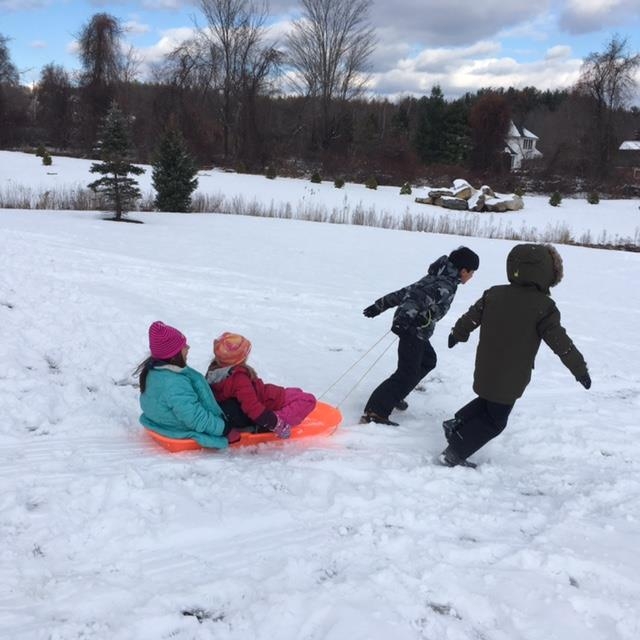
  • Sledding: Dragging a sled up a hill while trudging through snow is a workout!  The reward of sliding down a slippery slope each time is fun for all ages.
  • Star Gazing: Even younger children with earlier bedtimes can enjoy star gazing on crisp winter nights.  
  • Skiing and Snowboarding: Whether you prefer the speed of the slopes of the quiet of cross-country, there are options for everyone.  Many mountains offer lessons for children as young as three.
  • Visit local parks: Public parks stay open year-round.  Go together and enjoy your local resources, or make a day trip of it and visit a park that’s a bit farther away.
  • Feed the birds: Because many species migrate during the winter months, your area’s population will look different now than during the spring and summer.  Borrow a field guide from the library and do some bird watching.  Set up or make your own bird feeders and place them outside a window of your home.
  • Make environmental art: Use what you find in nature to create inspiring pictures and sculptures!  
  • Take a closer look: Use a magnifying glass to examine snowflakes, ice, or whatever else sparks curiosity.
  • Walk: Perhaps the simplest option, this can be made even more special if done while it’s snowing outside!  Consider location as well - think about any access to nature nearby, whether it be a forest, river, or even a city park.

Shifting Our Mindset

One way Norwegians support their philosophy of friluftsliv is with an old saying: “There is no such thing as bad weather, only bad clothing.”  By preparing ourselves adequately, spending time outside can and should be enjoyable, no matter the season.  So bundle up and head outside!

Sources
http://www.sciencedirect.com/science/article/pii/S0272494413000959
https://www.ncbi.nlm.nih.gov/pmc/articles/PMC1448497/
https://www.ncbi.nlm.nih.gov/pmc/articles/PMC2793341/
https://www.ncbi.nlm.nih.gov/pmc/articles/PMC3520840/ 

Embracing Diversity from a Young Age

034-IMG_4465.jpg

We all want our children to be be peaceful and accepting of others.  It is never too early to start teaching them to embrace diversity.  Too often, we falsely imagine that young children do not notice what makes them different from each other.  They do notice, and instead of waiting for them to ask questions or gather information on their own, we can be proactive about diversity education.  We can teach them that while there are so many ways humans can be different from each other, those differences (and our similarities) should be celebrated.

Setting an Example

Our children constantly look to us as models for their own behavior.  We can take the lead by embracing the values we hope to see in our children.  This starts by educating ourselves.  We can learn about different cultures and groups of people.  We can confront our biases and consider how they might be coloring our view of the world.  We can read about current issues in social justice and decide what responsibilities we have to make the world a more equitable place for all people.   

Read Together

There are many quality books written for children about this very topic.  Here are just a few... (click on the book images to go to the book's page on Amazon)

Last Stop on Market Street, by Matt de la Peña & illustrated by Christian Robinson

This book was the 2016 Newbury Medal Winner, and also received a Coretta Scott King Illustrator Honor and a Caldecott Honor.  A little boy rides the bus with his grandmother after church each Sunday.  His grandmother’s laugh guides him through the journey as they meet a wide variety of people.

The Ugly Vegetables, by Grace Lin

Award-winning author Grace Lin wrote this charming book for young children.  A daughter helps her mother in their garden, but becomes dismayed when she sees it is fully of “ugly vegetables” while the neighbors are all growing flowers.  The soup her mother makes and the gathering of neighbors teaches the value of differences.

The Sandwich Swap, by Queen Rania al Abdullah & Kelly DiPucchio, illlustrated by Tricia Tusa

Salma and Lily are best friends.  One day, a conflict arises over their sandwiches at lunchtime (pita with hummus, and peanut butter with jelly).  The food that threatens to end their friendship ultimately binds them together again.

The Family Book, by Todd Parr

Parr’s books are simple, but his bright illustrations and straightforward story are perfect for young children.  The Family Book highlights many different types of families, and ends by saying, “There are lots of different ways to be a family.  Your family is special no matter what kind it is.”

You Hold Me Up, by Monique Gray Smith & illustrated by Danielle Daniel

Smith’s website states that she “wrote You Hold Me Up to prompt a dialogue among young people, their care providers and educators about reconciliation and the importance of the connections children make with their friends, classmates and families.” (link: http://moniquegraysmith.com/writing/ )

Experience Together

There are so many ways a family can have fun together while encouraging curiosity, understanding, and empathy with different groups of people.  Think about the activities your family already enjoys, and find ways to make those activities learning experiences.

Do you and your family enjoy cooking?  Try whipping up new recipes from different cultures around the world.  Preparing and sharing a meal is one way we all bond, so why not explore other cuisines?  

Many cities and towns hold festivals celebrating the cultures of the various people who live there.  Music, food, traditional crafts, and performances can be a fun way to learn about another culture.

Does your family love music?  Visit your library to borrow CDs or find some audio clips online.  Music from around the world can inspire your child to sing and dance.  Grab any instruments you may have on hand (or make your own!) to join in on the fun.

Share Your Own Experience

Each family has its own unique history, heritage, and traditions.  Teach your child about their ancestors, where your family originated, and what makes your family special.  Offer to share these traditions at your child’s school.  Teachers love to have parents come in for special presentations.  Whether you teach the children to prepare a snack, sing a song, or read them a traditional story, every new bit of cultural learning gives them a broader view of their world.  

Let’s open up the world for them, so that they may share it peacefully with each other.

Independence and the Montessori Child

HollisMontessori-February2017GeneralPhotos-ForPrint-18.jpg
Never help a child with a task at which he feels he can succeed.
— Maria Montessori

You may already know that Montessori educators value and encourage independence in even their youngest students.  Why is it so important?  We believe that nurturing this valuable character trait is both empowering and necessary.  

Benefits of Cultivating Independence

In short, giving a child the gift of independence lets them know we value them and know they’re capable.  Children can grow up feeling empowered and safe in their abilities to make sound choices.  When we trust them, they learn to trust themselves, ultimately becoming happy and productive members of their communities.

Of course, this looks different at different ages.  Children birth to age six want to do things by themselves, while elementary aged children want to think for themselves.  Adolescents seek both physical and social independence while they tread the waters between childhood and adulthood.  It’s important to remind ourselves of these developmental stages, both as teachers and parents.

What Independence Means at School

In the earliest years at school, children focus on what we refer to as practical life skills.  This may include learning to prepare simple snacks, putting on their own shoes or coats, or caring for classroom plants and animals.  Children are given endless opportunities to practice these skills.

Another facet of independence at a Montessori school involves choice within limits.  Children are able to decide what work they are interested in.  Teachers carefully prepare the classroom environment so that all choices are safe and desirable, but within those boundaries the child is free to explore.

As children get older (the elementary years and beyond), they must meet certain academic expectations.  Teachers use a variety of tools to help students work independently while still meeting their goals, including work plans and time management strategies.  Research becomes of great interest at this time, and children are given ample opportunity to deeply explore topics they choose.

How Parents Can Support This Work at Home

How can families continue the cultivation of independence in the home?  It all starts with a shift in the way we view our children’s capabilities.  They are often able to do much more than we realize, and with a little bit of modeling they tend to eagerly accept a challenge.  After all, our children want to do what we do, and if we give them the proper tools and support, they can begin practicing.

The chart below highlights some of the possibilities.  Think of this as an inspiring guide that highlights what children of various ages are typically capable of.  Giving our children tasks such as these builds their confidence while helping them learn how to be contributing members of a community - in this case, their family.

Looking Forward

One of the easiest ways to encourage independence in our children is to be more aware in the moment.  Though it can be a challenge to slow down and let them move at their pace (like when they insist on zipping up their own coat while we’re rushing out the door to get to work), it’s going to benefit them in the long run.  Building a little extra time into our schedules can help!  Some little changes we can make to embed this value into our days:

  • Send your child to put their shoes on 10 minutes before you’d like to leave.
  • Leave child-friendly cleaning supplies within reach.
  • Put pre-portioned or easy-to-prepare snacks on low shelves.
  • Turn spills and messes into opportunities.
  • Let your child (eek!) pick out their own clothes. For younger children especially, some weather appropriate guidance is just fine.  Enjoy the creative fashion statements that ensue.

Montessori reminds us that supporting independence is a conquest that does not end, though it most definitely evolves.

Independence is not a static condition; it is a continuous conquest, and in order to reach not only freedom, but also strength, and the perfecting on one’s powers, it is necessary to follow this path of unremitting toil.
— Maria Montessori

Making the World a Better Place - One Child at a Time

Last Thursday was Gandhi’s birthday, and also the International Day of Nonviolence, a day to honor peacemakers around the world. To observe the day in the Lower Elementary, we read a short story about Gandhi’s life and talked about ways each of us might practice peace. The children thought of many different ideas like writing letters to new neighbors, helping someone, thinking about Gandhi, working with a Zen garden, saying kind words, and appreciating nature.

11 Ways to Foster Independence

Developing Skills, Grit and Resiliency through Trial, Trust and Failure. 

After reading and agreeing with popular articles explaining how losing is good for kids, that grit is essential for success and that a 4th R resiliency  has been added to child-rearing, it seemed like the next logical, large scale conversation might be:

  • How do we allow failures to occur naturally in our child’s life?
  • What will it look like to foster independence?
  • Can my child handle what comes along?
  • What can I do to encourage and show trust in my child?

Failures occur naturally when we allow our children to take a more active role in their own lives by providing them with ample opportunities to choose. Young children, with not much life experience, are bound to choose to play with a favorite toy instead of getting their snack or lunch ready for school, resulting in a hungry belly at snack time. The result is a learning experience that provides good information for the following day and a chance to develop resiliency as they experience a minor failure.

Here are 11 Ways to Put Trying, Failing and Recovery into the Everyday

  1. Send the kids outside.

    Often, we send the kids outside when we’ve decided we’ve had enough. Enough screen time, enough rough-housing, or enough whining because they are “bored.” Instead of using outside time as a reaction to enough of something, get creative and spin it. Show the children how you used to make teeter-totters out of scrap wood. Or better yet, leave a pile of wood, nails and a hammer and see what happens. If your child is younger, allow for time to play in a puddle, pile of leaves or muddy zone. There are countless ideas out there.

     
  2. Ask the kids.

    Consider asking your children to identify one thing they have never done, then encourage and enable them to try. The end result is not the goal. The process is! Give it a try, simply ask, “What is one thing you have never done but would like to try?” Then plan how and when, and simply be there without commentary, as they give it a go.

     
  3. Start small.

    After we ask, we have to allow our kids to make toast, knowing it will lead to making eggs and pancakes one day. We have to slow down and say, try it. Even if as Lenore Skenazy says, “Maybe these tasks seem small, even silly, but in a culture that has created mountains of fear around every childhood experience, these kids (who are encouraged to try) have started their climb. Pretty soon, they’ll be ready to fly.”

     
  4. Share stories.

    When we look to other people, to our own childhood stories and success stories from other children, it becomes easier to put it all in perspective. For example, Ringo Starr, a surviving Beatle, was chronically ill as a child and never finished school, in fact he spent many years in the hospital. It keeps things in perspective to think one of the most famous, beloved drummers in history discovered his own talent while tapping sticks to pass the time in his hospital stay. This certainly wasn’t a picture perfect- mom- and-dad-will-make-it-happen-route and he turned out pretty successful on his own, don’t you think?
     
  5. Encourage other parents.

    Parents talk. Parents want what is best for their children. Avoid showing off what your child can do, but rather encourage other parents to discover for themselves that their children CAN handle more than they think.

     
  6. Identify your fears.

    After your child has chosen a task, it’s helpful to write down the fears you have. Once you do this, you can plan for how you will respond if your worst fears actually come true. (Example: If I let my child pack her bag, she will forget her boots. I am afraid the school with think I am a bad parent. Plan: I will send a note saying I am encouraging my child and if she forgets her boots, we will work on ways to remember them at home.)

     
  7. Get the facts.

    After writing down your fears, get the facts. If you’re afraid of the bigger, “what- ifs” like abduction, find out the real stats and then plan accordingly. See Protecting the Gift by Gavin de Becker. Bottom line: instead of putting the axe on an idea altogether, find another way to create the same experience through alternative planning and enabling.

     
  8. Let go.

    Here’s where we, as moms and dads, have some work to do on ourselves as we develop the habit of letting go. We can try to control the outcomes and direction of our children while they are young, but as our children get closer and closer to leaving the nest, it is imperative that they learn and practice staying afloat and recovering in the wake of mistakes and mishaps. If we impede their progress neither of you will be prepared for what the real world will deliver from 18-years to 80-years-old.

     
  9. Practice, practice, practice.

    In order for kids to experience and garner meaning and develop resiliency from the lumps and bumps, the ups and downs, the oopsies and flops that go hand-in-hand with all learning, kids will need oodles of practice time. And as parents, we have our own job to practice stepping out of the way and trusting our children. No parent I know is likely to wake up one day saying, “Alrighty kiddo- this time you’re on your own.” Likewise most kids won’t wake up one day saying, “No problem, I didn’t make the team or I forgot my lunch, I’ve got this,” without some practice. Baby steps and practice are good for everyone in the family.

     
  10. Keep track.

    When parents keep track of the efforts and outcomes, it becomes very clear that over time, these “simple” tasks add up. They also keep motivation high and evidence in hand that yes, children do benefit from us backing off and staying quiet (grab the duct tape) and showing our kids that we have faith in their abilities to tackle new things and overcome failures.

     
  11. Celebrate!

    If your second-grader made eggs for the first time (after four failed attempts with shells in the scramble), he’s a rockstar because he’s taking on more responsibility and he did it. He made it through the failures, as minimal or as grand, as they may seem to us. This is progress! Have a big breakfast and make it a celebration.

As children grow and mature, parents can foster independence by allowing children to make choices, learn from them, make necessary course corrections, experience failure and success and develop the resiliency they require to tackle any of life’s challenges and obstacles. As the Buddhist Quote says, “Fall down seven times, get up eight.” 

By Vicki Hoefle (Guest Blogger) 

Join me for a lively workshop on Monday, October 6th, 7-9pm,
right here at Hollis Montessori School. Details & Directions

Vicki HoefleCreator, Parenting on Track (TM)Author, Duct Tape Parentingwww.vickihoefle.com

Vicki Hoefle
Creator, Parenting on Track (TM)
Author, Duct Tape Parenting
www.vickihoefle.com

How to be a Montessori Parent

Just like there is more to being a mother than conceiving and bearing a child, there is more to being a Montessori parent than sending your child to Montessori school.  Being a Montessori parent involves taking a real interest in what your children are doing in school, engaging in the school community and making Montessori a way of life outside of school.

I haven’t had any training but I think I understand some basic tenets of the Montessori method and it seems like the most natural way to learn in my mind - similar to the way a mother duck or horse teaches their young. They show the little ones what to do (the presentation), encourage them to try it on their own (the work) and then allow them to rely on their new skill (independence).

In our quest to be Montessori parents, my wife and I try to remind ourselves to observe a few key guidelines that are worth thinking about:

  1. Let children play - resist the urge to over-organize free time and allow active play time. Play fosters imagination, creative problem solving and interpersonal skills when others are involved.

  2. Dive into things they show interest in - like showing how a key actuates a deadbolt - allow time for questions and comprehension.  This is hands-on learning which always sinks in quickly but even more indelibly when they are asking for it.

  3. Let them do it - try to wait a little longer than is comfortable before jumping in to help them when they are trying to do something such as tie their shoes, pronounce a new word or graph an equation.  There’s nothing better than the feeling of accomplishment to help children develop self confidence and independence.

  4. Keep them by your side - don’t stick them in front of the TV or iPad when you need to get things done around the house.  This requires patience and it will take longer to get things done at first but children want to do what their parents do and they want to help. Eventually, this pays off when the “help” turns real and they are picking up life skills.

Of course, this all requires commitment and tremendous effort but it is as important as being a good mother or, maybe, it’s just part of being a good mother (or father).

-John (HMS Parent)