Why Start at Age 3?

What is the ideal age to begin Montessori school? Age 2.9 to 3! The young child's ability to effortlessly absorb information from his environment is only possible during this window of time. Dr. Montessori observed that during these early months, which she called sensitive periods, a child's entire being is molded: his intelligence itself is being formed! 

The child from age birth to six years old passes through three significant sensitive periods; those for order, movement and language.

SUPPORTING A YOUNG CHILD'S NEED FOR ORDER

During the sensitive period for order, a young child needs her environment to be predictable and orderly. If her life has a rhythm and her routine is maintained, she begins to trust the environment. If her needs for food, sleep and bodily comfort are predictably met as they arise, she uses this satisfaction as the basis to feel secure and to explore her world. The three year-old is at the height of sensitivity to ritualistic order; she still needs routines and yet can begin to create her own order. This is the perfect time to model that activities have a beginning, a middle and an end. 

COORDINATION OF MOVEMENT

The sensitive period for movement is the time the child develops his coordination and fine and gross motor skills. Allowing your child safe yet challenging movement without interference develops this skill and his self confidence. It's time to jump, hop, skip, and climb, to carry heavy things, to balance objects on a tray. He needs to use a scissors, to pick up tiny objects and to refine his eye/hand coordination allowing his hand to truly become an instrument of his mind.

THE PRIME TIME FOR LANGUAGE DEVELOPMENT

During the sensitive period for language, the child can hear the individual sounds in words as she learns vocabulary— an ideal time to begin learning the sounds of letters. During this time she will expand her vocabulary immensely. She wants huge words and funny words and rhyming word and words in songs. Our Montessori environments, rich in vocabulary, meet her word hunger perfectly.

When the children's environment is based on and organized around the sensitive periods, the children work with an enthusiasm and sustained interest that is truly amazing. Their development is strong and steady.

Authentic Montessori preschool is a three-year cycle designed to engage children from age 3 to 6 (preschool through kindergarten). The activities in the first year lay an important foundation for future learning. Over the following two years the activities and lessons build upon themselves at the child's own pace. Parents are often amazed when a child "explodes" into reading, writing, and math during the final year. It might look like magic, but it is really the culmination of the first two years in the Primary classroom. By starting at 3 and remaining in the classroom community for three years, Montessori children have an inspiring educational experience.

-Kari

Recess

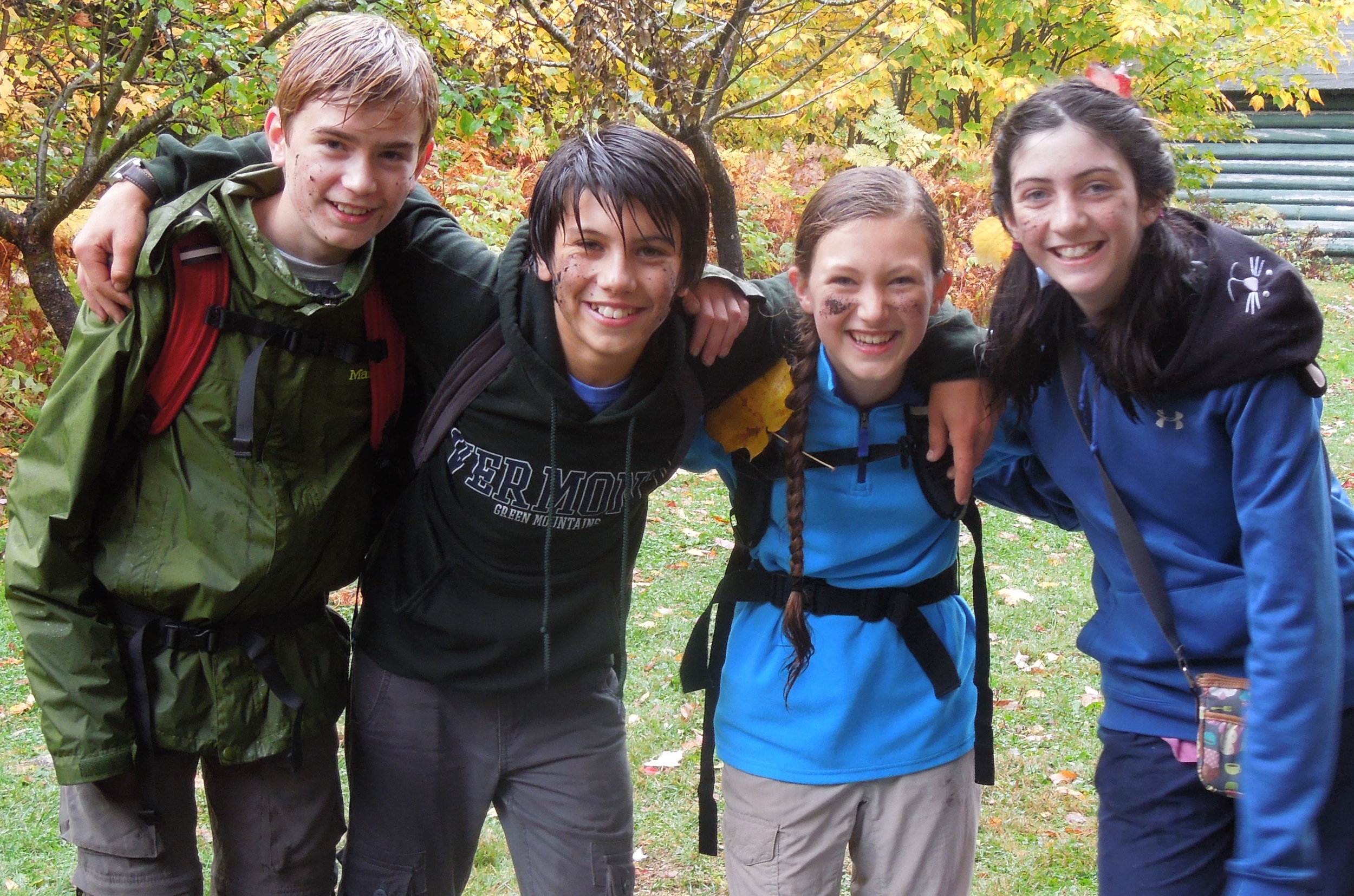
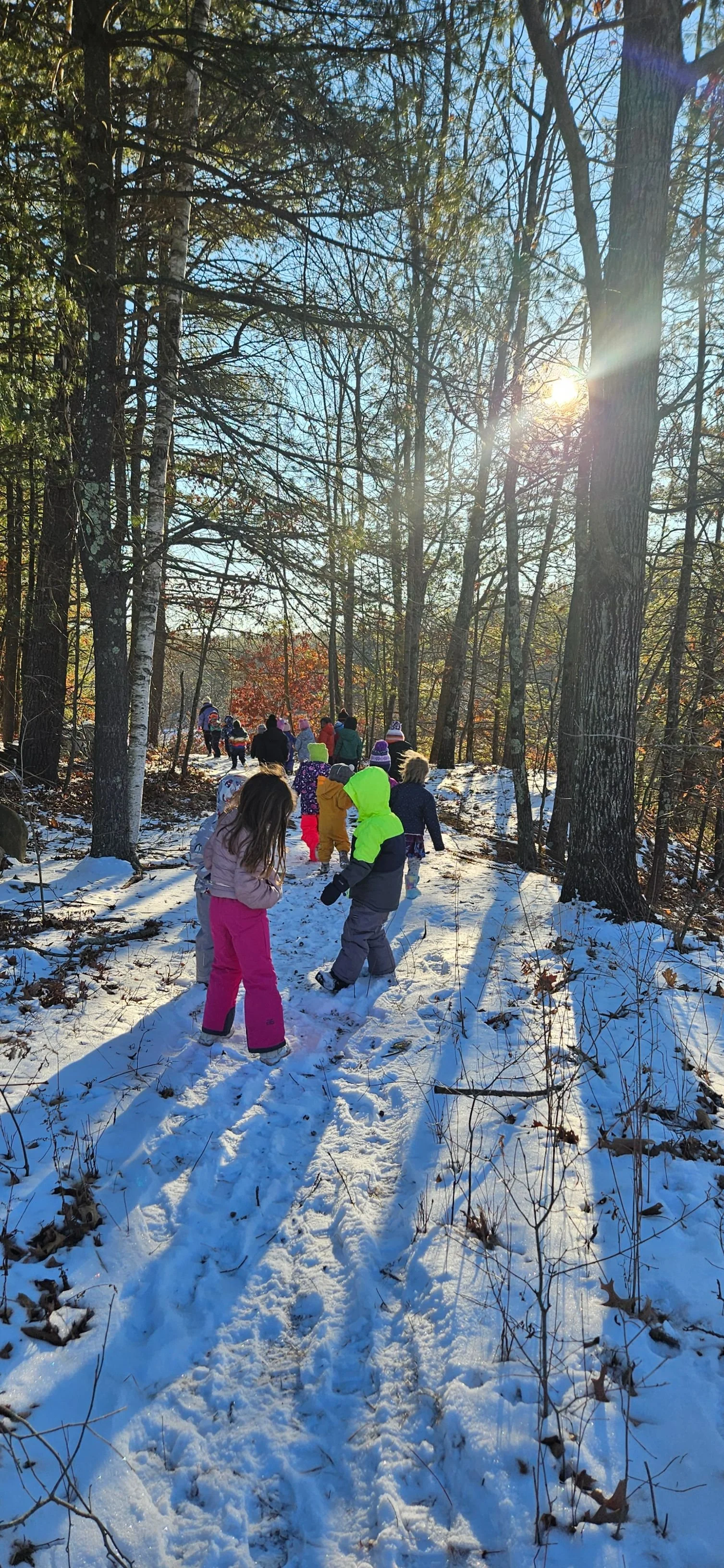
A line of students filed out of the big metal door. You could hardly see our faces under our brightly colored raincoats. Boots squeaked and thudded. Rain pants rustled. Inside the door, the line was straight and organized, but as soon as we stepped outside, we were wild — children of the Earth.

Recess had begun.

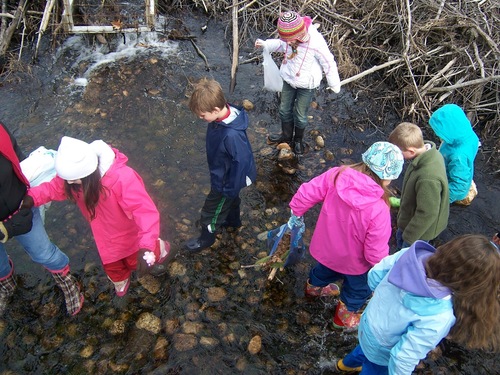
A newly formed river of mud and rain in the woods. A slippery fallen tree acts as a bridge, or a castle, or a throne. Leaf crowns. Tiny rocks, twigs, and the sand pile make a tiny fortress. A moat is carved out of the dark brown mulch much to the chagrin of our teachers, and the rain quickly fills it in. Wet bark peeled off a dead tree, rocks, leaves, twigs, acorns, pine cones, a feather from home, and we built a fairy house. Capture the flag goes on in all weather. The wetness is an added challenge, an extra bit of fun. We liked to show off our grit.

We slipped and slid across the soaked playground. Our heels rubbed raw in our boots, but we didn’t care. Fingernails quickly filled with dirt and sand and wet bits of bark, but we didn’t care. Mud splashed in our faces and we wiped it away with muddier hands, but we didn’t care. Our fingers and noses were numb with the wet chill, but we didn’t care. Despite the “waterproof” rain gear we were wearing, we were soaked through, but we didn’t care.

We did care though, when the teachers began to call us inside. When the little bark castles had to be left for tomorrow — who knew if they would keep from collapsing without us watching over them? When the imaginary kingdom by the new river in the woods had to be abandoned for another day. When the capture the flag game had to end before anyone had scored. When the leaf crowns had to be taken off. Then we cared.

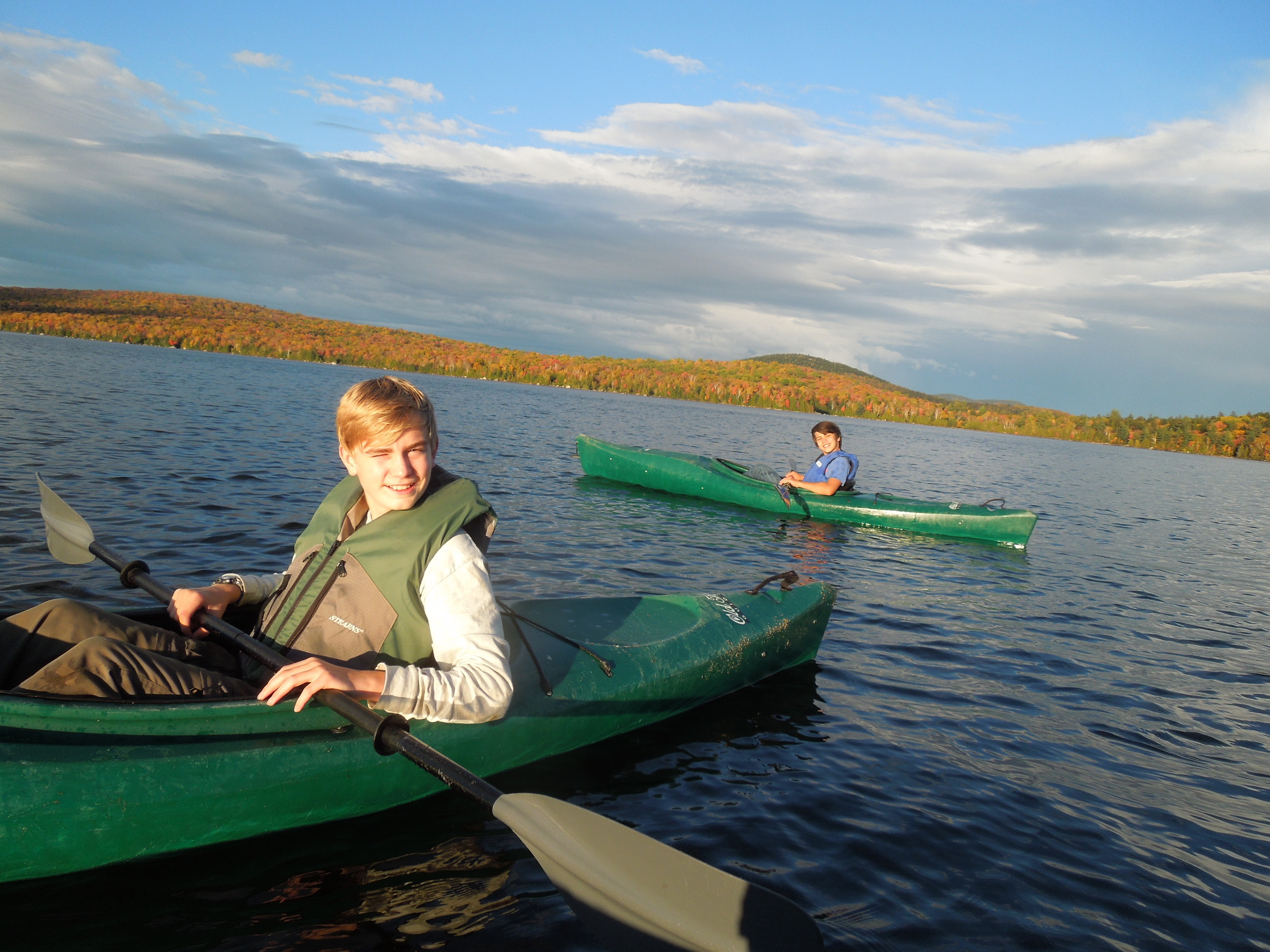
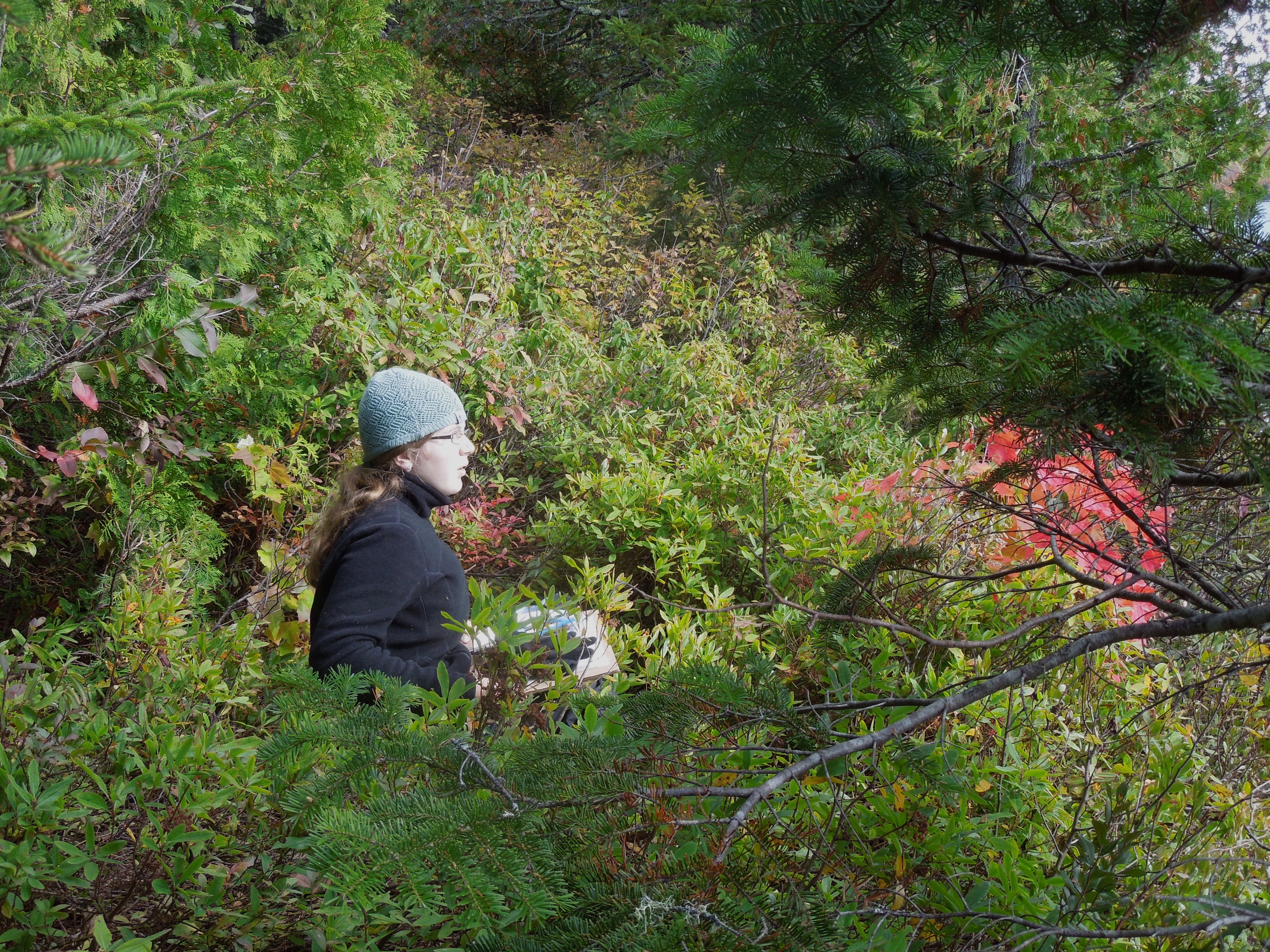
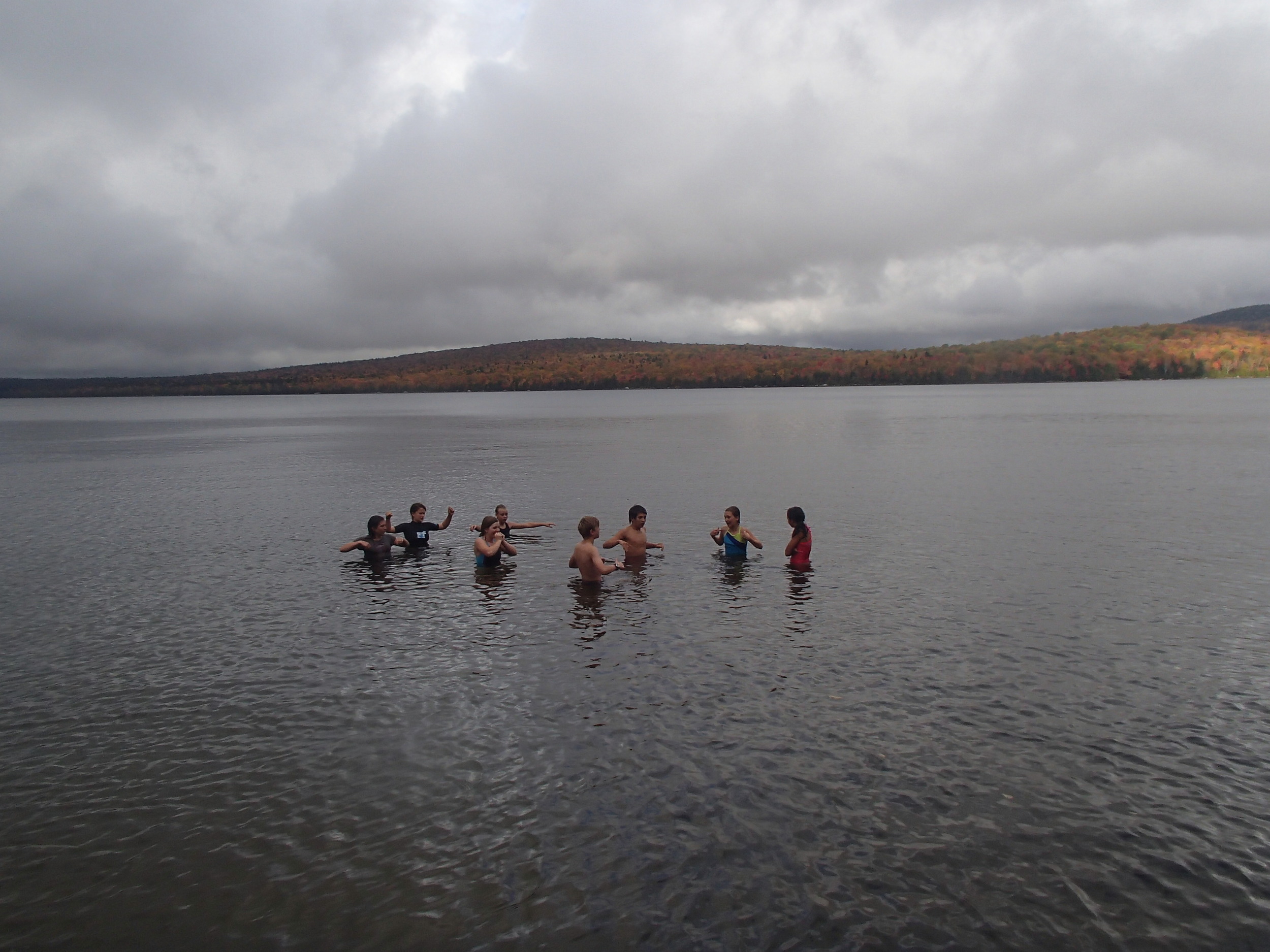
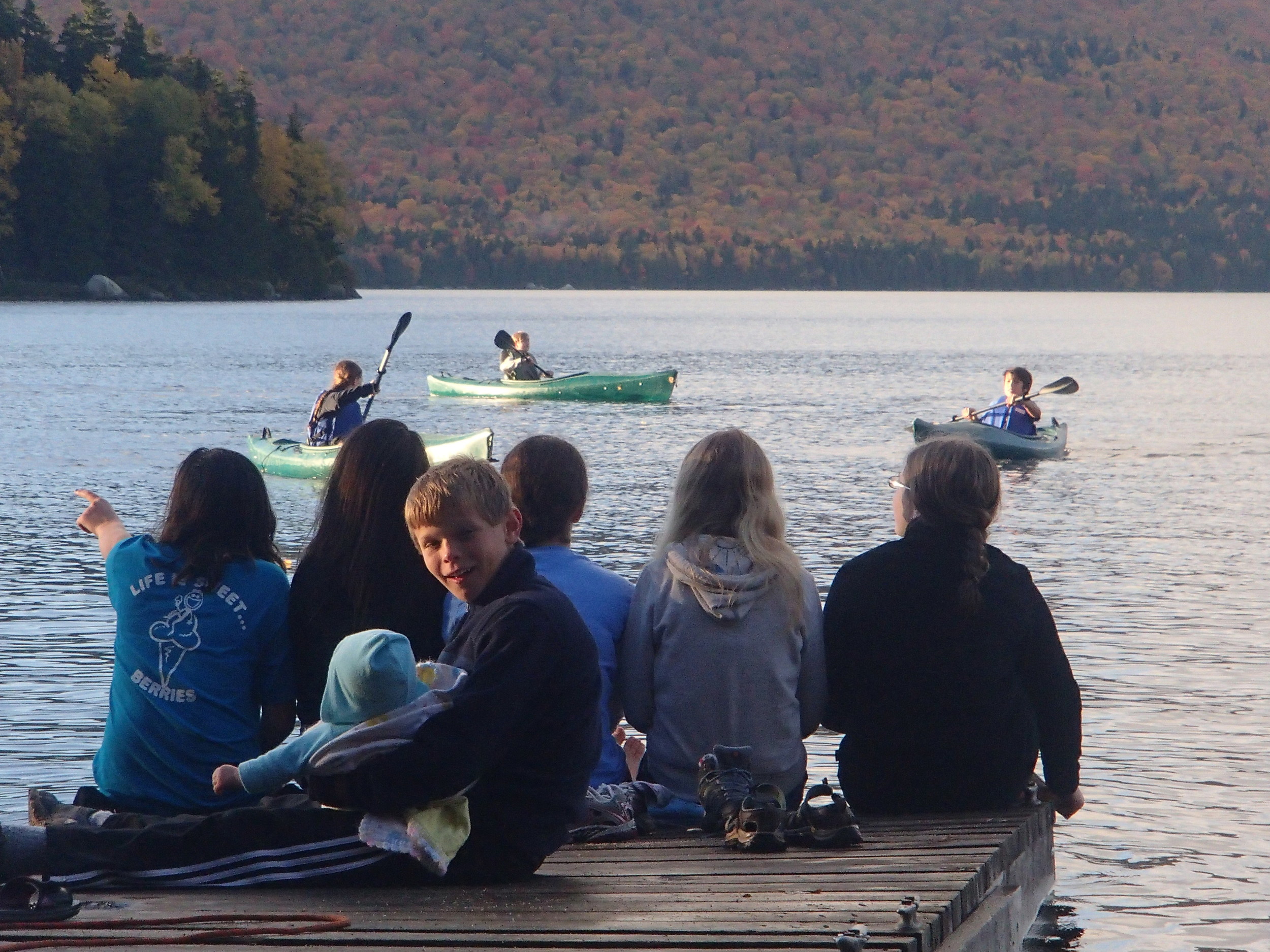
Up until two years ago, I attended a Montessori school. This meant I spent a lot of time outside. In elementary, we had recess every day, whether it was snowing or raining or sleeting. We had lessons out in the woods and took trips to the beaches and mountains. Unless the temperature was way below freezing or it was thundering and lightning, we were out in it.

Curiosity, love, and concern for the natural world has been a part of who I am from a very young age. Now that I am older, I read the biology textbooks, watch the powerpoints on ecology, take my dog for a walk after school every day, and I understand a little more of what is happening out there in the world. I get it. And I love getting it. Learning about life and nature gives me a sense of fulfillment that no other subject in school does. I compost and recycle at home. I am President of the Green Group at my high school, and I am happy to say that the school now recycles! When I’m out with my dog I'll pick up trash from the side of the road. I hike mountains with my dad, even in the snow. I love being outside.

Recess, but also every lesson and trip we took in the outdoors while I was in Montessori, was a very meaningful experience for me. It made me the person I am today. It instilled in me a curiosity and a passion that otherwise might not exist and for which I am very grateful. I’m seventeen years old now, but I will never stop playing outside. I will never stop loving the earth and I will never stop fighting for it. I will never stop asking questions and never stop wondering how the earth works. I will never stop — because of recess. Because of log kingdoms, leaf crowns, little sand fortresses, and muddy games of capture the flag.


-Alexandra Campbell, HMS '14


The Difference

To be curious, self-directed, and engaged; to be compassionate, collaborative, and think critically;  to be adaptable and problem solve—these so called "soft skills" are now seen as most necessary for our rapidly changing world. Montessori education focuses on all of these with the same amount of importance as academic skills. 

How do we do it?

IT STARTS WITH UNDERSTANDING THE NATURE OF CHILDREN

Children come into this world wired to learn. They are naturally curious with an eagerness to explore, discover and figure things out for themselves. The Montessori classroom—based on years of scientific research—is a supportive environment rich with materials designed for children, cultivating their natural curiosity and joy of discovery with the guidance and encouragement of trained adults.

REAL LIFE HAPPENS HERE

Philosopher and educator John Dewey said, “Education is not preparation for life; education is life itself.” From the very beginning of their Montessori experience, children learn to take care of their own needs (preparing snack, putting on their own shoes and jackets) and environment (sweeping up, watering plants). In doing so, they develop a level of physical and intellectual independence not often seen in young children. This daily experience of being trusted with real responsibility for meaningful tasks results in children with authentically earned self confidence. 

COOPERATION AND COLLABORATION ARE THE CULTURE

The youngest children start with lessons in “Grace and Courtesy”—lessons that teach them how to respect themselves, others, their classroom and the environment. As the children grow older, they learn to respect and understand the connectedness between all living and non-living things, leading to the adolescent’s profound awareness of the complex web of human existence.

THE GIFT OF UNINTERRUPTED TIME

Each child is free to choose her own work. A teacher will carefully observe—but not interrupt—a child’s work as long as it’s purposeful. When children are given the opportunity to engage in meaningful, interesting, self-directed work, they achieve a high level of focused concentration. Scientists refer to this as a “flow” state of prolonged, energized work that produces both calm satisfaction and a profound joy in learning. 

EMOTIONAL INTELLIGENCE IS BUILT IN

Children stay with the same teacher for three years, building lasting relationships with the teachers and friendships with children of different ages. The multi-age classroom offers a dynamic social setting where children learn from each other, master skills, and become facilitators of learning for their classmates, creating experiences that build emotional intelligence not possible in traditional single-age classrooms.

NO ROWS OF DESKS

Anyone who has been around children knows: children need to move. Children can choose to work at tables, on the floor, or outside if their work takes them there, eliminating the fidgeting and boredom that often comes with being forced to sit still at a desk for extended periods of time. The youngest children develop their motor skills in the Montessori classroom by working with materials that focus on skills such as grasping, pouring, stacking, carrying and balancing. Appropriate physical skills are integrated into the curriculum at all levels because our goal is not only intellectual competence, but human competence. 

FREEDOM WITH RESPONSIBILITY

Montessori classrooms strike a balance of developmentally appropriate freedom with responsibility—you cannot successfully have one without the other. As a child grows, so do his choices and responsibilities, providing him with the necessary framework to succeed in ever-larger spheres. In their early elementary years children are planning out their activities for a week, and by their later elementary years they are conducting month-long independent research. By middle school students are running their own business. Is it any wonder that so many entrepreneurs credit their Montessori foundations with their success?

NO GOLD STARS

Techniques that focus on external rewards like grades or gold stars tend to take the joy out of learning by reducing it to a means to an end, rather than a journey of discovery. Programs like "No Child Left Behind" and "Race to the Top" forces conventional education to focus on tests and grades. It’s not that our students never experience a test, but our teachers are not encumbered by “teaching to the test.” We don’t measure competencies that way. Because students work independently and one-on-one with the teachers, assessment happens all day, everyday, through careful observation of each individual child. 

TIME IS THE VARIABLE. LEARNING IS THE CONSTANT.

The teachers present lessons when the child is ready for them, not necessarily when a national curriculum dictates that she’s ready. This allows each child to learn when she shows readiness and eagerness for a particular subject, which is when learning happens most effortlessly and deeply. Children move uninterrupted through the curriculum at their own pace, often exceeding the state's education requirements. This removes much of the frustration and boredom that can hinder positive learning experiences in conventional education, where time is the constant and, unfortunately, learning can be the variable.

FROM CONCRETE TO ABSTRACT

Developmental psychologists now confirm: an integrated, active, hands-on approach is the most engaging and effective way for children to develop skill and understanding. In contrast to classrooms where learning comes from texts, worksheets, and lectures, a Montessori classroom features materials specifically designed to make abstract concepts real. For example, a very young child works with strings of beads to sensorially experience “five” or “ten,” bending the strings into a square or cube—developing his mathematical mind and a foundation for increasingly abstract concepts later. Maria Montessori said “Never give more to the mind than you give to the hand,” and we’ve seen that knowledge built this way is not forgotten.

GRIT

Perseverence. Resilience. “Stick-to-it-tiveness.” Call it what you will, Montessori kids have it and researchers agree that kids who have it get along further in life. We understand that sometimes the most valuable thing that a teacher (or parent) can do to help a child is to back off a bit. To let children face some adversity on their own, to fall down and not be helped back up. We allow children to make mistakes, to learn from mistakes and hence, to learn what it takes to succeed. It only makes sense that children who learn to try and try again develop the crucial ability to overcome setbacks and in the process, develop true strength of character.

WE ASK THE BIG QUESTIONS

The world isn’t divided neatly into subjects, and neither are young minds. Starting in first grade, Montessori students are presented with “Great Lessons”—formal stories about the universe, time, humans, communications, and numbers. In addition to stoking the flames of curiosity and forming a context for exploration, children become adept at drawing inferences between subjects, critical thinking, and understanding the big picture—skills that are highly valued in today’s rapidly changing world.

EDUCATION FOR LIFE

We view education as helping each child reach his full potential. Montessori isn’t just a philosophy, nor is it based on a national common curriculum. Montessori is an education methodology based on the natural development of the human being and has proven successful for more than a century in tens of thousands of schools around the world. We teach the way children learn. We focus on all of it. That is the difference. Montessori is more than just school. It is education for life.

-Camille Campbell
Core Curriculum

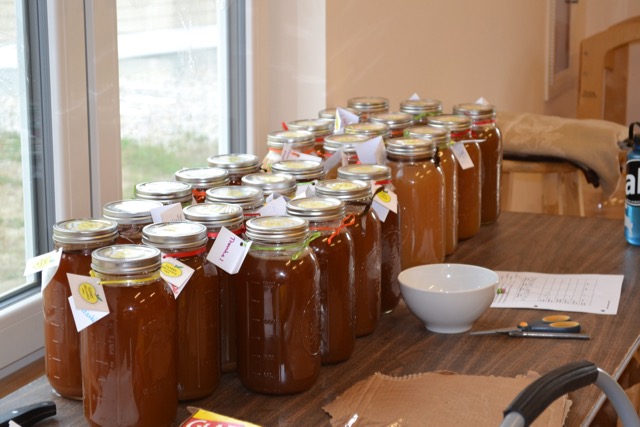
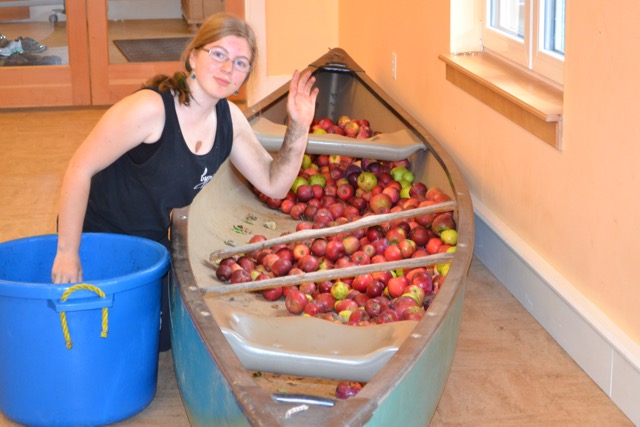
You have seen the Upper School students in orange vests with bright, smiling faces outside of our school selling cider these past few weeks. Have you wondered why? It is part of the work Montessori found most meaningful for adolescents. She believed that this is the time for these nascent adults to begin to join the society of adults, namely its economic life. It is the time for them to contribute their efforts and to receive compensation (in our case, the building up of a travel fund) in return. This "Micro-economy" work need not center upon apples. We may well sell jars of honey, chocolates, or candles as the year progresses. We chose cider because Hollis has long produced excellent apples and our property is an old orchard, where we tend and harvest our own apples. And apples are a celebration of the sunlight now fading. They are a sweet conclusion, a symbol of life, and a suitable gift to offer you. 

What is required of Micro-economy work is that it engages both the hand and the mind. These students have new, growing bodies that need to be strengthened and challenged. They need, as well, to be called to reason, to communicate, to make decisions, and to evaluate the results of those decisions. Their business name "Sunny Orchard" is such a nice, simple thing but it represents hours of discussion. This decision, however, was far easier that determining the price of a half-gallon of cider or choosing whether to offer pasteurized or unpasteurized cider. They have needed to think ahead, to think on their feet, to plan for contingencies, to compromise, to work when they were worn through.

They have needed to research regulations and processes, to talk to strangers, to write checks and keep accounts. They have worked in the rain; they have stood their ground when faced with yellow jackets and maggots. They have learned to persevere, an essential quality to a successful life as an adult. And by standing through these tests and by producing through their own efforts a lovely drink that the community wants to buy they have grown in confidence; in themselves and each other.

Academics have not been set aside. Problems with pasteurization and fermentation lead to chemistry and microbiology lessons. Contact with wasps lead to discussion and the key differences in form and function between wasps and bees. Articles and advertisements need to be written well. Conversion of units of measure, ratio and proportion, pi, and compounding interest have been required in order to achieve success. It has been real to the students. This has led to their complete engagement in the process. Engagement is the first requirement of learning.

-Jim Webster

Making the World a Better Place - One Child at a Time

Last Thursday was Gandhi’s birthday, and also the International Day of Nonviolence, a day to honor peacemakers around the world. To observe the day in the Lower Elementary, we read a short story about Gandhi’s life and talked about ways each of us might practice peace. The children thought of many different ideas like writing letters to new neighbors, helping someone, thinking about Gandhi, working with a Zen garden, saying kind words, and appreciating nature.

11 Ways to Foster Independence

Developing Skills, Grit and Resiliency through Trial, Trust and Failure. 

After reading and agreeing with popular articles explaining how losing is good for kids, that grit is essential for success and that a 4th R resiliency  has been added to child-rearing, it seemed like the next logical, large scale conversation might be:

  • How do we allow failures to occur naturally in our child’s life?
  • What will it look like to foster independence?
  • Can my child handle what comes along?
  • What can I do to encourage and show trust in my child?

Failures occur naturally when we allow our children to take a more active role in their own lives by providing them with ample opportunities to choose. Young children, with not much life experience, are bound to choose to play with a favorite toy instead of getting their snack or lunch ready for school, resulting in a hungry belly at snack time. The result is a learning experience that provides good information for the following day and a chance to develop resiliency as they experience a minor failure.

Here are 11 Ways to Put Trying, Failing and Recovery into the Everyday

  1. Send the kids outside.

    Often, we send the kids outside when we’ve decided we’ve had enough. Enough screen time, enough rough-housing, or enough whining because they are “bored.” Instead of using outside time as a reaction to enough of something, get creative and spin it. Show the children how you used to make teeter-totters out of scrap wood. Or better yet, leave a pile of wood, nails and a hammer and see what happens. If your child is younger, allow for time to play in a puddle, pile of leaves or muddy zone. There are countless ideas out there.

     
  2. Ask the kids.

    Consider asking your children to identify one thing they have never done, then encourage and enable them to try. The end result is not the goal. The process is! Give it a try, simply ask, “What is one thing you have never done but would like to try?” Then plan how and when, and simply be there without commentary, as they give it a go.

     
  3. Start small.

    After we ask, we have to allow our kids to make toast, knowing it will lead to making eggs and pancakes one day. We have to slow down and say, try it. Even if as Lenore Skenazy says, “Maybe these tasks seem small, even silly, but in a culture that has created mountains of fear around every childhood experience, these kids (who are encouraged to try) have started their climb. Pretty soon, they’ll be ready to fly.”

     
  4. Share stories.

    When we look to other people, to our own childhood stories and success stories from other children, it becomes easier to put it all in perspective. For example, Ringo Starr, a surviving Beatle, was chronically ill as a child and never finished school, in fact he spent many years in the hospital. It keeps things in perspective to think one of the most famous, beloved drummers in history discovered his own talent while tapping sticks to pass the time in his hospital stay. This certainly wasn’t a picture perfect- mom- and-dad-will-make-it-happen-route and he turned out pretty successful on his own, don’t you think?
     
  5. Encourage other parents.

    Parents talk. Parents want what is best for their children. Avoid showing off what your child can do, but rather encourage other parents to discover for themselves that their children CAN handle more than they think.

     
  6. Identify your fears.

    After your child has chosen a task, it’s helpful to write down the fears you have. Once you do this, you can plan for how you will respond if your worst fears actually come true. (Example: If I let my child pack her bag, she will forget her boots. I am afraid the school with think I am a bad parent. Plan: I will send a note saying I am encouraging my child and if she forgets her boots, we will work on ways to remember them at home.)

     
  7. Get the facts.

    After writing down your fears, get the facts. If you’re afraid of the bigger, “what- ifs” like abduction, find out the real stats and then plan accordingly. See Protecting the Gift by Gavin de Becker. Bottom line: instead of putting the axe on an idea altogether, find another way to create the same experience through alternative planning and enabling.

     
  8. Let go.

    Here’s where we, as moms and dads, have some work to do on ourselves as we develop the habit of letting go. We can try to control the outcomes and direction of our children while they are young, but as our children get closer and closer to leaving the nest, it is imperative that they learn and practice staying afloat and recovering in the wake of mistakes and mishaps. If we impede their progress neither of you will be prepared for what the real world will deliver from 18-years to 80-years-old.

     
  9. Practice, practice, practice.

    In order for kids to experience and garner meaning and develop resiliency from the lumps and bumps, the ups and downs, the oopsies and flops that go hand-in-hand with all learning, kids will need oodles of practice time. And as parents, we have our own job to practice stepping out of the way and trusting our children. No parent I know is likely to wake up one day saying, “Alrighty kiddo- this time you’re on your own.” Likewise most kids won’t wake up one day saying, “No problem, I didn’t make the team or I forgot my lunch, I’ve got this,” without some practice. Baby steps and practice are good for everyone in the family.

     
  10. Keep track.

    When parents keep track of the efforts and outcomes, it becomes very clear that over time, these “simple” tasks add up. They also keep motivation high and evidence in hand that yes, children do benefit from us backing off and staying quiet (grab the duct tape) and showing our kids that we have faith in their abilities to tackle new things and overcome failures.

     
  11. Celebrate!

    If your second-grader made eggs for the first time (after four failed attempts with shells in the scramble), he’s a rockstar because he’s taking on more responsibility and he did it. He made it through the failures, as minimal or as grand, as they may seem to us. This is progress! Have a big breakfast and make it a celebration.

As children grow and mature, parents can foster independence by allowing children to make choices, learn from them, make necessary course corrections, experience failure and success and develop the resiliency they require to tackle any of life’s challenges and obstacles. As the Buddhist Quote says, “Fall down seven times, get up eight.” 

By Vicki Hoefle (Guest Blogger) 

Join me for a lively workshop on Monday, October 6th, 7-9pm,
right here at Hollis Montessori School. Details & Directions

Vicki HoefleCreator, Parenting on Track (TM)Author, Duct Tape Parentingwww.vickihoefle.com

Vicki Hoefle
Creator, Parenting on Track (TM)
Author, Duct Tape Parenting
www.vickihoefle.com

From the Mouths of Babes: Our Top 10

Language is essential to humanity, but it is something we often take for granted.  It allows us to communicate our thoughts and emotions and lays the foundation for reading and writing.  It sets apart entire cultures.  

Anyone who has children of their own, or those of us who work with children know the great capacity of their ability to listen and to speak. Maria Montessori, who had her own gift for words said, "At the base of every language is the great register of the sounds of the language - the child. The child is, as it were, a machine made by nature for this task. The child hears the sounds exactly.  That is in itself marvelous....The child has no preparation either, yet nature has given him this immeasurable gift which is that of registering and fixing these sounds in exact measure.  The adult prepares the intelligent part, the child takes it up, fixes it, keeps it." (Creative Development in the Child)

Sometimes we marvel at their words, and sometimes we wish we had been more careful speaking around their little ears.  Either way, children certainly have their own unique way of communicating. In that light, here is the top 10 list of gems we have compiled "from the mouths of babes":

  1. "I know the biggest number in the world.  It's five thousand, two hundred, fifty-three hundred thousand twenty-seven."
     
  2. Child approaching Guide with a tangled necklace halfway around his head, "Can you help me with this?  It won't fit.  My head grew too much."
     
  3. Child:  Today is my daddy's birthday!
    Guide: Well tell your daddy happy birthday for me!
    Child:  Ok.  He's turning um, 90, well, I think 91 today.
     
  4. "We have to have our heads checked to make sure no lace is in our hair." (child referring to a lice check)
     
  5. "I saw a mommy worm and then I went away and came back and it gave birth to three baby worms!"
     
  6. "My mom said I can't choose that work."
     
  7. Child:  "My dad has a job."
    Guide: "What does he do in his job?"
    Child:  "He rides his bicycle all over the place and sells pieces of plastic."
     
  8. After an informative discussion on spitting and germs, a child excitedly waved her hand to share a comment:  "Well one time when I was a little baby, I stuck my hand all the way down my throat and threw up all over my bed."
     
  9. "My grandma sleeps ALLLLLLLLLL day.  Until the afternoon!"
     
  10. Guide (asking a child if he is available for a presentation):  "Are you free?"
    Child:  "No!  I'm 4!"


-Becky (Children's House Guide)