Embracing Diversity from a Young Age

034-IMG_4465.jpg

We all want our children to be be peaceful and accepting of others.  It is never too early to start teaching them to embrace diversity.  Too often, we falsely imagine that young children do not notice what makes them different from each other.  They do notice, and instead of waiting for them to ask questions or gather information on their own, we can be proactive about diversity education.  We can teach them that while there are so many ways humans can be different from each other, those differences (and our similarities) should be celebrated.

Setting an Example

Our children constantly look to us as models for their own behavior.  We can take the lead by embracing the values we hope to see in our children.  This starts by educating ourselves.  We can learn about different cultures and groups of people.  We can confront our biases and consider how they might be coloring our view of the world.  We can read about current issues in social justice and decide what responsibilities we have to make the world a more equitable place for all people.   

Read Together

There are many quality books written for children about this very topic.  Here are just a few... (click on the book images to go to the book's page on Amazon)

Last Stop on Market Street, by Matt de la Peña & illustrated by Christian Robinson

This book was the 2016 Newbury Medal Winner, and also received a Coretta Scott King Illustrator Honor and a Caldecott Honor.  A little boy rides the bus with his grandmother after church each Sunday.  His grandmother’s laugh guides him through the journey as they meet a wide variety of people.

The Ugly Vegetables, by Grace Lin

Award-winning author Grace Lin wrote this charming book for young children.  A daughter helps her mother in their garden, but becomes dismayed when she sees it is fully of “ugly vegetables” while the neighbors are all growing flowers.  The soup her mother makes and the gathering of neighbors teaches the value of differences.

The Sandwich Swap, by Queen Rania al Abdullah & Kelly DiPucchio, illlustrated by Tricia Tusa

Salma and Lily are best friends.  One day, a conflict arises over their sandwiches at lunchtime (pita with hummus, and peanut butter with jelly).  The food that threatens to end their friendship ultimately binds them together again.

The Family Book, by Todd Parr

Parr’s books are simple, but his bright illustrations and straightforward story are perfect for young children.  The Family Book highlights many different types of families, and ends by saying, “There are lots of different ways to be a family.  Your family is special no matter what kind it is.”

You Hold Me Up, by Monique Gray Smith & illustrated by Danielle Daniel

Smith’s website states that she “wrote You Hold Me Up to prompt a dialogue among young people, their care providers and educators about reconciliation and the importance of the connections children make with their friends, classmates and families.” (link: http://moniquegraysmith.com/writing/ )

Experience Together

There are so many ways a family can have fun together while encouraging curiosity, understanding, and empathy with different groups of people.  Think about the activities your family already enjoys, and find ways to make those activities learning experiences.

Do you and your family enjoy cooking?  Try whipping up new recipes from different cultures around the world.  Preparing and sharing a meal is one way we all bond, so why not explore other cuisines?  

Many cities and towns hold festivals celebrating the cultures of the various people who live there.  Music, food, traditional crafts, and performances can be a fun way to learn about another culture.

Does your family love music?  Visit your library to borrow CDs or find some audio clips online.  Music from around the world can inspire your child to sing and dance.  Grab any instruments you may have on hand (or make your own!) to join in on the fun.

Share Your Own Experience

Each family has its own unique history, heritage, and traditions.  Teach your child about their ancestors, where your family originated, and what makes your family special.  Offer to share these traditions at your child’s school.  Teachers love to have parents come in for special presentations.  Whether you teach the children to prepare a snack, sing a song, or read them a traditional story, every new bit of cultural learning gives them a broader view of their world.  

Let’s open up the world for them, so that they may share it peacefully with each other.

Independence and the Montessori Child

HollisMontessori-February2017GeneralPhotos-ForPrint-18.jpg
“Never help a child with a task at which he feels he can succeed.”
— Maria Montessori

You may already know that Montessori educators value and encourage independence in even their youngest students.  Why is it so important?  We believe that nurturing this valuable character trait is both empowering and necessary.  

Benefits of Cultivating Independence

In short, giving a child the gift of independence lets them know we value them and know they’re capable.  Children can grow up feeling empowered and safe in their abilities to make sound choices.  When we trust them, they learn to trust themselves, ultimately becoming happy and productive members of their communities.

Of course, this looks different at different ages.  Children birth to age six want to do things by themselves, while elementary aged children want to think for themselves.  Adolescents seek both physical and social independence while they tread the waters between childhood and adulthood.  It’s important to remind ourselves of these developmental stages, both as teachers and parents.

What Independence Means at School

In the earliest years at school, children focus on what we refer to as practical life skills.  This may include learning to prepare simple snacks, putting on their own shoes or coats, or caring for classroom plants and animals.  Children are given endless opportunities to practice these skills.

Another facet of independence at a Montessori school involves choice within limits.  Children are able to decide what work they are interested in.  Teachers carefully prepare the classroom environment so that all choices are safe and desirable, but within those boundaries the child is free to explore.

As children get older (the elementary years and beyond), they must meet certain academic expectations.  Teachers use a variety of tools to help students work independently while still meeting their goals, including work plans and time management strategies.  Research becomes of great interest at this time, and children are given ample opportunity to deeply explore topics they choose.

How Parents Can Support This Work at Home

How can families continue the cultivation of independence in the home?  It all starts with a shift in the way we view our children’s capabilities.  They are often able to do much more than we realize, and with a little bit of modeling they tend to eagerly accept a challenge.  After all, our children want to do what we do, and if we give them the proper tools and support, they can begin practicing.

The chart below highlights some of the possibilities.  Think of this as an inspiring guide that highlights what children of various ages are typically capable of.  Giving our children tasks such as these builds their confidence while helping them learn how to be contributing members of a community - in this case, their family.

Looking Forward

One of the easiest ways to encourage independence in our children is to be more aware in the moment.  Though it can be a challenge to slow down and let them move at their pace (like when they insist on zipping up their own coat while we’re rushing out the door to get to work), it’s going to benefit them in the long run.  Building a little extra time into our schedules can help!  Some little changes we can make to embed this value into our days:

  • Send your child to put their shoes on 10 minutes before you’d like to leave.
  • Leave child-friendly cleaning supplies within reach.
  • Put pre-portioned or easy-to-prepare snacks on low shelves.
  • Turn spills and messes into opportunities.
  • Let your child (eek!) pick out their own clothes. For younger children especially, some weather appropriate guidance is just fine.  Enjoy the creative fashion statements that ensue.

Montessori reminds us that supporting independence is a conquest that does not end, though it most definitely evolves.

“Independence is not a static condition; it is a continuous conquest, and in order to reach not only freedom, but also strength, and the perfecting on one’s powers, it is necessary to follow this path of unremitting toil.”
— Maria Montessori

Losing our Grip

static1.squarespace.jpg

Last week we posted the following article (Losing our Grip http://bit.ly/2ghoMsv) on our facebook page. The article discussed the increasing number of children in kindergarten without the fine motor skills needed to manipulate scissors, hold pencils, etc. The New York Times reported in February that public schools in New York City saw a 30 percent increase in the number of students referred to occupational therapy, with the number jumping 20 percent in three years in Chicago and 30 percent over five years in Los Angeles.

Why is this?  The article points to three causes:

  1. Our culture has increased pressure on parents to involve young children in organized activities. More organized activities does not equal more body awareness. There is less time for free play and opportunities for children to manipulate their environments to understand spatial concepts. As we Montessorians know, young children learn by doing, not by being told what to do.
  2. Parental Fear. Some parents are afraid to let their children engage in physical play or use tools such as scissors. Today’s children spend less time outside, where they have more opportunities to explore how their bodies move through space, learn balance and figure out how to handle tools and toys in relation to one another. Playgrounds have changed tremendously over the years. The equipment that supported sensory integration, such as merry go rounds and monkey bars, are no longer present. 
  3. Technology. The “educational” tablet has replaced the activities which support fine motor skills such as playdoh and coloring. 

Montessori Children’s House classrooms offer ample opportunities for fine and gross motor development. With the absence of technology in our programs, the children are free to work towards developing their hands and bodies and in turn their minds for the academic work to come. Many people are surprised to learn that fine motor skills are a robust predictor of academic achievement. Read more about that here.

-Kari

Homework or Work of the Home?

“I like a teacher that gives you something to take home to think about besides homework. ”
— Lily Tomlin

For most of us, homework doesn’t enter our thoughts until the mid-elementary years and is typically thought of as worksheets and assignments given by the child’s teacher. That’s where we are different. Traditional homework emphasizes the repetition of rote behaviors rather than the development of understanding. These assignments limit the possibility for exploration, substituting the mere completion of a task for the joy of discovery and personal understanding.

Montessori schools, on the other hand, think of homework, or rather the work of the home, as an opportunity for real purposeful work, decision making, and an opportunity for the child to show choices about their learning. To that end, the work should be of interest and meaningful. At the Children’s House level that takes the form of self care in washing and dressing, caring for the environment by wiping up spills, putting things away, setting the table, etc. They can help care for pets and learn vocabulary at the grocery store. It means leaving plenty of time in their day to explore the natural world and make decisions about their free play.

At the Elementary level they can learn to knit, sew, build a bookcase with an adult, learn photography or learn a new song to teach the class. It could mean finding a newspaper article to discuss with your family, play Scrabble, or write poetry and stories. It can take the form of comparison shopping, keeping statistics of when you go to bed or helping with the family budget. They can plan a family vacation, play on a sports team, learn an instrument. The list is endless! (An actual list exists! Ask your elementary guide or the front office for one).

Our Upper School children experience homework by preparing writing assignments to read aloud to their class, reading and writing responses to seminar topics, completing math assignments that they will then present to their classmates and teacher, and practicing their Spanish. The focus here is on real, purposeful work. This homework is intended to wrestle with ideas and to think deeply about questions that matter.

-Kari


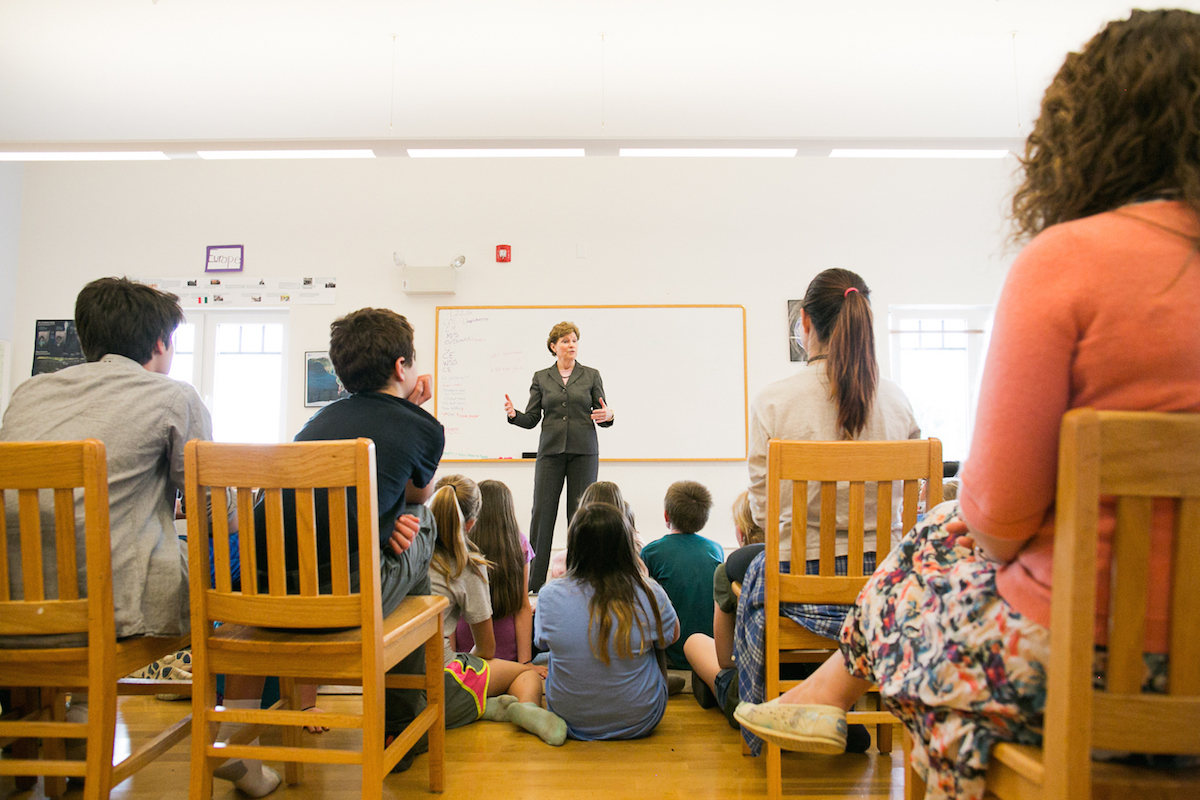
Earth Day with a U.S. Senator

Imagine my surprise in late April when I received a call from U.S. Senator Jeanne Shaheen’s office requesting a visit to our school on Earth Day! How exciting for our school! While our Board Chair, Frank Grossman and our building’s architect, Dave Ely, pointed out the features of our energy efficient building, I was excited to share with her the beauty of our classrooms and the Montessori work going on within.

As she walked through each classroom I had a chance to share tidbits of information about our programs. In Lower Elementary, where the children were at gathering, one child shared her version of energy efficiency telling the Senator how much better it would be to grow our food locally so that the “raisin wouldn’t have to use all that energy traveling to New Hampshire”. Another child presented her with a knitted potholder. The Adolescent students asked her well articulated questions on her energy bill and why she chose to become a Senator. They presented her with products from Sunny Orchard, their small business, as a nod to her work as a member of the U.S. Senate Committee on Small Business and Entrepreneurship. The visit was a wonderful opportunity for our children and school.

-Kari


Why Start at Age 3?

What is the ideal age to begin Montessori school? Age 2.9 to 3! The young child's ability to effortlessly absorb information from his environment is only possible during this window of time. Dr. Montessori observed that during these early months, which she called sensitive periods, a child's entire being is molded: his intelligence itself is being formed! 

The child from age birth to six years old passes through three significant sensitive periods; those for order, movement and language.

SUPPORTING A YOUNG CHILD'S NEED FOR ORDER

During the sensitive period for order, a young child needs her environment to be predictable and orderly. If her life has a rhythm and her routine is maintained, she begins to trust the environment. If her needs for food, sleep and bodily comfort are predictably met as they arise, she uses this satisfaction as the basis to feel secure and to explore her world. The three year-old is at the height of sensitivity to ritualistic order; she still needs routines and yet can begin to create her own order. This is the perfect time to model that activities have a beginning, a middle and an end. 

COORDINATION OF MOVEMENT

The sensitive period for movement is the time the child develops his coordination and fine and gross motor skills. Allowing your child safe yet challenging movement without interference develops this skill and his self confidence. It's time to jump, hop, skip, and climb, to carry heavy things, to balance objects on a tray. He needs to use a scissors, to pick up tiny objects and to refine his eye/hand coordination allowing his hand to truly become an instrument of his mind.

THE PRIME TIME FOR LANGUAGE DEVELOPMENT

During the sensitive period for language, the child can hear the individual sounds in words as she learns vocabulary— an ideal time to begin learning the sounds of letters. During this time she will expand her vocabulary immensely. She wants huge words and funny words and rhyming word and words in songs. Our Montessori environments, rich in vocabulary, meet her word hunger perfectly.

When the children's environment is based on and organized around the sensitive periods, the children work with an enthusiasm and sustained interest that is truly amazing. Their development is strong and steady.

Authentic Montessori preschool is a three-year cycle designed to engage children from age 3 to 6 (preschool through kindergarten). The activities in the first year lay an important foundation for future learning. Over the following two years the activities and lessons build upon themselves at the child's own pace. Parents are often amazed when a child "explodes" into reading, writing, and math during the final year. It might look like magic, but it is really the culmination of the first two years in the Primary classroom. By starting at 3 and remaining in the classroom community for three years, Montessori children have an inspiring educational experience.

-Kari