What is Montessori? 5 Main Points

Girl with Montessori Pink Tower

Pretty much anyone reading this article knows the answer to that question is not a simple one.

Are you new to Montessori? Have you found that anytime you ask the question you are amazed by the utter depth of the answers?

Have you had a child enrolled in Montessori for several years? Do people ask you to describe it and you find yourself unable to summarize it into a brief conversation?

You’re not alone. It’s challenging to squeeze an entire philosophy into a five-minute conversation.

Today, we’re giving it a try anyway, with what we feel are five main points that summarize the essence of Montessori education.

Montessori considers human development and aims to meet people where they are.

Human development lies at the core of Montessori. Dr. Montessori spent years observing children and their behaviors, noted their individuality and variety, then categorized and summarized typical growth patterns. She called these the planes of development, and they span across the first 24 years of life.

Does everyone develop at different rates? Of course. Are there patterns that are seen in the development of most children? Absolutely. By developing a deep understanding of human development Montessori was able to create an entire educational system that honored children’s needs at different times in their lives. From the age groupings to the materials used, the physical environment and the very manner in which lessons are presented: everything is intentional. Everything is about meeting the child where they are in order to best support their needs. 

Instead of delivering standardized information, Montessori hopes to guide students as they travel their path themselves.

You will never see a Montessori guide standing at a chalkboard at the front of a classroom lecturing students sitting in rows of desks.

In fact, you’ll never see a Montessori guide lecturing at all.

Is there a Montessori curriculum? Absolutely. Do modern Montessori schools take the time to ensure the curriculum continues to cover skills necessary for today’s students? They sure do. The major differences lie in the delivery of this curriculum.

Our youngest students (0-6) are taught almost exclusively via individual lessons. They each progress at their own pace, and while they are all working their way through the same materials and lessons, they don’t have the pressure of doing that at the same time as their peers. They also have the benefit of leaning into areas that interest them more deeply.

As our students get older, they do receive more group lessons, although the main driving factor for this approach is the older child’s need for peer connection. They still get to move at their individual pace, and they still get to explore areas that they feel particularly connected to.

Education should never be one-size-fits-all or even fits most. Our guides understand the importance of mastering critical skills, but they also know that there cannot be a forced timeline when it comes to getting the job done.

Independence, from the start, leads to confidence and excellence.

That subheading really says it all. Infants in Montessori programs are allowed and encouraged to move freely; they aren’t confined to cribs but rather lie safely on floor beds. Toddlers learn to dress themselves, take an active role in their toileting progress, and begin to learn how to care for their environment. The gradual release of independence continues through adolescence, with Montessori teens learning to run their own businesses.

We believe in the capabilities of young people. We honor and respect their abilities to do things by and for themselves. We support them as they work toward independence, and the results are astounding.

When you are trusted to be independent, you feel respected and confident. That sense of confidence builds on itself with each experience and develops children into adults who are not afraid to take appropriate risks because they know that they can achieve what they set out to do.

Social interactions are a critical part of our growth, and social learning deserves as much attention as academics.

‘Educating the whole child’ is a phrase that gets thrown around a lot. It’s an admirable goal - critical, even. The problem is, most modern educational systems don’t actually support teachers in achieving this goal.

Montessori does. We know that’s a bold claim. We wouldn’t make it if we didn’t believe it was absolutely true.

When educators or families transition from a conventional school to a Montessori school, one of the most stark differences is that of the daily schedule. Montessori school days are not rigid or organized by subject matter. They have long blocks of time that are flexible and able to be used for all kinds of learning. Sometimes this means a child spends an hour working on large multiplication problems. Other times it means they sit with a friend and a teacher and talk about mediation skills.

Social learning is not taught in isolation in our classrooms; it’s an underlying theme that runs throughout. We have the benefit of being able to truly teach in the moment, so when conflict arises, it can be approached as a learning opportunity.

Society stands to benefit from a system of education that teaches students about the universe as a whole, as well as the interconnectedness of everything on Earth.

The Montessori curriculum was very intentionally created to nurture compassionate and active community citizens. When we teach children, our goal isn’t to prepare them for the workforce (although we do that as well). Our goal is to prepare them for life.

We teach our students about the universe, about how life has changed on Earth over time, about how each individual organism plays a part in the delicate balance of our ecosystems. We teach children about the ancient history of early humans, with a focus on how they developed skills like writing and systems of mathematics. This appeals to their own development of the same skills, and gives them a reverence for the people who came before them. It also allows them to feel a deeper sense of where they fit into the big picture.

To close, we will leave you with one of our favorite quotes by Dr. Maria Montessori herself. This idea is one that drives us to do what we do each day, and a hope we know we share with all of you.

The child is both a hope and a promise for mankind.
— Dr. Maria Montessori

Materials Highlight: The Fraction Insets

Montessori Fraction Insets

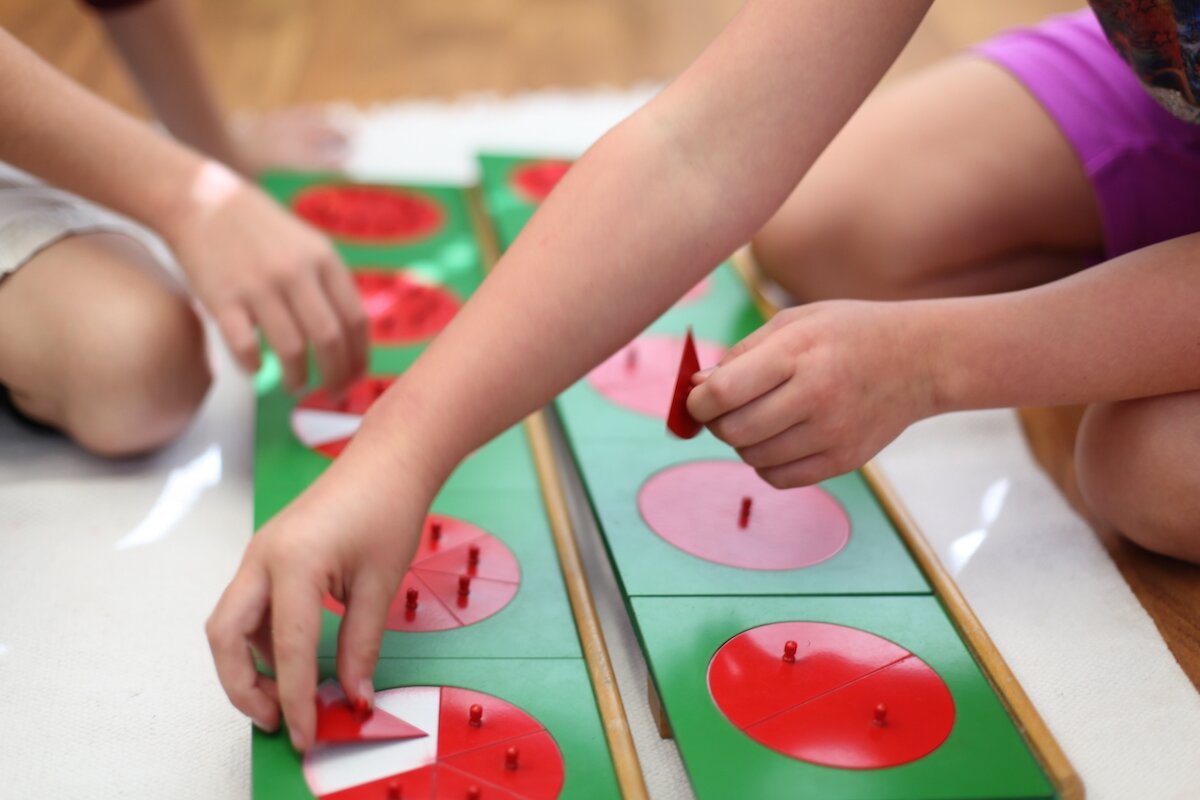
For this month’s Materials Highlight we bring you the fraction insets; a beautiful set of metal templates resting on slanted wooden trays. As you can see in the photo above, the insets range from one whole through tenths, and each piece has a small knob allowing children to move them easily.

But before we get to the insets, perhaps we should back up just a bit.

Prior to an introduction to fractions, the child has had extensive instruction and experiences with numeration being based on the unit. One unit (or one, one whole, etc.) has been the basis by which they have learned to count, skip count, add, and subtract. As the child enters lower elementary, they are ready to learn who we may divide a unit.

This work often starts with an apple. The Montessori guide sits the children in a small group and tells them the apple will be divided for them to share. They then proceed to cut the apple without any regard to straight or even lines, creating small chunks and larger ones. The children quickly realize the injustice in distributing such apple slices, so the guide takes out a second apple to cut it evenly and impart the importance of equal slices being fair. The stage is set for learning about fractions.

An Introduction

It’s important to note that while the most commonly used and popular fraction insets are circular, there are also triangular and square fraction insets. It’s important for guides to refer to this at times so the children have an understanding that anything may be divided, not just circles.

The first time children use the insets they are encouraged to observe what they notice, and they develop the concept that each inset is a family of sorts. “These are the thirds, these are the sixths, etc.”

The guide will make a point to use intentional language to create a firm basis in understanding: “This circle is divided into four equal parts. We call them fourths.” The guide will write out “fourths” as well as “/4” as children are able to verbally express their understanding.

The Numerator

During the course of this lesson, the guide doesn’t actually use the term numerator just yet. What is emphasized is that while the children previously learned the family names of each inset, the focus will now shift to individual pieces. Examples will be shown using the material, and both verbal and written expressions will accompany each.

For example: “This is one third, or ⅓.” “This is four fifths, or ⅘.” This may be the end of the lesson, or, if the children seem to grasp the concept quickly and easily, it may be combined with the third presentation.

The Third Presentation

The third presentation is essentially a culminating review of what has been covered so far. The children may take turns matching labels with fractions to show their understanding. The critical piece is that the guide will now formally name the numerator and denominator

There is a lot of opportunity for practice and extension work at this point. Children may trace and label fractions, make booklets or charts, work together to match labels, and so on. This work typically happens during the first year of lower elementary.

Equivalence

This is an exciting lesson for children. Once they have a firm grasp on naming fractions, the guide will again sit them down in a small group. The one whole circle will be removed from its frame and the two halves will be put in its place. The guide will show the children how one whole is equal to two halves. This will be repeated with similar equivalencies: 3/3=1, 4/4=1, etc.

Next, smaller equivalencies will be discovered. The guide will try and fit a piece into a number of different spots, proving where it does and does not fit. Children will learn several simple equivalencies, such as 2/6=1/3 .

As with the previous skill, there is plenty of opportunity for exploration and extension in regard to equivalencies. This is arguably the most important fractions skill of lower elementary.

Operations with Fraction

Once a child has a firm grasp of fraction basics, they are ready to learn operations. This will likely begin in lower elementary and extend into upper elementary, and are taught initially using the fraction insets material. Another material often used is called the fraction box, which includes small plastic replicas of the red circular fraction pieces. Skills include:

  • Addition and subtraction using the same denominator

  • Multiplying fractions by whole numbers

  • Dividing fractions by whole numbers

  • Addition with different denominators

  • Addition with more than two addends

  • Subtracting with different denominators

  • Multiplying whole numbers by fractions

  • Multiplying fractions by other fractions

  • Dividing whole numbers by fractions

  • Dividing fractions by fractions

Moving to Abstraction

Use of materials when teaching fractions is critical; we believe Montessori students excel later in life with more complicated math concepts because they have such a strong foundation in the basics. Rather than memorizing rote procedures they are physically manipulating numbers with their hands, giving them a deeper understanding of why we do what we do.

One cannot rely on materials forever, though, and there comes a time when the child is prepared to move onto abstraction.

This is often achieved by the teacher again showing an operation with the material while also writing out the pencil and paper process simultaneously. In fact, children will often come to this learning independently. They are able to make the connections as they master skills. If not, the guide is there to show them the way. There comes a point during the upper elementary years when a child no longer needs to rely on the materials to determine the answer to a problem. In fact, using the materials becomes cumbersome, and they are eager to put them behind.

Want to learn more? We encourage you to reach out and schedule a virtual tour.

5 Ways to Follow the Child

Follow the child.

It’s a beautiful, perfect, profound, and frequently used Montessori mantra. Our entire educational approach is built upon those three words. They are backed by science, proven by generations of children, and consistently revered by families around the world.

It seems so simple, but the truth is, everyday life can make them seem so challenging.

Today we break it down into five real, manageable ways to “follow the child” in your life.

1. Stop, look, and listen.

Observation is where everything begins. It seems so obvious, but it’s hard. Balancing parenting with the rest of our lives means we are often rushing around, doing our best, and feeling stressed from time to time.

This is not always possible or realistic but we’re going to say it anyway: find the time to slow down, stand back, watch your child, notice what they’re doing, and really listen to what they’re saying. Not just for 30 seconds, but really take some time to observe them from a distance. You may be paying close attention, but the best way to gain insight is to watch quietly until they forget you’re even there.

You will likely be amazed by what you learn.

There’s no need to even draw any concrete conclusions from what you notice; just paying attention and learning more about who your child is at this moment in time will give you amazing insight. It will inform your own parenting in ways you may not expect.

2. Make the time.

Just as we mentioned above, we know this is not always possible. Perhaps one of the greatest challenges of parenting is finding the time for just about everything.

The truth is our children usually need more time than we do. It takes them longer to get ready in the morning, there are falls and injuries that will need tending to, there are feelings that will become hurt, and a whole bunch of other unplanned events that occur during the course of every single day.

When possible, plan some extra time into whatever you’re doing. Expect the unexpected, because it will happen, and extra time will allow you to be whatever your child needs you to be in the moment.

Do children need to learn to be flexible and keep a schedule? Absolutely! But they are learning and being able to stop and address issues as they happen is so valuable.

3. Truly and enthusiastically embrace individuality.

As parents we do everything within our power to ensure our children’s success. We care about their nutrition, their education, their emotional well-being, their social skills, and countless other aspects of their lives. We know we can’t control it all, but we just hope that all our hard work will pay off in the end.

Guess what? It will. It just won’t always look exactly the way we imagined it would.

For each and every one of us there will come at least one point in time when our child will express the desire to choose a path which we did not envision for them. As long as it’s positive (not harmful or hurtful to anyone), our job is to support their endeavors. It sounds so simple, but when faced with the reality, it can be tough.

It can help to practice early and often. Maybe you always dreamed of your child following in your footsteps and playing basketball, but they are more interested in ballet. We need to honor those personal preferences in celebration of the unique person they are. Perhaps everyone else in your family is an extrovert, but your child is more introverted. It might take some adjustments and learning about their needs, but finding ways to support those needs will let them know they can count on you.

Sometimes our children will travel down paths they don’t even choose for themselves, but that we didn’t anticipate nonetheless. They may struggle with something or have incredible and unexpected strengths in other areas. No matter who they are or where their life leads them, kids need to know their parents are on their team, no matter what.

4. Examine your own biases.

Our expectations as parents come from a lifetime of information we’ve taken from our own environments and experiences. Whether positive or negative, these perceptions of how things should be color the way we parent our own children.

Remember at the beginning of this article when we encouraged you to slow down and observe your child? The same approach can be used to look within yourself. Rules, structure, and boundaries are important, as are expectations for our children. The important piece is to often ask yourself: “but, why?”

When we make parenting decisions, we can refer to some handy self-reflection questions:

  • What are my values?

  • Does what I’m saying reflect those values?

  • Am I doing this because it was my experience as a child, or because I believe in it?

  • Is this what society expects, or what I think is right?

  • Does this support my child?

It’s pretty enlightening to notice some of the choices we make and what they are really based on.

5. Keep learning.

The never-ending task of all humans - parents included - is to always continue learning. Some of this will happen with experience as we grow, and some of it will be information we seek out from other sources.

Not only does a continuation of learning help us to be the best parents we can be; doing so shows our children how much we value curiosity, knowledge, and self-improvement. It lets kids know that no one, not even their parents, has all the answers, and that’s okay. It’s so much more important to want to learn more, to know where to look, and to do our very best.

Miniature Environment and the Grammar Boxes

Montessori Miniature Farm

We love grammar! This probably doesn’t come as any surprise, considering we work at a school. In our humble opinion, Montessori grammar materials are so beautiful, and they do a great job of drawing kids in to learn about something many of us dreaded when we were kids ourselves.

It all begins in the final year of primary or the first year of lower elementary, with a sweet introduction to the miniature environment.

The Miniature Environment/Function of Words

Traditionally, the miniature environment consists of a replica barn, complete with tiny toy animal figures, although some Montessori schools today have strayed from the original farm and created other environments.

When we think of grammar and six-year-olds, the goal is to let them graze. We don’t expect mastery. We want to introduce concepts in a way that is light and fun and makes them want to engage.

This is where the farm animals come in.

Nouns are naming words, and six-year-olds are often still developing their reading skills. It’s so much fun for them to match labels to animals as they name cow, sheep, chicken, and even fence, barn, farmer. As time goes on, we introduce the concept of articles, and how their function is to introduce the noun. The cow, a sheep, an ox. Tiny paper labels lie alongside the figures as the child works. This progresses through all the parts of speech: adjectives, verbs, prepositions, adverbs, pronouns, conjunctions, and finally, interjections.

The Grammar Boxes

Of course, there’s more to grammar than adorable toy animals. In the second year of lower elementary, and extending into the third year, children use the grammar box materials. The grammar boxes consist of wooden boxes containing cards with words and phrases, sectioned trays to lay the cards in, and open-topped containers with larger index-sized cards.

We start with the latter, which are called command cards. As with the functions of words lessons, these progress through the different parts of speech. The command cards direct children to physically do specific things. “Throw the eraser out the door” is a crowd favorite. This is one exciting way Montessori turns language work into something more hands on and participatory.

Once they’ve worked their way through the command cards, children engage with the filling boxes, recreating phrases and sentences and identifying the various parts of speech.

At some point, the children learn the corresponding symbols for each part of speech (some are seen above in the picture), and they become able to write sentences in their notebooks and draw the correct labels above each word.

The grammar boxes are typically completed sometime during the final year of lower elementary, although upper elementary teachers may choose to use the material for review purposes.

Sentence Analysis

Montessori Sentence Analysis

Montessori sentence analysis is not the same as the sentence diagramming some of us did when we were younger, but it is based on some of the same concepts.

At this point in a child's Montessori career, they are beginning to move toward what we call abstraction. That is, they are beginning to internalize concepts in a way that doesn’t require them to use hand-held manipulatives or materials nearly as often. This is obvious in that the sentence analysis materials are still moveable, but there’s a lot less to interact with. A series of wood circles and arrows, they help the child learn concepts like subjects and predicates.

Eventually, sometime in upper elementary, children explore all kinds of sentence analysis concepts, like indirect objects and adverbial extensions.


Want to learn more about the Montessori language curriculum and materials? Keep an eye on our blog as we highlight more throughout the school year.

Developing Fine Motor Skills

Developing fine motor skills is critical for everyday activities. There are many ways to help children along this process, and Montessori classrooms have specifically designed materials that are intended to strengthen the small muscles in the hands and wrists. The strengthening of these muscles allows us to make more precise movements and perform detailed tasks, as opposed to the large muscles required for gross motor activities like jumping and walking.

While fine motor development is supported at various levels in Montessori environments, we can observe the bulk of this work occurring during the primary years, when a child is between the ages of 3 and 6. Three areas of the classroom play particularly important roles: the sensorial, practical life, and language work. In this article we highlight some of the ways Montessori materials in these areas help children strengthen their hand and wrist muscles. Interestingly, these materials have other purposes as well, teaching a wide range of skills.

Sensorial Materials

The Pink Tower

A series of pink cubes are meant to be stacked vertically from largest to smallest, with the top block measuring 1cm cubed. Using this material requires a child to use their focus and carefully balance each block, using precise movements as the blocks get smaller.

Knobbed Cylinders

Wooden cylinders of varying sizes fit into a block designed for this purpose. Each cylinder has a tiny knob for children to hold onto, and there is only one way to fit the cylinders correctly. In addition to developing fine motor skills and their pincer grip, this is one of many materials that aid in developing visual discrimination.

Mystery Bags

A small cloth bag containing tiny objects and miniatures, a child is meant to feel inside, hold the objects, and determine what they are without seeing them.

Practical Life Materials

Clothespins

Montessori students learn to wash clothes or linens used in the classroom. One step in the process is, of course, hanging the cloth to dry using clothespins.

Spray Bottles

Spray bottles are used for a variety of practical life activities in the classroom, including window washing and plant care. The repeated action of squeezing the trigger on the bottle is great for strengthening hand muscles.

Crumbers and Dustpans/Brushes

Again, with a focus on precision and careful use, there are several practical life materials used for cleaning up the classroom that are also fantastic fine motor tools. Dustpans and brushes are used for cleaning up messes on the floor, while crumbers are similar sets meant for picking up on the surface of a table - after eating but before washing the table.

Cooking Utensils

A major part of Montessori practical life work is food preparation. There are countless kitchen tools that are used in this learning, and so many of them require the development of fine motor skills. Just a few of these include: vegetable peelers, knives for chopping, apple slicers, whisks, and spatulas.

Dressing Frames

One of the most direct fine motor materials, the dressing frames teach children to fasten clothing in a variety of ways. A wood frame with two cloth panels is attached in the center; children practice lacing, buttoning, buckling, snapping, zipping, pinning, and more.

Language

Sandpaper Letters

Perhaps one of the most famous Montessori materials, the sandpaper letters are small wooden tiles with textured letters in the surface. Indirect preparation for handwriting and reading, children use their index finger to trace the shape of the letter while saying the sound it makes aloud.

Moveable Alphabet

When learning how to write, children are ready to share their ideas before they are ready to grip a pencil. The moveable alphabet is a set of tiny wooden letters that children lay out on a work rug to spell words, phrases, and sentences. Organizing these small letters takes plenty of hand control.

Metal Insets

Another material that is meant to indirectly prepare the child for handwriting, The metal insets are like a stencil that children are meant to use colored pencils and trace, create lined patterns within, and follow a series of directions to recreate the shapes on paper. This is often a child’s first real experience with learning how to hold a pencil properly, and aids in developing the critical pincer grasp. Some Montessori environments even provide triangle-shaped pencils to aid in this process.

Bonus: Pin Punch

A small wooden or plastic stylus with a sharp metal tip is used to make perforations. Children will often trace a shape onto a piece of construction paper, place the paper onto a specific soft surface, and use the pin punch tool to make a series of holes along the drawn line. If they take their time and do this correctly, they are able to punch out their shape upon completion.


Want to learn more? Curious to discover ways you can support your child’s fine motor growth at home? We welcome questions and love to talk about children’s development. Contact us today.

Practical Life for the Holidays

The holiday season is nearly upon us, and no matter how you celebrate, this time of year is often steeped in family traditions. The foods, smells, decorations, songs, and gifts echo in our memories for a lifetime. As a parent, it can be magical to experience the holidays through your child’s eyes; everything is so exciting and full of wonder.

Many families involve their children in preparing for special days and celebrations. By doing so, you may already be engaging in what Montessori refers to as practical life, or the teaching and practicing of skills that a person will use to get by in their everyday lives as an adult. Practical life covers a wide range of skills, but this time of year is ripe with opportunities — and not just for the preschool crowd. Check out our ideas below!

Caring for the Self

As with everything, it’s important to consider where your child is developmentally, what their interests are, and set your expectations accordingly.

Choosing what to wear

Special occasions call for special outfits. It can be fun for parents to pick out adorable clothing for their small children, but it’s also nice to involve kids in the process so that they are able to share in the fun and develop a sense that their opinion is important. Younger children (toddlers, preschool-aged) might benefit from being able to select from two or three choices that you have found ahead of time.

Older children enjoy (and deserve) to be more involved in selecting their own clothing. It can help to talk about what you’re looking for ahead of time and what your expectations are. If a family occasion calls for something more dressy than jeans, let your child know. Remember that choice is important, but so are limits. Be open-minded (this can be even more challenging when your teenagers are developing their sense of self through style), but it’s okay to let your child know that you have the right to veto an outfit. Ultimately, it all comes down to finding something you can both appreciate and that is appropriate for the occasion.

Practicing hygiene

There are two main opportunities in this category this time of year: practicing hygiene in social situations and taking advantage of extra time at home together to teach new skills.

When it comes to actions like using a napkin to wipe ones’ face at the dinner table, toddlers will find this new concept fun and exciting, but even your elementary-aged child may need some reminders and practice. Although your children are likely experts on the following by now, it doesn’t hurt to remind them what to do when they need to cough, sneeze, or blow their nose around others.

Enjoying some vacation time and days around the house together? What better time to teach your three-year-old how to brush her hair, your five-year-old to floss, or give your twelve-year-old a crash course on skin care?

Food preparation

This item on our list may just be the most fun.

Many families have traditional recipes they share for special holidays. What are yours? Could you teach your child how to make Grandma’s jelly-filled cookies? Your famous vegetable side dish? That roast everyone looks forward to enjoying once a year?

Regardless of what you’re making in the kitchen, there’s a way for pretty much everyone to get involved. Whether it’s simple slicing or complicated multi-step directions that need to be followed, it’s great to teach children how to make their own food. It’s extra special when you’re sharing memories and creating new ones.

Budgeting

This is a special section just for the teens in your life. They may be at an age when they would like to start participating more in gift-giving. Enter: budgeting lessons. Whether you give them a certain amount to spend or they have their own money (saved or earned from a part-time job), many of us wish we had gotten financial lessons when we were younger.

What does your teen already understand about money? What do they still need to learn?

Caring for the Environment

Caring for ourselves is important, but so is taking care of the space we live and exist in. The skills in this section focus on the home and beyond.

Cleaning

It seems like cleaning tasks tend to increase this time of year. There is cleaning to be done ahead of time, maintenance cleaning should you be expecting visitors, and cleaning once the season is over and everything needs to be put away.

It’s never-ending!

Hand your toddler a dustpan, teach your third grader to load the dishwasher, and remind your adolescent how to properly sort the laundry.

Outdoor work

Some people need to start shoveling snow this time of year, while others are still gardening. Depending on where you live, the jobs are different, but there are almost always tasks to be taken care of outside of your home.

If your children are still young, kid-sized tools can help. Smaller rakes, shovels, and the like aren’t too hard to find, and they can make all the difference. Our children want to participate in family tasks; finding ways to let them help increases their confidence, teaches them valuable skills, and lets them know that all family members are important and can/should contribute.

Grace and Courtesy

The way we interact with others on a social level is an important set of skills that we carry with us throughout our lives. Kids pick up a lot on their own and just by playing with one another, but some bits need to be taught. This is a great time of year to talk about, model, and practice grace and courtesy.

Interacting with relatives

Does your son need to hug his aunt? Not if he doesn’t want to. Does he need to say hello and learn how to have a polite conversation (even if it’s short and sweet)? Definitely.

When our students enter our building, their teachers greet them at the door in the morning with a smile and a hello. They look one another in the eye, and our staff teaches children what they expect in return. Manners matter; showing other people basic respect is the foundation for positive human interaction. Too often children are excused from pleasantries, but we believe the opposite should be true. Let’s teach them while they’re young!

Before celebrating holidays with family members, talk to your child about what you expect. Role-play together so they have a chance to practice ahead of time. If, in the moment, they don’t quite get it right, don’t fret. There’s always next time.

Giving gifts

Gift giving is not synonymous with spending money. It’s about showing the people we love that we care about them. It can be making something special by hand or spending quality time together.

If your family exchanges gifts this time of year, talk to your child about how they might like to contribute. It’s also nice to consider giving charitable gifts - what are some ways your family might work together to support folks or organizations in your community this time of year?

Showing gratitude

Expressing our thanks is a win-win. We let others know that we notice and appreciate them, but it also feels good to be grateful. Consider some ways you would like your child to show gratitude and lead by examples. This may be as simple as saying the words aloud and with conviction, or you might teach them how to write a nice thank you letter to drop in the mail.  

Movement with Purpose

The way we move through the world is one last set of practical life skills that are taught in Montessori schools. Traditionally this work would be left to the primary classroom, but our suggestions extend to the years beyond.

Decorating the home

While this doesn’t apply to everyone, many families have old or fragile holiday decorations, with some having been passed down for generations.

Let your child know how precious special items are, and how they need to be handled and cared for. Then, as you are comfortable, let your child participate in decorating with these items. There is always a risk that something may break, so start small!

Dancing

This final point is just for the fun of it. Moving our bodies feels good and moving our bodies joyfully to music feels great.

So crank up some tunes and have a fun dance-fest around the living room with your kids! You’ll all be glad you did.