Where Are They Now Part 1: Owyn Desrochers

Where Are They Now Part 1: Owyn Desrochers

After 15 years as a school, some of Hollis Montessori’s alumni have become adults. Over the next few issues, we will be featuring stories about them in our “Where Are They Now” series. In Part One, we talked to Owyn Desrochers. After graduating from the University of New Hampshire, Owyn accepted a role with the PGA TOUR in Florida.

Meeting Adolescent Needs

Montessori Adolescents

As we adapt, learn, and exist in the world, we rely upon unconscious, innate drives that help us orient, explore, work, order, calculate, imagine, abstract, communicate, repeat, and self-perfect. In Montessori we call these “human tendencies” and we take care to observe how these tendencies show up in different ways at different stages of development.

As young people enter adolescence, it becomes even more critical for us to consider how these aspects of being human show up. When we recognize these internal drives, we can better ensure that we are effectively supporting adolescents’ process of self-construction during a vulnerable and dynamic time in their lives.

So, let’s take a look at each human tendency and consider how to support adolescents’ characteristics and needs.

Orientation

During adolescence, young people need to orient themselves to their new bodies and the new ways their brains are functioning. Sometimes adolescents don’t even quite know who they are from one moment to the next. This can be easily seen in those times when adolescents swing from child-like behavior to adult-like behavior. They also need to orient to a different learning environment, including understanding the new adults in their lives, as well as a new social/peer community. They are trying to figure out boundaries: of their space, their body, and their minds.

As a result, adolescents need orientation to rules and responsibilities. In Montessori adolescent programs, adults support this orientation by providing time and space for training and introduction. When starting a new skill, introducing a new concept, or even starting a new school year, adolescent guides are sensitive to the orientation process that needs to happen and also to the fact that adolescents’ executive function skills are still developing.

Exploration

Adolescents are also navigating issues of their own identity and exploring how they feel comfortable in their world. This normal, developmentally appropriate process can lead to a great deal of creative exploration. They will often want to try on new kinds of self-expression, sometimes through physical presentations such as the fashions and hairstyles they choose or create for themselves.

During adolescence, young people may also explore (or continue exploration of) where they are on the gender spectrum. They seek safe, judgment-free settings in which to see how it feels to be identified in different ways. As a result, they need supportive adults through this dynamic process of identity development.

Adolescents are also exploring new capabilities and their own bodies. They want (and neurologically need) to take risks. Adolescent guides provide opportunities for healthy risk-taking, perhaps through a ropes course, a backpacking trip, or even through big physical expressions, while also being sensitive to the physical and psychological disequilibrium that can happen when adolescents are re-orienting and exploring who they are and what is possible.

Work

This exploration of what is possible connects to adolescents’ ability to engage in really hard work. If they feel connected to the purpose of the work, if it has personal or social value, they can take on big incredible tasks. When they feel this connection, adolescents will easily take on a challenge, even something as monumental as moving a whole building, and do so with vigor. If they have an investment in the activity, they will work relentlessly to see that it happens.

Adolescent guides support these experiences of purposeful work that has a real impact. This often means working side-by-side with adolescents to get the work started and to help them find a connection to why the work is important. Sharing their own passion for the work is another way adults can support adolescents’ engagement. Likewise, adolescents can dig into hard intellectual work, again if it has meaning and purpose for them and their social group.

Montessori adolescents

Imagination & Abstraction

Often adolescents’ imagination will aid them in the process of big work. Undaunted by limits, they can imagine better, more innovative ways to get something done. To support this, adolescent guides allow room for failure and mistakes, so that adolescents can experiment and learn from the process. Adults can also allow adolescents room for putting what they imagine into action, rather than focusing on an adult agenda or needing to move things along more efficiently. Adolescents’ ability to think abstractly can help in this process of creating new possibilities.

Adolescents are abstracting patterns and social norms. They are able to start thinking about their own thinking (metacognition). Adolescent guides offer opportunities to connect these new abilities to intellectual pursuits. This can also be an amazing time for adolescents to explore forms of self-expression and appreciate the abstractions that can be found in forms of art. Often adolescents are even creating their own form of language or social norms with their peers.

Adolescents’ imagination can also manifest itself in their focus on what others may think of them. This tendency to think there is an “imaginary audience” watching them all the time or to imagine that they are center stage in an experience, can be challenging for young adolescents. Adolescent guides offer opportunities for adolescents to experience and understand different perspectives, while also considering how sensitive adolescents can be in moments of feeling like the spotlight is on them or that they are misunderstood.

Order

Although adolescents may not seem like they need order, they still need the consistency of routines and order in their environment. They benefit from having all the tools back where they belong at the end of their work: the kitchen utensils back in the correct drawer and school items back in their storage space. How that space or drawer looks may not be completely ordered, but adolescents will experience the value of being able to access kitchen tongs when they need tongs!

Similar to how toddlers need the comfort and order of a regular routine, adolescents also need to rely on an ordered schedule, especially when so much is changing for them internally. It’s worth noting that adolescents might have a completely messy and disorderly room, but then will go through a period of redefining themselves and creating a space that matches a new persona they want to convey.

Repetition, Self-Perfection, & Calculation

The tendency for repetition or exactness can often be seen in adolescents’ desire to play the same guitar chord over and over or to jump up and touch the door frame each time they pass through. They are experiencing new abilities and being able to repeat and make those

abilities more precise can really appeal to them. This also relates to the tendency to self-perfect. Adolescents want to perfect that one move to sink the basketball into the net. They want to get the drawing of a character or a face just right. They may also need to repeat or perfect a way of connecting to their social group–a joke that the group bonds over, a funny dance move, a line from a movie–and this repetition reinforces that they belong to the group. They are also calculating constantly: where do I fit in, how do the connections through social media accounts show my status in the social hierarchy, how can I fine-tune my appearance to convey changes in my identity?

Association & Communication

The need for association and communication is paramount for adolescents. They want and need to learn in association and communication with their peers. They work things out together and need to debate and discuss. Adolescent guides provide healthy opportunities for this through seminars or Socratic dialogue, so adolescents can learn how to listen respectfully, hear others’ perspectives, and communicate their own thoughts. Adolescent guides also honor adolescents’ need to connect with others, being sensitive to the constant talking that often needs to happen for adolescents to work through ideas or feel connected to their peers.

Ultimately, adolescent guides are observing for these tendencies so they can make sure the learning environment matches adolescents’ social, emotional, moral, and physical needs and characteristics during this critical time in their development.

Let us know if you’d like to learn more about how our program helps young people on their journey to adulthood!

Sensorial Superpowers

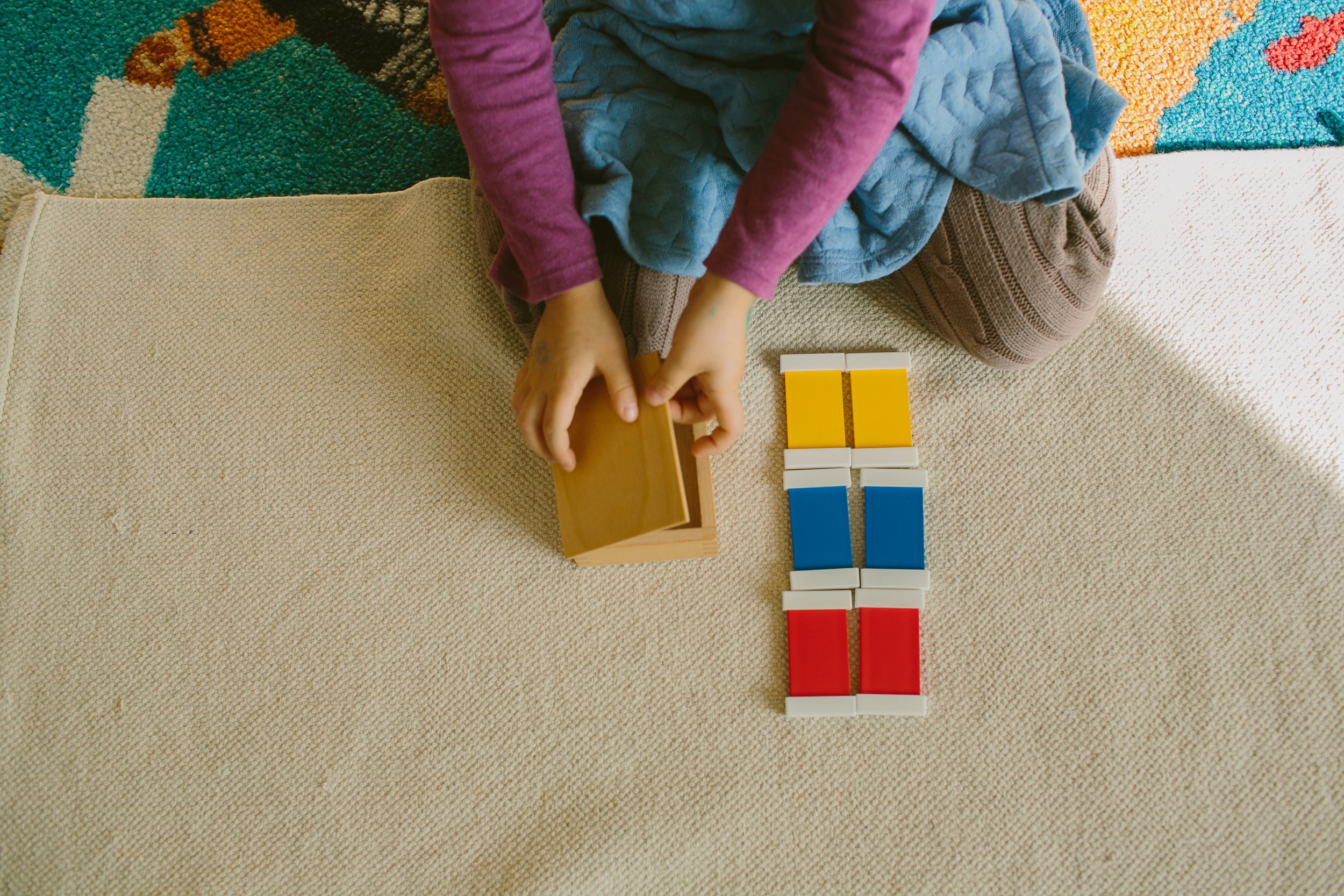
montessori color tablets

Young children are in a powerful process of creating an understanding of their world and where they fit in. To do this, they rely upon their senses as an interface to the world. Everything that comes into young children’s minds comes through their senses.

During the first few years of life, children are absorbing sensory input without any discrimination. Then around age two-and-a-half to age three, children begin to bring images from their subconscious into their consciousness. They begin to work with these images and in the process embark on an important journey of building their intelligence.

The Sensorial Materials

To support this development, Montessori programs offer carefully designed sensorial materials.

that follow a formal, systematic approach. The materials isolate each sensorial quality and offer children what Dr. Maria Montessori called the “keys to the world.” In addition, the sensorial materials support children’s classification of impressions and lead to clear levels of conscious discrimination. If children have these experiences in the formative period of brain development, they establish a foundation for a lifetime of order and precision, as well as logical, reasoned thinking.

How do sensorial materials accomplish all of this? Well, they have some really significant purposes!

Sensorial materials support children’s classification and categorization of sensorial impressions.

For young children, the first three years are like collecting impressions and throwing them into a closet. The images or concepts are a bit of a hodge-podge jumble, thus to go in and access what is needed from this unorganized collection can be a challenge. Because this warehouse of impressions doesn’t have order or classification, children need to develop mental organization so their collection of impressions becomes useful.

The sensorial materials help children to classify and categorize all of the impressions they have absorbed and unconsciously stored since birth. When children interact with the sensorial materials, images come out of their unconscious memory and come into working memory. As children use the materials, these impressions become part of their conscious memory. When children become accurate in distinguishing sensorial differences, we give language for the images, which then helps the concepts become fixed in children’s minds.

Children aren’t born with organized brains that have predetermined categories, so this neural organization has to be built up through experience.

Sensorial materials support children’s refinement of their sensorial perceptions.

It’s important to understand that sensorial exercises don’t make children’s ears hear better, eyes see better, or tongue taste better. Rather, the materials help children develop powers of discrimination so that they can analyze smaller and smaller degrees of difference.

When we take in sensorial input, everything goes into our brain. Then the brain has to make discriminations, a skill which develops through experience and the process of making finer and finer discernments. The materials offer children a clear means for starting to classify and to increase their perceptive powers, both of which are important mental abilities.

Sensorial materials support children in the development of abstractions.

 What do we mean by abstractions? An example of an abstraction is the notion of “red.” Red as a quality does not exist in nature. Red can be represented in physical things, but we cannot bring “red” to a person. Red is a quality. It is an abstraction.

Children may have some abstractions already in place, but when they are young the number is limited purely due to the fact that they haven’t had a sufficient amount of experience to develop the abstraction. Furthermore, children don’t typically get to experience sensorial qualities in isolation. The Montessori sensorial materials isolate each quality and give children the opportunity to have enough experience to develop abstractions.

Because we, as adults, have a lot of experience in the world, it can be hard for us to understand what children need to create abstractions. To better understand the significance of abstractions, imagine being told about a quince. If you haven’t had a quince before, it is hard to pull up the image in your mind, much less what it tastes like. If you hear a description that a quince is a fruit, you are able to pull up an idea of what a fruit is. Then if you hear that a quince is in the same family as an apple and pear, you can pull up an image that brings you closer to imagining the fruit and perhaps even the type of skin it has.

But without these experiences and the organization of images, children can’t pull up the same level of abstraction. Imagination helps us, as adults, to be able to do this: pull up images in our minds of something haven’t experienced before based on abstractions. In order to imagine, we must have abstractions. This area is most related to the development of intelligence.

Sensorial materials support children’s development of accurate and discriminating recall of perceptions.

The materials engage children’s memory, help them access information from their memory, and support them in using their intelligence. Memory is a tool of the intelligence, but because children aren’t born with memory, they need support with developing it. While children do have an unconscious memory, they have to take the impressions they have absorbed and build memory from them. The sensorial materials help this process.

Memory needs practice and experience to become stronger; it is only increased through activity. We want children’s memory to be strong and thus we provide lots of experience with the materials and variations with the materials. With each sensorial material, there are many ways to extend the activity and help children with recall.

One significant strategy is giving language to each perception. The language is based on what is isolated in the materials–thick/thin, large/small, long/short, right-angled isosceles triangle/right-angled scale triangle, rough/smooth, heavy/light, ovoid/ellipsoid, bitter/sweet. The vocabulary is extensive and rich, and ultimately fixes the perception in children’s memory.

The second strategy we use is playing games which challenge children to hold the perception in mind for longer and longer periods of time. They might put each of the pink tower cubes scattered about the room so that in rebuilding the tower of cubes from largest to smallest, they have to remember the size of the previous piece in searching for the next largest cube. Some of the sensorial games also help children notice particular qualities in the environment, rather than just in the materials. One favorite is searching for items in the classroom that have exactly the same shade of each of the color tablets. 

Through repeated experience with the sensorial materials, children develop clearer and more accurate perceptions and create reference points that they can use throughout life. Dr. Montessori talks about the possibility for children to develop touchstones, a sort of fixed, accurate reference by which this quality can be accessed. These points of reference can provide a lifetime tendency for order, precision, and recall, for example hearing the note of G without any other reference or being able to look at a pane of glass and know if it will fit into the window frame.

Sensorial materials help children develop life-long tendencies towards order and precision.

We don’t know what touchstones might develop for each child, but Dr. Montessori says that touchstones developed during these early years will remain with children throughout their whole life. If children can get accurate discriminations while in this time of sensitivity to sensorial input, this precision will remain with them into adulthood. Of course, children’s unique interests will also lead them to their own level of proficiency.

Functionally, this tendency toward order and precision will be important as children move into more academic work in language and math. They will be able to access powers of discrimination that will aid them in future endeavors.

Sensorial materials also provide indirect preparation for further study.

This indirect preparation means that we are taking advantage of children’s spontaneous interest and activity and thus planting the seeds for other areas that children will explore as they get older. When we introduce shapes–from a decagon to an ellipse to a quatrefoil–through the geometry cabinet, children visually discriminate the shapes while also tactilely experiencing the shapes by tracing around them. Multisensory input is stronger than input through just one sense. Tracing the shape also helps to prepare children’s hands for writing. To write, our hands have to be able to follow a form. This is how the sensorial materials provide indirect preparation for further academic study.

Sensorial materials support the development of children’s memory and intelligence.

Dr. Montessori talks about the sensorial area as being most strongly related to the development of intelligence. Working with sensorial materials requires a very different engagement from the practical life work of washing hands or scrubbing a table. Practical life activities help children with coordinating movement and following a sequence with a logical beginning, middle, and end. Sensorial materials don’t have the same kind of logical sequence. They are open-ended and exploratory. Children have to consider each piece and how it works in relation to the other pieces. In working with the red rods, for example, children have to examine each rod’s length in relation to the other rods. Thus, children have to make a reasoned distinction every time they move a piece of material. This process engages the intelligence and elevates children’s level of awareness. In addition, children then have to hold the images in their mind, which helps their memory.

Having an ordered, classified mind is also the foundation for intelligence. When children struggle in more academic areas like language and math, we take time to consider how to better support their mental order and classification. When the mind isn’t prepared well, academic work can be difficult to do. However, if children can recognize and distinguish between a trapezoid and a parallelogram, they will be more likely to be able to distinguish two other shapes like “g” and “q.”  When children have a lot of experience recognizing shapes through sensorial materials, they are more able to recognize the shapes they encounter in letters. Sometimes we go back and explore if perhaps children recognize the shapes but don’t have a strong memory. We then use sensorial games specifically designed to help different forms of memory (auditory, visual, etc.).

The sensorial area serves as an important foundation for more academic work because language and math are completely based on abstractions. Words represent concrete things but the words themselves are abstractions. The sensorial area is critical for providing the foundation for abstract thinking.

Outcomes

Although the sensorial materials may look relatively simple, they provide so much! When children use these materials, they are refining their powers of discrimination, creating an ordered mind, enhancing their memory and recall, categorizing their impressions, and building a foundation for rational thinking and intelligence.

As children achieve these skills, they experience life with an increased level of richness, becoming aware of the lovely details of their world. With a prepared mind, children can see things in a new light and with new enthusiasm. This is perhaps one of the most delightful outcomes of children’s work with the sensorial materials: they develop a whole new appreciation of the life around them–dimensions, shapes, smells, sounds, textures, tastes–which is what gives life value and beauty.

We hope you can come visit our school, experience the sensorial materials, and see how children get to develop their sensorial superpowers!
The Power and Potential of Sleep

child sleeping soundly

We work so hard to provide the best for our children. When they are young, we may try to find innovative toys, sign up for parent-infant programs, or research brain-boosting foods. As they get older, we might enroll them in enrichment programs, pursue assessments, or invest in tutors. But what if the best thing we could do was completely free, within our own household, and could provide a lifetime of benefits?

More and more research reveals the purpose of sleep and the importance of getting enough of it. Sleep provides the power behind a multitude of important aspects of our lives, especially for our children. Sleep not only enriches the ability to learn, memorize, think logically, and consider choices, but also provides emotional recalibration and allows for inspiration and creativity. Furthermore, in addition to a slew of physical and mental health benefits, sleep allows the immune system to work most effectively.

Here’s the surprising thing, though: our children typically aren’t getting enough of it (and neither are we!). 

A 2014 poll conducted by the National Sleep Foundation (NSF) shows that the majority of school-aged children aren’t getting the recommended amount of sleep (although over 70% of parents believe they do). 

The American Academy of Pediatrics (AAP) also reports that 25% of children under age five don’t get adequate sleep.

Why does this matter? 

In Montessori, we believe in understanding the whole child as a developing human being. We prepare learning environments to meet the needs and characteristics that children have at each stage of development. We carefully observe how children are interacting with each other and their surroundings. We also partner with families to support children in achieving their full potential. Understanding the role sleep plays in this development is critical.

Cognitive Ability

In Why We Sleep: Unlocking the Power of Sleep and Dreams, sleep researcher Matthew Walker, Ph.D., describes that “a tired, under-slept brain is little more than a leaky memory sieve, in no state to receive, absorb, or efficiently retain an education.” If we want our young people to have the most benefit from their learning experiences, it’s essential to consider the role that sleep has in brain development. A lack of sleep prevents the formation of lasting memories. Whereas a full night of sleep allows the brain to continue to improve skill memories (e.g. playing a section of music on the piano) even without further practice. “Sleeping on it” is just the thing our children need!

Emotional Regulation

On an anecdotal level, we know how our children can be cranky and irritable after a bad night’s sleep. Studies have also confirmed how sleep deprivation affects the emotional centers of the brain. Basically, without enough sleep, our brains revert to very primitive patterns of reactivity. In this state, it’s hard to understand the broader context of a particular event or action, which can lead to inappropriate emotional reactions. The sleep-deprived brain experiences dramatic mood swings and the rational control centers of the brain essentially lose control. It makes sense then, how lack of sleep can lead to aggression, bullying, and behavioral challenges in children across a range of ages.  

Symptoms

In addition to these behavioral problems, sleep deficiency symptoms in children can appear as an inability to maintain focus and attention, distractibility, irritability, moodiness, and even depression. Often, we see these symptoms but don’t consider the role that sleep (or lack thereof) might be playing in children’s lives. To further complicate matters, the symptoms of sleep deficiency can look a lot like ADHD symptoms. 

With all this in mind, it’s worth taking a pause when children are exhibiting challenging behaviors, bumping up against intellectual or academic challenges, or struggling socially or emotionally. Before jumping to other conclusions, we should be asking if they are getting enough sleep.

Connection 

We care about your child’s development and want to partner with you to provide your child with the best environment for their growth and learning. Come see how we consider the whole child and work with families as partners!

To Learn More

For more information about how much sleep is needed at each stage of development, visit The National Sleep Foundation.

For information about healthy sleep hygiene for children visit Sleep Foundation.

And if you want to learn more about the science behind sleep, be sure to read Why We Sleep: Unlocking the Power of Sleep and Dreams, by Matthew Walker, Ph.D.

Toothbrushing for Toddlers!

Father and child brushing teeth

In Montessori, we put a lot of emphasis on young children learning basic self-care skills. A big part of self-care is something we do every day, at least twice a day: brushing our teeth! This is a tricky one, though, because we want to teach independence while also ensuring that our children’s teeth are clean and cavity-free.

Because COVID has brought about some shifts in the practical life activities that traditionally happen in our early childhood classrooms, we thought we would combine a “materials spotlight” with a little “how to at home.” 

It’s important to remember that when we introduce toothbrushing, we are not only helping young children develop lifelong oral hygiene habits, but we are also helping them develop a sense of capability. As parents and caregivers, we partner in the process so that years later our children haven’t become dependent upon us for a necessary skill. 

In showing and supporting toothbrushing, we want to really isolate and slow down each part of the process. As adults, we often move quickly through the activity. We don’t have to think about the separate steps of what we are doing, because we can rely upon habit and muscle memory. Young children, however, are consciously working through each component. Thus, we have to be very intentional about demonstrating the procedure. In the process, we also highlight what we call “points of interest” which are like little benchmarks that focus children’s attention and help them remember key components.

As with all practical life activities, we want the experience to be meaningful and embedded in a real-life context. Thus, we introduce toothbrushing when it makes sense: after eating!

After enjoying a snack or a meal, we invite a child to the sink to brush their teeth. We often make a point of noticing that we have just eaten and want to clean our teeth, so the child makes the connection of why we are going to use a toothbrush. 

Small travel-size toothbrushes work well for children. The toothbrushes can have a case or small enclosure for the toothbrush head and some way to designate which brush belongs to which child (such as a photo of the child). We start by modeling taking our own toothbrush out of the holder and placing it on an empty tray. 

Depending upon the child and their age, we might have the child try each step right after we show it. Or if the child is a little older, we may show a series of steps and then invite the child to try. One of the gifts of Montessori is that we can tailor each activity to a child’s needs and temperament. 

After the child takes their toothbrush and puts it on the tray, the adult selects a toothpaste container and shows how to open and close it. Because we want the child to only use a small amount of toothpaste, it can be helpful to prepare individual portions of toothpaste. Contact lens holders work quite well for this. 

After demonstrating how to select, then open and close the toothpaste container, the adult places it on the tray with their toothbrush and invites the child to select their own toothpaste container, open and close it, then place it on the tray. One critical detail is closing the toothpaste container. We aren’t ready to use the toothpaste yet, so having the container closed helps communicate that we aren’t ready to use toothpaste. We are just making sure that the child knows how to access the toothpaste.

At this point we are getting everything set up, so we want to have the layout prepared for all the steps, including rising our mouths with water after toothbrushing. In the classroom setting, we’ll often have a small pitcher of water and small glasses turned upside down, but at home often just a small glass will suffice. Ideally, the glasses look different from regular drinking glasses because this water will be used for rising rather than drinking. Because this process often happens in the bathroom, small stainless-steel cups work well. Regardless, we next select a glass or cup and pour a small amount of water from the pitcher into it so that the cup is about 1/4 full. We place the cup on the tray with our toothbrush and invite the child to pour water into their own cup and place it on the tray.

Now that everything is set up, we open the toothpaste container and leave it open on the tray. We pick up our toothbrush and wipe bristles into toothpaste. It can be helpful to show how to hold the toothpaste container with one hand while getting toothpaste on the bristles of the brush.

We then place the toothbrush down on the tray and use both hands to close the toothpaste container. The child can also have a turn preparing their toothbrush with toothpaste.

The materials are ready, so it is time to demonstrate brushing teeth! This is best done slowly and with a wide-open mouth. We start on one side, perhaps the left, brushing our top teeth with clear, deliberate downward strokes. We then pause and brush underneath those top teeth. Pausing again, we then move to the back of our left top teeth with downward strokes. Staying on the same side, we brush our left bottom teeth with upward strokes, then the tops of those teeth, then the backs. We pause between each section and repeat on our right side. 

At the end, we brush our tongue lightly. Then we place our toothbrush onto the tray. With almost a bit of exaggeration, we make sure the child sees that we need to spit the toothpaste into the sink. After ridding our mouth of the excess toothpaste, we then pick up the glass and take some water into our mouth. We swish the water around and around and then spit right into the center of the sink, repeating if necessary. It’s nice to also have a small cloth or hand towel to model drying our mouth after this process.

We rinse the toothbrush under the faucet for a few seconds and tap the toothbrush on the side of the sink to get excess water off the brush. Then we invite the child to have a turn with the toothbrushing, spitting, and rising.

At the end, we return our toothbrush to its holder. One at a time we take the used items, the toothpaste container and the cup, to the dirty dish cart to be washed. After the child takes their used items to the dirty dish cart, or at home perhaps another appropriate place, we invite them to brush their teeth whenever they would like to clean their teeth.

Depending upon the child’s engagement while presenting this activity, we may determine different points of interest by using a pause, slightly exaggerating the movement, or merely showing our own intense interest. Some possible points of engagement for toothbrushing can include getting toothpaste on the toothbrush, the downward or upward brushing strokes, swishing water to rinse our mouth, spitting into the sink, or tapping the toothbrush on the side of the sink.

In a school setting, the adult will model and allow the child to practice brushing teeth independently. At home, it’s also best to establish an understanding that at key times, for example in the morning and in the evening, the adult will be taking a turn to help ensure the child’s teeth are clean. For example, during the evening routine, the child gets a chance to clean their teeth, and then they know you, as a parent or caregiver, will then do a final toothbrushing for them. This can be done by putting your hand over the child’s and continuing the brushing process after the child is done, or by just asking the child to hand you their toothbrush when they are done so that you can have a turn brushing their teeth.

The important thing to remember is that we want to support young children as they build the manual dexterity necessary for this important self-care skill. Just like we wouldn’t do all the coloring for them when they want to use crayons, we don’t want to do all the toothbrushing for them when they are learning to use the toothbrush. We want to give the message that they are capable and can practice cleaning their teeth. At home, we also want to make sure they understand that because dental hygiene is so important, we will also have a turn making sure their teeth are clean.


We hope you have great success at home! Let us know how it goes. And if you need some inspiration, you are always welcome to schedule a tour to see how we support children’s development of self-care skills, as well as their sense of capability.

Our Montessori Bookshelf: All About Geography!

In Montessori we love to explore how our language shapes our thinking, so we often explore the etymology of words. The word geography comes from the Greek geo, which means earth, and graphein, which means to write. So, geography can be understood as a description of the earth and all that occurs physically upon it. 

Although we name geography as a distinct subject, in Montessori geography is really woven throughout children’s learning experiences. These are some of our favorite books that support what children are experiencing in their geography explorations and that also encourage their natural curiosity about the world.

Click on the titles to link to the book on Goodreads.

Land and Water

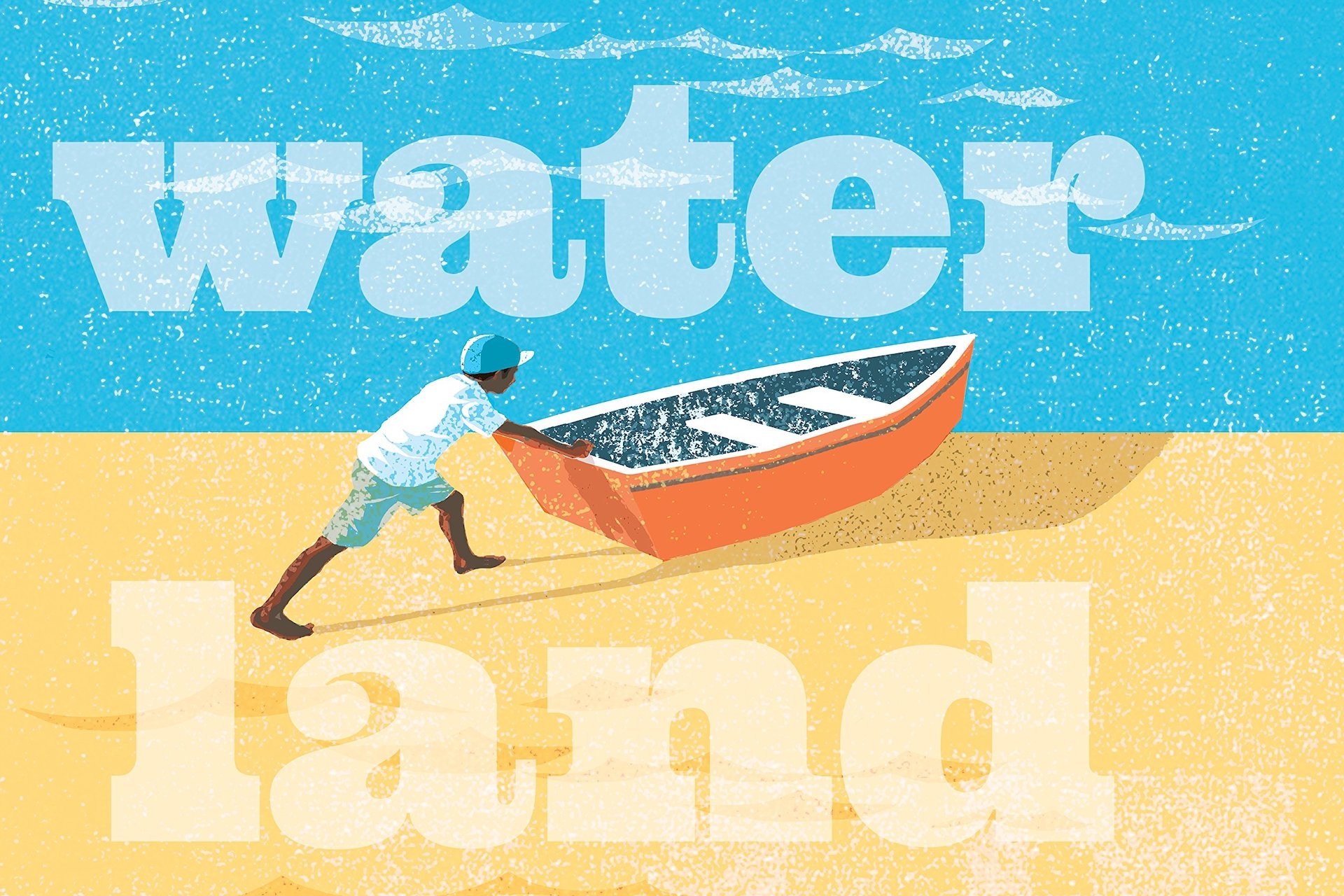
Water Land: Land and Water Forms Around the World
by Christy Hale

This picture book shows the visual relationship between land and water forms by using cut-out portions of the page. Turn the page and a lake becomes an island! The simple yet lovely illustrations of humans interacting with the water and the land are accompanied by one word on each page that states the vocabulary: lake, island, bay, cape, strait, isthmus, etc. This is a perfect book for young children beginning their journey in geography!

Political and Physical Geography

Maps
by Aleksandra Mizielinska and Daniel Mizielinska

This is the perfect tome for children beginning to learn about continents and countries. The sturdy pages give the book a sense of weighty importance, and each page reveals treasures upon treasures. The book offers an overview of the world, then focuses in on each continent and key countries within the continents. Presented in map form, the pages also illustrate animal and plant life, as well as cultural traditions and interesting facts. Both an amazing reference guide and a key to further exploration, this book is rich in visual appeal as well as in content.

Maps of the World's Oceans: An Illustrated Children's Atlas to the Seas and all the Creatures and Plants that Live There
By Enrico Lavagno and Angelo Mojetta

This illustrated atlas combines an enticing visual overview of the world's oceans with easily digestible bits of information about what is found there. Easily a jumping-off point for a slew of research, this book is a must-have resource for any child interested in history, marine biology, or really just cool facts in general.  

Cultural Explorations

This Is How We Do It: One Day in the Lives of Seven Kids from around the World
by Matt Lamothe

Based on seven real children around the world, this book depicts a day in each of their lives. The illustrations and short text of the children’s lives are shown side-by-side, so it’s easy to explore the similarities and differences in how they live: their families, what they wear, their school, what they eat, how they enjoy their evenings, where they sleep, and more. Designed to appeal to a range of ages the book provides large, simple text for each part of the day, as well as short descriptions for more confident readers. Younger children are also fascinated by the pictures of young people engaged in a variety of activities. Best of all, the book offers a delightful reminder of what unites us. 

The Earth

How to Dig a Hole to the Other Side of the World
by Faith McNulty, Illustrated by Marc Simont

Elementary children love this book! The simple illustrations are just enough to spark their imagination as the text takes them on a “what if” journey that starts with finding a soft place to start shoveling. The adventure continues with finding fossils, drilling, perhaps finding oil or a geyser, using a jet-propelled submarine, and eventually resurfacing on the other side of the earth. The best part is that the story perfectly dove-tails with the elementary geography lesson that introduces the layers of the earth. Despite the imaginative aspects of How to Dig a Hole to the Other Side of the World, the book is firmly grounded (pun intended!) in fascinating scientific information presented in just the right way to appeal to elementary-aged children. 

Life Story: The Story of Life on Our Earth from Its Beginning Up to Now
By Virginia Lee Burton

Set as a play, complete with a program detailing the cast and characters, Life Story progresses through scenes from the earth’s beginnings, through the prehistoric eras, to the seasons of human life. This book perfectly illustrates the passage of time and appeals to the elementary-aged child imagining the emergence of the universe and their own place in the story.

Earthshake: Poems from the Ground Up
By Lisa Westberg Peters, Illustrated by Cathie Felstead

These 22 poems offer whimsical yet scientific scenes all about planet earth: from wind to quartz to lava to water. Reading these poems reminds us that we can revel in the love of language while also learning about our world. As a bonus, the endnotes provide a bit more context and information about each of the 22 topics. 

Other Books to Explore

If you and your children are super excited about these titles, here are some other geography books we recommend!

Land and Water: Landforms & Bodies of Water
By Eve Heidi Bine-Stock

Wake Up, World!: A Day in the Life of Children Around the World
By Beatrice Hollyer

Let’s Eat!: What Children Eat Around the World
By Beatrice Hollyer

The Shortest Day: Celebrating the Winter Solstice
By Wendy Pfeffer, Illustrated by Jesse Reisch

Solving the Puzzle Under the Sea: Marie Tharp Maps the Ocean Floor
By Robert Burleigh, Illustrated by Raúl Colón

Ready for the Universe: Geography for the Elementary Age

Montessori work

When children enter a Montessori elementary classroom around age six, they have undergone a great transformation. Whereas they previously wanted and needed to explore their immediate environment on a sensorial level, now they want and need to explore by using their intellect and imagination. 

The study of geography takes on a whole new meaning at this age when children are fascinated by the smallest particles and the largest stars. They want to know why the seasons differ in the Northern and Southern Hemispheres. They are curious about what made the Grand Canyon. They want to know why ocean currents affect the weather.

This desire to know why propels children to discover relationships and functions, not just learn facts. They are also fascinated by the extreme and the outstanding. They are drawn to the very large and the very small. They ask Why? What for? How is this related?

The Universe

Elementary-age children have a consuming interest in everything! To cater to this all-embracing thirst for the reasons of everything, we begin with the universe. One of the earliest lessons we introduce is the story of the universe. From this first story, children are delighted by a myriad of lessons and activities which fall under the general heading of ‘geography.'

Beginning with the universe gives elementary children a big-picture context. In Montessori, rather than encountering bits of disconnected knowledge, children learn about the order and harmony of the universe, as well as the relationships that exist between all things. 

“If the idea of the universe be presented to the child in the right way, it will do more for him than just arouse his interest, for it will create in him admiration and wonder, a feeling loftier than any interest and more satisfying. The child's mind then will become fixed and can work. The knowledge he then acquires is organized and systematic; his intelligence becomes whole and complete because of the vision of the whole that has been presented to him and his interest spreads to all, for all are linked and have their place in the universe on which his mind is centred.”  — Dr. Maria Montessori, To Educate the Human Potential 

Constructing Understanding

Dr. Montessori observed that children around the world tended to ask similar questions at this age. The geography presentations and lessons support these fundamental reoccurring questions. 

Our goal is to help elementary children have an explosion into understanding. However, this kind of understanding does not come from adults explaining everything.

Instead, we give children experiences and just enough information so they can find out more and make associations. When children make their own connections, real and lasting understanding happens. Even better, the children respond with enthusiasm and excitement!

Geography Topics

Children in a Montessori classroom do not encounter subjects grouped under curricular headings. Subjects are integrated because children are building their minds. They are exploring their world, rather than the chapters of a textbook. Although there is a structure in the classroom environment, children have the opportunity to explore different many different aspects of geography including:

  • Space, Earth, and the Universe

  • Composition of the Earth

  • Nature of the Elements

  • Sun and Earth

  • Work of Air

  • Work of Water

  • Life on the Land

  • Interdependencies

  • Economic Geography

The lessons we present, and the resulting children’s explorations, lead into astronomy, physics, chemistry, meteorology, geology, and more. For example, as we look more closely at how the earth revolves around the sun, children learn about solstices and seasons, climatic zones, and flora and fauna found in particular regions.

Aids to Understanding

For each topic, we provide imaginative aids, often in the form of stories, colorful impressive charts, and a variety of experiments. Many of these instructive aids have been selected to provide impressions, not just facts. The aim of our geography presentations is to intrigue the children and spark their imagination. We want them to be inspired to find out more!

We concentrate on giving key information, discussing reasons, and illustrating details, all of which draw children’s attention to certain phenomena. Once interest is there, children want to learn as much as they can. It is as if we are giving elementary students keys to knowledge and understanding. Once they have the keys, they can open doors and continue their explorations.  

Geography is a vibrant aspect of the Montessori elementary and generates spontaneous, active, self-renewing interest! A love of learning blossoms in the children, and many develop a lifelong fascination with elements of geography. We invite you to visit our school and see this love of learning firsthand!

Grasping the World: Geography for Young Children

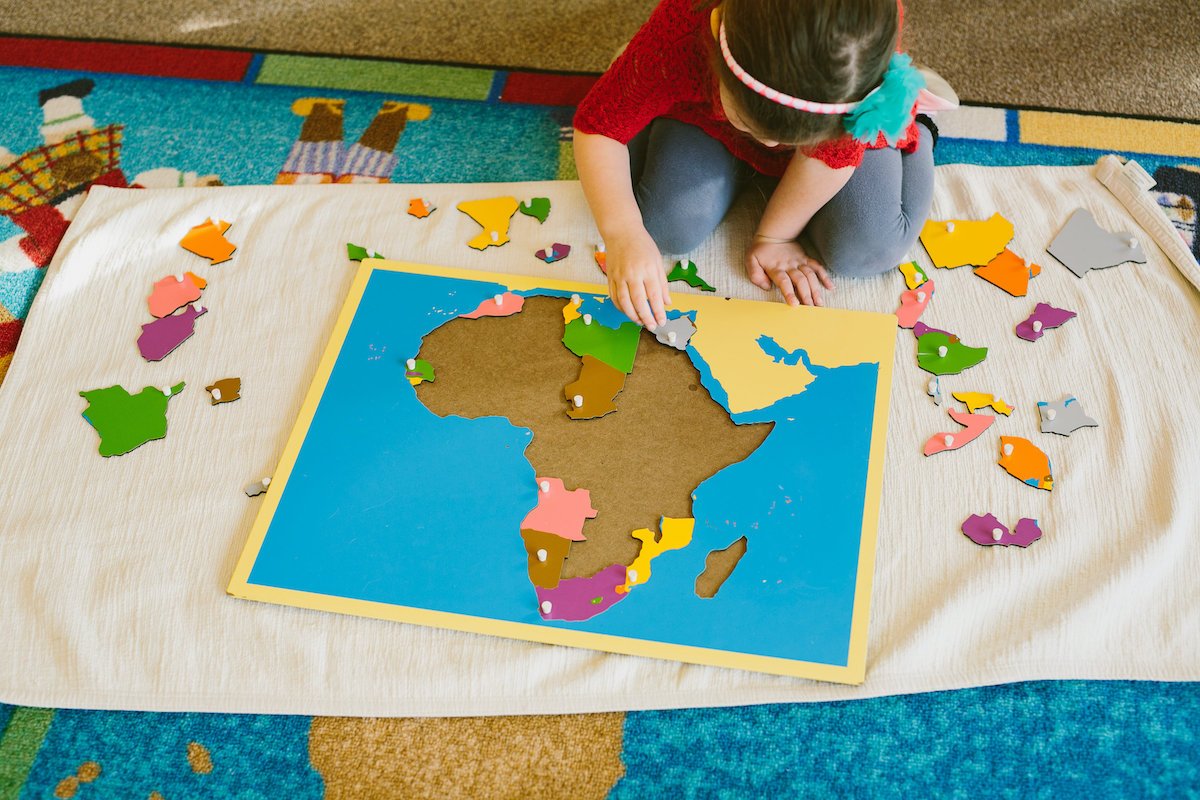
montessori child using puzzle map

Between mass media and family travel, young children are exposed to all sorts of language about their planet. They may hear phrases like “going around the world,” “as the world turns,” or “the other side of the world.” Young children absorb this information yet still need concrete experiences to help make sense of what “the world” even means!

Over 100 years ago, Dr. Maria Montessori observed how younger children were drawn to the globes that older children were using. Through careful observation, Dr. Montessori came to understand how young children crave a concrete understanding of concepts like the world, the earth, and the globe.

Concrete Materials

In Montessori, we offer concrete materials so children can experience accurate representations of these abstract concepts. We start by providing a small globe. The land surfaces are covered with fine sandpaper and the water surfaces are covered with smooth blue paint, so children can tactically explore the distribution of land and water surfaces over planet earth. With the globe, children get to literally grasp the shape of the planet and have a richer understanding of phrases like “going around the world.”

We also have a set of materials so children can learn about different kinds of land and water forms. Children can pour water into beautifully created models of an island, lake, peninsula, gulf, isthmus, strait, cape, bay, archipelago, or system of lakes. The water flows into the water area (painted blue) and moves around the land area (painted brown). As children learn the names of these land and water forms, they also explore folders with photographs of actual land and water forms from around the world. 

Montessori classrooms also have a second globe to show how the land surfaces are divided into continents. Each continent is painted a different color (green for Africa, red for Europe, orange for North America, pink for South America, brown for Oceania, and white for Antarctica). The color coding of the continents stays consistent throughout all the materials, which helps with association and retention.

Once children have grasped this concept of the land and water distinctions on the globe, we show them a flat puzzle map divided by the Eastern and Western hemispheres with each continent (color-coded as above) as a separate puzzle piece. This continent puzzle map gives children the chance to see all of the continents at once as they look on a two-dimensional map. 

We also offer maps of each continent to show the political partitions formed by countries. Each puzzle piece is a country, with the knob for picking up the piece located at the country’s capital. Children initially use these puzzle maps in a very sensorial way, taking the maps apart and putting them back together. As children engage with this experience, we begin introducing the names of the continents and then the countries. Young children absorb this vocabulary effortlessly and delight in learning the names of all the countries. As children get older, they also enjoy taking on additional challenges, sometimes even closing their eyes, feeling all the way around the puzzle piece, and then naming the country!

Cultivating Appreciation

Although this is all rather impressive, it’s important to remember that our purpose is not to turn children into walking encyclopedias. Even when children may come to rather astonishing intellectual skills, these abilities are a by-product. Our purpose is to offer young children activities to help them understand their place in the world, become aware of the oneness of humanity, and appreciate the incredible variation among people that results from physical geography and humans’ creative efforts and inventions.

To help in this effort, we share collections of pictures of human life organized by continent. These pictures offer impressions of different modern cultures, lifestyles, and traditions. The pictures reflect commonalities of human needs and the great variety of ways humans fulfill these needs. The photographs highlight regional food, farming, shelter, transportation, daily life, traditions, and the physical geography represented in landmarks, climate, flora, and fauna.

As children develop a relationship with the world around them, they may also explore more about the different places in the world, including climates, plants, and animals. Often children love to begin creating their own maps by carefully tracing the puzzle map pieces and coloring and labeling the continents and countries.

In Montessori education, children absorb a great deal of geography skill knowledge! But our focus is on giving children the opportunity to develop a constructive and creative relationship with the whole world, as well as a love for how our planet offers a diverse home to the whole of humanity. Schedule a virtual tour to learn more about this love of geography!

Focused on Friends (or Frenemies!)

Children with pumpkins on a wagon

During their elementary years, it can seem like our children are only focused on friends (and frenemies!). We hear about what happened at recess or who they sat with at lunch. They come home with elaborate accounts of being wronged. It’s easy to begin to wonder what they are really learning at school!

In Montessori we always try to understand what is happening developmentally, so we can address children’s needs and offer the best forms of support. When we consider our six- to twelve-year-olds, it’s pretty apparent how they are intensely focused on peers!

Physical Changes

As children approach the age of six, it’s easy to see the physical changes of middle childhood. Their hair becomes coarser. They lose that soft baby skin. Their first teeth begin to fall out. Their bodies become more stretched out. It is as if our children literally become rougher!

In addition, they have incredible physical stamina and can ride bikes, swim, climb trees, and play games from dawn to dusk. This newfound toughness means they are less likely to make a fuss over scrapes, bruises, or falls. Often neatness and cleanliness no longer seem to matter and we may find ourselves offering multiple reminders to comb hair, change clothes, brush teeth, or even take a shower.

A Focus on Friends

In addition to these physical changes, elementary-age children are also shifting how they relate to others. They are developing their moral compass during a time in their lives when their thinking is still pretty black and white. As a result, they are regularly trying to evaluate what is happening with everyone around them. This is when tattling can take center stage. When they come to report someone else actions, it’s often their attempt to figure out if the choices others made were right or wrong. Elementary children are trying to make sense of the rules, including how a group is organized: who leads, who follows, and what sacrifices need to be made.

In addition, elementary-age children begin to want to extend themselves beyond their family structure. This is when we start to see them separate from us as parents. They might walk ahead on the sidewalk or be reluctant to hold hands. What was previously a long goodbye at the start of the day shifts to a quick wave as they head down the sidewalk. They want to stretch beyond the bounds of home, and even past the school walls. They seem to constantly ask for playdates and sleepovers. Sometimes it can be hard to keep up with what is happening in their social world!

All of these shifts are part of normal development. In fact, it’s not just nice for elementary-aged children to be involved with their peers: it is essential for their social-emotional development. This is when children are trying to figure out who they are in relation to their friends.

Montessori Support

In Montessori, instead of working in opposition to this development, we use it to our advantage. Rather than relegate this social time to lunchtime or recess, we give lessons to small groups of children and encourage collaboration. When you come to visit our elementary classrooms, you might see a handful of children working through the steps of long division together as they navigate if 23 goes evenly into 2,425, or two students constructing the unfolding of events on an American History timeline, or a guide supporting four children sorting nouns by whether they are common, proper, abstract, or concrete.

For elementary children, there is incredible value in working with peers. Social learning comes first and foremost and opens the door for intellectual and academic pursuits. A reluctant writer can be inspired by a friend who wants to create a story together. Seeing classmates construct the periodic table can lead to an interest in learning about elements as building blocks of matter. Joining a group researching ancient Egypt can spark a lifelong joy of digging into history.

In Montessori, we also recognize that elementary-aged children need to go out beyond family and school bounds in order to practice taking steps in the broader world. To support this need, we offer opportunities for students to organize excursions based on their interests. A small group might arrange an interview with a local historian, visit a museum to see a style of art they have been studying, or even organize a trip to the store to gather supplies for a project.

At Home Support

Even though it can be hard to embrace some of the changes that emerge in the elementary years, it’s a great time to celebrate this new level of independence. Elementary-age children are more capable than ever before! The key is finding jobs and responsibilities that appeal to their sense of no longer being a little kid.

At home, we can explore opportunities for running an errand, which can start as simply as sending our kids to a different aisle in the grocery store to fetch an item from the list, or delivering a note to neighbors down the street. Eventually, they might want to take on additional jobs or responsibilities, like weeding the garden, mowing the grass, or stacking wood. Their physical stamina can be a gift as they take on bigger work at home.

When your child comes home complaining about the latest social event at school, take a deep breath and remember it’s developmental! Acknowledge their feelings and resist the temptation to want to solve the social drama of the day. Being a thoughtful and reflective listener allows our children to process and reflect on what they are experiencing in their little practice society.

If something sounds particularly concerning, it’s helpful to ask if they would like some help in solving whatever is coming up for them. Sometimes our kids just want to vent or air grievances, not unlike the times we may come home from work and just want to complain a bit. Yet it is also helpful to let our children know we can support proactive and respectful communication and problem-solving.

Although it may seem like our elementary children are only focused on friends, it’s a natural and healthy part of their development. In many ways, they are experimenting with and practicing what it means to live in a society. Our patient understanding and support will serve them well and provide hope for the future. 

Achieving Economic Independence

Adolescents exist between two worlds: they are no longer children but they aren’t yet adults. On this bridge to adulthood, adolescents need opportunities to develop real, meaningful, adult-level skills. They aspire to do what adults do. They are curious about how to make their own way in the adult world.

As adults, we are part of an economic system. Even if we aren't using money to buy something, through our work or our hobbies we produce or consume aspects of culture. In this way, economics is about the web of interdependence we have with other people. We all depend upon the work and activity of others.

Economics and Interactions

If we look at economics as how people offer value in their interactions, as well as the production, distribution, and consumption of services and goods, we can really think about economics as how we organize ourselves in society. Because adolescents are building the skills for stepping into the adult world, it’s important to consider how they are developing their ability to navigate this economic aspect of adult life.

How many of us had the opportunity, as adolescents, to develop the skills necessary for economic independence? How would our lives be different if, as adolescents, we had a support system so we could figure out a fair and reasonable cost for goods we produced, faced the reality of a profit and loss statement, or found our way in navigating the paths of spending, saving, and sharing?

Road to Achieving Economic Independence

Dr. Maria Montessori realized the importance of adolescents developing these kinds of skills. In From Childhood to Adolescence, Dr. Montessori made a bold statement about our approach to education and its impact on the greater society. She stated it clearly: “The essential reform is this: to put the adolescent on the road to achieving economic independence.”

So in Montessori adolescent programs, we offer our emerging young adults the opportunity to learn key skills of production and exchange. We sometimes call this “microeconomy.” The basic idea is that adolescents need opportunities to produce goods and services, and work with money and monetary systems, so they can develop an understanding and appreciation for how economies work and their own role in economic systems.

Real, Meaningful, and Purposeful Work

This experience can take many different forms depending upon the community. Whether running a farm stand or a holiday marketplace, adolescents get to learn key skills. They learn to balance profit and loss. They discuss and determine how much money should be reinvested into the business to help it grow or how much money should be reinvested in the greater community. They respectfully listen to their customers’ needs and concerns and incorporate that feedback in useful ways.

In order to have these learning experiences, adolescents need real, meaningful, and purposeful work. Just like young children need to actually prepare food rather than play with a pretend kitchen set, adolescents need actual experiences in creating a business plan, keeping track of income on a spreadsheet, and balancing a budget. They need to practice accounting work so they can build the skills for their own economic independence. They need to have the thrill of handfuls of cash and then face the responsibility of keeping track of those earnings. They need the experience of paying for replacement materials when they have overused key supplies. If they have developed some savings and want to invest the money, they need to find opportunities that align with their values.

Preparing for Adult Life

Too many of our young people enter the world of adult lives without having experienced their role in an economy (perhaps other than being consumers!). Economic independence is a key part of preparing for adult life. We want our adolescents to step into maturity with confidence that they can independently navigate their new responsibilities and roles. If we give adolescents the opportunity to learn how to have a sound basis for their economic decisions, imagine where they will be when they are adults and making decisions that affect broader aspects of society!