Montessori at Home: Caring for Pets Montessori-Style

The summer months can be a wonderful time to integrate some Montessori principles and practice into our home environments. With that in mind, our focus this week is on how to care for pets, Montessori-style. 

Montessori classrooms regularly have pets as part of the community for a number of reasons. When children have contact with the natural world, especially when they are part of taking care of living things, they develop a deep reverence for life in all its forms. In addition, as children are learning how to independently care for themselves, they can apply their skills to caring for an animal, leading to increased self-control and responsibility. Becoming aware of and attuned to another being’s needs supports the development of increased empathy and compassion.

“Children have an anxious concern for living beings, and therefore the satisfaction of this instinct fills them with delight. It is therefore easy to interest them in taking care of plants and especially of animals. Nothing awakens foresight in a small child, who lives as a rule for the passing moment and without care for the morrow, so much as this.”
— Dr. Maria Montessori, The Discovery of the Child

Daily Care

If you already have a pet or pets at home, encouraging children’s participation in their daily care is a good place to start. The easiest first step is giving a pet food and water. Even young toddlers can do this! The key is having the correct amount of food prepared in an easy-to-dispense container. The container can be placed on a tray or consistent place that is available for your child to access, carry to the pet’s food bowl or space, and then pour or place for the pet. 

If the pet is a fish, a small dish for the food can work. A hermit crab might need a small piece of fruit stored in a container that can be easily opened so the fruit can be retrieved and placed into the habitat. Whereas a larger animal like a dog or cat, will likely need a portion of food in a container that can be poured into their food dish, or, in the case of wet food, scooped out and transferred to the food dish.

The same approach can be applied to refilling a water bottle for hamsters or gerbils or pouring water into a water dish for larger pets. Ensure your child can access the water source and has a child-sized pitcher or measuring cup that holds just the right amount of water for your pet. 

Break it Down

To make the process most successful, it’s best to think about breaking down the steps and making sure the materials are accessible and child-friendly. Does the container open easily? When pouring does the food or water come out from one place so it goes where intended? How far is the reach to get food into a habitat? Look at everything from your child’s perspective and anticipate any obstacles. 

After figuring out the best materials and set-up, the next step is to show your child how to complete each part of the process. For young children, always make sure there are a limited number of steps. It can help to have a visual guide available, too. For example, if the pet needs to be fed once in the morning and once at night, you can have a picture that represents this. The visual guide can be laminated or put in a sheet protector and hung at your child’s eye level. Older children can use a dry-erase marker to check off when they have fed the pet. 

Cleaning or Grooming

The same practice can be applied to other parts of pet care. Perhaps the food area needs to be cleaned by washing the dishes, wiping a mat wiped, or sweeping spilled food. The learning process can be incremental. In the beginning, maybe your child is just misting something like a hermit crab habitat but over time learns how to clean the enclosure, too. Other animals might need their bedding replaced or washed. If a pet needs a bath, a young child can be part of filling the tub with water or scooping water for rinsing. Eventually, children can take ownership of more and more of the process. If your child is ready for more responsibility, they can also learn how to independently clean or groom your pet. From brushing to bathing, children can be involved in various aspects of pet care!

Interacting & Playing

Learning how to interact with pets offers children opportunities to learn how to read non-verbal cues and anticipate needs. In treating animals with care, children get to practice grace and courtesy which helps them extend these skills throughout all their relationships. We all appreciate gentle touches, soft approaches, and respectful care!

Different pets require different kinds of toys and handling. Children can be involved in creating some play items for particular pets, such as toys on a string for cats to chase or making a yarn pull for birds. Children can get creative with finding things around the house for a pet to use, like recycling toilet paper rolls for gerbils to chew. Older children can research healthy treats or training tips. 

Children can take on other responsibilities, too, such as taking a dog for a walk or being involved in training. Even small animals can often experience different levels of training, such as parakeets learning how to make certain sounds or to perch on a finger. Having books and resources available for children to learn more about their pets is another nice extension and cultivates more curiosity about what living things need and how to provide for them. 

Ultimately, children like to be involved in the care of their pets. It is important for them to feel the connection with their beloved animals, and foster the feelings of responsibility and self-confidence that come with it.

If you would like some inspiration for how to support your child’s care of pets, let us know! We are happy to share our experience with having pets in our classrooms. 

Symbiosis: The Newborn’s First Months

Those first moments after giving birth are some of the most precious. Newborn and mother come together for the first time as separate beings. This relationship is so intimate and incredibly unique because of the symbiotic link between the birth mother and her newborn child. 

The word symbiosis comes from the Ancient Greek “σύν” which means "together" and “βίωσις” which means “living.” As a biological term, symbiosis means the union of two different organisms based on mutual benefit. The mother and the newborn both need each other. Their lives are intertwined. 

Mutual Benefits

We generally recognize how a newborn is dependent upon their mother. Because of the increased size of their brains, human infants are born before their gestation is complete. Often called the “fourth trimester,” the first three months is a time when babies are still developing dramatically outside of the womb. 

A mother’s dependence upon a newborn is perhaps not as obvious. Yet after birth, a mother needs contact with the newborn for her own body to complete the birth process. Immediate breastfeeding stimulates the secretion of oxytocin which helps the mother’s uterus contract, thereby helping the placenta detach and eventually helping the uterus return to normal size. Breastfeeding also reduces the risk of maternal hemorrhage. In addition to the release of oxytocin, breastfeeding induces the pituitary gland to release prolactin. This hormone is not only responsible for lactation but also contributes to hundreds of other bodily processes.

The mother also needs contact with her baby for bonding and her own emotional stability. A process of attachment develops from this contact. The process of birth has been trying for the mother and infant and both need reassurance. Through the closeness of cradling and caressing, the mother and newborn experience mutual benefits.

In addition, the newborn relies on their mother for points of reference to help them adapt to an otherwise unfamiliar environment. When held close, the newborn can hear the mother’s heartbeat and can hear the mother’s voice. Maternal warmth and closeness allow the newborn to feel secure. 

Needs of the Newborn

This is a critical time for the mother to establish a bond with her child. And in doing so, she establishes the future relationship between her child and the environment. When a baby can relate to familiar points of reference, they feel secure and their energy can go into their growth and development. 

The newborn has five basic and immediate needs: 

  1. direct contact with the mother, 

  2. adherence to biological rhythms, 

  3. temporal, physical, and social order, 

  4. space for unhindered vision and movement, and 

  5. opportunities to explore with all the senses.  

The newborn is reliant on the mother (and any other family members) to meet these needs so as to develop into a healthy human being.  

During the first six to eight weeks of life–the symbiotic period–there are three aspects of the mother-child relationship that provide opportunities to meet these basic needs: holding, handling, and feeding.  

Holding

Holding, with skin-to-skin physical contact between the mother and newborn, is ideal immediately after birth. Being held during the weeks after birth continues to be important for the child’s feeling of acceptance and assurance. 

The infant should feel physically secure when held. Ultimately, though, emotional communication when being held is most important for the infant. They need to feel love and acceptance transmitted through touch, which thus provides a sense of trust. 

Handling

In addition, the infant needs their mother and caregivers to handle them lovingly while dressing, changing, bathing, and otherwise caring for them. During these times of “handling” when a caregiver uses their hands to care for an infant, it is important for the caregiver to make a meaningful connection. By collaborating and communicating with the infant, caregivers establish yet another form of trust and ultimately social security. 

In providing these caregiving routines, it is critical to establish a predictable pattern while also respecting the infant’s biological rhythms. The newborn is trying to adjust to day and night while also establishing a sleeping schedule that meets their needs. Having an order to the daily activities is essential for providing a frame of reference. For example, it is best to have one parent give the baby a bath at the same time each day, such as before bedtime. This process of establishing meeting points provides a sense of predictability and thus security for the child. These daily activities should also include time for the child to move on their own and experience appropriate sensory richness in the environment.

Feeding

Through feeding, the mother and infant develop a powerful sense of togetherness and direct union, thus establishing physical and psychological unity. With this in mind, how breastfeeding happens is significant. Even though a baby needs support in coming to the breast, they should be allowed the freedom to choose when to suckle. This establishes a fundamental basis for their relationship with food. Food can always be offered with love and placed before someone, yet not inside, a person. This establishes healthy boundaries.

Eventually, the mother and infant will be in communication about feeding so that the mother will recognize the child’s signs of hunger and the child will feel secure in their ability to have their needs met. This relationship around feeding forms the basis for the child’s understanding not only of how food is nourishment but also how to relate to others. It also helps when the mother can give her total attention to her nursing infant. 

Key Experiences

Through these key experiences of holding, handling, and feeding, the infant forms a fundamental understanding of their environment. With positive experiences during the symbiotic period, the child develops a trust that their needs will be met. They experience how their environment is a place in which they feel safe. This eventually leads to being able to confront new situations with assurance. 

The symbiotic period is an important foundational time for the mother and child. The collaborative experience provides mother and child with the physical, psychological, and emotional basis for the next stages. After the six to eight weeks of the symbiotic period, the newborn should have a basic understanding that the external world will be responsive to their needs. The mother will feel secure in this new relationship with her child. Mutual needs and close connections lay the foundation for all the wonderful development to come!

Curious to learn more? Be sure to check out Understanding the Human Being: The Importance of the First Three Years of Life by Silvana Quatrocchi Montanaro. Another informative resource is Touching: The Human Significance of the Skin by Ashley Montagu.

Adolescence: Time of Transformation

Adolescents have such power and potential. They can achieve so much when they have a supportive space that helps them develop their incredible abilities and ultimately realize their possibilities.

The book, The Teenage Brain: A Neuroscientist’s Survival Guide to Raising Adolescents and Young Adults, shares a helpful analogy for understanding adolescence: “...the teenage brain is almost like a brand-new Ferrari: it’s primed and pumped, but it hasn’t been road tested yet. In other words, it’s all revved up but doesn’t quite know where to go.” 

To best support adolescents who are all primed to go but don’t yet know where, we can work to better understand their developmental characteristics and needs. 

Time of Transformation

The first three years (ages twelve to fifteen) of adolescence are comparable to the physical and cognitive transformation that happens from zero to three. Adolescents are forming themselves, physically and psychologically, into the adults they will become.

This is a transition from childhood into adulthood, evidenced by dramatic bodily changes. The relative calm and stability of the previous years shifts to a more tumultuous time. During this period of intense change, adolescents’ health becomes more fragile. They require more sleep and are more prone to acne, depression, bulimia, anorexia, mono, etc. As Frances E. Jenson, MD, and Amy Ellis Nutt explain in The Teenage Brain: A Neuroscientist’s Survival Guide to Raising Adolescents and Young Adults: “Adolescence is a time of increased response to stress, which may in part be why anxiety disorders, including panic disorder, typically arise during puberty. Teens simply don’t have the same tolerance for stress that we see in adults. Teens are much more likely to exhibit stress-induced illnesses and physical problems, such as colds, headaches, and upset stomachs. There is also an epidemic of symptoms ranging from nail biting to eating disorders that are commonplace in today’s teens.” 

Adolescents need a special kind of care and protection during this time of transformation. Like caterpillars that need a chrysalis in order to metamorphose into a butterfly, adolescents need a protective space for reconstruction.

Neural Changes and Emotional Needs

The adolescent brain is also undergoing dramatic changes, from neural pruning when unneeded neural synapses are removed, to an increase in myelination which allows for faster neural transmission. 

Due to these dramatic physical and cognitive changes taking place, adolescents can have difficulty concentrating and staying focused. This also leads to a decrease in their organizational skills and judgment, as well as a reduction in their executive functioning abilities like working memory, flexible thinking, and self-control. Because of this diminished executive functioning ability, adolescents often make decisions based on emotion. Their brains are relying upon the limbic system rather than their developing prefrontal cortex. 

Thus, adolescents can experience strong and tumultuous emotions and it can be a struggle for them to gain mastery over these emotions. As such, adolescents need time for personal self-reflection, and yet this need exists in the midst of an intense desire to be within and accepted by a group. 

Rational and logical expression can be challenging during this time, thus adolescents also need creative outlets for releasing and exploring emotions, thoughts, and any conflicting experiences. Creative outlets can include dance, writing, art, music, sports, etc. In addition to providing an expressive outlet, physical activities also release endorphins and help regulate hormonal balance. 

Finding Equilibrium

Because adolescents are working to integrate their new physical and emotional selves, they need as many opportunities as possible to integrate manual work (work of the hand) and academic work (work of the head). In addition to experiencing an equilibrium in mental and physical activities, adolescents need opportunities to explore their personal identity in the context of their social identity. 

Like younger children, adolescents are somewhat ego-centric. After leaving the elementary years of calm and confidence, early teens become self-conscious and are highly sensitive to peer acceptance. This results in a sensitivity to the looks, comments, or actions of others, which is further complicated by adolescents having difficulty reading facial expressions. It’s no surprise, then, that our teens often imagine that someone is upset with them or thinking negatively of them. Close relationships and feeling accepted by their peer group become extremely important to balance these feelings. 

Being Valued

Because this is a time of extreme vulnerability, adolescents need to be treated with understanding and respect. They want to know their value, their role, their contributions, and their worth. Adolescents benefit greatly from opportunities to contribute to their community in meaningful ways. This is best achieved through adult-level work. When this contribution is acknowledged by their peers, adolescents feel valorized, or recognized, which leads to a bolstering of their self-confidence.

Having choices is also a vital component of adolescents’ work. This opportunity to make a choice about what to do and when to do it provides teens with a strong sense of empowerment and allows them to practice making constructive choices. 

Role of Adults

Adolescents need the guidance and support of adults. They also rely upon and appreciate the opportunity for side-by-side work. We can shift into more of a supportive, coaching role with our adolescents, which can more easily be achieved when we are working alongside each other. Adolescents relish this opportunity to collaborate in what it means to be an adult by engaging in adult-level work.

This side-by-side work also offers us, as adults, the opportunity to respectfully share information and teach skills, without risking offending our adolescents. In “Three Ways to Change Your Parenting in the Teenage Years,” Christine Carter explains: “When we give our adolescents a lot of information, especially when it is information that they don’t really want or that they think they already have, it can feel infantilizing to them. Even if we deliver the information as we would to another adult, teenagers will often feel disrespected by the mere fact of our instruction.”

Respectful treatment connects to adolescents’ need to feel a sense of justice and personal dignity. While elementary-aged children focus on distributive justice (e.g. fairness), adolescence is a time when young people begin to grapple with and understand restorative justice, social justice, and economic justice.

Adolescence is a period of dramatic growth and change. Although the dramatic physical changes that accompany the onset of puberty can rock the stable foundation of elementary years, if we understand adolescents’ needs, we can help our teenagers emerge as empowered and full of creative energies.  

Shakespeare Dinner Theater: Behind the Scenes of an Adolescent Program Event

It is really hard to describe the incredible growth and learning that happens through putting together a big event in the Adolescent Program. Adolescents thrive on real, big, creative work that happens in community with others. When I say “real work,” I mean work that has a purpose besides one’s own learning, work that affects other people, work so complex that if you don’t pull your own weight other people and the quality of the whole will suffer. The recent Shakespeare Dinner Theater, our classroom Gala project, was one of these events.

I was reflecting on the skills and qualities I observed students developing throughout the two months or so of preparation for the event, including: organizing, delegating, communicating, grit and perseverance, problem-solving, critical thinking, follow-through, a sense of personal responsibility, a sense of responsibility to one’s community, time management, leadership (including when to step back), risk-taking, receiving and implementing feedback, offering constructive feedback. Do these sound familiar? Look up any list of “traits of successful people,” “top desired qualities of college graduates,” “15 traits of successful people that all business leaders should cultivate,” and so on, and these qualities are on the top of the lists.

The beautiful thing that can be so hard to make transparent is how a Montessori adolescent program helps students to develop these qualities and skills. It comes back to Dr. Montessori’s vision of the Prepared Environment. The prepared environment of our Adolescent Program, by design, provides opportunities and support for students to have experiences in which to practice these skills on a regular basis. The prepared environment includes both the physical (materials, buildings and grounds, schedules, lessons, etc.) and social environment (guides, students, administration, customers, adult experts; expectations for grace and courtesy, civility, kindness, etc.).

Here’s a peek behind the scenes at how the experiences of creating the Shakespeare Dinner Theater event unfolded:

The Script

Critical thinking, compromise, creativity, communicating, writing, flexibility

In the winter term, students read either A Midsummer Night’s Dream or Romeo and Juliet. Somewhere along the way the idea was floated and voted on to create an original mashup of the two and perform it as our Gala project. When it came time to write it, a group of about 6 or 7 students, a Guide, and our guest director (a parent in the program), sat together and brainstormed a general storyline. Pairs or small groups of students then went off and wrote scenes by abridging and combining scenes from the original Shakespeare. Pulling out the lines that would keep the essence of the stories and the language intact while also creating a new story, was no small feat. These 7th, 8th, and 9th year students showed incredible understanding of the plays to feature key scenes from the original and to create original transitions to give the new plot continuity. The students also had to be adaptable as we went through rehearsals and had to add, cut, or change lines to better fit the actor or the staging.

Blocking / Choreography

giving, receiving, and implementing feedback, discipline, grit, patience, flexibility

“Let’s take it from the top!” “One more time, from Puck’s line.” “We are going to do the sword fighting dance again, but slightly faster this time.” “Yes, we need you for running this scene, even if you only have one line.” Creating the play took many iterations and a huge amount of patience from everyone.

Memorizing Lines

Follow-through, personal responsibility, helping one another, honoring different learning styles

Shakespeare in the park! Students worked on memorizing lines in New York City on the spring trip (and in the van, and at home, and at school…).

Acting

risk-taking, self-confidence, trust, receiving feedback

The growth in each student from the beginning of this project to performance night was incredible to witness. Some of the students who said at first “I don’t want to have speaking lines” ended up as powerful forces on stage with long scenes. Others knew they wanted a big part from the beginning but may have ended up taking on a role that was quite different than they had first imagined. Each person made incredible leaps throughout.  

Music & Dancing

risk-taking, communication, personal responsibility, follow-through

Why not add live music and a dance while we’re at it? Many students, and guides, drew on their skills as musicians and dancers to add to the festivities. Others performed in a court dance even though they may never have danced before. Some students tried it and were able to advocate for themselves that it was just too far outside of their comfort zone. In all of these cases, students found their areas of challenge and worked through them to contribute to the whole.

Costumes & Set

organizing, asking for help, delegating, communicating, time management, leadership, perseverance, problem solving

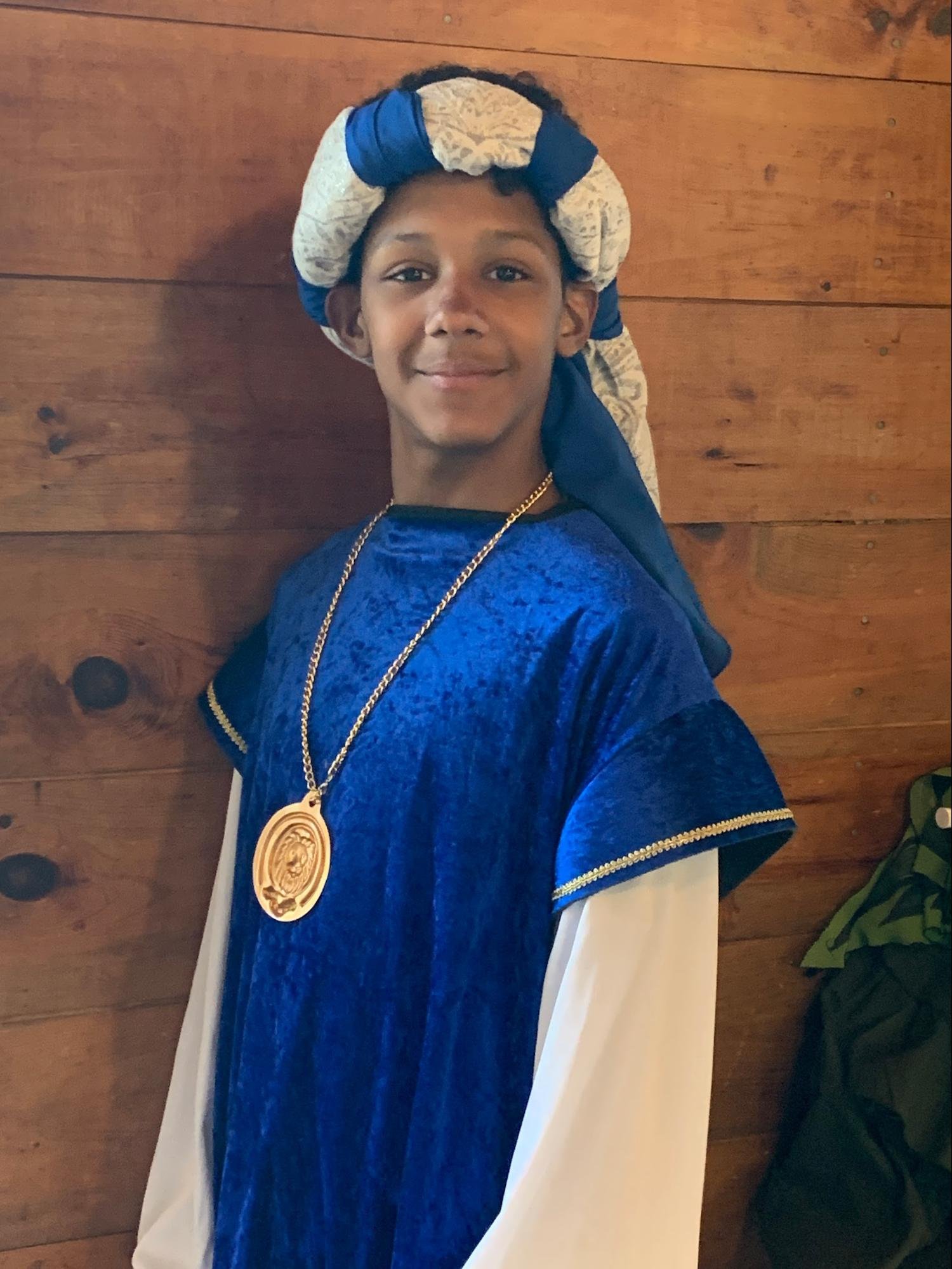
After many trips to resale stores, generous loans of costumes from school families, sewing by both students and guides, and a lot of creativity, we created costumes for everyone (some students had more than one as they played multiple roles) and turned the side of the AP building into a beautiful setting for the play and the dinner. We battled with the wind and problem-solved our way through many different ways to secure an outdoor set. Thank you to our parents and other community members for your generous support!

Logistics & Set-up

high level executive functioning, willingness to pitch in, grit, organization, delegation

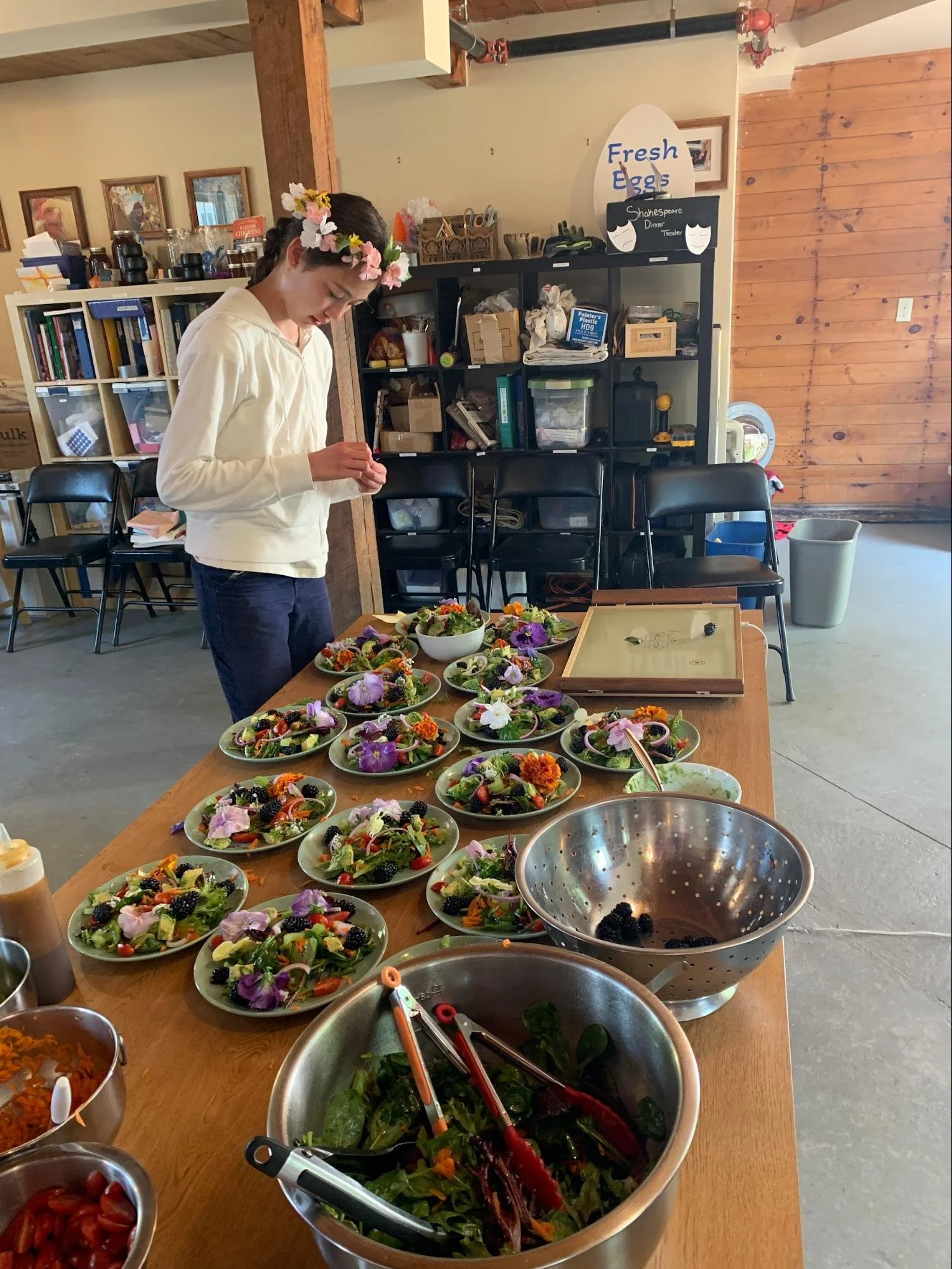
During this event, students and adults were on stage, cooking,  serving food, plating food, cleaning up, washing dishes, and more. They had to know when to stop plating and get in their places back stage for their next scene, then immediately move on to their next task, whether it was clearing the next course or changing costumes to play a different character.

This was incredibly complex. Our student kitchen manager for the event spent many hours creating diagrams and grids of how this would be organized. We wrote one grid on the kitchen white board of what needed to be prepped, who was outside on stage, and who was in the kitchen. The white board in the project room, which served as our backstage and plating area, was a detailed grid of who was serving, prepping, clearing, acting, playing music, checking in with guests, and cooking for every scene. This was a huge organization challenge and all of the students stepped up to do their part.

Cooking & Cleaning

organization, delegating, communicating, follow-through, perseverance, problem solving, time management, leadership, offering support

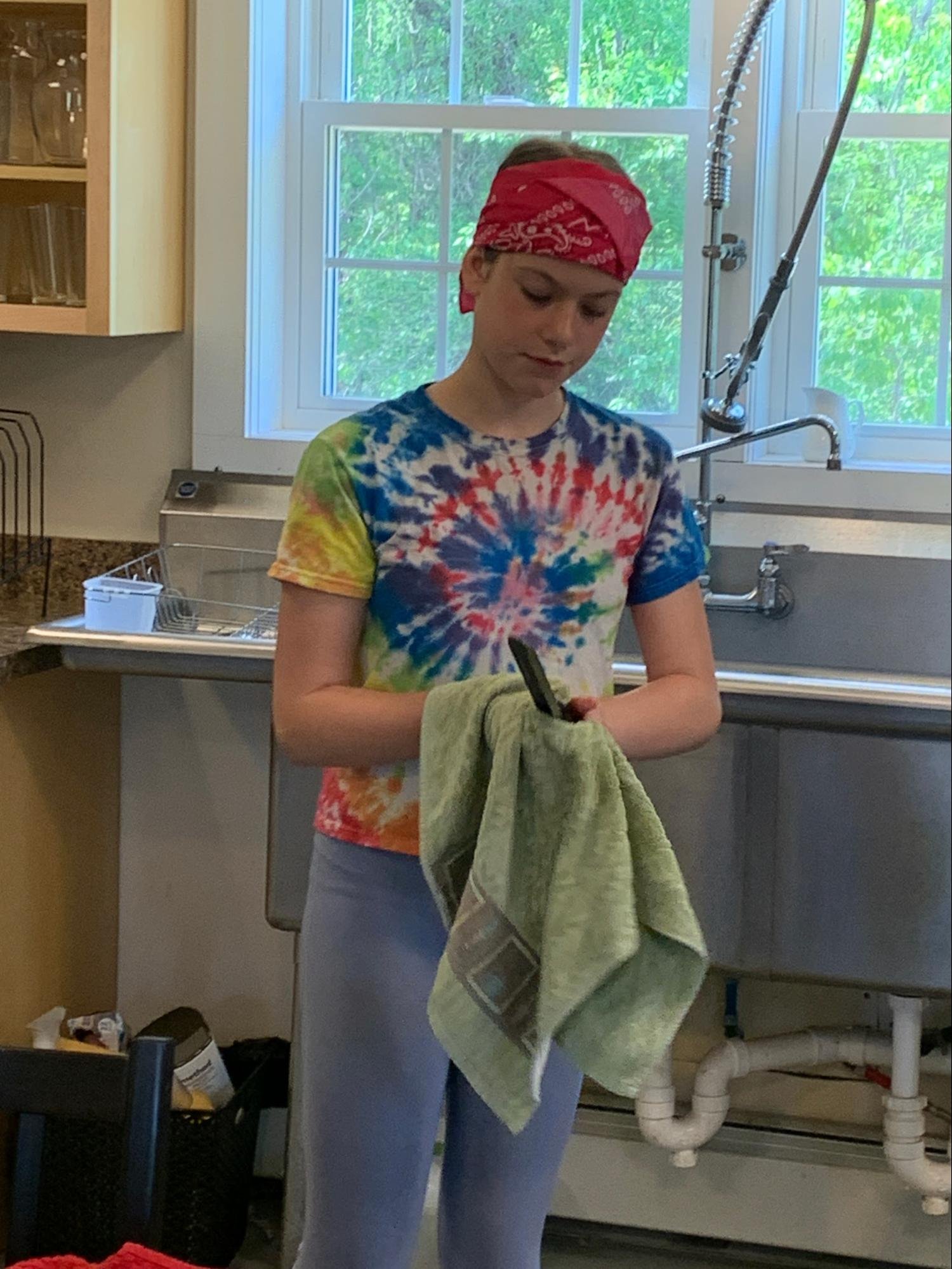
We prepared and served a four-course meal. What this means behind the scenes is weeks of brainstorming courses, cooking and revising meals through community lunches (lunches prepared by students for our community of 20 people), offering feedback on what worked and how dishes could be improved, pairs of students finalizing recipes, scaling the recipes for the 14 guests we would be serving, creating shopping lists, going to the grocery store, prepping ingredients ahead of time, cooking the food, having each course ready at the correct time, and plating the food in the most appealing way. This involved seeking advice from adults experienced in the restaurant business and a lot of trial and error. We also did lots and lots of dishes!

Serving & Welcoming Guests

presentation skills, poise, grace and courtesy, organization, delegation, communication

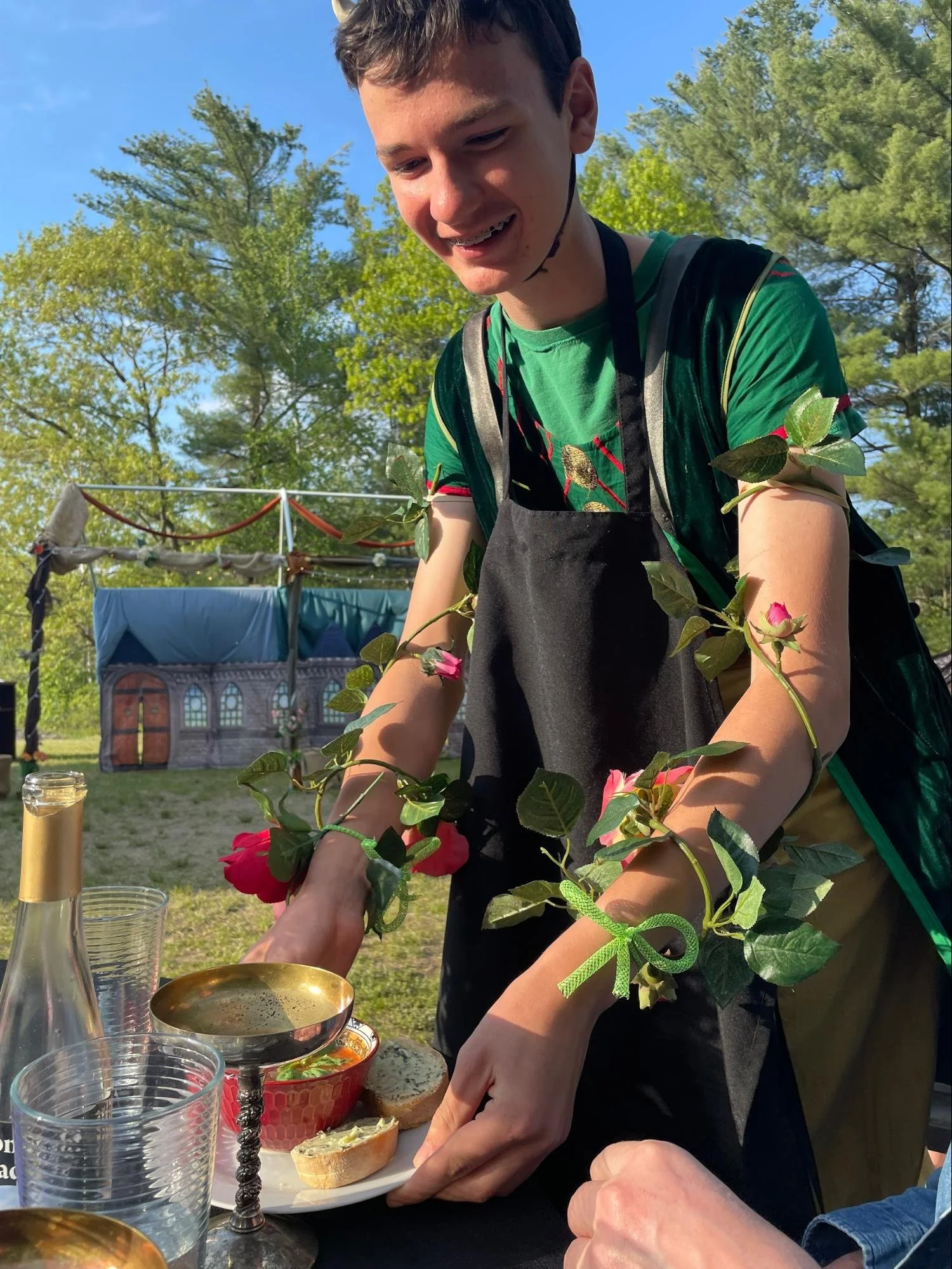
While all of these pieces going on simultaneously behind the scenes, each individual had to take a steadying breath and calmly greet our guests and then interact politely and graciously with them to serve and clear their meals. In some ways this dinner theater was more difficult than just being an actor in a play, because it required students to be in character on stage, remembering their blocking, choreography, lines, inflections, etc. and then switch into server and chef mode. As if being a young actor wasn’t already a challenge! These students found new depths within themselves and honed a multitude of skills along the way.

Celebrating!

And finally, everyone departed for a good night’s sleep to start to consolidate all of that development!

The First Six Years: Conquests of Independence

As caregivers and parents, we have a bit of a bittersweet role. While we want to keep our children close, we ultimately need to support their path toward independence. 

We expect dependence at the beginning. Yet our newborns take their very first step toward independence at birth. Once born, they have to breathe on their own. And rather than get nutrition through the umbilical cord, they use effort to begin latching on or suckling. 

Throughout their first six years of life, our children achieve so many milestones of independence. Let’s take a look at some of these conquests of independence. You can use this framework as a guide and reminder of how we can support our children as they grow and develop. 

Birth to One Year

  • The first conquest of independence is birth which comes with the cutting of the umbilical cord. At this point, infants must breathe and gain nutrition on their own. Even our expression “It’s time to cut the cord” indicates the shift to increased independence.

  • Movement is another acquisition of independence in the first year as children begin to use their arms and legs, sit up and crawl, and move from one place to another. With this increased locomotion children no longer need to be held or carried.

  • Our children also begin to feed themselves. Even in the beginning when babies are nursing, we want them to indicate hunger. The weaning process and shift to using the weaning table supports this path to independence. As our children begin to eat and drink on their own, it is important to have foods and tools they can use independently (e.g. a shot glass for water, finger foods, etc.) rather than having an adult putting a utensil or bottle in their mouth. 

  • Children can also start to practice basic use of utensils. Having utensils that are child-sized and functional is key to independent use. 

  • In addition, our children need the opportunity to develop the ability to be by themselves. To become independent, they need to practice separating from their caregiver(s). Healthy separation depends upon healthy attachment, and our children need the chance to have some time without adult engagement.

  • Around the end of the first year, children begin to develop language to communicate their needs. Prior to this time, they are able to use other methods to communicate: crying, cooing, smiling, etc. This communication is the beginning of social skills and children’s ability to relate socially to others.

One to Three Years

  • During this time children can walk confidently and begin to run and climb. Once children can walk, they can begin the process of becoming independent in toileting. 

  • They become more independent with the use of their hands, which become tools for exploration. Because of this, children no longer need to rely on others to hold and carry items.

  • Language use allows children to begin to express themselves independently.

  • Children can start to become independent in dressing themselves. 

  • They begin to be able to use simple tools (crayons, sticks, cups, utensils, etc.).

  • They become more capable of caring for their own personal hygiene (brushing their teeth, washing their face, brushing their hair, etc.).

  • Children become more proficient with and capable of carrying their own items. 

  • They have the capacity to clean up after themselves (putting away belongings, folding clothing, wiping spills, sweeping crumbs, etc.).

 As children get older, they need opportunities to develop their will. Thus, during this stage of independence, it is really important that children can make choices. Making a choice means they are acting for themselves and exercising their will.

From Three to Four and a Half

  • If it hasn't happened already, children experience separation from the family (e.g. going to school). To be able to separate from one’s family is a new skill of independence. For children who haven’t been able to be by themselves, this is a harder process. During this time, children realize they can survive and trust others, which is a significant step in independence.

  • Children develop a wider range of social skills.

  • Children’s motor and visual skills become more developed and refined.

  • They are able to engage in more games (e.g. catching and throwing a ball).

  • They have finer manual dexterity (using individual fingers) as well as refined fine motor skills (when all fingers are working in unison).

  • Children begin to develop the ability to use language to express their emotions. They can learn a multitude of words to be able to express feelings. 

  • They can use utensils and tools to prepare their own food (which ideally happens prior to age three). Research shows that children involved in preparing their own food are more likely to try diverse foods.

  • Children learn to master fasteners (zippers, buckles, bows, etc.) and thus the self-care involved with dressing and undressing.

  • They can contribute to their community and care not only for themselves but also for the environment through simple responsibilities like setting the table, folding towels, etc.

  • They are more independent in caring for their own hygiene needs.

  • Because their vocabulary is expanding, children can use words to express emotions, as well as to better express their thoughts.

Four and a Half to Six

  • Children have more social independence and can not only do for themselves but can also use acquired skills to help others.

  • They become more independent in their social skills so they can internalize and apply the social norms of their community (e.g. pushing in chairs, greeting visitors, communicating that they need space, etc.).

  • Children become proficient in dressing themselves and can help younger peers with the dressing and undressing process (e.g. getting dressed for going outdoors).

  • They acquire the capacity to have empathy and compassion.

  • They have a basic understanding of quantities and how they are represented, instead of just mimicking or rote counting.

  • Children begin to recognize and use the symbols of our language (e.g. expressing themselves through writing or interpreting the thoughts of others through reading).

These conquests of independence are ultimately about becoming functionally independent. Young children are in a process of mastering different aspects of their lives and they need us, their caregivers, to support them in this process. 

Our children are so capable and they benefit when allowed to move toward increasing independence. If you’d like to see how our Montessori environments set children up for success, please schedule a tour!

Pandemic Impacts on Older Kids and Teens

While there has been a certain amount of awareness of how COVID has impacted young children, we thought it would be helpful to shift our attention toward those in their elementary and adolescent years. While the impacts may manifest differently, those in the middle of their school years also experienced considerable disruptions from COVID. From increased anxiety and physicality to challenges in social interactions and work engagement, elementary-aged children and adolescents are facing their own share of struggles.

Social Development

Those who experienced the start of the pandemic during their elementary and early adolescent years were at home during a time when developmentally they needed to connect with peers and figure out their social identity. It’s during this time that our kids develop their own sense of individuality within the context of community. This interplay amongst peers allows older children to both develop their ability to communicate with others while processing how their individual actions impact those around them. The result? Our young people begin to learn how to practice empathy for others while also advocating for themselves.

During the locks-downs and distancing from COVID, many children missed out on key formative experiences, like how to join a group, how to invite others into a group, and even how to have positive conversations. Without some of these skills, navigating social situations, especially those that involve more than one other person, can be trickier. 

Even children’s awareness of others’ physical space has been impacted, perhaps due to maintaining six feet of distance or even having more time in close proximity to screens. As children have been able to be together again, the boundary line of what is too close or what is too physical is something they are having to discover. 

Direct instruction and guided practice can help. Elementary-age children love to role-play, so even acting out different scenarios can be beneficial. To foster developing friendships and healthy peer interactions, have conversations with your children and teens about the qualities of a good friend and how to be a good friend to others.

Regulating Emotions & Managing Anxiety

During the elementary time period, our children are developing their emotional skills, which provide an important base before young people enter their more tumultuous adolescent years. Major emotional skills mastered during this stage include how to adjust to different rules and social norms for behavior, understand others’ feelings, acquire more control and management of emotions, and develop strategies for patience and general adaptability.

In addition to not having as much opportunity to flex these social-emotional muscles, so much was outside of our children’s control during the early COVID years. As a result, more young people have developed increased anxiety, which can manifest in a multitude of ways.

For some children, just the transition into the school building and away from parents or caregivers can cause anxiety to flare up. For others, trying to figure out how to interact with peers in-person can be anxiety-provoking. 

To help, we can focus on communication and collaboration. This can range from recognizing and discussing emotions when children are calm, to remaining open and empathetic when strong emotions surface. It’s essential that, as adults, we model emotional regulation so our young people can see how we use coping strategies, like taking deep breaths or stepping away from a situation, rather than just reacting.

We can also be sure to address our kids’ behavior rather than their emotions. This helps young people understand the distinction between their feelings and their actions. For example, if someone feels angry, that is just a feeling, which is neither good nor bad. However, if someone acts on that feeling by hitting another person, the behavior of hitting is unacceptable. When we handle disciplinary situations, our responses can help our kids begin to internalize that it is okay to experience a range of emotions and that they have choices and limits in terms of how they behave. 

Involving our children in the conversation is essential. They might need help voicing or expressing their emotions and anxieties so worries don’t stay hidden inside where they can easily proliferate. Most importantly, we need to help ensure that children don’t keep avoiding whatever is causing them stress or anxiety.

Getting Back Into the Rhythm

Healthy routines are important for older children and teens, who need structure and predictability to offset the stress associated with the changes they begin to experience in their social lives, their bodies, and even their emotional experiences. With all the disruptions of the pandemic, we need to be especially sensitive to the importance of following through and following up. Our children need us, as adults, to hold consistent, firm, and kind boundaries, so that they can feel secure and settled. 

From regular sleep and predictable mornings to completing chores and finishing assignments, routines can be the guide. With older children and teens, we also need to engage in respectful, curious conversations about what causes them to feel stressed, tired, or overwhelmed. Ideally, we are encouraging our young people to take an active role in planning routines that will help them manage themselves better. If we brainstorm with our kids and write down the plan together, we can more easily revisit what is going well and what might need to be modified. Also be sure to celebrate the wins and compassionately communicate if something isn’t working well.

Above all, our young people need our patience and understanding. This requires us, as adults, to practice our own mindfulness and grounding so we can be present and supportive. If concerns arise, we can work in harmony to compassionately identify possible problems and strategize practical solutions. 

To see how we support students' emotional regulation, social development, and intellectual engagement, come visit our school. We love to share what we do!

Observation to Instruction

Do you see your child throwing their clothes on the floor in a heap? Maybe leaving things out on the kitchen table? Interrupting during mealtime?

It’s so tempting in these moments to jump in, perhaps correcting or reminding (often for what seems like the umpteenth time). 

One of the keys to a Montessori approach is taking the time to observe what is happening, noting what you see, and waiting for an opportune time to teach what to do rather than what not to do.

Supporting Undeveloped Skills

For example, a Montessori teacher saw that a child new to the classroom was regularly cutting to the front of the line as children prepared to wash their hands. Other children were getting quite upset with this young friend’s tactics to get to the front of the line. 

Instead of reprimanding the child, the Montessori teacher observed that he wasn’t acting maliciously. He just seemed to not yet have or know the skills to line up successfully. At a quiet moment, the teacher connected with the young boy and let him know that when there is a line, we just go to the end of where the line is forming. Grateful for this information on social graces, the child then happily started going to the end of the lines. It turns out the child just didn’t know the expectations!

It can be so tempting to jump in when we see something happening that we don’t like. Yet as long as children aren’t hurting others, their surroundings, or themself, we practice observing and determining what children still need to learn to be successful. 

Observation is Key

The heart of the Montessori method is learning how to observe children in an objective and meaningful way. Adults learn how to look rather than merely see. In order to look without judgment, expectation, or preference, adults work on developing a deep inner awareness. This requires that we observe to understand rather than see something and jump to conclusions. 

Thus Montessori education is focused on the natural emergence of young humans at their own pace. The role of adults is to prepare the environment and support children in their optimal development. In order to do this, we have to become constructive observers. We focus on waiting and observing, rather than intervening right away.

How This Can Work at Home

This is something that we can try at home, too. Perhaps your child is throwing their clothes on the floor in a heap. Rather than scold or lecture in the moment, try taking a deep breath and making yourself a little note to remember to circle back to the undeveloped skill. Later, when everyone is relaxed and content, take the time to connect with your child. Let them know you want to show them how to either put their clothes in the laundry basket or fold and store them for later use. Practice these options together. Finally, thank your child for taking the time with you to learn this skill. 

Or perhaps you can go over the steps to loading dishes in the dishwasher. Or how to wait for a pause in the conversation. The trick is to observe for the need and wait to give instructions. Children want to do well. Often they just need us to observe, pause, and later take the time to show them how to be successful. 

This doesn’t mean that our children will always remember how to do what we’ve shown. Sometimes they’ll need a smile and a gentle reminder. Sometimes they’ll need us to cycle back and demonstrate something again. The key is remembering to observe, rather than reacting in the moment. 

The Montessori Approach

Through observation, Dr. Maria Montessori discovered how children’s character is formed through experiences in the environment, how children adapt to their culture, and how children have sensitive periods for acquiring all sorts of important skills. 

Observation allows us to provide children with opportunities to become competent and capable. Come observe this for yourself! Schedule a tour today!

Caring for Community

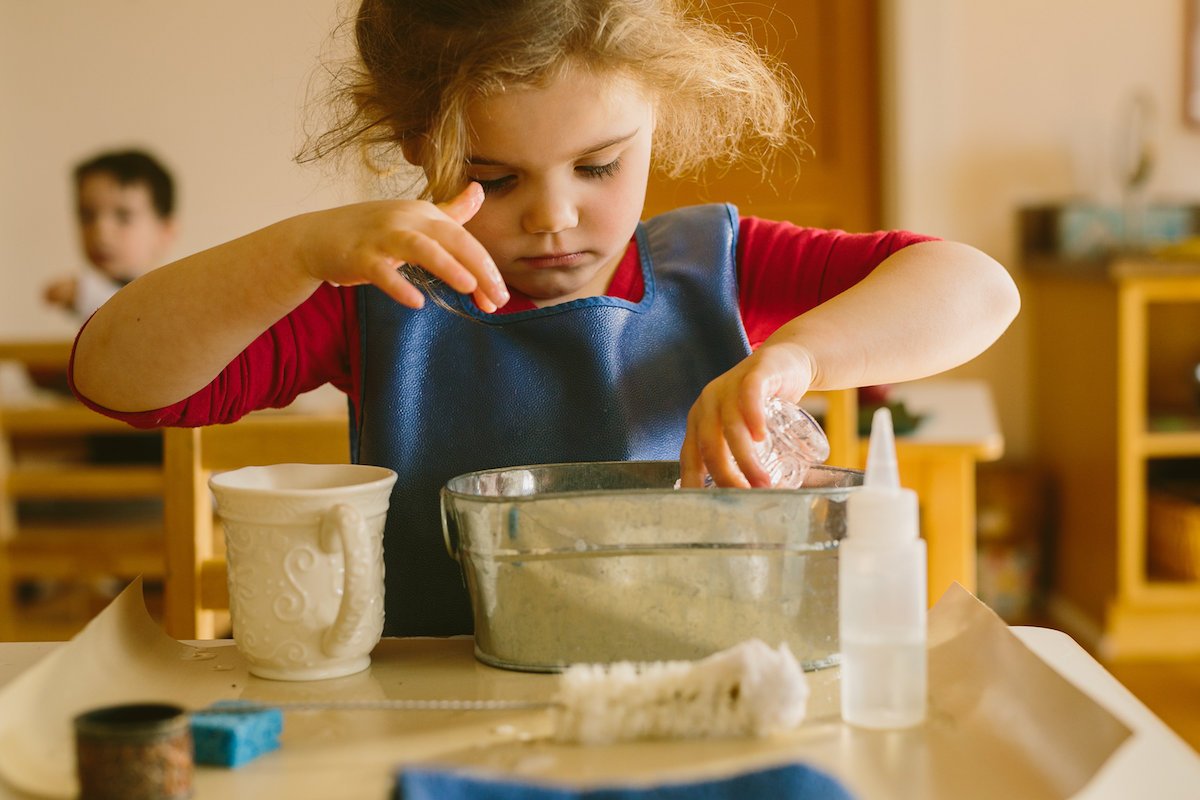
Part of being part of a community is participating in the daily routines to care for our surroundings. In Montessori, we provide numerous ways for children to participate as community members. 

Children love being able to help care for their environment through real and meaningful activities. In the process of helping maintain and care for their classroom and school, children develop a sense of belonging. They begin to feel at home.

Laying the Groundwork

In order for children to be successful in this process of caring for their surroundings, adults do a lot of behind-the-scenes preparation. We make sure we have materials ready that are both real and child-sized. Because young children learn from (and love!) repetition, we also want children to be able to continue working with the materials as long as they desire. This might mean having just the right amount of polish for cleaning the mirrors, or vases for arranging fresh cut flowers, or cloths for wiping the tables.

Real Outcomes

The activities we provide in Montessori environments are real work, rather than something to keep children busy. As such, the outcome of the activities must be clear and necessary. If the plants need water, children can water the plants. If the floor is wet, children can mop the floor. If a table is dirty, children can scrub the table. 

Because our young people are learning how they can have an impact on their environment, adults work hard to not redo what children just did. Thus, if the table is still dirty, the adults leave it as is. Perhaps later another child can be invited to clean the table, but the adults refrain from swooping in and cleaning the table afterward.

Types of Activities

In order to determine appropriate care of the environment activities for the classroom, we observe children and also consider what practical maintenance needs to happen each day. If there is an easel with paint, we create a material for washing the easel. If there is an easel with chalk, we offer an activity for washing the chalkboard.

The specific kinds of activities depend upon community norms, the greater culture, the climate, and even the length of the day. Regardless of these variables, the activities always have an intelligent purpose and are part of the everyday, regular part of what happens in the community.

Individual Satisfaction to Community Impact

At first, children will pursue the activities for their own satisfaction. They will clean a table to enjoy the process of creating soapy bubbles and wiping them off the table. Later they will realize how they are caring for the environment in ways that benefit everyone. They will want to scrub a table because they see it is dirty and they want it to be clean. This realization causes children great joy. They love to contribute to the greater good! 

To help children develop this awareness and sense of belonging, it is nice to acknowledge something a child has done that day to contribute to the community. However, we must tread lightly in this process so that children maintain a sense of doing the activity for themselves and the community, rather than for adult praise.

Responsibility 

Ultimately, care of the environment activities help children learn how to be responsible for their actions.  If a plant needs to be watered, and it isn’t watered, eventually the plant will die. We can offer children the opportunity to water the plant, but if no one is willing, there is a tangible and natural consequence. Children learn that their actions matter and they take great pride in being capable contributors. 

Presentation 

Before presenting these practical life activities, we work carefully as adults to practice the steps, ensure that the activity makes sense, analyze our movements, and be confident that the presentation flows. Once we create the activity, practice it, and present it, we step back and observe children working with the materials. In the process of observation, we ask questions like: Is this activity working? Do I need to change anything? Do I need to change some of the steps? Do I need to take out unnecessary steps? Does the activity need to be removed?

Ultimately though, children will observe what is essential in the activity and make it their own unique process. As children internalize the procedure, they will start to realize how capable they are. They will put their whole focus into the work and experience great satisfaction in the process of engaging with meaningful work in the community. They will develop a strong sense of belonging, and ultimately flourish into their fullest self.

Support at Home

As parents, we are often curious about how we can support our children’s Montessori experience at home. One of the best ways is to create care of the environment routines and activities at home. Children can clean up their toys at the end of the day, set the table for dinner, or put dirty clothes in the laundry basket. We don’t need elaborate preparation, but rather carefully selected items or furniture: special shelves for toys, a low shelf or drawer prepared with items for setting the table, or a basket in the room for laundry. 

Taking a little time to think through the steps involved and what children will need to be successful goes a long way. As adults, we move through daily activities without having to think about what we are doing. Young children, though, are learning how to master their movements. Thus, when we are presenting how to do something, our children need us to slow down and really isolate each step of the process. 

Significance and Belonging

For children, learning how to care for their surroundings is a remarkable gift. Through this meaningful work, children develop a strong sense of belonging and significance. They see how their contribution matters. Come visit our school to see how even our youngest children care for their community and develop personal purpose!

The Significance of Food

Throughout history, human survival has depended upon finding, preparing, and consuming different kinds of food. It is certainly understandable why food is a central part of our lives!

In Montessori, we recognize that food plays a bigger role in our young humans’ development. While nutrition is key, food also represents so much more! Therefore, we offer children the opportunity to use food as a way to develop a richer understanding of the world, master abilities to function independently, and develop a rich language for communication.

Understanding the World

As children develop their relationship with food, it’s important that they get to experience food in its natural state rather than only prepackaged. During the sensitive period for refining their senses, young children need to be able to explore their food sensorially so they can experience the taste, texture, smell, appearance (uncooked and cooked), and even any sound food might make.

In Montessori environments, we offer children opportunities to see and taste fresh foods, and even experience creating homemade breads and soups. Rather than opening a can or package, we start with natural raw ingredients and let the children put all the pieces together so they can see the steps involved in making different foods.

Whenever possible, we also try to give children meaningful connections to nature and its bounty, including when foods are in season. It’s a bonus when we can have fruits, vegetables, and herbs growing in planters or in the outdoor environment! Our goal is for children to develop a connection to food and its growth cycle throughout the year. In the process, children can learn about the parts of plants we eat: leaves, stems, roots, seeds, and flowers.

As children get older, they become more involved with the production and exchange aspects of food, from purchasing ingredients to preparing whole meals for others.

Mastering Abilities & Movement

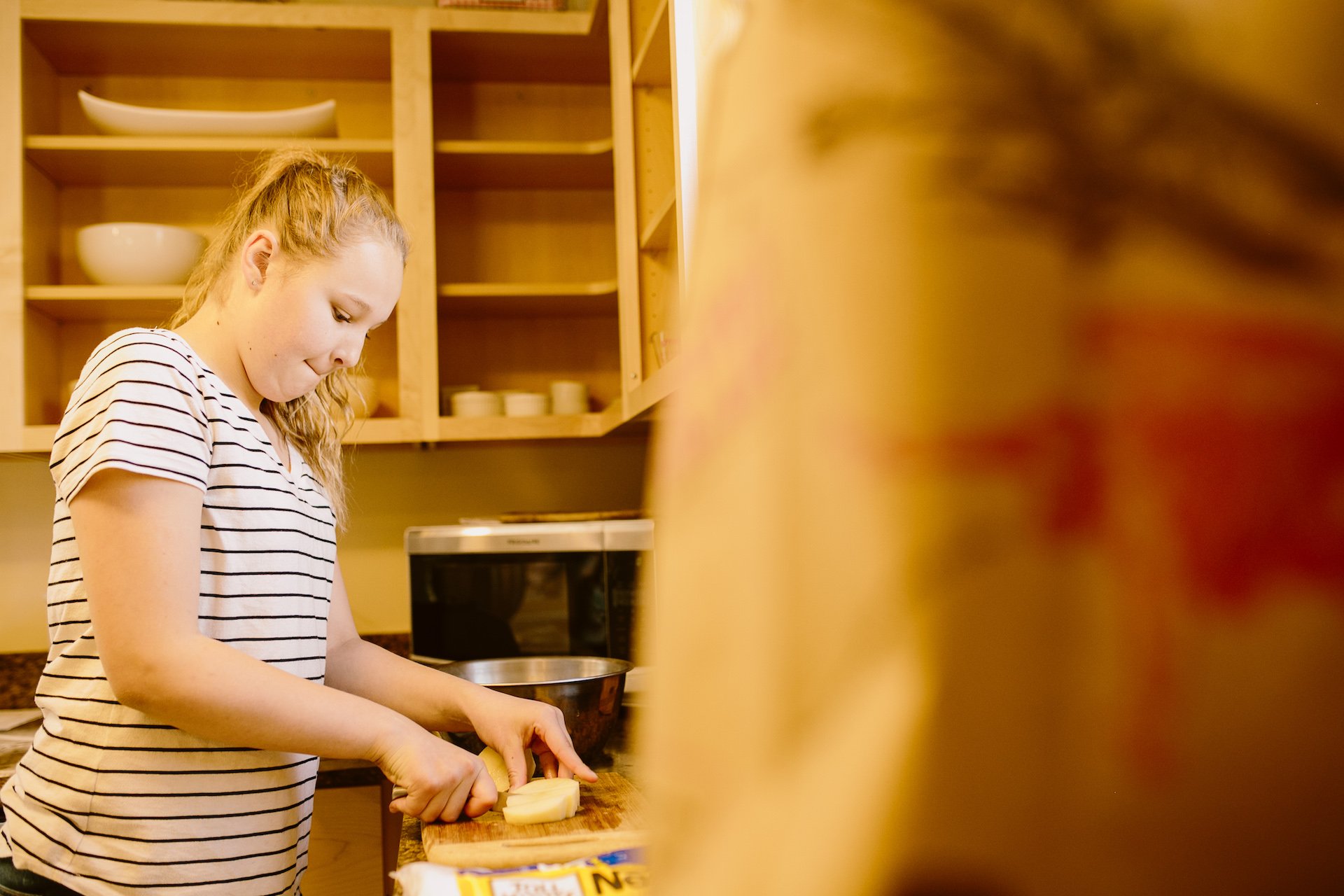
When children are preparing food, we start with basic skills such as cutting, dicing, peeling, grating, and juicing. As children gain more dexterity and skill, like holding and using a knife, we move toward teaching more complex skills, such as how to prepare the ingredients when following a recipe, or how to operate kitchen appliances such as toasters, openers, coffee makers, juicers, mixers, etc.

Whether using simple or complex equipment, children need items that they can learn to manage on their own. As such, we provide kitchen items that are sized appropriately. So children can master their movements and abilities, the kitchen tools must work for children and not cause unnecessary obstacles. Through plenty of repetition with food preparation and the varied kinds of tools involved, children begin to coordinate their movements and refine their skills.

Developing Language

While children are working with food preparation activities, adults take care to use precise terminology to name the ingredients, materials, and actions involved. When we do this, we help increase and expand children’s language and more permanently fix the concepts in their memory.

Table setting also offers a wonderful opportunity for language development. For the youngest children, we can say, “We need four plates.” Then together the adults and children can count to four. While our youngest children may not have an idea of the concept, they will set the plates one to one and lay the foundation for future math work. Table setting can also be an indirect lesson about prepositions. In a very natural way, we can ask children to put the spoon next to the plate, or to the right of the plate, or a napkin on top of the plate. The word “preposition” is never spoken but the experience gives children exposure to the concept of the function of a preposition in a sentence. 

As children get older, we can introduce more complex language and also offer opportunities for them to interpret recipes, write their own instructional steps, and even tap into the expressive creativity involved with food preparation and presentation. 

Thai Mango Curry Recipe

Cultural Importance

Where we live in the world dictates how and what we eat. Different cultures have disparate expectations about cooking or consuming. Yet in all cultural groups, people have explored and experimented with food. This makes sense, of course. People have needed to know what they can eat, if food needs to be cooked to be edible, how foods can be combined, and how our bodies might react to particular foods or food combinations. 

Food also plays a key role in rituals and customs, from people coming together socially to religious ceremonies to relying on food for medical purposes. All cultures have some kind of beliefs about both the significance of food and different foods’ ability to make our bodies feel better or worse.

With all of the cultural richness woven into food, bringing in family traditions, customs, favorite recipes, and rituals around food can enhance the classroom community’s experience and provide a culturally responsive school-family partnership.

Food preparation is an essential part of our learning communities and a significant part of our children’s development. Please schedule a time to visit the school, see this work for yourself, and perhaps even share a bit about your own culinary traditions!

Going Out: An Expansive Elementary

Montessori children in a museum

At the elementary level, children want to know the how and why of everything. As a result, they have a strong drive to explore the world beyond their immediate family and even their classroom or school. New interests compel elementary-age children to explore anywhere and everywhere! Plus, they are creating their ability to function in society. In order to achieve this, our elementary children need to acquire new skills.

One of the ways Montessori elementary programs help six- to twelve-year-olds develop these new skills is through something called “going out.” Dr. Maria Montessori developed the idea of “going out” both literally and figuratively. She recognized how, developmentally, elementary-age children needed to go out the door of the classroom and that the door should open into the wider world.

What is Going Out?

Imagine that a group of two, three, or four children have been studying something in the classroom. They have exhausted all of the resources in the class or school library and are eager to learn more. For example, a group of children may have learned about falcons. They want to interview a falconer and see some falcons up close. Or maybe a couple of students have been interested in mice, so they visit the local pet store to learn about the care of rodents. Students who just researched the Titanic may discover a nearby museum with a display about the Titanic, so they arrange a visit. Children learning about a period in history might visit a local theater’s costume shop to find clothing from that time period and recreate what someone would wear. The options are endless. 

Purposes of Going Out

This small group experience serves elementary children’s need for independence, collaboration, and experience. They need new opportunities for intellectual stimulation. They are curious to learn more. They want to learn everything about the universe and the universe won’t fit into our classrooms!

In addition, elementary children need to be social and collaborate. In preparing for a “going out” experience, students get to work together in an authentic and meaningful way. In the classroom, they share resources, make group decisions, delegate and divide labor, take responsibility, and celebrate each other’s success. Inevitably conflict can arise and can be a necessary and important part of their work. With support, children practice respectful problem-solving. So with all this practice, they are ready to apply these skills outside of the classroom through their “going out” experiences. 

“Going out” trips also require a new level of self-discipline. Children must make decisions and take action. In order to have a successful outing, they have to organize their thinking, themselves, and each other. They also must demonstrate a high level of responsibility, as individuals and as a group.

Different than a Field Trip

Although field trips are important and delightful, they are quite different than the “going out” experience. Field trips involve the entire class and are often planned and executed by an adult. The “going out” trip, however, involves a small group of children who want to learn more about something they are studying or investigating. Those children are then responsible for all of the logistics of the “going out” trip. The outing is conceived, planned, organized, and carried out by this small group of children who have a mission to learn more.

The responsibility for setting up a “going out” experience can require a variety of skills ranging from letter writing, sending emails, filling out forms, making appointments, finding transportation, reading schedules, budgeting for the day, making a phone call, speaking to different kinds of people, using electronics respectfully, packing supplies, confirming appointments, and following up with acknowledgments or thanks. 

Sometimes children may need little mini-lessons about particular forms of decorum related to their “going out” — how to enter a theater, how to conduct an interview, how to write a thank you note, how to show you are listening, how to pay an admissions fee, etc. These are all vital skills that help our children prepare for how they will enter society.

A Community Effort

A successful “going out” program requires the support of the whole school community and the community at large. Sometimes parents or school staff offer to transport children. Being a “going out” driver is very different than being a field trip chaperone. A “going out” driver relies upon the children to share the directions, where to park, and what to do. If the children have neglected to check the hours of the place they are visiting, and they arrive to find the doors locked, the driver merely waits for instructions from the children about what to do next. This requires a great deal of adult self-restraint and an understanding of the aims of the program! 

The children take on the challenge and expectation of what is expected. They want to be capable and they want to know what successful entry into society requires. When they find out what the rules are, they feel more secure in the world. Over time, as children develop connections and relationships out in the greater community, they also pave the way for future “going out” trips.

Support at Home

The spirit of “going out” can be supported at home, too! Think about the various activities that happen in our daily routines and how our children can take on some ownership or responsibility. For example, going to the grocery store can become its own “going out” experience. Part of the planning and preparation can involve sitting with our children to peruse the weekly sale flier to map out some menus for the week ahead. Children can make a list of what to buy and even estimate how much it will cost or try to work within a predetermined budget. Before leaving for the store, they can gather what is needed: reusable bags, the shopping list, snacks so no one shops hungry, etc. Or perhaps a recent weekend hike sparks curiosity about a particular subject, like rock slides or mushrooms. Children can find out the hours of the local library, talk with the librarian about their interests, and initiate the process of checking out or requesting some resources.
Elementary children are capable of so much, physically and mentally. Thus, we want to acknowledge their potential and offer keys for our children to unlock new experiences and step into the wonderful world beyond the school. The best part? Not only does the “going out” experience meet elementary students’ developmental needs, it also promotes a future full of good citizenship and responsible community members.

To see this work in action, please schedule a tour!