
Happy New Year!

newyear.jpg

New Year’s Eve can be a really fun night for adults and kids alike.  There’s something special about a fresh start and finding ways to celebrate as a family has the potential to establish traditions and make memories.

Whether you already have plans or not, read on for some fun facts and ideas!

Go out or stay in?

One time-honored way to celebrate the new year is to hire a babysitter and head off to a party.  This can be a fun way for busy parents to reconnect with a partner, catch up with friends, and have a little fun.

If you plan to spend the night with your kids, you still have options: stay home for a night of celebrating or attend local festivities.  Many cities and towns have their own first night celebrations - if you have never been, you are in for a treat!  Activities and sights might include live music, ice sculptures, street performers, face painters, and of course, plenty of tasty food.  Some events even include a fireworks display.  One benefit of taking your younger children to a first night event is that they can participate in the festivities, and still get home for a reasonable bedtime.  

One last (really great) option is to stay home for the night and celebrate.  This is a great idea for all ages; little ones get the rest they need, older kids can invite friends over to join in the fun, and there’s a whole lot less pressure on the adults.  Add in a few games and snacks, and maybe watch the ball drop on the TV, and the night will surely be a success.  We share more fun ideas toward the end of this post.

Traditions around the world

People across the globe celebrate the new year in a variety of fascinating ways.  Here are just some of the many traditions:

  • In some parts of Brazil, it’s customary to head to the beach and jump over seven waves for good luck in the coming year.

  • Buddhist temples in Japan ring their bells to celebrate. The interesting part is they ring them 108 times, to symbolize the number of human desires - which lead to human suffering - in order to alleviate some of that suffering. Eating soba noodles is another tasty tradition!

  • One of the more famous international traditions takes place in Spain, where twelve grapes are eaten during the twelve strokes of the clock at midnight. The catch is you must finish them all before the clock finishes chiming for good luck during each month of the coming year.

  • The Dutch eat a donut-like dessert called olie bollen. Its ring shape is meant to symbolize coming full circle.

  • Many places, like the United States and France, look to champagne as their drink of choice on New Year’s Eve. People in parts of the United Kingdom enjoy Wassail (a type of hot mulled cider) instead. Russians like champagne, but they write a wish on a piece of paper, burn it, and toss it into a glass of bubbly that they must then drink.

  • In Greece, a special sweet bread is made to be eaten at midnight. A single coin is baked within, and the person who gets the piece with the coin is considered lucky. Greeks also hand an onion from the doors and wake their children in the morning by tapping them with it!

  • In the Philippines, circles are important and lucky; people eat plenty of round fruits for New Year’s to bring prosperity.

  • In Denmark, people save up all their old and chipped plates and dishes to throw at each other’s front doors on New Year’s Eve. The more shards on your doorstep in the morning, the better. In South Africa they throw old appliances out the window.

  • Red is a lucky color in Chinese culture, and many families make sure their front door is painted red for the new year.

  • The Swiss drop dollops of whipped cream on the floor - intentionally - to wish richness into the new year.

  • In Estonia, eating is serious business when ringing in the new year. Seven, nine, and twelve are all lucky numbers, and you must choose one of the numbers and eat that many times.

  • In Finland, tin is melted and dropped into water. The shapes the hardened tin create are meant to represent what the new year will bring.

  • The Scottish call their celebration Hogmanay, which involves swinging balls of fire, enthusiastic parades, and a special tradition regarding whoever steps first over the threshold of a home in the new year.

Fun family ideas

So you’ve decided to stay in and have fun together as a family?  Looking for ideas that will help make memories?  Look no further…

Food!

Eating tasty snacks is half the fun when it comes to celebrating.  Here are a few ideas to help break away from your typical nightly routine.

  • Appetizers for dinner - brainstorm everyone’s favorite snacks, make up a bunch of plates, and leave them out to munch on throughout the evening. Think cheese and crackers, veggies and hummus, cut fruit, chips and dip, or perhaps something a little more fancy.

  • Cook a fancy meal together. Flip through your cookbooks and choose something that sounds good to everyone. Even the youngest children will have fun mixing and measuring. Set the table, light some candles, and feast in great company.

  • Mix up some mocktails. A little juice plus a bit of seltzer, with a few pomegranate seeds tossed in, and you have something special.

Fun!

Pass the hours away enjoying each other’s company and having a few laughs.

  • Break out the board games. With the whole night ahead of you, what’s the rush? Whether it’s CandyLand or Monopoly, or a silly made-up card game, your children will remember this quality time spent together.

  • Have a movie marathon. Rewatch your favorites or try something new. Even better? Share one of your childhood favorites with your kids.

  • Make New Year’s Eve crowns, using whatever you have on hand. It can be as simple as cut paper and markers, or you can add stickers, glitter, or whatever else you and your children come up with.

  • Plan out some family fun for the coming year. Set goals, dream about vacations, or figure out what projects you want to do together around the house.

Countdown!

If you plan on staying up until midnight, figure out a fun way to ring in the new year.  Countdown from ten together, add in some noisemakers, and shout out Happy New Year!

May 2020 be a great year for us all.  
7 Little Ways to Create a Montessori Home Environment

home.jpg

Many families of young children are turning to Montessori methods when it comes to parenting.  After all, it’s one approach that honors the child as an autonomous being and gives them the respect they are due.  But how can we make space for our children in our homes without the place becoming one giant toy bin?  This list of seven helpful tips will get you started on the right track.

1. Have a kid-friendly shelf or cabinet in the kitchen.

This is one of the simplest ways to encourage your child to be independent and show that you trust them.  Starting when your children are toddlers and continuing until they are able to reach and use everything the adults do, set aside a small cabinet or drawer in your kitchen just for them.  This is where you will keep child sized plates, bowls, cups, silverware, and perhaps even a few cloth napkins.  This will allow your child to get what they need whenever they need it; you won’t need to stop what you are doing to help them, and they can feel good about doing something for themselves.

Want to take it a step further?  Keep pre portioned snacks in the cabinet for your child to access whenever they want.  Some families also designate an area of the refrigerator for this purpose, along with a small pitcher containing water or milk that little hands can easily pour themselves.

2. Consider a few minor additions to your entryway.

Getting out the door in the morning can be one of the most rushed and sometimes stressful times of day for families of young children.  A few quick additions to your entryway can help make everything run a bit more smoothly.

Consider your child’s height and hang one or two hooks near the door just for them.  Keep a small box or bin that they can toss their shoes into, thus keeping them contained, tidy, and easy to find when they need them.  We have even seen some families hang a small mirror at child height in the same area.  Taking these steps will help build responsibility, keep your home organized, and ease the frantic pace of many of our mornings.

3. Put most of the toys away.

This recent study covers the scientific reasoning behind why less is more.  That said, it isn’t easy.  Even if you are mindful of not buying your child too many toys (a feat in itself), there are always gifts from family members, party favors, and so many unpredictable little treasures that kids collect.

How can we manage all that stuff?

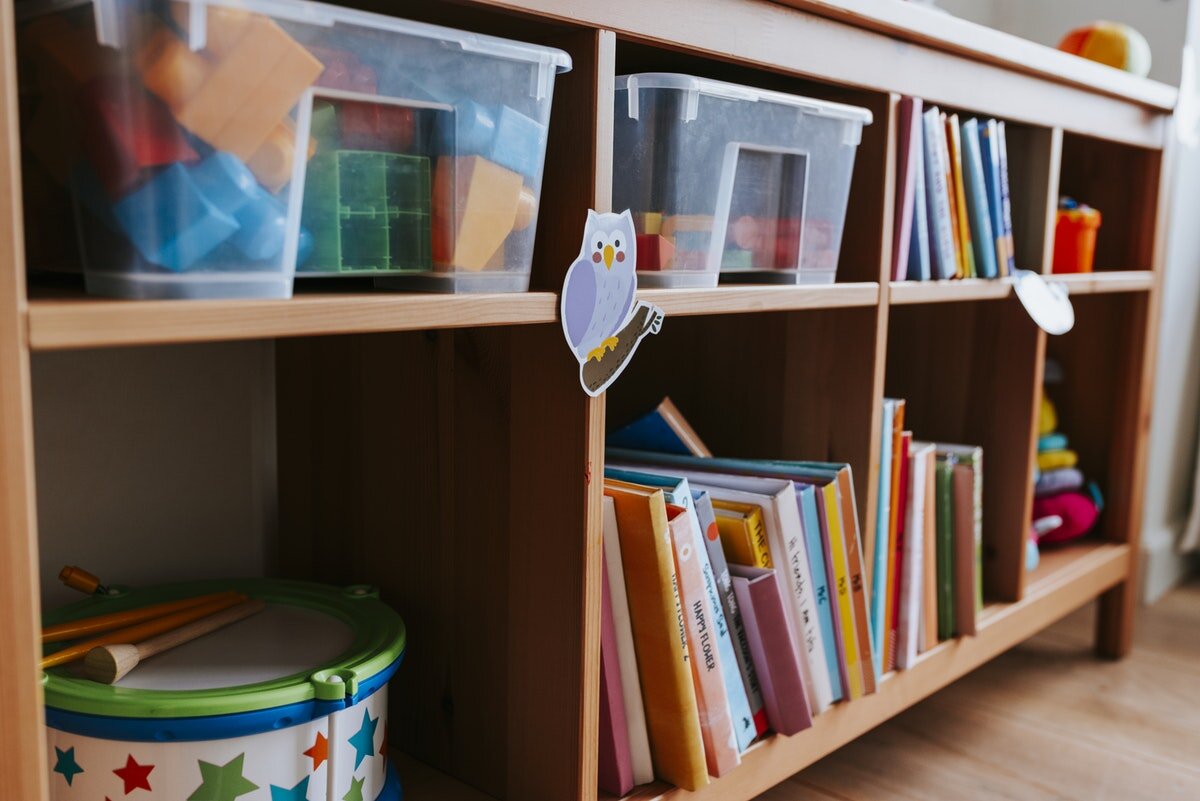
When your child is at an age where they can comprehend the ideas, it’s good to talk to them about waste and consumption, then ask for their help in working to manage it all.  Until then, observe your child at play, determine what they actually use or enjoy, then rotate toys according to what you notice.  Avoid the bottomless toy box and opt instead for using low shelves as storage.  Items are easier to see and manage that way.

4. Keep baskets of books handy.

Reading is great for children in so many ways, so keeping books handy wherever you are is important.  It can even be fun to make your selections.  Some ideas:

  • Keep a basket of seasonal books in the corner of your living room.

  • Stack your potty training books in the bathroom.

  • Your child loves dinosaurs? Check some dino books out from the library and keep them in a bag in the car so they’re always on hand (for trips, waiting rooms, an older sibling's soccer game…)

  • Basically, anywhere your child spends time and there isn’t a bookshelf nearby, collect up a few books and tuck them within reach.

5. Build independence into children’s bedrooms.

One of the earliest ways to build independence into your child’s bedrooms is with your choice of bed when they are infants.  Many Montessori families choose to use a floor bed.  If the rest of the child’s room is safe, this allows them freedom of movement when they wake.  Many babies and toddlers will wake up and crawl/walk around the room, keeping themselves occupied with their toys until their parents wake up and come to get them.  The floor bed can be implemented whenever the parents feel comfortable giving it a try.  If your little one starts crawling out of the crib but isn’t quite ready for the height of a toddler or regular bed, a simple solution is to just lay the mattress on the floor until they are ready for the next stage.

Another area to keep in mind: your child’s access to their clothing.  Older toddlers and preschool aged children can begin selecting their own clothes.  By making a limited number of choices available to them, you can ensure they will wear something appropriate for the weather while still giving them the empowering ability to decide for themselves.

6. Keep color schemes and decor simple and natural.

Depending on our own childhoods and other factors, sometimes we feel like we need to decorate children’s spaces in bright colors.  The truth is, we all function better in calming environments.  There’s no need to spend lots of money to replace what you already have, but consider the following swaps:

  • Paint over bright walls with a more neutral color.

  • Opt for wood, glass, metal, and natural fibers over plastics.

  • Framed art (inexpensive prints or thrift store finds) or photos can replace cartoon posters.

7. Make space for your children.

It all really comes down to shifting our perspective.  Our children are human beings who are worthy of living in a home that serves them and their needs.  The key is balance.  Should our children’s things take over the entire house?  Definitely not!  (You live there, too, after all.)  Small adjustments in each room children spend time can make a huge difference in their lives.  

Do you already implement some of these ideas in your home?  How has it worked out for your family?  Do you have other suggestions to share with families who are looking to make their home more Montessori friendly?

It’s Okay to Set Limits

limits.jpeg

As parents today we are bombarded with advice, ideas, suggestions, and rules on how to be the best parents we can be for our children.  Some change is good; emerging research tells us more and more about human development and how our brains work, and making progress as a society is always a good thing.  Still, it can be hard to weed through the good ideas and those with good intentions that don’t really serve us or our children.

Giving children choice is important.  Respecting children as autonomous human beings is important.  We should recognize that even though they are young, their lives are not ours to live.  Their dreams are not ours to fulfill.

So, we give our kids choice.  We let them make their own decisions.  We honor their growing independence and understand that their ideas may sometimes (often) conflict with our own.  And we try to be okay with that.

But should we let our children do whatever they want all the time?  We would argue that no, that is a very different scenario.  Giving choice is one thing, neglecting to set any boundaries is something altogether different.

What do children need?

In order for a child to strengthen their sense of independence they need to be able to make their own decisions, but they need to make these within a framework that feels safe.  As kids learn and grow, they need to be able to take risks and make mistakes; after all, making mistakes is one way we learn.  It is critical, however, that we keep give our children boundaries within which they are able to make choices.

As children grow and develop, it is critical that they form bonds with adults in their lives that are trusting and secure.  Our kids really do test us sometimes; they push against the rules we set because they are seeking a sense of how strong our limits are and whether or not we mean what we say.  Giving guidance and setting boundaries isn’t just okay, it’s critical to letting our children know we are here for them and care about their well being.

In short: kids need choice.  They also need those choices to fall within limits that keep them safe, both physically and emotionally.  When they’re younger, they need fewer choices and more limits.  As they grow, we increase the choice and decrease the limits.  This way, once they are fully mature adults, they have had plenty of time to practice making decisions prior to any expectation that they actually do so successfully on their own.  Isn’t that what childhood is all about?  Human children are able to experience a joyful period of time in which we get to practice becoming a responsible adult.

What does this look like in our classrooms?

Montessori classrooms are carefully prepared environments with built-in choices and limits.  Some examples of how we achieve this balance:

  • Furniture is arranged so that children are free to move around, but most classrooms are devoid of large open areas that might encourage running in such a confined space. Those shelves are placed with intention!

  • Materials on the shelves are rotated frequently. Children may only access what is available to them. Materials that we do not want the children to have access to are kept stored away in a cabinet or closet.

  • The snack table might be just large enough for two chairs. We want children to eat and socialize when they choose, but we also know that if there is space for ten children to do so at once, the activity may become disruptive and lose its original intent.

  • Older children may utilize work plans. This enables them to determine the pace, order, and details of their work, but requires them to be accountable for completing all desired tasks within a specified amount of time. For example, a child may be asked to complete a range of math, reading, and biology work within a given timeframe, but there is plenty of choice in how they accomplish the goal.

  • Children in Montessori classrooms do not typically have to ask permission to use the restroom. Instead, we create structures so that they may do so safely whenever the need arises. Some schools have restrooms located within the classroom, others have hall passes available, or hold class meetings to discuss procedures with the children.

What might this look like in our homes?

If your family is new to Montessori, it can sometimes take a bit of time to shift ideas and expectations.  Once you do, however, it’s hard to imagine doing things any other way.  Some ideas to get you started:

  • Allow your children to make decisions about what they wear. For older babies and toddlers, this may be as simple as allowing them to choose between two different color shirts. For older children, you may just set guidelines, such as their clothing must be appropriate for the weather.

  • If you need your child to get a few things done, let them choose the order. For example, ask them if they would rather take a bath or make their lunch first. Be clear that your expectation is that they will do both, but that you value their opinion and want to let them help decide how to spend their time.

  • Define boundaries when your child is struggling with emotions. It’s great to let your child feel whatever they are feeling, but that doesn’t mean they should mistreat those around them when they are frustrated or angry. “I see that you are frustrated. It’s normal to feel that way but you may not scream in our house. Here are some other ways to express that feeling…”

  • Have frank and open discussions with your older children. Have you been feeling like they’re overdoing it with video games or staying out too late? Tell them what your concerns are, what your limits are, and solicit their ideas with solutions. Rather than implementing sudden new rules, engage your older children in problem solving talks until you come to a conclusion you can both live with.

We hope this post has been helpful and inspiring.  In a world of permissive parenting and misunderstandings about what Montessori really means, it can be easy to get caught up in giving in to our children’s every desire.  The good news is, you don’t have to.  Our children look to us to be the adults in their lives.  Each and every child deserves adults who love and respect them for who they are.

Why Montessori?

whymontessori2.jpeg

How does a parent prepare their child for an unpredictable future?  Don’t we all just want to give them every possible advantage?

How do we define success in our children’s lives?  Is it about being able to provide for oneself or is it finding joy in the work we do?  Is it about contributing to our communities or perhaps continuing to learn throughout our lives?  Couldn’t it (shouldn’t it) be a little bit of all of those things?

Goals

We think Montessori is one beautiful way to work toward all of these goals, and we are prepared to make some bold statements:

  • Montessori gives children a strong understanding of basic math and language skills, starting earlier than most methods and using materials that support their development and methods that correlate with current research findings.

  • Building a sense of independence and confidence is a major component of what we do. We know that children of all ages are fully capable of doing more for themselves than they are often given credit for. We have learned to sit back, observe, and assist only when necessary. This allows children to grow in incredible ways, amazing their parents (and frankly, us, too!).

  • Respect for and connection to the earth is built directly into our curriculum, especially in the elementary grades. We know that around age 6, children start to think about where they fit into the bigger picture. We teach them about the universe, our solar system, the beauty of our planet, and the variety of life on it, just at a time when they are seeking those answers.

  • Choice and freedom are important for all human beings. We give both to children because we believe they are capable of knowing what they need and want, and the more practice they have the better they will get at making decisions when we are not there to support them.

  • We value teaching responsibility and time management skills. This goes hand in hand with focus and attentiveness. The ability to make choices about one’s learning must be balanced with accountability; as the children in our classrooms get older, they know there are certain expectations. For example, they may be able to choose the order of their work, but they know that they have to do grammar at some point during a specific time period, even if it’s not their favorite subject.

  • Rather than drilling arbitrary facts into children and forcing them to memorize information that may not serve them in the future, we take a different approach. All children are exposed to a wide variety of basic scientific, geographical, and historical information, and are given extensive opportunities to more deeply explore the topics that they find fascinating.

Graduates of Montessori schools go on to be successful in other settings, whether they go on to attend other private schools or their local public schools.  They tend to view the world a little more creatively than the rest of us, and their contributions are often felt throughout society.  There are many notable public figures that credit their early Montessori education to the successes they experienced later in life.  To learn more about some of these people, take a look at this article.

Research

Montessori-specific research is a fairly new field, but the initial results in recent years are fascinating.

One study conducted in Hartford, Connecticut, took a look at preschool students in a public Montessori magnet school.  Federal magnet grants are awarded to public schools who commit to special, high-quality educational programming (in this case, Montessori) in an attempt to create a socioeconomically diverse school community within an urban setting.  In the study, two groups of preschool-aged children were observed over time: 70 children in the Montessori setting and 71 who were in other settings.  While the children tested similarly at the onset of the study, eventually the Montessori children outperformed the others academically, as well as notable increases in their enjoyment of work, social understanding, mastery orientation, and executive function.  Subgroups within the study showed some other interesting findings that suggest Montessori education might help close the gaps on certain factors that typically hinder children’s success (such as income and executive functioning).

Another study in public Montessori schools in Milwaukee concluded that a Montessori education has long-lasting positive benefits for children.  The study also determined that when Montessori-educated children eventually transitioned into more traditional educational settings they were successful and the transition was positive.

While there are other great studies out there, we will touch on just one more here.  This study took a look at the effects of a high fidelity Montessori environment versus a low fidelity Montessori or conventional classroom environment.  Children who learned in a classic Montessori program in which the guides adhered to traditional methods made significantly higher gains during the school year than their counterparts in conventional classrooms or Montessori classrooms that were supplemented with other types of learning materials and methods.

Community

Montessori schools are also something unexpected: they provide a community for more than just the children.  Parents, educators, students, and local community members gather together in support of common goals.  They work together, socialize together, and find ways to solve problems together.  In our society today, many people have lost the sense of community that is so important to our well being; Montessori schools serve an important function of not just educating children, but giving like-minded adults a way to connect and form meaningful relationships.

On the Topic of Competition

competition.jpg

You may have noticed that in Montessori schools, we do not typically encourage competition between children.  Our lack of traditional grading is one obvious marker of this approach, but you will notice that the lack of peer competition threads itself pretty much throughout the entire program.  This is quite intentional, and we work hard to give children a foundation built on competition with oneself, rather than with others.  

It is important to note, however, that a Montessori education does not leave children unprepared for “the real world”.  We recognize that competition is a part of life for many, and we work hard to cultivate characteristics that will allow children to engage in healthy, fulfilling competitive experiences.

Curious to learn more about what we do?  In this post we not only explain why we favor internal motivation, but what we do to help nurture well-rounded and adaptable children.

Internal versus External Motivation

One of our core values as Montessorians is that we believe intrinsic motivation is far more powerful than external rewards.  This has been the foundation of our educational model for over a century.  In recent years, studies have backed the theory that we are most successful when we are driven by our own internal motivations, not perceived rewards (like prizes, grades, or money).  Information on one such study can be found here.

How We Prepare Children for Healthy, Real-World Competition

Montessori schools can sometimes feel like a bit of a protective bubble.  As educators, we need to recognize this and make sure we are preparing children for what comes next.  Montessori students tend to be highly successful when they eventually move on to more traditional schools, regardless of when that might be.  The following character traits are cultivated throughout a child’s time with us, and we believe this is part of what it takes to create successful and fulfilled people in the long run.

Self Confidence

We all like having the ability to believe in ourselves, and we do whatever we can to guide our children toward feeling the same way.  From a very young age, Montessori children learn to do things for themselves.  They are respected by the adults in their lives and their personal autonomy is honored. 

When a toddler sweeps up her own crumbs, she feels it.  When a four-year-old makes his own sandwich for the first time, he feels it.  When an eight-year-old solves a challenging long division problem, they feel it.  

We build routines and structures that allow children to accomplish big things, and to revel in the feelings of self-accomplishment.  After many, many of these experiences, children develop a strong sense of self, and an “I can do it” attitude.

Resiliency

In Montessori classrooms, we know what children are capable of.  We know that traditional settings often expect less than what is developmentally appropriate for them.  When our students feel driven to work hard on challenging tasks, failure becomes an early and welcome part of their experience.  

As adults, we often equate failure with negative outcomes.  In reality, failure is nothing more than a learning experience, and we can use that experience to guide us toward mastery.  When following an internal desire to learn about or accomplish something, children welcome these necessary building blocks.  They see them for what they are: another motivator to keep pushing forward. 

Independence

If it’s not already obvious, our students are encouraged to be as independent as they are able to be, both according to their age and their individual needs.  This means they do not need to rely on others to get started on or execute tasks; they have plenty of experience confronting challenges independently.

Having a strong sense of independence allows us to take on leadership roles.  It brings us towards self-awareness and trusting our own abilities.  Our independence can encourage us to block out unimportant details and distractions, leading us to focus clearly on the task at hand.

Cooperation

While independence is critical to our success, it is equally valuable to be able to work cooperatively with others.  Many competitive situations involve teams of people working together toward a common goal, and this is something Montessori children get lots of practice in.

We recognize that one of the hallmarks of the elementary age (6-12) is that children are highly motivated by social interactions.  To this end, we carefully craft the classroom environment to support this need.  Children are given lessons in small groups, and even the furniture is arranged for a variety of seating options. If you were to observe in an elementary classroom, you would notice most of the children clustered in small groups working together, and this inevitably leads to many opportunities to practice important skills like compromise, flexibility, and advocacy. 

Self Advocacy

Montessori classrooms have a bit more flexibility in terms of daily scheduling than most settings.  One critical element that must remain is the three-hour work cycle in the morning.  Beyond that, our guides are able to schedule class meetings regularly, or any time conflict arises.  We teach our students skills they need to navigate all sorts of interpersonal situations, including how to advocate for themselves.  

Another interesting aspect of a Montessori classroom is that even young children have frequent opportunities to present their work and ideas to their classmates.  Being able to stand up and speak in front of a group of people from the time one is six years old seems to have a profoundly powerful effect on how we are able to convey, with confidence, our ideas and feelings.  

Did you know that there are a number of well-known figures who attribute their Montessori education at least partially to their success?  In this video, NBA MVP Stephen Curry shares how his own Montessori education gave him the confidence necessary to become the successful adult he is today.

Montessori Basics: How we Teach Handwriting

handwriting.jpg

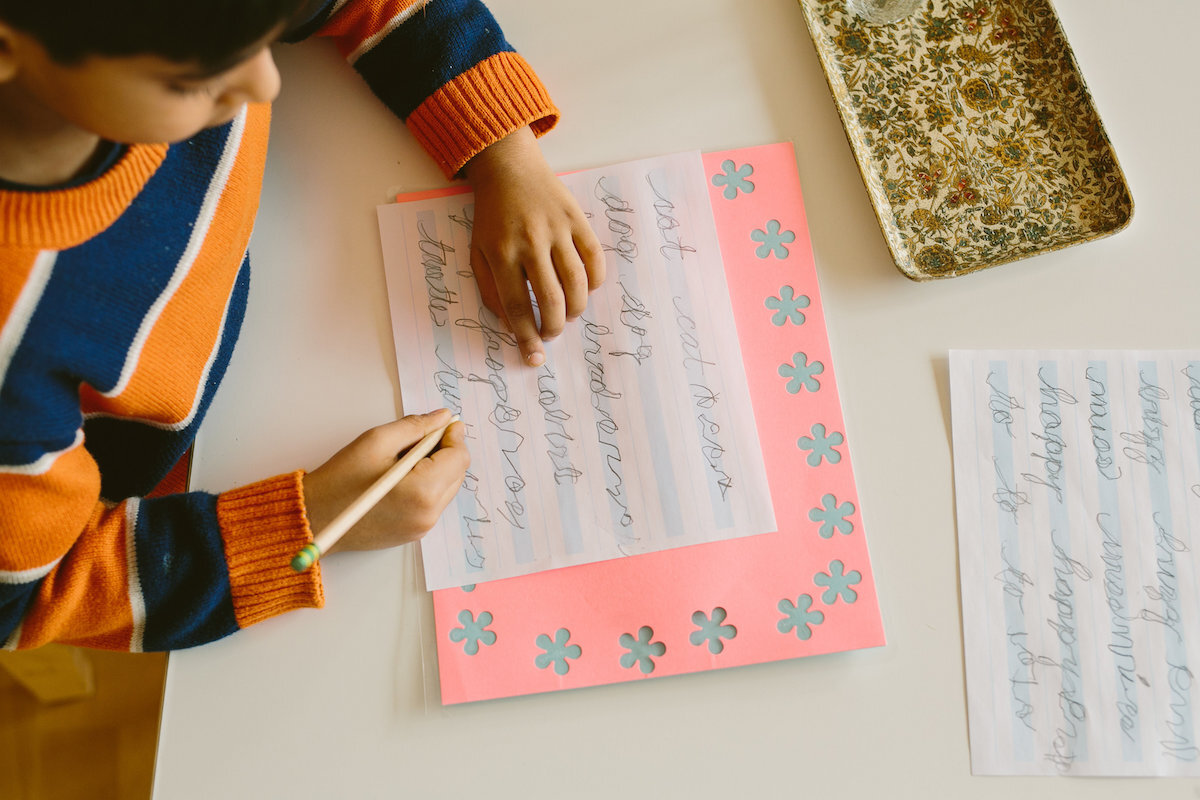
Handwriting or penmanship; no matter what you call it, it was likely an important part of your early education.  Pressured by time and content constraints, many schools have abandoned explicit handwriting instruction.  This is resulting in a generation of children who do not know how to write in cursive, and who sometimes even struggle to form legible printed letters.

A number of scientific studies point to the importance of handwriting, including this one which concluded that handwriting (as opposed to typing or tracing) guides preliterate children toward developing reading skills.  

Interested in learning more about the scientific evidence that supports the importance of teaching handwriting as a skill?  Check out this article that highlights five of the important reasons we should not allow direct instruction in this area to go by the wayside.  Not only does learning handwriting early help children develop skills needed for reading, evidence suggests it makes children better writers, spellers, and leads them towards future success in academics.  Higher brain density and gray matter volume have been connected to high-quality handwriting, suggesting that frequent practice may aid in neural processing.  Studies also conclude that it is critical for teachers to model the correct way to form letters, but also to utilize direct instruction.

In Montessori schools, handwriting is a critical component of children’s learning.  As with so many other skills, our curriculum takes a spiraling approach, indirectly preparing children prior to direct instruction.  Very young children develop the muscles necessary for a pincer grasp while they manipulate materials such as the knobbed cylinders, a Montessori favorite!  

There are two other important materials in the primary classroom that facilitate handwriting readiness: the metal insets and the sandpaper letters.

The metal insets are wooden trays that hold a series of stencil-like shapes.  Removable shapes are blue with a pink background.  Some shapes have straight-lined sides while others are curved.  Children trace the shapes with a pencil, giving their hands a chance to practice creating a variety of lines.  Increasingly challenging activities encourage children to create different patterns with colored pencils while staying inside the original traced lines.  At first glance, this may appear to be a fun art activity (which it certainly is!) but its main intention is to prepare children for their upcoming work in handwriting.

Montessori sandpaper letters take the work a step further.  Twenty-six wooden tiles are adorned with gritty, sand-textured letters of the alphabet.  Children are given lessons on how to trace these letters with their fingers and say the sound.  (As a side note, Montessori children are taught the sound of each letter in conjunction with its name, which makes much more sense for reading preparation.)  Perhaps you have observed this in a Montessori classroom; if you have not, we highly suggest coming in to watch the magic of this work in person.

Interestingly, children who attend Montessori schools are typically able to write even before they have begun to read.  Once they do begin reading, these previously developed skills allow them to seamlessly work on the various components of literacy development simultaneously.

Once children enter the elementary years in a Montessori school, they are required to write throughout the day.  Typically, children work throughout the three-hour work period in the morning on a largely independent basis, unless they are receiving a direct, small-group lesson from the guide.  During this independent work they record parts of what they do in notebooks.  For example, if a child uses a card material to learn about the internal body functions of a fish (how they perform the tasks of respiration, circulation, movement, and so on), they will record at least part of this work in their notebook.  For example: “Circulation.  Fish have two chambers in their hearts.”  This writing continues throughout the day and is directly connected to other content children are learning.

Some classrooms include direct handwriting practice even in the elementary years.  This is typically something for children to copy in their notebooks, such as a poem or a paragraph about something they recently had a lesson on.

One final and very important reason to teach handwriting: when children learn how to form beautiful letters early on, they are better able to focus on a myriad of other things.  For example, when writing a story, they can actually think about their story ideas instead of belaboring over how to write a ‘q’.  

Interested in learning more?  As mentioned earlier, we encourage you to come visit the school and observe in one of our classrooms.  Doing so is common practice in Montessori schools, is unobtrusive to the children, and can provide excellent insight for those who are looking to learn more about this unique educational approach.

Holiday Gift Giving Guide 2019

Believe it or not, the holiday season is rapidly approaching!  We thought it might be fun to share some of our favorite Montessori-friendly gift ideas.  Click on the name or picture for shopping information..


Montessori Infant Mobiles

Montessori infant environments traditionally use mobiles for newborns.  There are different types, but their purpose remains the same: they aid babies in the development of their visual tracking, but they also just bring the babies a sense of joy.  Etsy is a great source for finding beautiful handmade versions.  To learn more about Montessori mobiles, take a look at this article.


Baby Boo Silk Scarves

Silk scarves are an excellent option for open-ended play.  Children use their imaginations and creativity as they think of ways to incorporate them into their play.  The scarves will be used for hiding, covering, waving, dancing, and as a dress-up option.  We have even seen them worn by patient and willing family pets.  This particular scarf is a bit smaller and colored with nontoxic dyes, making it perfect for babies and toddlers.  

 
a275_fsh09_p.jpg

Crayon Rocks

Art supplies are a must for any child.  Keep it simple; children are happy to use paper from the recycle bin and whatever else you have around.  If you’re looking for something a little more special, check out these crayon rocks.  Comfortable for tiny hands to grasp, they are made with soy wax and colored with mineral powders.  They lay down gorgeous color and are appreciated by children of all ages.

 
q40_ms1718_p.jpg

Child-Sized Snow Shovel

Young children love to do whatever the beloved adults in their lives are doing.  The tasks we often view as monotonous or even tedious are exciting for little ones.  Giving children real tools that are sized down for them makes this important work possible.  This snow shovel will allow you to get your driveway cleared while your child learns alongside you, getting fresh air, exercise, and important bonding time with you.


Young Carpenter’s Set

Much like the snow shovel listed above, this toolbelt, hammer, and safety glasses set will allow aspiring young carpenters to work alongside the adults they admire.  Montessori Services offers many different child-sized tools, depending on your child’s level of interest and what types of projects you have envisioned!


Leaf and Flower Press

Children are collectors.  Especially when they spend time outdoors, their natural fascination with the world spurs them to gather tiny objects.  We are all familiar with pockets full of rocks and crushed dandelions found in the back seat of the car.  As children get a little older, this leaf and flower press can allow them to preserve their botanical finds.  Once leaves and flowers are dried and pressed, they can be used in many different ways.


Marble Run

If your child loves to build, marble runs are a great way to encourage independent development of a wide range of skills.  Kids will experience trial and error, general engineering concepts, creativity, and more.  There are endless possibilities for configurations, and children can enjoy using the toy by themselves or with a friend or adult.


Jigsaw Puzzles

Puzzles are a classic way to pass the time together.  We really appreciate this particular brand because they are well-made and have many great designs for children.  The beauty of puzzles is that they don’t need to be completed in one setting.  Designate a tabletop and have one out for the family to work on together a little bit each day.  Rather than linking to one particular puzzle, we decided to just share the page for children’s puzzles so you can find one that would be appealing to your child.


Child-Sized Mug

There’s nothing quite like cozying up with a warm drink on a chilly winter day.  These 4-ounce ceramic mugs were created with kids in mind.  They are adorned with pictures of wild animals, and a portion of each sale is donated to conservation efforts.


Kites

Kites are a classic children’s toy.  They encourage our children to run around outside and to pay attention to keeping the kite afloat.  Teaching your child how to fly one can be a fun and rewarding experience, and there are so many different places to take them.  Some families like to keep one in the trunk of their car, just in case!


We hope this list has provided you with some helpful inspiration.  Do you have other ideas to share?  Let us know!