Inclusivity in the Montessori Classroom

montessori-inclusivity.jpg

Montessori is a method of education as well as a general philosophy on human development. If we could summarize it into one sentence it might be something like this: A deep understanding of typical human development, coupled with careful observations of the individual and a meticulously prepared environment, can allow each human being the freedom to explore their world to the best of their ability.

Wouldn’t it be amazing if we could do that for everyone?

Montessori schools do their very best to make this goal a reality for all who become a part of the community. Below are just a few of the variables we take into consideration.

Age

As you already know, our classrooms are multi-age. This may not be typical when compared to most conventional educational settings, but it’s very intentional and an integral part of what we do. We believe children of varied ages have much to offer one another, and having a span of a few years in one classroom allows for the blending and blurring of different abilities, so everyone always has a buddy to work with. Multi-age classrooms give children opportunities they wouldn’t have elsewhere, such as older models for the young children, and a chance for older kids to explore leadership roles.

Beyond the typical three-year age span, we like to take every opportunity for children to interact between the levels. In the same way we see within the walls of a single classroom, the younger children at our school are able to look to the older children as models, and the oldest children have chances to lead in new ways.

Did you know that Montessori can be for adults as well? Some adults read about Montessori and learn to incorporate the principles into their own lives. Others go on to obtain Montessori teaching credentials or explore Montessori higher education. There have even been studies regarding the benefits of applying the Montessori approach to dementia care.  

Gender

Montessori schools aim to honor children as they are. We acknowledge that society places certain expectations on children according to their gender, and that it can be a challenge for children whose identity does not conform according to these expectations. This can take form across a wide spectrum; whether a child prefers certain toys and colors that our society has attached gender to, to being transgendered, and everything in between.

Our goal is to acknowledge these differences, to work hard to eliminate expectations that do not serve the children, and to create a nurturing environment where all children feel supported and accepted.

More on this topic here.  

Race

To fully educate a child, a school must acknowledge that child and family’s experience. We believe that “colorblindness” is harmful; race is an important part of a person’s identity and must be recognized. We want our students to be proud of who they are, and we also want to recognize the struggles that some face due to the color of their skin.

While people of color have known and felt these struggles for centuries, society as a whole is beginning to recognize their reality in recent years. There is still so much work ahead of us, but we are hopeful that we may be on the verge of a shift in cultural awareness. 

In our classrooms, we do what we can to support this work. We include families of all backgrounds. We ensure there is literature in our classrooms that is representative not only of the children who are in the room, but of all types of people. As educators, we aim to keep learning, keep supporting, and keep moving forward.

We’re not the only ones. To learn more about the important work that is being done, check out Montessori for Social Justice.  

Cultural Heritage

In Montessori classrooms, different cultures are something to be celebrated. We may not celebrate holidays in the same way many other schools do, but we do enjoy exploring different cultural celebrations from around the world. We believe that learning about each other’s unique traditions helps bring us closer together.

We encourage parents to come into our classrooms to share cultural traditions. This might be making latkes with the children for Hanukkah, creating a Nowruz table in the lobby for Persian New Year, or making clay lamps with students for Diwali.

Children love to learn about (and taste, and make) things from other cultures. If your family has something special to share, we encourage you to get in touch with your child’s teacher and see if there’s a way to incorporate something into the school year! These experiences are enriching for everyone involved.

Different Abilities

By design, Montessori education is supportive of children with different abilities. The two most obvious examples of this are our multi-age classrooms and individually-paced learning. No two children are alike, and we believe teaching a single, rigid curriculum to a whole room full of children actually serves very few. Differentiation is a popular buzzword in education; we believe true differentiation is about individualizing the curriculum so that it meets the specific needs of each and every child.

Because Montessori honors the child as they are, and aims to guide them on their own path, it makes sense that it’s the perfect environment for many children with special needs. Some needs are more visible than others, but we believe that every child has the right to be a valued member of our community. To learn more about how Montessori environments are supportive, check out this video:
Materials Spotlight: The Puzzle Maps

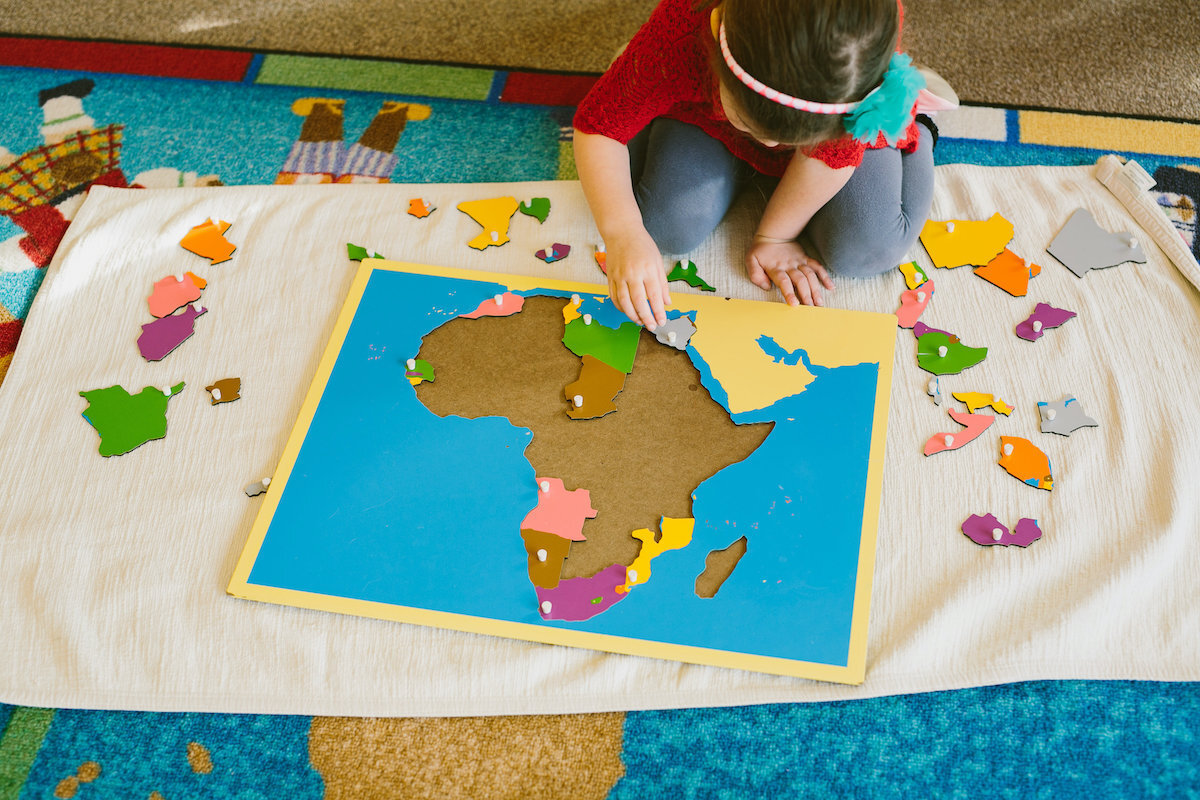
In this second installment of our new materials spotlight series, we celebrate and explain the Montessori puzzle maps. Beautifully and colorfully painted and carefully crafted out of wood, they can be found in both primary and lower elementary classrooms. While they are used differently in the two environments, educators take a developmentally appropriate approach to utilizing this beautiful geography material.

The Material

In a Montessori classroom, one will find a wooden rack that contains a series of puzzle maps. They are arranged intentionally, starting with the top shelf and working downward:

  1. The planisphere: two blue circles with removable colored continents

  2. A map of the child’s continent: puzzle pieces indicate countries

  3. A map of the child’s country: puzzle pieces indicate states or provinces

  4. Maps of the other continents of the world: pieces indicating countries

There is typically also a set of control maps, or corresponding laminated paper maps that have the pieces drawn to scale and labeled. Children may use these as reference depending upon the activity.

An Introduction

Of course, we begin with the top map of the world. Previously, the child will have worked with the Montessori globes, so they will have some idea about the world, the continents, and the oceans. Using the three-period lesson format, the guide introduces (or reviews) the names of the continents. The guide will demonstrate how to properly retrieve the puzzle, lay it out on a work mat, remove each piece carefully and replace them while naming them. Some classes may have laminated paper labels the child can lay on top of the pieces while they work.

A critical part of the introductory lesson is showing the child how to properly put the puzzle back together and return it to the correct shelf in the rack. Our guides take great care in making sure lessons are not just about the academic skills, but also about how to respect the materials, ensuring they will be in good working order for the next child.

The Work

Once the child has been given the introductory lesson, they may return to this work whenever they like. As with everything else in the Montessori environment, if the child continues to feel drawn to a material, they are still getting something out of the experience. This may appear overly repetitive to our adult eyes, but it’s important that we suspend those judgments and allow the child to trust their instincts.

Once the child has tired of the world map, they are welcome to proceed downward through the others. Their teacher does not necessarily need to give a lesson for each one (although they may, for various reasons); once a child understands how to use the puzzle maps they are free to explore them all.

During the elementary years, we encourage children to use an atlas alongside them while they work. While control maps are useful and serve their purpose, it’s important that they begin to develop their proficiency with a variety of reference tools. When using an atlas, they often need to refer to the table of contents, find the correct page, and look carefully for labels that don’t correspond exactly with the colors and fonts they are used to seeing on the Montessori control maps. This is just one of the many ways we gently guide children toward being able to find answers for themselves.

Extensions

The puzzle maps are such a popular material among children, that it’s only natural we should offer extension work to create more learning experiences for those who are ready and eager. Just a small sampling of the possibilities:

  • Pin punching: In the primary classroom, children may trace continent pieces onto construction paper and use the pin punching tool to perforate each one. They may then adhere them to perforated blue spheres, thereby recreating the map so that they may have a copy to keep.

  • Map making: Giving children large pieces of white paper, they may carefully trace, label, and color each individual piece.

  • Embark on research projects: Children who have enjoyed and mastered the puzzle maps may then choose to read and write about various continents or countries.

  • Continent studies: Some teachers choose one continent each semester to focus on in depth. While the puzzle maps serve as a focal starting point, the study will include exploration of biomes, animals, culture, and more.

What’s Next?

Kids love the puzzle maps, so they often spend years absorbing everything they can from them. Eventually, however, they are ready for more. At some point during the elementary years we introduce the pin maps. These are smaller wooden boards with maps drawn on them, and with three tiny holes drilled into each country: one for the country’s name, flag, and capital city. Corresponding metal pins with labels are available for the child to use as they learn to identify each. Control maps are available for the child’s reference.

As with many other materials, the pin maps are introduced in steps. First, the child will just focus on learning to label each country. Once they have mastered that skill, they will move on to flags, and eventually, the capital cities.


Want to learn more? Interested in observing as children engage with these fascinating geography materials? Let us know!

Graphic Novels (ages 6-18)

IG image 4October2021.jpg

Graphic novels are having a moment. There was a time not long ago when it was easy for most adults to view them as “not real” books. Today we know that couldn’t be further from the truth. Many graphic novels are of very high quality; the plots and characters are well developed, and they are recognized for the important contribution they make to youth literature. They can motivate reluctant readers and increase reading comprehension. And what’s even better? There are great options out there for readers of all ages.

Whether your child is 6 or heading off to college soon, check out our list for suggestions. Many of these are part of a series, so it’s easy to get hooked on one title and feel eager to reach for the next. Suggested ages are listed below each title (but we will fully admit that we loved reading each and every one).

Narwhal: Unicorn of the Sea by Ben Clanton

(6-9 years) One day, a narwhal and a jellyfish meet - neither one believing the other is real. They decide to be friends anyway, and embark on many silly adventures, with some amazing science facts sprinkled in. Narwhal and Jelly love to use their imaginations...about as much as they love waffles.

Arlo & Pips: King of the Birds by Ben Clanton

(6-10 years) Arlo, a crow of many talents, meets a tiny yellow bird named Pips. Together, they wander around the city, delighting readers with incredible information about crows (did you know they give gifts to people they like?) and plenty of jokes.

Consent (for Kids!): Boundaries, Respect, and Being in Charge of YOU by Rachel Brian

(6-10 years) If we could recommend just one book on this list, it would be this one. The information on these pages is critical for all children to read, and the illustrations and text are presented in such a way that will keep them interested. Sitting and reading this one together with your child will provide opportunity for some important conversations.

Binky the Space Cat by Ashley Spires

(ages 7-10) Binky is an indoor house cat. He loves the large and small humans that live with him, but he fears for all their safety because he believes there are space aliens just outside the door. The only logical thing to do is to become a certified space cat, build a spaceship, and do everything he can to protect those he loves. This book is fantastically ridiculous.

Noisemakers: 25 Women Who Raised Their Voices & Changed the World

(8-12 years) From the makers of Kazoo (an amazing magazine for kids), this collection is graphic novel meets Goodnight Stories for Rebel Girls. Information on each woman is clear and accessible, and teaches readers about influential women. Included are figures such as fossil hunter Mary Anning, ballerina Maria Tallchief, detective Kate Warne, and explorer Jeanne Baret.

Science Comics: Coral Reefs: Cities of the Ocean by Maris Wicks

(9-13 years) Packed with fascinating information (like radial symmetry, life cycles, animal classification, ocean salinity, reef formation, and the water cycle), science-loving kids will really enjoy this book. Coral reefs, the creatures that live within them, and their effect on other living systems are more complex than one might think. Bright illustrations and a friendly fish narrator keep readers turning the pages.

Seen: True Stories of Marginalized Trailblazers: Rachel Carson By Birdie Willis, Rii Abrego, and Kieran Quigley

(11-16 years) This one might be a little trickier to track down; we found our copy at our local library, but it’s also sold at comic book stores. Definitely worth the extra searching, this book tells the true story of a girl who grew up loving nature and writing, and eventually found a way to put both talents to good use. Rachel Carson changed the way the people looked at the environment, and the role we play in caring for it.

The Girl from the Sea by Molly Knox Ostertag

(12-18 years) Morgan is 15, and her life isn’t exactly what she wants it to be. Her parents just got divorced, her little brother is being rude, and she’s hiding a pretty big secret. She’s realized she likes girls, but she doesn’t feel like she can tell anyone until she goes off to college in a few years. Then she accidentally falls into the ocean and is saved by a beautiful girl named Keltie - who turns out to be a selkie with the heart of an environmentalist. Morgan’s summer - and life - is about to change.

Constitution Illustrated illustrated by R. Sikoryak

(13-18 years) Everyone living in the United States should read through the constitution at some point, and with the recent major shifts in our nation, even adolescents are becoming more interested in learning about politics and our history. This book contains the original text...accompanied by some entertaining illustrations. Characters like Calvin and Hobbs, the Peanuts, Spongebob, and senators and congressmen stylized like superheroes grace the pages, making reading the text more relatable to young people.

Run by John Lewis and Andrew Aydin, illustrated by L. Fury and Nate Powell

(13-18 years) “First you march, then you run.” Co-authored by former Congressman Lewis and released this past August, Run details what it’s like to work against oppressive systems, and how that work can span decades. Covering some of the most influential moments of the civil rights movement, Lewis emphasizes that those powerful events were the beginning of a long and challenging journey.

Montessori Materials: The Stamp Game

montessori-stamp-game.jpg

This post is the first in a new series we are so excited about. Each month, throughout this school year, we will share information about a different Montessori material. Doing so will help parents who are curious about what goes on in our classrooms, but it will also give unique insight into Montessori principles and how the method was developed in the first place.

Today we talk about the stamp game. A beloved math material that is used by children sometime between their kindergarten and second grade years (depending upon their readiness), it allows young children to add, subtract, multiply, and divide using numbers into the thousands. Using a material such as the stamp game allows children to learn a concept in concrete terms, rather than abstractly (which is what they will be doing when they eventually complete the same types of problems with just pencil and paper).

Think back to when you learned basic math computations: it was very likely done abstractly, and you memorized what must be done when your numbers added up to more than ten in one column, or you needed to borrow some from the next column, and so on. Being taught that way certainly gets the job done, but what we are effectively doing then is teaching children to memorize the process.

Using a material like the stamp game? This allows children to physically manipulate the numbers in a way that provides a deeper and richer understanding of mathematical processes. Instead of feeling tedious and confusing, the stamp game provides a stepping stone that makes them excited to discover the secrets of numbers and operations. Many Montessori children have reported that as they get older and find themselves working on much more complicated math concepts, they still picture the movement of the tiny stamps in their minds. They have a lasting visual image of what the numbers are doing as they work; it’s not just rote memorization.

Please bear in mind that prior to being introduced to this material, the child will have a solid understanding of place value, as well as the basic concept of adding numbers. These skills will have been gained through other Montessori materials that were carefully developed and intended to be used in a specific sequence.

So let’s get down to the important part: how the stamp game is used.

A child or small group of children will be seated on the floor across from their guide. A work mat will have been unrolled, and the guide will stand up, walk across the room, and carefully select the material from the shelf, carrying it carefully to the work mat. Even this small action has purpose: the guide is wordlessly teaching the child where the material can be found and where it is expected to be returned, as well as modeling how it should be carried around the room.

When the box is opened the guide may ask the children what they notice. They may comment on the colors of the wooden tiles: green, blue, and red. They will notice the small numbers printed on each tile: ones (units), tens, hundreds, and thousands. They may even notice little pegs that they will use much later when they use the same material for division.

The first step is to learn how to make numbers using the stamp game. The guide will either have a pre-printed card or perhaps a dry erase board to write a number such as 3,721. They will then demonstrate by taking one green unit stamp out of the box and lining it up neatly on the rug in front of the compartment it came from. This will be followed by two blue tens tiles, seven red hundreds tiles, and three green thousands tiles. (The color pattern begins to repeat because much later, using a different material with the same colors, the child will learn about number series and why we separate larger numbers with commas. The idea is being introduced indirectly long before it is expressively taught.)

Children will then take turns making numbers. If the concept takes some effort, this may be their work and their practice for several days or weeks. If they seem ready for more, the guide will move on to the next step.

An addition problem will be presented. The children will learn the terms addend and sum, and will make each addend, separated by a space or perhaps a pencil, on the work mat. The guide will then slide the bottom of each column of tiles upward, creating a single line for each place, as illustrated in the photo above. Starting at the bottom of the units, the tiles will be carefully counted and recorded in the proper place wherever the problem is written down. This will continue with the tens, hundreds, and thousands.

At first, the problems will have been carefully selected so that there is no need for exchanging. Once the child is ready for more of a challenge, they will learn that if there are ten unit tiles, they will need to be gathered up, deposited back into their compartment, and exchanged for one tens tile. They will learn to say aloud to themselves, “Ten tens is equal to one hundred,” and so on.

The lesson will end, and if the guide feels the children have grasped the concept well enough, they will be expected to use the material regularly and independently (or with a friend) to complete problems. The guide will periodically check in to observe and determine when mastery is achieved.

Whenever the child is ready (which could be weeks or even months), they will learn how to use the stamp game for subtraction. Again, the first problems will not involve any exchanging of numbers and will simply be a way to understand the basic process. You can begin to imagine the many steps and complexity of each Montessori material. When subtracting, the child will lay out the minuend, slide down the subtrahend, and find the difference.

Multiplication comes next. Children learn that all multiplication is making the same number a specific amount of times. They will see its connection to addition, as the process is very similar.

As for division, the guide will introduce tiny wooden cups - one for each place value. Children look at the dividend and put the correct amount of tiles into the cups. They will then use the wooden pegs mentioned earlier (called skittles as they resemble bowling pins), to mark the divisor. Rather than lining the tiles up beneath the compartments, they now learn to line them up beneath the skittles. They learn that division is about being fair, and that it is the only operation in which we start by using the largest number available rather than starting with the units (ones).

It can take an entire year (or longer) for a child to move through each of the steps described. The guide will keep a close watch on each individual’s progress, and provide them with more challenge as soon as they are ready. When a child has fully exhausted their learning with the stamp game, they are ready to move on to a slightly more abstract math material: the bead frame.

We hope you enjoyed this article. Want to see the stamp game in action? Contact us to learn more.

Freedom Within Limits: What Does It Look Like?

One of the most common misunderstandings about Montessori education surrounds the freedom we give the children in our care. Generally speaking, once folks actually step inside a classroom and observe what really goes on, there is no doubt and all misconceptions are quickly cleared up.

Montessori isn’t a trademarked concept though. Anyone (school or individual) can claim to be “Montessori” but that doesn’t necessarily make it so. This is why specific, high-quality teacher training programs, along with affiliation or accreditation with a major Montessori organization (such as AMI or AMS) is critical to ensuring a high fidelity program.

All that aside, yes, it’s true: Montessori philosophy relies heavily on freedom of choice. We also rely heavily on appropriate limits. There is a critical balance, and achieving this balance is what gives children the sense of dignity, empowerment, and success they deserve. Children are no less human than adults, and they deserve respect, albeit in developmentally appropriate ways that support their growth.

What does this look like in our learning environments, and how might parents utilize these strategies in the home? Read on to learn more.

The physical boundaries of the environment

Montessori schools and guides are very intentional in the ways they structure the physical classroom environment. We want our students to be able to move freely around the space, but we don’t want that movement to inspire behaviors that are distracting to others or unsafe. The good news is there are plenty of things we can do to ensure choice, safety, and learning, all at the same time.

In classrooms for younger children, we avoid having wide open spaces that invite running indoors. The wooden shelves that house learning materials are strategically placed to block paths that children may otherwise utilize in such a way. Instead, we provide indoor-appropriate movement opportunities, we teach children how to use them, and we make sure they are located in spaces that don’t disrupt the work of others. We also make sure there is time and space built into the day that allows for running outside.

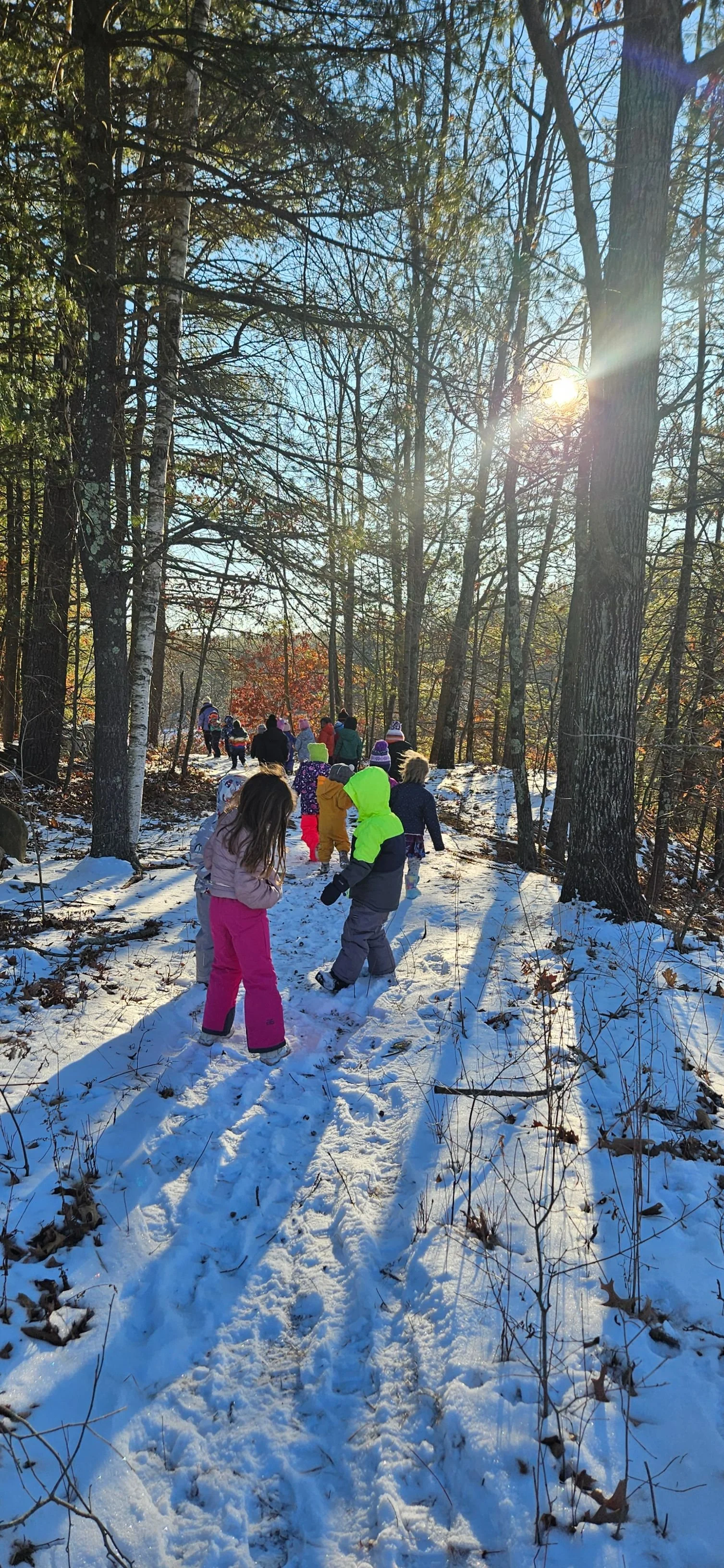
Dr. Montessori valued the opportunities available to children outdoors and in nature, so our schools work hard to provide appropriate and safe space for children to explore. This looks vastly different depending on the child. A four-year-old might enjoy a fenced-in area with raised garden beds, trees, and grassy fields. An 11-year-old might walk to an adjacent wooded area under the supervision of an adult where they independently gather materials with peers to make forts and other structures.

Choosing what to work on

As adults, we don’t like to be micromanaged. Neither do children. Even a small degree of autonomy allows a person to feel like their decision-making is valued and trusted. This overarching idea is kept in the forefront of our minds, but it does look different at different levels.

During the first plane of development (newborn - age 6) children are given presentations on how to use various materials and complete various tasks. During their independent work cycle they are generally permitted to choose which of these tasks they would like to repeat and in what order. This allows them to follow their interests and develop skills they are internally primed to master without being tethered to a prescribed one-size-fits-all program. As they enter the final year or this period, their guide may start to implement some of the structures seen in the second plane to ease their transition and provide for evolving developmental needs.

During the elementary years, there are certain academic expectations. Children in Montessori environments are given regular lessons on topics of interest as well as to teach basic math and language skills. They are still able to choose their work, as well as make choices about what they would like to spend more time on and study in depth. Our guides are watching closely, however, to make sure children do not avoid subjects. (More on that later in this article)

Honoring personal health needs

We don’t believe children should have to ask permission to address their own basic needs. Whether it be using the toilet, getting a drink of water, or having a snack, all people (children included) should be able to listen to their own bodies and care for those needs on demand.

When children are very young, they need more assistance, but we teach them to listen to their bodies’ cues and guide them through the processes. As they get older and more independent, we build structures into the environment that allow them to meet their needs independently. Even as young as age three, children serve themselves a snack if a seat is available at the snack table. They know where their water cup is located and how to clean up a spill if it happens. The restroom is located in the classroom or nearby so that they can use it without the help of an adult.

Multiple winning options

Want to give kids choice while still achieving specific goals? Give win-win options. We use this strategy in the classroom, but parents can use it at home as well. Some examples:

“Would you rather get dressed or eat breakfast first?”

“I need help with some of the chores. Are you in the mood for washing dishes or doing laundry?”

“It’s almost bedtime. Please go get into your pajamas and brush your teeth, and any time you have leftover before 8:00 we can use to read together.”

“You need to pack some more protein in your lunch for tomorrow. Would you like sliced turkey or some hummus?”

Keep in mind that fewer options make decision-making easier. This is especially important to consider when a child is younger or if the decision is causing any kind of stress. 

Guidance and discussion

As children get older, it’s important to be transparent in the process of offering increasing freedom. We tell children that we value their input, that we want them to blaze their own trails, and that we are here to support them on the journey.

Remember above when we talked about addressing when a child avoids a particular subject? There are many reasons why they might do so, but it’s usually because the skill is too challenging or too easy. By observing the child at work we can often get an idea of what’s going on, but with children elementary-aged and older, a conversation can be incredibly enlightening.

Once we find out why the avoidance is occurring, we can help develop a plan. The child may need to be introduced to time management strategies. They may need a refresher lesson. They may need to be challenged in a whole new way. Montessori schools are structured so that opportunities for these quick but important check-in meetings are frequent. Long blocks of time dedicated to learning and working independently, coupled with a variety of goals that extend far beyond academics, allow students and guides to work together toward productive independence.


Questions? Comments? We love to hear from parents. Reach out any time!

Animal Books For Lower Elementary Children (and Kindergartners, too!)

animal-books-for-children.jpg

It’s no secret that most children of a certain age are completely enamored with animals. This love starts when they are quite young but grows to a fever pitch somewhere between ages five and nine. Luckily, the Montessori curriculum caters to this passion and provides many zoology lessons and activities.

In case your child is experiencing this fantastic phenomenon and you’d like to support that learning at home, we have curated a small list of amazing books you may not have heard of before. Take a trip to your local library or bookstore, or we have provided links here for ordering or more information.

The Frog Alphabet Book by Jerry Pallotta, illustrated by Ralph Masiello

If your child ends up enjoying this book, know that Pallotta has created many alphabet books on a range of subjects, many of them animal-related. Although alphabet books generally tend to be created with toddlers in mind, these books are most definitely for older children and appeal even to third graders. With beautiful illustrations and interesting factual information, each page highlights a different frog or amphibian, ranging from the ichthyostega (the very first amphibian which is now extinct), to the goliath frog (the world’s largest frog), to the brightly-colored blue-legged strawberry frog. 

Lifetime: The Amazing Numbers in Animal Lives by Lola M. Schaefer, illustrated by Christopher Silas Neal

“In one lifetime, this caribou will grow and shed 10 sets of antlers.” “In one lifetime, this alligator will build 22 nests and lay 550 eggs.” “In one lifetime, this female red kangaroo will birth 50 joeys...So many hoppy birthdays!” Schaefer combines elementary-aged children’s love of animals with their simultaneous love of math and numbers in this incredible book. After gathering available data and determining averages, she shares fascinating facts on each page, with more detailed information about the animals and math for interested readers at the end of the book.

The Girl Who Loved Wild Horses by Paul Globe

“There was a girl in the village who loved horses. She would often get up at daybreak when the birds were singing about the rising sun. She led the horses to drink at the river. She spoke softly and they followed. People noticed she understood horses in a special way.” This Caldecott medal winner beautifully honors native American tradition while telling the tale of a girl who was so connected to the horses she loved that she eventually became one of them.

Crab Moon by Ruth Horowitz, illustrated by Kate Kiesler

Horseshoe crabs are ancient creatures that continue to grab the attention of children, adults, and scientists even today. While on a beach vacation with his family, young David’s mother tells him how the horseshoe crabs come ashore each year to lay their eggs, and she promises to wake him in the middle of the night so that he may experience this wonder for himself. This book does such a lovely job of explaining the experience, readers will almost feel like they are right there with the crabs. As with so many wonderful children’s books today, there is additional factual information at the end of the story. As an additional bonus, learning about horseshoe crabs connects nicely with children’s history work in their lower elementary Montessori classroom, especially regarding the Timeline of Life material.

Inky's Amazing Escape: How a Very Smart Octopus Found His Way Home by Sy Montgomery, illustrated by Amy Schimler-Safford

This is a true story of an octopus found near reefs in New Zealand. Readers learn a bit about how young octopuses get their start in the world, what may have happened to cause Inky’s injured arms, and how he came to stay at the National Aquarium in Wellington. His caretakers at the aquarium took excellent care of him, and children will delight at hearing about how he enjoyed playing with Legos and Mister Potato Head in his enclosure. Octopuses are curious and adventurous, however, and Inky eventually snuck out of his tank, found his way into the building’s plumbing, and then back into the ocean.  

Andre the Famous Harbor Seal by Fran Hodgkins, illustrated by Yetti Frenkel

Today there are laws that protect the safety of wild seals by prohibiting humans from even touching them without special permits. This was not always the case, however, and this story tells the tale of how one seal became a pet, a famous local performer, an honorary harbormaster, and an ambassador for his species. Over the years, Andre spent time living with a family of humans, swimming in the local waters near his Maine home, wintering at the New England Aquarium in Boston or the Mystic Aquarium in Connecticut, and spending stretches of time freely roaming the waters along the coast of Massachusetts, New Hamphsire, and Maine. A lovely statue of Andre remains today, overlooking the harbor in Rockport, Maine.  

Frozen Wild: How Animals Survive in the Coldest Places on Earth by Jim Arnosky

Perhaps one of the most interesting elements of this book is the fold-out pages with extended illustrations; children enjoy the novelty and appreciate interacting with the book in a different way. They will learn, through factual text and detailed illustrations, about all sorts of ways animals survive in the cold. Topics range from beavers in the winter, the various animals that call the arctic and antarctic regions home, how animals stay warm in the winter, and more.  

Even More Lesser Spotted Animals by Martin Brown

A follow-up to the original Lesser Spotted Animals, this great book aims to highlight some of the animals we don’t hear about all the time. Lions, giraffes, and grey squirrels are great, but have you ever heard of the dingiso, rufous sengi, tamandua, or altai argali? Humor peppers every page, along with relatable size descriptions (“about the size of a one-year-old toddler with a tail”), what we know about each animal, where they live, what their current status is, and any other information that kids will find amazing and interesting. With a goal of encouraging conservation and preservation, Brown believes that to care about saving animals people need to know about them, and this includes the underdogs we don’t often hear about.


What other books has your animal-loving child enjoyed that you think other families should know about? Feel free to share your recommendations with us!

5 Ways to Support Independence as They Grow

montessori-independence.jpg
“The child’s development follows a path of successive stages of independence, and our knowledge of this must guide us in our behaviour towards him. We have to help the child to act, will and think for himself. This is the art of serving the spirit, an art which can be practised to perfection only when working among children.”
— Dr. Maria Montessori

It’s nothing new to hear us advocating for children’s independence. After all, it’s a cornerstone of our Montessori practice, and we believe one of the most important keys to fully educating a child.

It’s also no surprise to consider that independence looks vastly different depending on your child’s developmental stage. When we meet a child where they are and offer them opportunities to do things for themselves, it’s simply amazing to encounter what they are capable of.

Here are a few ideas that parents can consider when aiming to support their child’s independence.

Infants: Freedom of Movement

Our sweet newborn babies don’t ever stay little for long. Before long they are working to roll over, scoot, sit, crawl, stand, and even walk. These milestones are so exciting as they happen, but in hindsight, they seem to zip by in a flash.

Figuring out how to move independently is one of your baby’s most important tasks. They are driven to do so instinctually, and as adults we can be there to support this work. 

One choice that some parents make (please know we understand it’s not a perfect choice for every family) is to give their infant a floor bed. Rather than being confined to a crib, this allows your growing baby an opportunity to independently explore their environment when they wake in the morning. Using a floor bed means creating a bedroom environment that is completely safe and developmentally appropriate for your baby to explore independently; consider laying soft carpet on the floor and having a low shelf with simple toys they can access. Many parents find that rather than awaiting their child’s cries to be lifted from a crib in the morning, the child instead spends quite a bit of time moving and playing quietly.

Another big tip we have for parents of infants: when your child is learning to walk, they’re not very good at it. The only way for them to get better is to practice, and they have a strong drive to do so as much as possible. Although it may force us as parents to slow down and plan extra time into our schedules, consider relying a little less on carrying and strollers (although they certainly have their place in our routines) and a little more on giving your child time to use their own developing skills.

Toddlers: Dressing

This section is perhaps the most fun in this entire article. Toddlers learning to dress themselves is not only an important skill, but it is, frankly, adorable.

Start simple and give limited choice. Let your child choose between two different shirts, then show them how to go about putting it on. In the beginning, they will need lots of help, but as time goes on resist the urge to insert their tiny hands into the sleeves and give them a chance to figure it out. They will. It will take some time and many unsuccessful attempts, but each time they try they will get closer to being able to do it themselves.

As time goes on, your child might select their whole outfit. Another practical tip is to choose (or have them help you choose) a week’s worth of outfits ahead of time. Hang enough low hooks on your child’s bedroom wall and allow them to choose their clothing and get dressed each day. As with everything, this will be slow going in the beginning, but in the long run the independence gained will not only save time but instill critical feelings of confidence.

After taking the above mentioned steps, all that’s left to do is sit back and enjoy the interestingly paired items of clothing and the smile on your child’s face.

Primary-aged: Helping Tasks

Shocking but true: between the ages of 3 and 6, kids LOVE chores. By helping them learn and engage in important daily tasks while they are young, you are instilling habits that will last a lifetime.

Our children watch us go about our daily lives and they want to be a part of what we do. They want to be like us, so when they see you sweeping the floor, they want to help. From dusting, to laundry, from cooking to caring for pets and plants, your child wants in on the fun. Let them!

There are countless tasks that young children are fully capable of completing (or at the very least, assisting with). Rather than list them here, we share some general guidelines to help the process along. 

  • Follow your child’s interests. They will let you know, whether by actions or words, what they want to try.

  • Carve out time to slow down and let this work happen. Will it take them ten times longer to sweep up their own spill than if you did it for them? Absolutely. But putting the time in now is well worth it in the long run.

  • Embrace mistakes. Teach them to embrace mistakes. Mistakes are how we learn.

  • Learn to view chores as contributions we all make to our families. By working together (children included), everyone is part of a team. With this mindset, your child will take great pride in their work.

Elementary-aged: Trust Moments

This step varies significantly from child to child and in each family. Your family’s values and comfort level, combined with your child’s individual development and abilities should be carefully considered.

During the elementary years, your child is ready to start setting off on their own in tiny ways. Letting them do so can feel thrilling for them, yet completely nerve-wracking for us. Take it slow and talk a lot about what each added freedom entails.

Basically, you’re finding small ways you can give your child opportunities to be safe, trustworthy, and independent. Some examples: 

  • Playing alone in the backyard - Discuss clear boundaries and expectations. In the beginning, you may be watching like a hawk from the kitchen window, but in time this will become a great option for your child as well as for you.

  • Retrieving items at the grocery store - Start small by asking them to grab something within your line of sight, but gradually ask them to retrieve an item from one or two aisles over. As a bonus, this will speed up your shopping trip!

  • Walking the dog/getting the mail - Similar to playing alone in the yard, set clear safety rules and talk about “what ifs”. What will your child do if they hear a car coming? What if the dog tries to chase a squirrel? Ask these questions repeatedly until you feel confident they fully understand.

  • Going to a friend’s house - This may not be something new, but as they get older children will want to spend more time with their friends. Again, talk about how they might handle various situations, but also discuss how they might contact you if they need to.

  • Babysitting - In the beginning, this might mean your 8-year-old reads to their 4-year-old sibling while you cook dinner. By the end of the elementary years, however, your child might actually be ready to take on some real babysitting jobs.

Adolescents: Exploring Interests

As your child leaves their younger years behind and inches toward adulthood, they will naturally begin to explore different interests as they figure out who they are and what they like. All they really need from us is to support this exploration. This will range significantly, from hobbies to potential careers.

We spend many years caring for our children when they are young and giving them every advantage possible so that they may grow to become successful and happy adults. Nothing can quite prepare us for this eventuality, though. And what we imagine our child blossoming into can be very different from the future they imagine for themselves. In these moments, we like to remind ourselves that we have worked hard to guide our child’s independence. They are individual human beings capable of making hard decisions. They will make mistakes, but they will also surprise us.

Our children often turn to us for guidance and support throughout adulthood. Perhaps the greatest feeling of all is to step back and appreciate that this unique human being, who steps out to make their mark on the world, let us hold their hand for a few years while they figure out how to do it.

A Note of Gratitude on Montessori’s Birthday

IG image 30August2021.jpg

Dear Dr. Montessori,

Tomorrow, August 31, 2021, marks 151 years since you were born.

The world is a very different place today than it was then. I wonder if you ever contemplated your own early days and how your world shaped you. You once said: “The greatness of the human personality begins at the hour of birth.” Would anyone have guessed that baby Maria would eventually become one of the most influential educators of all time?

Your own life stands as an example of what a person can achieve under the right circumstances. Your work created a foundation on which others have been able to support generations of children finding their own unique paths through life.

So this is a letter of gratitude.

Thank you for having the courage to do what your heart pulled you to, even if it meant being the first and traveling down an uncomfortable and challenging road. During a time when women were largely expected to stay at home, and were certainly not permitted to attend medical school, your persistence changed the system.

Thank you for having the wisdom to blend your scientific perspective with the empathy that all humans deserve. You noticed that children discarded by society had far more potential than they were given credit for, and you worked tirelessly to prove your theories and change yet another system.

Thank you for investing in communities that had high needs. Your very first school was opened in a poor neighborhood in Rome, and your work with the children and families there had amazing ripple effects that no one would have predicted.

Thank you for showing children the respect they so deeply deserve. It was completely novel at the time, and still is in many communities. But your ideas spread quickly and effectively, especially once people saw what life could be like if we just shifted our perspectives a bit.

The sole purpose of the teacher used to be to stand before their students with a definite air of authority, lecturing prescribed information that the students were meant to memorize. You changed all that. Your teachers are not enforcers and information dispensers, they are guides. They stand beside children and lay a path out before them that the child may willfully wander down and gather information for themselves. You created a system of empowerment for children, and a more meaningful (and much more effective) way of learning.

You were not a perfect human being (as none of us are). Your flaws lie in the memories of the people who knew you as well as in the pages of biographies about you. They are a good reminder that even the most positively influential people can make mistakes. We can all make mistakes, and hopefully, we will grow and change with time and experience. This is a lesson we must all share with our children.

You taught us to observe and to stay curious. We encourage children to do this with the world around them, but as adults it’s our responsibility as well. Learning should never end, and we should observe to learn about the children in our lives, but also continue to stay curious about the world ourselves. It takes a lot to unlearn previous assumptions we have gained over a lifetime, but it’s a worthwhile endeavor.

In Education and Peace, you said: “An education capable of saving humanity is no small undertaking; it involves the spiritual development of man, the enhancement of his value as an individual, and the preparation of young people to understand the times in which they live.” The timelessness of this idea is just as applicable today as it was then.

It seems fitting that your birthday happens to fall right around the beginning of a new school year. Right around the time when we all find ourselves reflecting on what we have learned in the past and also on what lies ahead. Just as with the history lessons we teach our elementary students, it’s helpful to honor those who have paved the way for the work we are doing now.

So once again, thank you. Your work continues on, touching the lives of people all around the world, generation after generation. We imagine it will continue to do so long into the future.

With deep gratitude,

The Montessori community

22 Important Montessori Terms

montessori-glossary.jpg

Montessori education can feel like a whole separate world of its own sometimes. The classrooms look different, the methods are definitely different, and even the language is a whole lot different from what you might hear elsewhere.

We decided it might be helpful to highlight some terms that may sound foreign to folks who aren’t very familiar with Montessori. Some of the terms are completely unique to us, and some are just used in unique ways in the context of Montessori. Are there any you think we’ve missed? Let us know!

albums: A series of binders filled with lessons and illustrations that are created by Montessori guides during their training. They are typically organized by subject and contain all of the specifically-prescribed steps and methods for presenting materials and lessons to children. Even the most experienced guide refers back to these, and they are invaluable.

Casa dei Bambini: In Italian, this translates to Children’s House. This was the name of Dr. Maria Montessori’s first school which opened in Rome in 1907. Casa is also the name sometimes used to describe the Montessori program of education for children aged 3-6 years.

concrete (versus abstract): This refers to a type of learning and thinking experienced by younger children. When a child explores a skill by using specially designed materials, they are likely understanding the skill concretely. As they deepen their understanding and are able to comprehend the skill without the use of materials we refer to this as abstract. For example, a six-year-old using the stamp game to add numbers into the thousands is working concretely, but an eight-year-old who completes the same calculation on paper without materials is working abstractly.

control of error: Montessori materials are usually autodidactic, meaning the child is able to teach themselves. Most materials are designed with a control of error, or some type of mechanism that allows the child to recognize on their own whether they have made a mistake. This allows for immediate correction and a sense of empowerment for the child. Your child’s guide can show you many examples of this.

 cosmic education: The Montessori elementary curriculum is based on the concept of cosmic education. Based on the developmental needs of children aged 6-12 years, as well as the Montessori aim to develop citizens that are more deeply connected with the earth, many of the lessons and units of study teach the interconnectedness of all things. This allows children to have a framework in which they may discover themselves and their place in the universe.

cultural subjects: This refers to the studies of science, history, and geography.

Erdkinder: A German word meaning children of the land, Dr. Maria Montessori coined this term as a name for the adolescent program, as she recognized their need to engage in physical work and envisioned the program taking place on a working farm.

false fatigue: While anyone observing a Montessori classroom during the morning work cycle (see work cycle for more) will notice deep engagement by the children, there is often a noticeable shift around 10:30. At this time it appears that the children have lost all focus and the room becomes a bit more noisy. Rather than redirecting the children, if the adults allow this period to occur, the children are usually able to independently re-engage after a short time.

grace and courtesy: A specific area of study during the primary (ages 3-6) years, this aims to teach children how to appropriately interact with others. While they receive formal lessons during these years, the work is continued (although utilizing a more flexible format) throughout their Montessori education.

guide: the term used for a Montessori educator, as it more accurately describes their role.

indirect (versus direct) preparation: Learning activities that lay a foundation for future skills without explicitly teaching them are considered indirect preparation. For example, three- and four-year olds in our programs use a small tool for pin punching (perforating pieces of paper into specific shapes) that allows them to develop their fine motor skills and finger grip in preparation for the physical act of writing.

isolation: Isolation of a skill means that the child is meant to focus solely on one specific goal. If a five-year-old is asked to write a story, the guide’s focus would not be on correcting for conventional spelling, but rather to encourage their expression of ideas in written form.

Nido: In Italian this means nest, and it is the traditional Montessori name given to an infant program.

normalization: Once a child has had time to adjust to a Montessori environment, they begin to joyfully select their own work, stay engaged, and interact peacefully with others. When they achieve this state we refer to the child as normalized.

parallel play: Children under the age of six tend to be more focused on their environment than on their peers (which shifts dramatically during the elementary years). When young children work or play beside one another while actually focusing on their individual pursuits, we call this parallel play.

planes of development: After years of observing children with the perspective of a scientist, Dr. Maria Montessori noticed clear patterns and characteristics. While acknowledging the definite variation between individuals, she organized her findings into four planes of development, and based her educational methods on them.

practical life: This subject is given just as much weight in Montessori schools as we give to traditional academic subjects like math and language. Practical life can include teaching children to care for their environment, others, and themselves. Lessons are wide ranging; our students nurture plants, wash dishes, practice greeting others, sweep spills, and prepare food.

prepared environment: The term we often use in lieu of “classroom”, our guides dedicate hours of careful and intentional adjustments so that the space serves as a teacher for children. In Montessori education, one way independence is achieved is by preparing an environment in which the children are able to care for and learn by themselves, with less direct dictation from adults.

sensitive period: Dr. Montessori noticed and theorized that there are certain periods during a child’s development during which they are primed to engage in specific skills. Once that time has passed, learning such skills is not impossible, but the natural drive to do so declines, making mastery much more challenging.

sensorial: An area of study during the first plane of development (newborn to age six), in which children work to refine a wide variety of senses. There are Montessori materials that have been specifically developed to aid in this process.

work: In Montessori environments, the lines between play and work are blurred. We tend to view a child’s actions through the lens of development and learning, so that even the most seemingly mundane of tasks serves an important purpose and is considered work.

work period/work cycle: This is the term given to a dedicated period of time during which Montessori students work independently and receive individual and/or small group lessons with a guide. Depending upon the school and the age of the children, it can range anywhere from two to three hours. Dr. Montessori believed such a lengthy stretch of time was critical to allowing children to become deeply engaged in their work.

New Class? Here’s What to Expect

montessori-back-to-school.jpeg

Welcome! Whether your family has been part of our community for years or you’re just joining us for the first time, we look forward to spending the school year together. After the past year and a half, everyone is looking forward to a fresh start, with a return to some semblance of normalcy.

Some children will be Montessori students for the very first time. Others are moving up to a new level. Either way, it’s helpful to know what’s coming, and to have a little information regarding what to expect. Scan through the headings below to find which section or sections apply to your child.

If you’re brand-new to Montessori

During the application process and through your own personal research, you’ve probably learned a bit about what makes Montessori schools different from more conventional settings. The journey you find yourself beginning will be awe-inspiring, as many seasoned Montessori parents will tell you.

Montessori education has been around for more than a century, and so much of what we do is grounded in what works and what has worked for generations. Still, as a rule, educators are curious people who never stop learning. We are always seeking out new ways to make the experience more enriching for the children in our care. We observe, we ask questions, and we try out different methods that have worked well for others.

We encourage you to try the same. There is so much to learn about this amazing educational approach, that it can’t possibly be done all at once. This blog is a great place to check-in and read helpful information. Your child’s guide, as well as other Montessori parents, are excellent resources to turn to. As a school, we do our best to facilitate community-building events as well as parent education offerings that will help answer your questions - although this type of learning usually leads to even more curiosity!

Thank you for joining us. We are so glad to have you with us.

New to Children’s House?

Montessori primary environments are magical places. This is, after all, where it all began with the opening of Casa dei Bambini in Rome in 1907. Just how is this setting any different than other preschools or kindergarten classes? 

Right away you will notice the emphasis on personal independence. We encourage even our youngest primary students to walk to their classroom by themselves (once they settle into the routine), remove and hang their coat by themselves, and change their shoes by themselves. You’ll notice the work continues in subtle ways as their teacher meets them at the door, makes eye contact, greets them warmly and intentionally, and guides them to do the same.

In the classroom, your child will be free to explore and learn on their own terms. Many folks are surprised this does not translate into children running wildly around the room. The reason is that the freedom we offer is bound within carefully constructed limits. Yes, a child may choose their preferred work from the shelves, but we only put out work that we want them to be doing. Yes, they may stop to have a snack whenever their body tells them it’s time, but they are taught to clean their own crumbs and wash their own dishes.

Some new-to-Montessori families wonder what we do if a child wants to focus on the same work or area of the classroom over and over again. Short answer: we let them. Our belief, which has been confirmed countless times with experience, is that if a child is repeatedly drawn to something it’s because they have something important to learn from it. Once they have exhausted that need, they will eventually move on. We have learned to remove our own expectations of how long it should take or what trajectory an individual’s learning should follow.

One important Montessori mantra to keep in mind: follow the child. We let this guide so much of what we do, and it leads to amazing results.

New to Lower Elementary?

There is a definite shift in children around age six, which is why Dr. Montessori determined this to be the beginning of the second plane of development. You will notice your child is suddenly more imaginative, social with their peers, physically a bit clumsy, and so very eager to learn everything they can about the world (and universe) around them.

So, we keep all these things in mind in the lower elementary environment. Some highlights:

  • Lessons are more often given in small groups (as opposed to individually when children are younger).

  • Learning and work is based on teaching important basic math and literacy skills as well as a globally-focused foundation in science, geography, and history.

  • The classroom is arranged so that children may work together with their peers.

  • New expectations are established to ensure that children are engaging with academic content in all areas. Teachers meet and converse with students to share tools, strategies, and give suggestions to help them achieve goals.

  • We give children BIG work, which is what they crave. Projects stretch out over days and weeks, and materials stretch across the classroom floor.

New to Upper Elementary?

Sometimes, upper and lower elementary classes are combined, as children aged 6-12 are all within the second plane of development. When schools are able, they do tend to separate this age group into two subgroups, as there are enough differences to make this worthwhile.

Sometime during the upper elementary years, your child will begin to stop using the gorgeous wooden Montessori materials. This is because after years of work, they have made their way to abstract learning. They no longer need concrete items to manipulate with their hands in order to understand concepts. This isn’t to say they never do anything hands-on, it just starts to look a bit different.

Upper elementary children have also had a few years to navigate social structures with their peers. They have had practice forming friendships and working through conflict. They have a better sense of who they are and how to interact with others. This brings a new sense of calm that was not seen when they were younger.

New to Middle and High School?

As with lower and upper elementary, all adolescents (middle and high school) are considered part of the same plane of development but are separated when a school is able or only offers middle school.

During this first half of adolescence, learning is still very much integrated. There are differentiations between subjects of course, but there are a multitude of ways in which the learning overlaps.

At this age, children begin to crave independence while also leaning heavily into peer relationships. They want their parents to be there but they also push them away. They crave new experiences but aren’t always able to make sound decisions due to their developing brain. To allow for all of these tendencies while also supporting growth, adolescents often meet together as a whole group with their teachers to discuss work, social dynamics, and a multitude of other important topics.

Social justice becomes more important to children at this age, and so our curriculum supports growth and learning that allows them to become active and engaged members of their communities.

One last very important element to note is that Dr. Montessori emphasized children at this age needing to work with their hands on something real and of value. This traditionally was working on a farm, but sometimes translates to microeconomy experiences, guiding students through running a business of their own.

Other aspects of Montessori middle and high school programs include:

  • Academics are studied more in-depth, and sometimes without quite as much integration as adolescents delve into more specialized content.

  • Service to the community is emphasized, and students take on powerful roles in this work.

  • Sometimes students are able to explore individual interests and participate in internships or similar programs.

  • Lengthy and complex culminating projects are completed over time, giving students a way to show their learning and a sense of what may lie ahead. This is an opportunity to practice practical life skills that are truly applicable to adult life.


Questions? Comments? We’d love to hear from you. Please feel free to reach out with your thoughts.