Art for Self-Expression

Numerous theories and lots of research expound upon the importance of artistic expression. For young children and adolescents, art is an especially crucial form of personal expression. As such, children need to experience their own process rather than to produce a piece that someone else wants. In Montessori, we also have sensitivity to different expressive needs throughout different stages of development. 

Process vs. Product

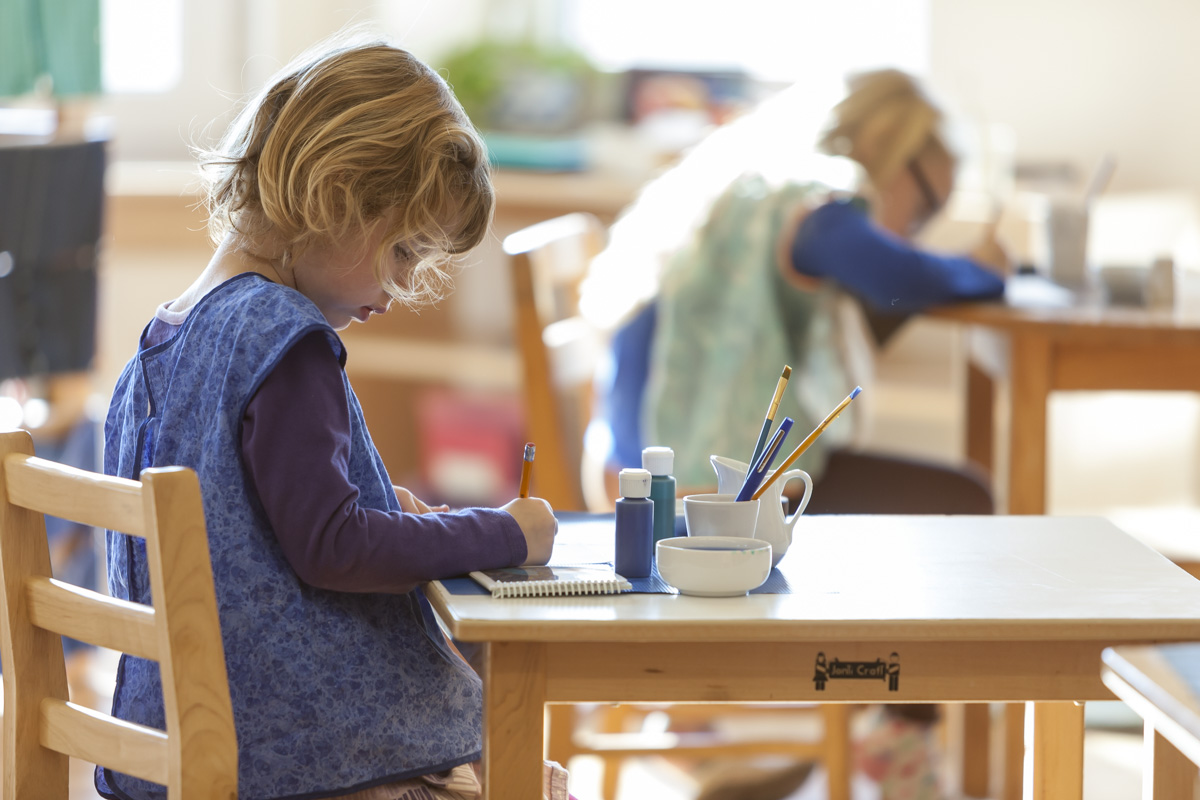
For young children, the process of making art is much more important than the product. When infants and toddlers are engaged in art activities, they are expressing feelings that they may not yet have words to express. Thus, during these early years, we focus on offering young children a variety of different artistic mediums.

When children are using different art materials, we first provide opportunities to work with larger spaces and then later move into the smaller more refined possibilities. For example, we start with painting at the easel, then as children develop more coordinated hand movements, we offer smaller paper or objects to paint.

Use of Tools

In addition to introducing different kinds of materials, we also show young children how to use different tools. We show how to use just a little water and the tip of the brush with watercolor paints. We explore different techniques with crayons. We introduce various tools–like knitting needles, crochet hooks, or looms–for fiber arts. Whatever the form of art, we offer the tools required for successful expression through that form.

We also open up a range of possibilities for children to explore. For example, in introducing clay, we show how to carefully get out the clay, how to use different techniques such as forming coils and slabs, how to cut, carve, or roll the clay, and how to store it when finished. We may also show examples of clay sculptures, whether in books or museums. With all of this information, children have a range of inspiration when they decide to work with clay. 

Adult Response

To support young children’s artistic expression, we offer objective comments: “Oh how interesting…the lines go up and down,” or “I can see you used a lot of red and blue paint today.” We want to be very careful with what we say so we don’t give any indication of judgment, either good or bad. Young children do not yet have the language to explain their art. Therefore, we want to make sure our comments don’t inadvertently create expectations for children.

In Montessori, adults don’t insist that children express themselves artistically, or tell children what to express. When children choose some form of artistic expression, adults allow them the freedom to be with themselves while in the process of creating art. With this in mind, children’s artwork is individual, creative, non-competitive, and often connected to other subjects. We don’t expect children to learn to imitate adult creations or turn out products that all look alike. 

Montessori elementary art

Into the Elementary Years

From six to twelve, children began to use art in a more cognitive way. Often elementary-aged children began to want their artwork to be very realistic. They may focus more on the finer details of a particular piece of art rather than on the overall composition. As a result, children of this age can become discouraged if they feel their art “doesn’t look right.” Their determination is relentless. Because they will often insist upon realism, even at the risk of giving up on their artistic ability, we offer many different sub-skills to help children refine their techniques.

Art in a Montessori elementary classroom is often connected to students' intellectual pursuits. When studying Ancient Egypt, students may want to create a portrait in profile or a model of a pyramid. If they are immersed in learning about a country, they might learn about the symbolism of the flag’s colors and sew a sample flag.

All of this work is aided by the fact that children of this age love big projects. To support their artistic and intellectual pursuits, we provide elementary students with a kind of mini-studio so they can access the materials they need to create big projects and share their learning with their peers. 

Through Adolescence

During adolescence, young people need even more opportunities to form, shape, express, and clarify their inner thoughts, feelings, and experiences. Artistic expression can be a vital outlet during this turbulent time, and can allow adolescents to not only reach a better understanding of who they are but also to be able to connect deeply with others through shared expression.

Questions of identity and fitting in weigh heavily on adolescents. Without ample opportunities for expression, these already perplexing questions can fester. Adolescents need creative outlets to keep their spirits vibrant!

In addition, expressive opportunities allow adolescents to merge their emotions with their intellect. It’s best to have a variety of avenues for artistic expression: instruments readily available to pick up, an art studio to transfer complex feelings into visual art, or opportunities for dramatic interpretation of academic content. 

Vital Form of Expression

In Montessori, we feel strongly that young people need artistic outlets so they can have balance in their physical, emotional, social, intellectual, spiritual, and creative development. A Montessori environment supports the development of the whole person, thus allowing children to explore their personal creativity.  

Art is a vital form of expression throughout different stages of growth. Through art children can express what they are feeling, elementary-age students can integrate their learning and refine their skills, and adolescents can better understand themselves and their connections to others. Creating art can allow our young people to reveal feelings that they could perhaps not express in words. Thus, we offer children a variety of art mediums and different experiences, as well as the freedom to choose and experience the form they have chosen.

As always, we invite you to come to visit our school to see this artistic expression in action!

Independence: The Foundation of Freedom

In order to be truly free, we need to be able to make our own choices, which means having the skills and abilities to then act upon our choices. Without independence, we can’t truly be free. 

As children’s independence grows, so does their opportunity for freedom. They have more choices available and more to consider. The freedom children experience in our prepared learning environments is directly related to their independence. Over multiple years in their classrooms, children feel like masters of their environment and younger children look up to them as if they have superpowers.

In order for children to develop this freedom and independence, we make sure that the following opportunities are present in our classrooms:

To Choose Their Own Activity 

Even at a young age, children have ideas of what they want and don’t want to do. This independence will only increase when children have opportunities to make decisions. In Montessori classrooms, we provide opportunities to make choices, but it is not a free-for-all!

The classroom is set up with a variety of activities designed to meet developmental needs. Children are free to choose any material they have been shown or that they have the ability to do. Thus, children must have the skill before being able to choose.

To build this ability to make a choice, we start by offering children choices about very simple things. When an activity has two parts, we might ask: “Would you like to carry the box or the tray?” Then we give another opportunity to make a choice: “Lovely! You may carry the tray to any table that you choose.”

Over time children develop the ability to make increasingly more complex choices and they build the skills that allow them more options in their learning environment.

To Work Without Interruption

Once children choose an activity, they are free to do it for as long as they like without anyone else (adult or child) interfering with their work. In this way, we protect children’s focus and concentration. As a bonus, because the materials are self-correcting, children don’t need an adult for validation. 

The adults in Montessori classrooms work to protect children who are actively engaged in purposeful activity from interruption (even if this is a three-year-old washing a table and water is pouring off the table!). If children get interrupted a lot, their concentration becomes broken which can result in them not wanting to take risks or engage with challenging learning material.

The experience of being interrupted can happen a lot to children. They try to start doing something and someone comes along and stops them or finishes it for them. Yet children need to be able to deeply dive into activity in order to develop concentration and focus.

To Move Freely

Children are free to move about the classroom. Rather than having an assigned table or workspace, they can choose to work where they want and also with whom they want. They have the liberty to get up and move, get a drink when thirsty, or go to the bathroom when needed. If there is a group activity in the classroom, children are even free to choose whether or not they want to participate. 

To Communicate With Others

Children also have the freedom to communicate. They can speak to whomever they want and when they want, as long as it is not disturbing their own or others’ work. This freedom is a gift to children who are often asked to be quiet and not to talk. Children in our learning environments have the freedom to speak and the ability to be heard, which means that the adults in the classroom make it a priority to be respectful when children want to communicate something. 

To Work at Their Own Pace

Unlike in traditional environments where children move together along the same path (this half hour is story time, this is math time, etc.), Montessori children have the freedom to work at their own pace. To facilitate this, our schedule is specifically designed to offer large blocks of uninterrupted time so children have the freedom to spend the time they need on the activities they choose. 

Working with learning materials is how children are developing themselves. They need time to reflect and integrate what they are learning. Therefore, children also need to be able to repeat an action as often and as long as they would like to do so. When children are new to Montessori classrooms, we sometimes need to let them know about the opportunity to work at their own pace and rhythm by reminding them, “You can do this for as long as you like!”

Limits

In order to support this foundation of freedom, Montessori classrooms have a few basic limits that support independence. In addition to ensuring that children aren’t distracted or interrupted in their work, we help children learn that materials can only be taken off the shelf and must be returned to their proper place on the shelf. These basic rules are clear social signals to children as to when a material is available for use: when a material is on the shelf it is available, and when the material is not on the shelf, it is not available. 

Children are also part of restoring materials so that they are ready in their proper place. In the process of making the activity beautiful for the next person, children learn how to replace wet towels with dry towels, how to dry drips of water off a tray, or how to replace anything that was consumable. When the materials are restored and returned to their proper place on the shelf, then children can access the materials independently.

Development of Independence & Freedom

As children gain skills and abilities, their independence increases and so do their choices. Activities are available and ready for use so that children are not dependent upon anyone to get things for them. Children can choose where they do their work. The lessons we offer are designed to provide just enough information for children to continue the activity independently. We offer these liberties in harmony with children’s skills, abilities, and level of independence so they can experience a variety of freedoms in their learning community. 

Curious about how this all works? Schedule a tour to see how independence and freedom are interconnected!

Our Montessori Bookshelf: Mathematical Thinking

The Man Who Counted

As humans, we are predisposed toward order, exactness, and precision. With this tendency to abstract and imagine, we could be said to have a mathematical mind. Children, young and old alike, are drawn to numbers and mathematical ideas. 

For thousands of years, math has been a part of the human search for meaning. We have long tried to quantify our natural world. From carbon dating artifacts to analyzing voting trends in politics, from understanding traffic patterns to examining climate change, math continues to be an integral part of our search for understanding.

Learning to think in mathematical terms is an essential part of becoming a person adapted to our time and place. Math is such an integral part of our lives and we feel that it’s vital to ensure our children are not only in touch with mathematics but also captured by the beauty and wonder of math in our world. 

With this in mind, we pulled some of our favorite books that promote mathematical thinking for young children through early adolescence. 

Counting Is for the Birds

by Frank Mazzola Jr.

Written in rhyme, this picture book can be used in different ways with young children. Some may just enjoy the story and illustrations, others can clue into the counting aspect of the book, and older children might explore the ornithological details provided on each page. This is the kind of book that you can revisit again and again with your children!

4,962,571

by Trevor Eissler, Ruth Chung, Bobby George, June George

Written by a former Montessori parent, this picture book is a lovely introduction to and extension of the concept of place value. A young boy wants to see how high he can count, so he figures out ways to create groups of numbers so he can count to four million, nine hundred sixty-two thousand, five hundred seventy-one (and beyond!). Plus, anyone who has been in Montessori will appreciate the color coding of the numbers in the title!

How Much, How Many, How Far, How Heavy, How Long, How Tall Is 1000?

by Helen Nolan, illustrated by Tracy Walker 

Children at the end of their primary years or those who have recently transitioned into elementary will definitely appreciate this exploration of the quantity of 1,000. Full of thought-provoking questions, this picture book takes readers on a journey through how a 1,000 can be represented in so many different ways – and how that can change our impression of the size of the number. 

One Grain of Rice: A Mathematical Folktale

by Demi

This stunningly illustrated picture book provides both a moral tale and an example of the exponential power of multiplying by two. After a raja in India has hoarded rice for his own benefit, a young girl returns some spilled rice to him and as a reward requests only one grain of rice, as long as the raja doubles what he gave her the day before over the course of 30 days. By the end, she has more than enough rice to share with all the starving villagers, as well as the goodwill to support the raja in continued kindness.  

Anno's Mysterious Multiplying Jar

by Masaichiro Anno, Mitsumasa Anno

For those who love Anno’s Journey, this is a must-read, but this time the illustrations and text take the reader on a mathematical journey through factorials. Then to show what happened mathematically, the Annos (father and son) illustrate the multiplication in a graphic way that fits so well with what children experience with the Montessori math materials. 

Mathematicians Are People, Too: Stories from the Lives of Great Mathematicians, Volumes 1 & 2

by Luetta Reimer, Wilbert Reimer

This collection of short stories dramatizes conversations and lives of mathematicians throughout history and can easily capture the imagination of elementary-aged children who love the power of a good story. The stories can stand alone or be jumping-off points for further mathematical or historical investigations. We love the glossary at the end, the short biography at the start of every story, and the fact that female mathematicians are fairly well represented in these two volumes. 

The Number Devil: A Mathematical Adventure

by Hans Magnus Enzensberger, illustrated by Rotraut Susanne Berner, translated by Michael Henry Heim  

This is the perfect book for older elementary-aged children who aren’t quite sure they want to still love math. A boy meets a number devil in his dreams who leads an exploration of all sorts of fascinating aspects of numbers. The wildly fun and irreverent approach (led by the devil) makes even complicated math feel accessible. The whimsical illustrations certainly help, too! And for those wanting to go back and reference helpful information, there is a “Seek-and-Ye-Shall-Find List” (aka index) at the end of the book. 

Doodle Yourself Smart . . . Math

by Helen Greaves, Simon Greaves

For elementary children and adolescents who like to play around with mathematical thinking, this is a fun activity-style book that appeals to mathematicians and artists alike. Each page offers beautiful space for playing around with the problems (and yes, there are answers in the back for those who just need to know if they got it right!).

The Man Who Counted: A Collection of Mathematical Adventures

by Malba Tahan

Those who like a good mathematical challenge, combined with a taste of the adventure that comes with travel, will love this series of chapters that form a bit of a novel. Each chapter of this book can stand alone or work as a cohesive whole as the narrator and the “man who counted” move through the Middle East. They encounter a slew of social problems that are solved with a sophisticated level of number sense that feels both mystical and matter-of-fact. 

Click here for a downloadable PDF of this booklist! As always you are also welcome to come visit the school and see how we support mathematical thinking for all ages.

Materials Spotlight: The Bead Chain Cabinet

Montessori bead cabinet

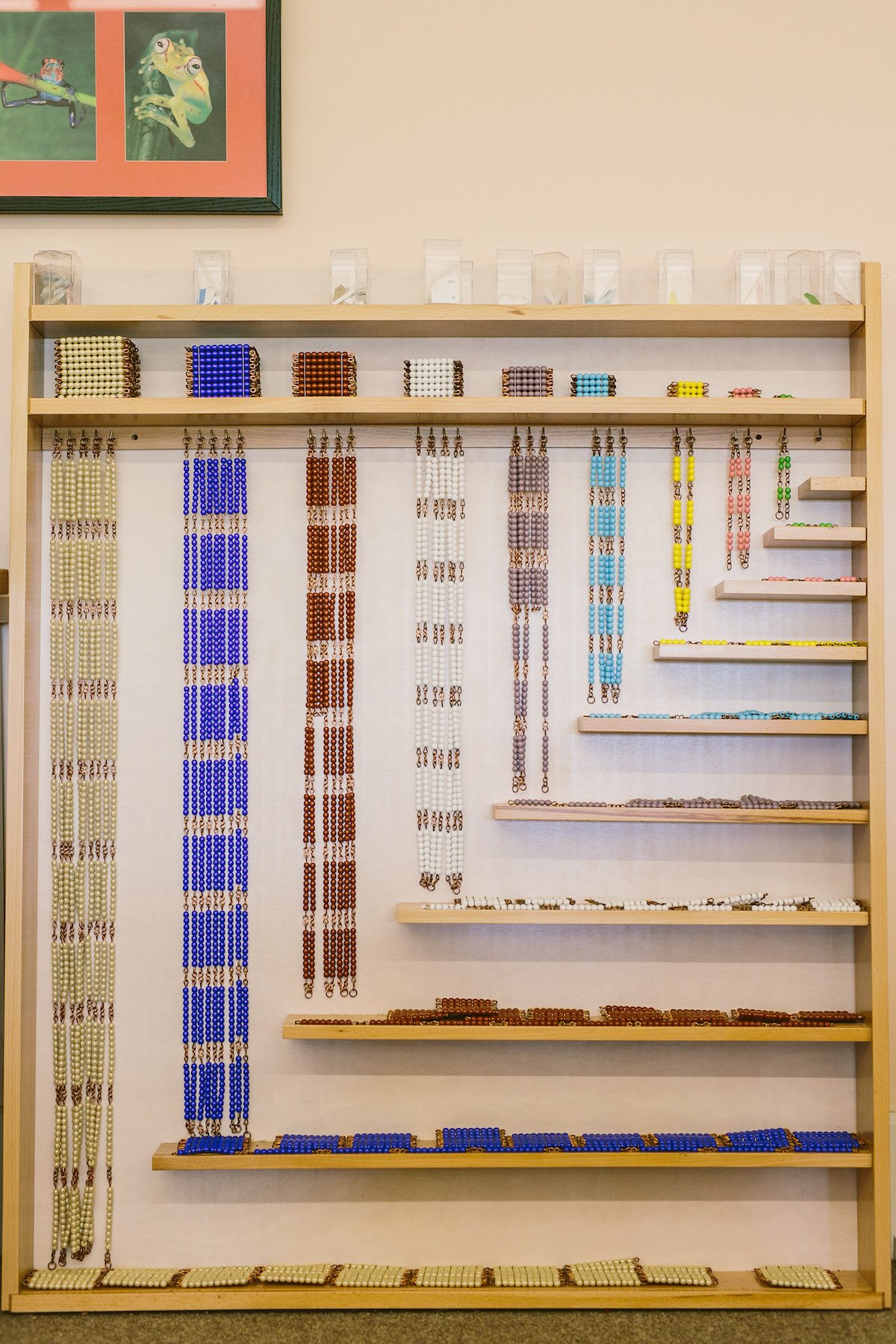
Visit any primary or elementary Montessori classroom and you’ll immediately notice a stunning display of colorful glass beads hanging in an open cabinet. Children (and adults!) are drawn to the order and elegance of the bead chains. Beyond their initial aesthetic appeal, the bead chain material offers an amazing array of intellectual opportunities for young children to those in their elementary years. 

Color-coding

One of the brilliant aspects of the Montessori math materials is how they provide children with multiple ways to make neural connections. For example, each of the bead bars represents a quantity and each bead bar is also color-coded so that the quantity is connected to a color: a bar with two green beads represents two, a bar with five light blue beads represents five, a bar with eight brown beads represents eight, etc. This color coding allows the child’s brain to establish multiple quick ways to understand the quantity: the number of beads, the color, and the size. 

Appealing

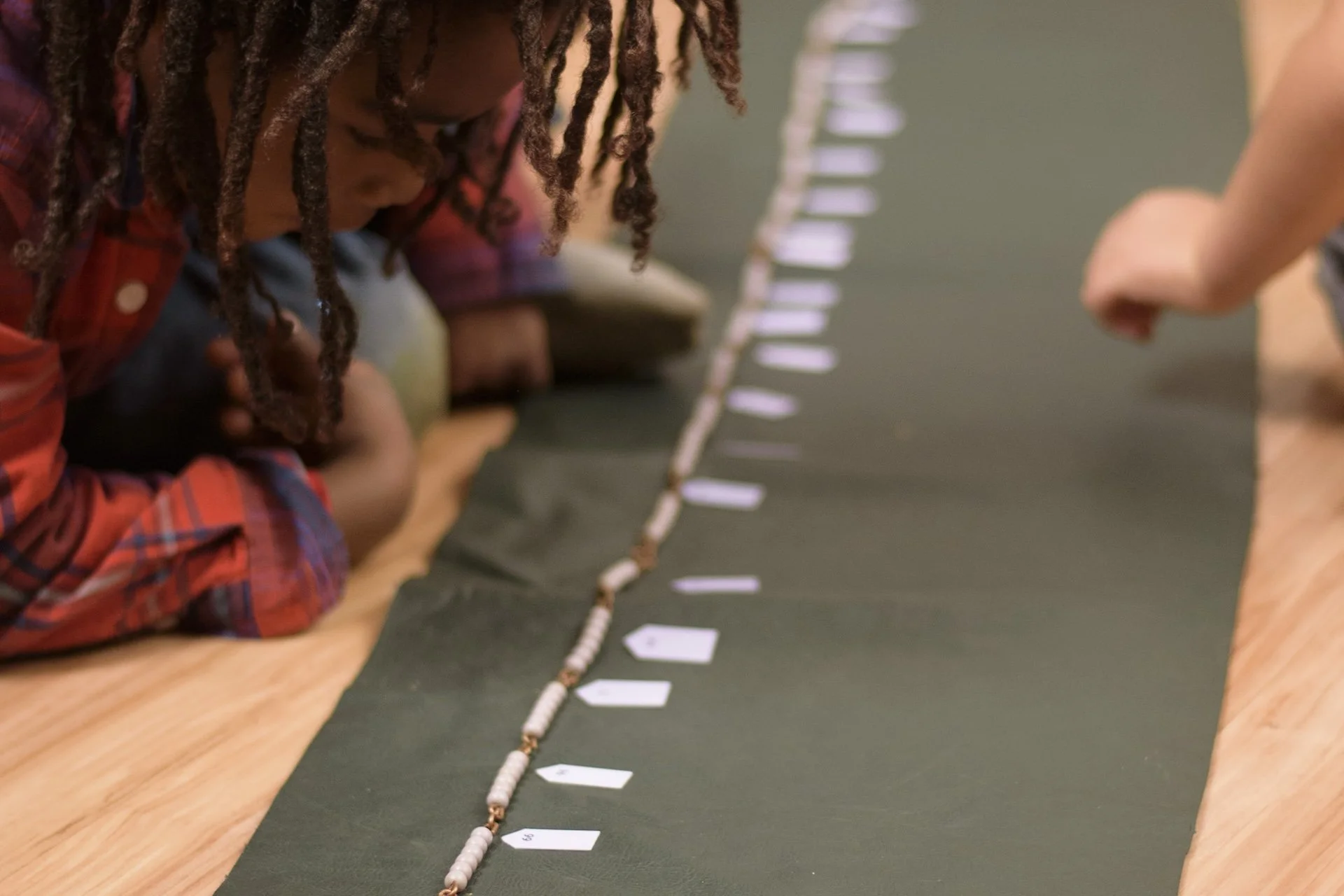
In Children’s House, young children are attracted to the beauty and fragility of these colorful, glass beads. Long before they are ready to use the bead chains, young children can learn how to dust and care for the beads. They develop a respect for the materials and understand how special they are. Often young children will watch in awe as their older classmates learn how to carry, lay out, count, and label the bead chains. 

Linear & Skip Counting

As they practice counting the bead chains, four- and five-year-olds solidify their understanding of teen numbers, as well as quantities from units, to tens, to hundreds, to thousands. Eventually the focus of work with the bead chains shifts from linear counting to skip counting, as children begin to focus more on the labels that indicate the end of each bead bar. For example, on the 100 chain, children label and name 10, 20, 30, 40, 50, 60, etc. Children can also layout, count, and compare the 100 chain and 1,000 chain side-by-side, providing the sensorial experience of the different quantities laid out in a linear fashion. 

Multiplying

As children move into their elementary years, they are solidifying their skip counting in relation to mastery of multiplication. They love to quiz each other by turning over some of the labels to see if their friends can figure out which of the multiples is missing. So for the short chain of multiples of seven, for example, they might turn over one label to see if their friend can figure out the missing multiple: 7, 14, 21, __, 35, 42, 49. 

The bead chains are also used to provide an impression of common multiples, which is critical for future work with fractions. Children lay out two long chains side by side, label the chains, and then find all the common multiples, and also begin to intuit the concept of the lowest common multiple.

Squaring & Cubing

The other fascinating aspect of the bead chains is how they geometrically represent the concept of squaring and cubing. Children learn how to fold up the bead chain so that it creates a square made up of four rows of four: 4 x 4 = 16. 

This work can continue with the long chains, each of which creates the cube of numbers one through ten.

In addition to the hanging chains of bead bars, the bead chain cabinet also contains beautiful squares of each number, which can be stacked to create cubes, as well as the actual cubes for each number. The squares and cubes can be used for explorations with powers of numbers as well as more advanced work when students start to explore working outside of the base ten number system. 

As children move into more advanced mathematics, they will often briefly revisit this foundational material to cue their memory when working with exponents.

Spiral Curriculum

The bead chain materials provide a perfect example of the spiral nature of the Montessori curriculum. From early linear counting, cycling into an understanding of multiples, to preparation for squaring, cubing, and base number work, children come back again and again to the beauty and breadth of the bead chains.

We invite you to visit our school to see the bead chains for yourself! 

Montessori at Home: The Baby’s Room

Montessori Baby's Room

When children come into our lives, we want to make sure we offer them the very best. Yet our children develop so quickly and their needs change so dramatically!  

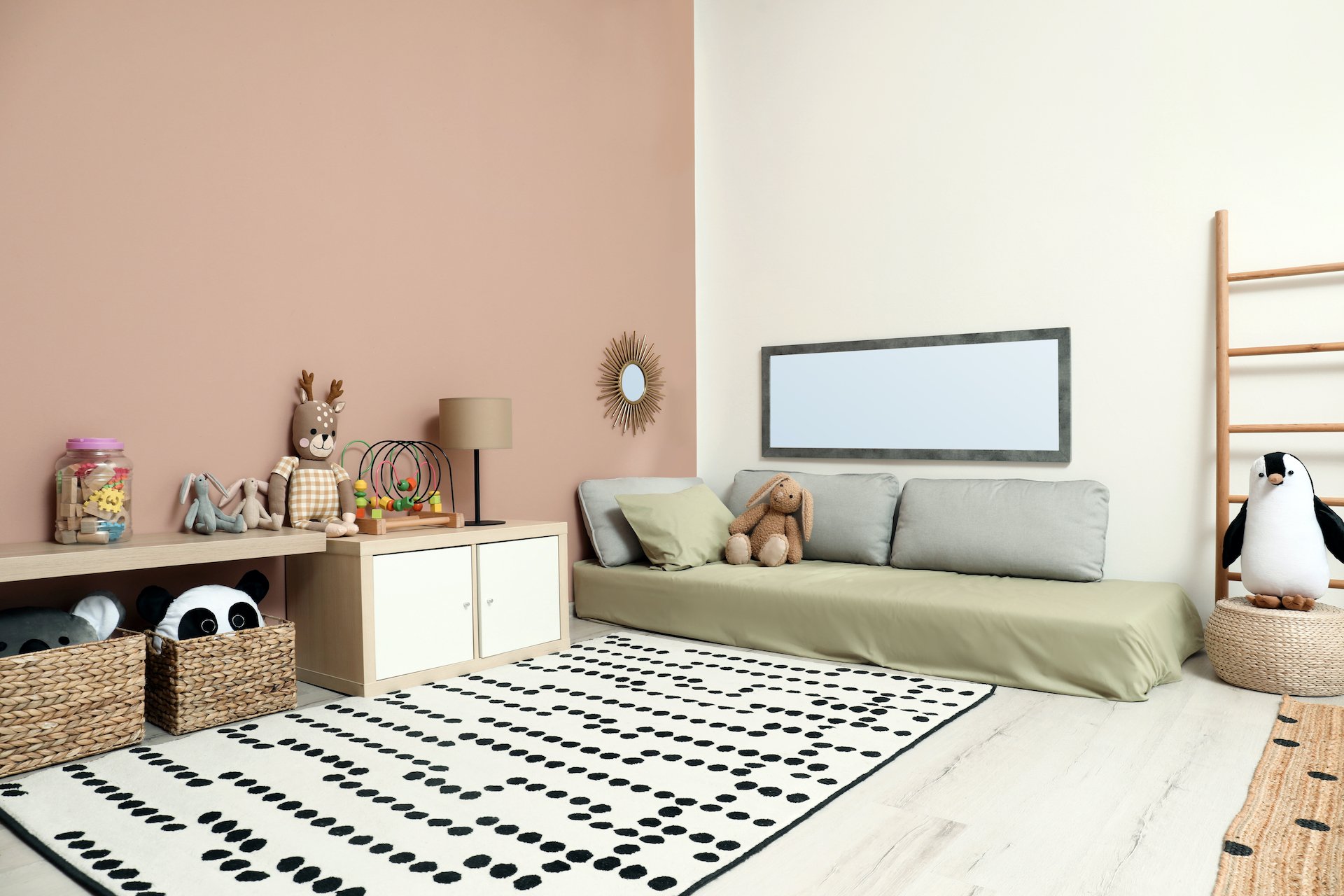
By having a clear, yet simple, plan we can prepare a bedroom space for our young children that not only supports optimal development but also helps us, as adults, feel prepared for each stage of development.

Clear Spaces

The child’s room should have boundaries that will help them be comfortable and thrive. One way to do this is to create a space that only has what is needed, with specific areas for each type of activity. For example, the child’s room needs to have areas for:

  1. Physical care

  2. Sleeping

  3. Feeding (until weaned)

  4. Moving

Although these spaces will shift a bit as our children develop and their needs change, we can prepare a room that is consistent yet easily adapted for each stage of development.

Above all, the child’s environment needs to be practical, beautiful, ordered, and safe, and at this stage, also needs to meet the parent’s or caregiver’s needs.

From Zero to Five Months: Birth to Weaning

Because young infants are adapting to a new world outside the womb, they need consistent points of reference to feel secure. This sense of security and consistency–with furniture, people, and daily routines–allows our newborns to feel able to explore their surroundings.

Physical Care

During these first months of the child’s life, the physical care area in the room has furniture and items for diapering and dressing. At this time the adult is the whole world for the child, so it is best for the changing table to be set up so the adult is at the baby’s feet so they can see the adult talking (describing what is happening, naming body parts, etc.). 

Sleeping 

Ideally the sleeping area has a low floor bed that provides an unobstructed view of the room and freedom of movement. Because this bed can stay consistent as our babies grow, it can help to start with a large-enough mattress (e.g. twin bed size). With room to move, babies will start to slither and eventually will be able to freely crawl into bed.

Feeding

The feeding area begins as a space designed for nursing mothers and babies to bond during breastfeeding. The space thus needs to be peaceful with a comfortable chair and a table or shelf with everything the feeding adult needs to have close at hand.

Movement

This area has three key elements: a mat, a mirror, and a low, open shelf. A hook in the ceiling above the mat can be positioned for hanging and rotating Montessori mobiles. A mirror mounted on the wall allows babies to begin to see themselves and their movements. A low, open shelf can store manipulative materials. Eventually babies will start slithering to the shelf to get these developmental aids.

From Five to Twelve Months: From Weaning to Walking

The room doesn’t need to change dramatically during this time and only needs a few, key modifications.

Feeding

The feeding area still has the adult chair for breastfeeding and snuggling, although during this time children begin the weaning process. This important separation process allows children to form their personal identity.

The weaning table and chair are important new additions to the room. This small, wooden table is very heavy and stable, with rounded edges and a beautiful place setting. In addition to a small, stable, supportive wooden chair for children just learning how to sit upright, the parent or caregiver has a stool so they can also sit and offer some of the first foods.

Movement

To help children be able to pull up and cruise, we can add a bar to the mirror and eventually remove the mat. An ottoman in the movement area can be a used for crawling around, pulling up on, and cruising around. The ottoman could be the same footstool used with the nursing chair. As children begin to cruise and walk, it’s nice to also include a lighter weight table, chair, and stool that they can push and move around themselves.

From Twelve to Thirty-Six Months: The Walking Child

Walking is an incredible accomplishment in human development. Rather than using their hands to aid in transportation, children can use them to transform their surroundings.

Sleeping Area

The bed can stay the same (or a little higher since they can now use their hands and whole body to climb onto it).

Feeding Area

At this point, the feeding area can shift completely to the family eating area. 

Physical Care Area

As children learn to walk and develop more muscle control, they will eventually shift from needing diapers to using the bathroom for toileting, or at least transitioning to standing diaper changes in the bathroom. We can thus remove the changing table and replace it with a small wardrobe with a mirror, so our children can see themselves dressing. 

Movement Area

Once children don’t need the assistance of the bar, we can remove it, as well as the mat and the mirror. It’s important to remember that children’s furniture should be proportionate to their mental and physical strength, so they are challenged, but in a way that allows for successful mastery with some effort. Above all, the furniture should be child-sized.

General Considerations

It is important to keep in mind that children have their own developmental paths. With this in mind, the above changes in the room should be done only after thorough observation of how our children are developing.

Children’s awareness of their environment begins at home, later expands to school, then to the community and local culture, and then beyond to their country and the world. The experiences children have in these environments become part of who they are, so we want to take care to prepare the best spaces possible!

If you want some inspiration, come visit our classrooms to see how we prepare environments for children’s optimal development.

The Montessori Prepared Environment

Hollis Montessori Primary Environment

In Montessori, we talk a lot about the “prepared environment.” Really, though, this concept of a prepared environment isn’t limited to Montessori. In fact, from the earth’s biosphere offering an array of support for life, to the fragrant and colorful flowers existing to lure pollinators, to a woman’s uterus preparing each month for the implantation of a fertilized egg – prepared environments are all around us!

A prepared environment has three essential purposes:

  1. to offer protection, 

  2. to provide nourishment, and 

  3. stimulate growth. 

In Montessori, a prepared environment is a place for children that is specially designed to appeal to their sensitive periods for learning, as well as their fundamental human tendencies. When designing these prepared spaces for children, we take into consideration how to ensure children feel protected and nourished, so they can reach their potential. Basically, the Montessori prepared environment is a place where children can feel at home as they develop their inner selves and outer skills.

One of the ways we offer children safe, home-like learning environments, is through our attentiveness to how the physical space is set up to meet children’s developmental needs. The classrooms have small, easy-to-move tables and chairs, as well as plenty of windows that let in bright, inviting light. Large open floor space allows children to work on the floor on rugs and move freely about the classroom. Low, open shelves display orderly arrangements of beautiful materials which invite children to engage with an array of learning activities. 

The materials on the shelves are quite aesthetically appealing and have been developed out of trial and observation in schools all over the world. The beauty of the materials and the classroom appeals to children’s development of an aesthetic sense, while the arrangement of materials from concrete to abstract provides children with a solid sense of order. 

In addition to being beautiful, the materials in the environment are real and purposeful. Containers for items even offer different textures and sensorial experiences. Because the materials are authentic, they offer children clear guidelines regarding use and misuse. Fragile items help children learn how to handle items with control and care. Plus, having access to beautiful, breakable treasures conveys an essential message of goodwill and trust.

In the beginning, adults assist children in getting their bearings in the classroom and teach the precise use of each material. The children then have the freedom to choose what they do and to focus for long periods of time. 

Although adults are not the focal point in Montessori classrooms, adults are of prime importance. While they may have an outward appearance of passivity, the adults are acutely alert to what is happening in the classroom community. In addition to this presence and awareness, adults in Montessori classrooms must prepare themselves in profound ways. They have extensive intellectual and practical training to be able to link children with different aspects of the learning environment as well as with the breadth and depth of educational materials. Because the adults model how to have a peaceful environment where everyone is respected and able to work without distraction, they also must prepare themselves on a personal and spiritual level. 

In addition to this psychological safety, Montessori prepared environments also focus on the importance and value of living things and outdoor spaces so children can keep and develop their connection to nature. Ideally, the classroom includes a garden area in which children can sow seeds, care for living things, and participate in harvesting the fruits of their work. The indoor and outdoor spaces often blend together with plants and animals as integral aspects of the classroom. In Montessori, we consider this connection to nature to be an essential part of education.

The connection to nature both in and out of doors, the arrangement of open space with child-sized furniture, the ordered and aesthetic materials, and the centrality of children with adults offering background support, all provide children with the protection and nourishment they need to develop independence and active engagement.  

Children in Montessori prepared environments love their learning spaces! Come visit our school to see how the classrooms appeal to children on so many levels as they engage with their community and construct their understanding of the world.