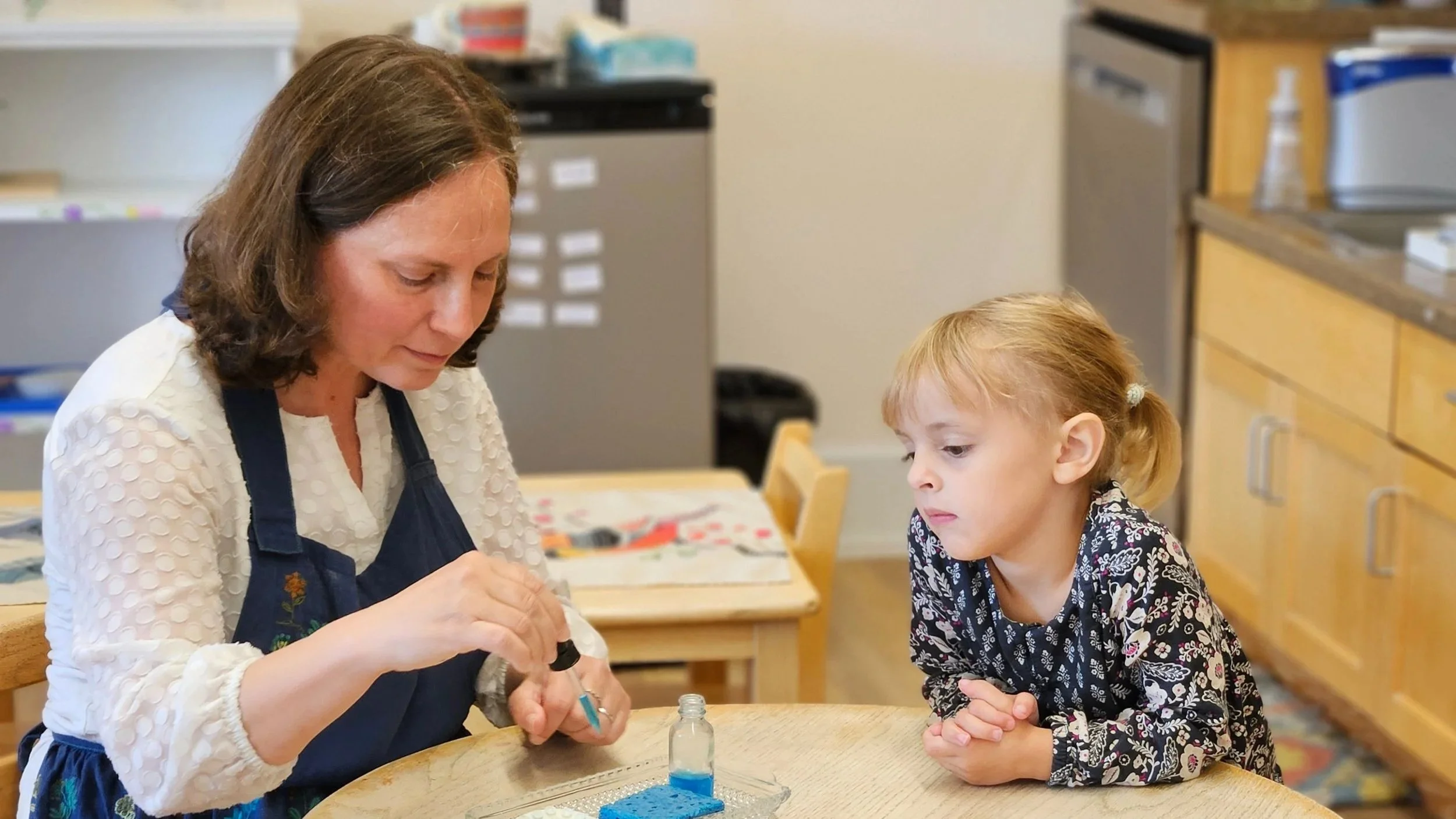
A new study by Angeline Lillard, one of the foremost education scholars studying Montessori education, has found that attending a Montessori pre-school has measurably positive impacts by the end of Kindergarten. The study, A national randomized controlled trial of the impact of public Montessori preschool at the end of kindergarten, looked at 588 children across 24 public Montessori preschools. By looking at students who had entered random lotteries for places at the schools, they were able to compare two randomly assigned groups of students who attended either public Montessori preschool or other public preschools.
The study found that students who attended Montessori preschools “had significantly better end-of-kindergarten outcomes for reading, short-term memory, executive function, and social understanding.” Interestingly, while there was no significant difference between the groups at the end of the 3 year old or 4 year old years, the significant differences appeared by the end of kindergarten.
The authors hypothesize that some of this effect is attributable to the fact that “the methods Montessori uses to teach reading align with the science of reading.” They also note that in other studies, Montessori children often test higher on executive function skills, which has a strong influence on working memory. The three year cycle of Children’s House might explain part of the differences. The paper notes that “Montessori teachers often claim that they see children blossom in their third year in the classroom, consolidating and taking on leadership roles reflecting the knowledge they gained in the classroom in the first two years.”
The authors cite a recent meta-analysis of 32 studies that found that “Montessori had better outcomes than traditional schooling on language and literacy, math, executive function, and social skills.” However there is a possibility of selection bias in many of those studies, in that parents who choose Montessori schools for their children may already be conferring the advantages of higher socioeconomic status and educational attainment on their children. This new study sought to avoid that bias by comparing two groups of children all of whose parents wanted them to attend Montessori schools. The control group consisted of children who did not attend public Montessori preschools because of the random effects of the lottery. The authors were also careful to control for demographic factors between the two groups.
As part of the comparison, the authors compared the cost of 3 years of public preschool education for both groups, finding that Montessori cost districts $13,127 less per child. This is likely due to the higher student/teacher ratio in Montessori classrooms. These findings, paired with the improved outcomes, imply that using a Montessori model may be a good choice for public preschools.
Lillard, Angeline, et al. “A National Randomized Controlled Trial of the Impact of Public Montessori Preschool at the End of Kindergarten.” Edited by Greg Duncan, PNAS, 25 Oct. 2025, doi.org/10.1073/pnas.2506130122.