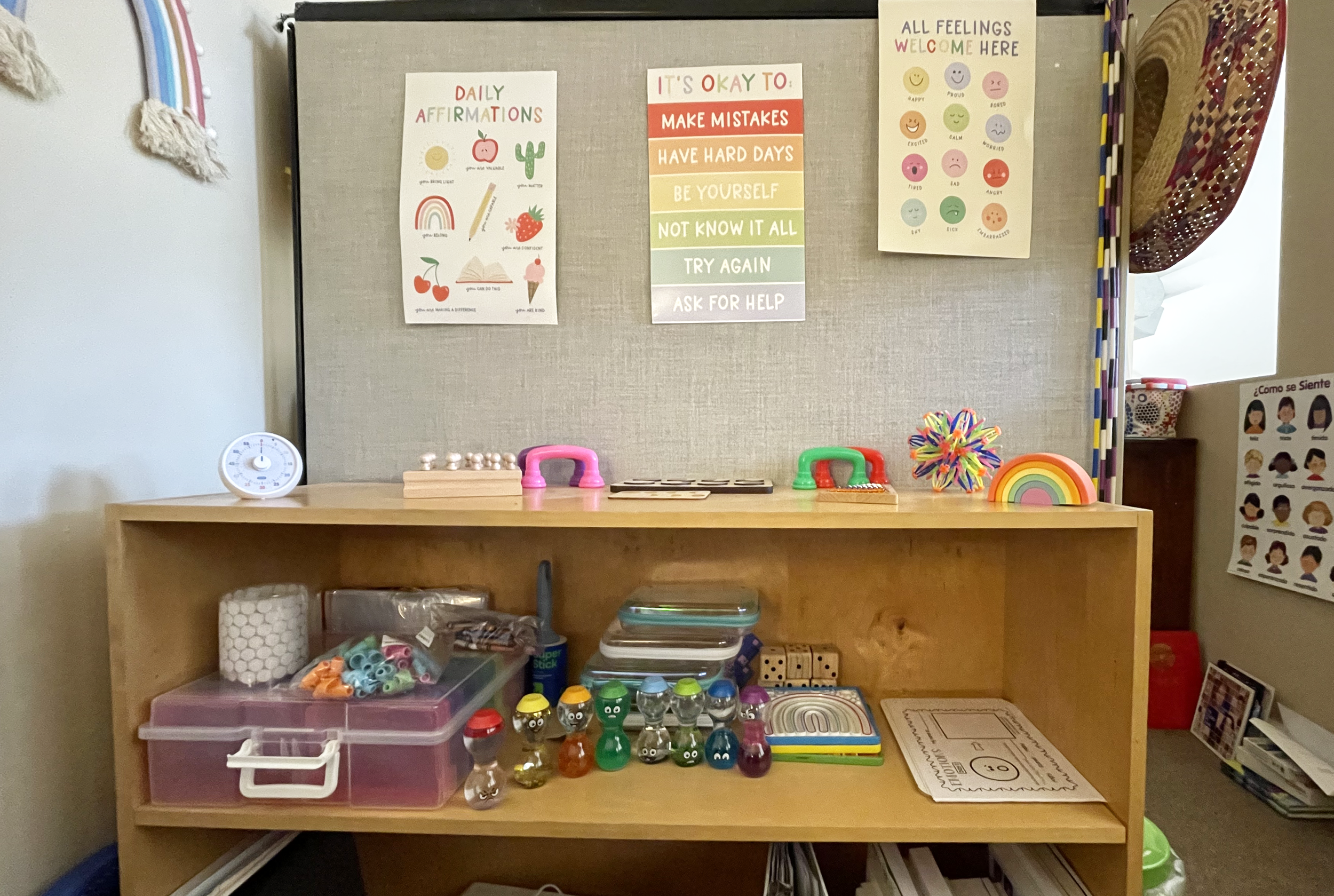
Profile of Our New Learning Support Specialist, Nicole DeRosa
At Hollis Montessori, our goal is to provide an environment where all students can succeed academically, socially, and emotionally. We believe every child deserves to thrive at their own pace and in their own way. As our community has grown, so have the diverse learning needs of our students. This year, we are very pleased to have hired Nicole DeRosa in the newly created position of Learning Support Specialist.
In this position, Nicole helps identify and address students’ individual learning needs, collaborates with teachers to develop tailored strategies, and ensures that every child’s educational journey aligns with Montessori principles of independence and growth. Nicole supports both students and teachers in creating an inclusive, responsive learning environment, and ensures that each child receives the individualized attention and strategies they need to reach their fullest potential.
We interviewed Nicole about the path of her career and how she came to Hollis Montessori School.
HMS: How did you end up at Hollis Montessori School?
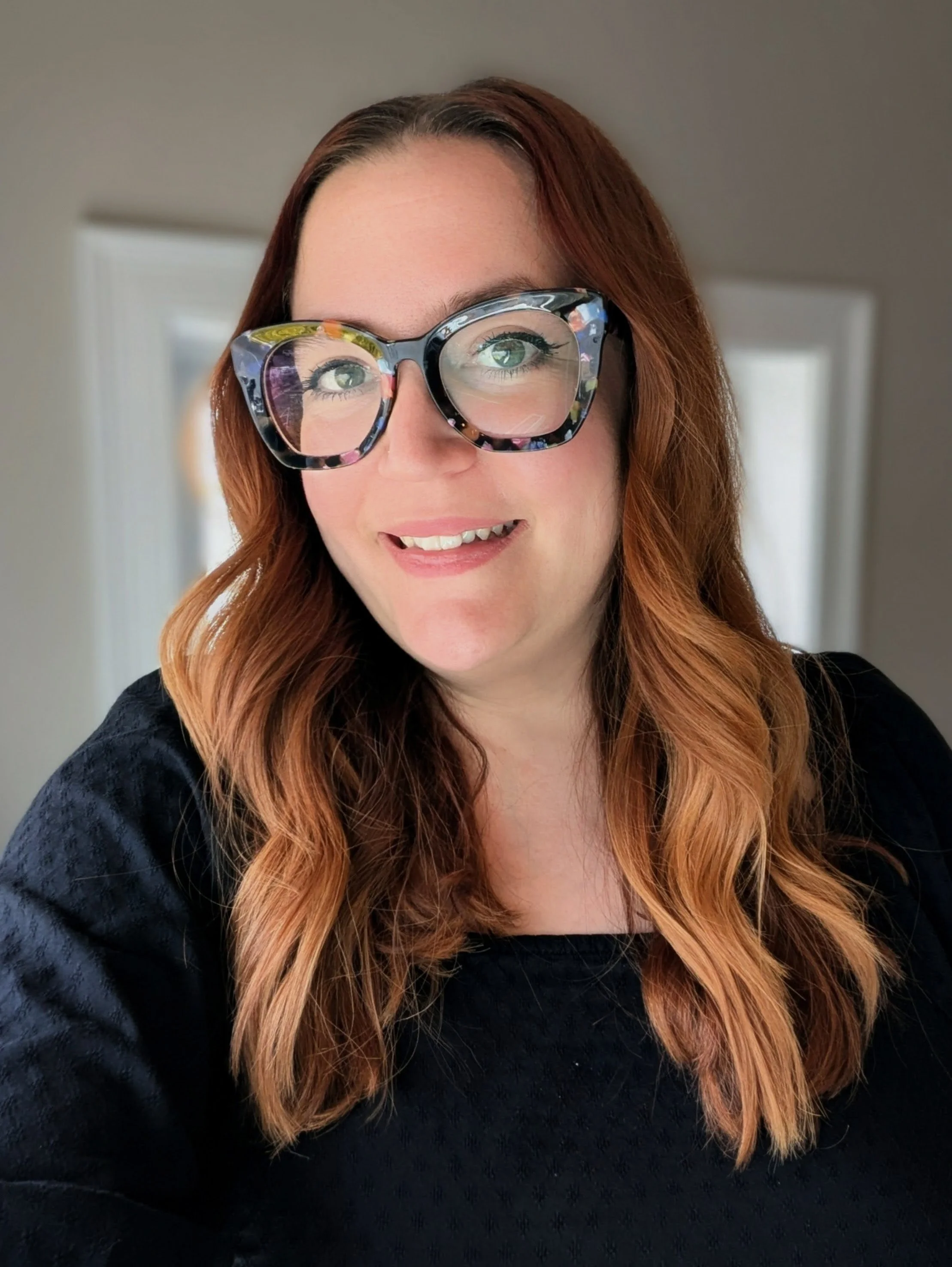
Nicole DeRosa
Nicole: I approached Head of School Kari Headington in early Spring 2025. I wrote about my desire to transition into a role where I could utilize the specialized ABA (Applied Behavioral Analysis) training I had spent the previous two years completing while honoring my love for Montessori, and with that, Kari and I began our discussions around what learning support could look like at Hollis.
The primary focus of my professional work prior to joining Hollis was in school Administration where I put my MBA to use for over ten years. As I neared the completion of my Master’s in ABA at Simmons University I—in Montessori practice—took a period of self-reflection to determine if stepping out of Administration and into the classroom was the best way to honor what was in my heart. It became clear through that process of self-reflection that I was happiest and most fulfilled when I was working directly with children, especially those that needed the most support. It is the child that challenges us the most that often needs us the most. It is my mission to be that support for as many children as I can.
I became energized each time I spoke with Kari because of her deep commitment to supporting neurodivergence and educating the entire community to create a culture of dignity and belonging. So it felt like kismet when I came to the campus and was able to fully envision the beautiful work and experiences I get to have here each and every day.
HMS: What brought you to the work of supporting neurodiversity?
Nicole: My personal journey supporting neurodivergence led to my pursuit of knowledge and later professional work here at Hollis. I am a parent of two children with ADHD and through my own journey navigating assessments, evaluations, diagnoses, as well as the myriad of service providers that can accompany complex diagnoses and behaviors, I often felt alone. I armed myself with as much knowledge as I could find regarding the needs of my children and in doing so became their greatest advocate. Advocacy is work that will be a life-long passion and journey for me and one that I bring into the core of my focus and work here at Hollis. I do not ever want a caregiver to feel as alone as I did, while navigating a diagnosis or finding services for their child. Early intervention support can be truly life changing and I speak from my own personal experience when I say that.
However, while I began to gravitate towards being in the classroom more than in Administrative offices it became clear that my knowledge of behavioral assessment, support, and at times intervention, needed to grow. I knew that I didn’t necessarily want a traditional Special Education focus, so I looked to my alma mater, Simmons University, where I had started my professional journey in their MBA program, and entered their Master’s program in Applied Behavior Analysis.
This program provided invaluable skills to support neurodivergent children, but at its heart, the most important lesson it taught me was that all behavior is a form of communication. Once we understand the function of a child’s complex behaviors we can develop appropriate skill building or identify replacement skills that will better serve the needs of the child and their learning journey. The focus on skill acquisition and identification of skill deficits, as opposed to imposing negative consequences or punishment for complex behaviors, reinforced for me that this was the work I wanted to pursue. It aligns with who I am as a person and aligns with the environment I had fallen in love with, Montessori.
HMS: What drew you to Montessori?
Nicole: I am truly a Montessori convert. Before I began my journey of understanding the Montessori philosophy, I did not comprehend the depth of intentionality behind each of the areas in the classroom environment, or how the self-correcting materials foster curiosity and independence in our children. I was blown away watching students in Children’s House care for themselves, others, and their environment with routines that much older children and even adults at times struggle to maintain. As I began writing my thesis manuscript, the capstone to my Master’s program, I knew that I wanted to focus on the Montessori environment. The more I began to research the earliest work of Maria Montessori, the more I drew parallels between Applied Behavior Analysis and her work with what she called children with “exceptionalities,” what we would more commonly refer to as neurodivergence today.
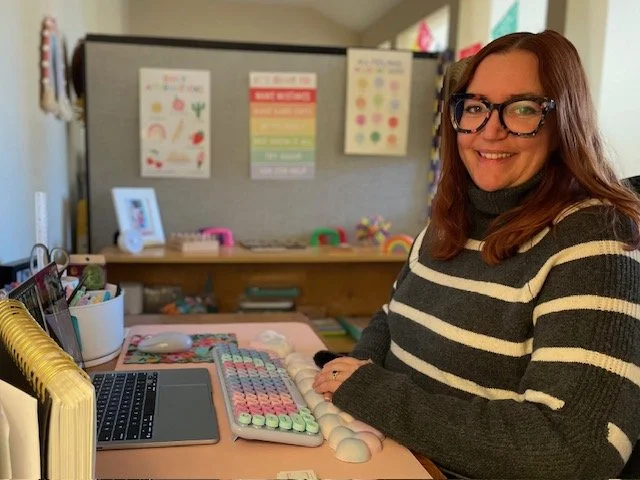
The core beliefs and practices of Montessori parallel my training in ABA: the deep understanding that comes from the observation of a child in their environment; the use of errorless teaching practices through self-correcting materials; the core tenet of becoming and belonging, and shaping our environment to fit the needs of the children as opposed to expecting the child to fit the environment; the fostering of grace and courtesy to build social skills and social connections. These parallels beautifully demonstrate why this pedagogy has persisted unchanged for this length of time. Both practices focus on skill building and fostering intrinsic motivation and preparing a beautiful environment for a child to learn in.
HMS: What else can you tell us about yourself?
Nicole: When I am not at Hollis Montessori, I am spending time with my two children, husband and dog, Miss Pickles. Whenever possible, I am in Southern Maine—Kennebunk and Wells being my personal favorites—collecting nautically themed antiques and sea glass. I love to read, am a through and through Swiftie, and love anything true crime or horror related.
Eventually, I would like to pursue my Montessori primary training because of my passion for early intervention work, and a doctorate degree in Psychology to further support the diagnostic side of my current learning support work.