Montessori

Work or Play? A Peek Inside the Montessori Classroom

20141120-0130 copy.jpg

You know Montessori classrooms are different than most.  You’ve heard the rumors: children run around doing whatever they please.  It’s all play and no work.  Or perhaps you’ve heard the opposite: our structures are so rigid we stifle creativity and natural childhood behavior.

What’s it really like?

We can practically guarantee that once you step inside a classroom for yourself, sit quietly in a corner, and observe the children and adults at work, your impressions will be transformed.  We encourage parents to do so whenever possible; the children are used to visitors and we have tips on how your presence can be unobtrusive to them but informative for you.  We hope you’ll schedule a visit soon if you’ve never been, or even if it’s just been a while.

In the meantime, this post will give you some idea of what you might see in a typical, high fidelity Montessori classroom.

Arrival

From the moment they step in the door, expectations are different for Montessori children, even as young as our toddlers.  Children are responsible for hanging their own bags and coats on hooks.  They learn to change their own shoes, with most classrooms requiring that children wear either slippers or a special pair of shoes designated for indoor school use only.  This is done in part to keep our classrooms clean, but also to give children a sense that their classroom feels more comfortable and home-like.

Guides greet students upon their arrival.  They often make a point of shaking a child’s hand, looking them in the eye, and saying their name along with a friendly hello.  By doing this, we are intentionally modeling polite human interactions.  Before long, the children learn how to greet us back, and they are even able to apply this skill outside of school.

The Work Period

Also called the morning work cycle, this period of time is a hallmark of the Montessori approach.  We believe that children need a longer stretch of time to involve themselves deeply in independent work, so we honor this need by providing an uninterrupted block of time each morning.

How much time?  That depends on the age of the child.  Typically, for children ages 3 and up, the work period is three hours long.  It’s not quite so long for younger children, and older children may have a second work period in the afternoon.  

During this time children work independently while guides give small group or independent lessons.  Sometimes it may appear that a child is playing, and while that is true, certain types of play are critical to learning.  It is also important to note that Dr. Montessori developed her educational materials to appeal to children, so what may look like a simple puzzle could actually be a manipulative biology diagram.  What looks like pretty colored beads are, in fact, tools for exploring complex mathematical concepts.

Montessori children are able to make a lot of choices during this time.  We allow freedom of movement: that is, they may sit where they like, stand and walk around the room if their bodies require a break, and use the restroom safely without needing an adult’s permission.  We provide a range of seating options as well.  Some children prefer to work alone or with others, some like to sit at a table or on the floor.  Adults appreciate having choices while they work, and we believe children should be afforded the same respect.

What types of work might you see?  You may be surprised to see even very young children working on the following subjects:

  • Math

  • Language

  • Biology

  • Geography

  • Practical life skills

  • Sensory refinement (up to age 6)

  • Geometry

Socializing

Montessori education takes the perspective that we must nurture the whole child.  This is a popular concept with parents and teachers across a wide variety of settings, but Montessori schools have structures built into their programs that allow for deeper exploration and support of the social self.

The aspects of choice are one way we support children’s social development.  Rather than assigning seats or requiring children to work alone or in pairings that are predetermined by adults, we generally let children choose if they would rather work independently or cooperatively, and with whom they would like to work.  That being said, in any group of people, some personalities work well together, while others do not; we help guide children to differentiate between what makes a positive complementary work partner for them, and what constitutes a fun (and perhaps silly) friendship that can be developed outside the work period.

As children grow older, they begin to place a stronger emphasis on friendships.  The process of figuring out what healthy friendships should look and feel like is a major work of children in the elementary years.  Attachments form, and children come to rely on the company of one another.  Of course, another reality of these years is that all children will face social conflict at some point or another.  

One benefit of a Montessori environment is that the guides are able to set aside time and space to help children navigate conflict.  We teach mediation strategies, inclusivity, and conflict resolution.  We are able to assist children both proactively and reactively.  We often use stories to teach children important lessons about social skills.  Role play is another tool used in classrooms when negative patterns begin to form; when children are able to have fun and remove themselves personally from an experience, they can learn positive approaches to resolving common dilemmas. 

The Guide’s Role

Another often surprising element of the Montessori classroom is the role our guides take.  To begin with, they are typically referred to as guides, rather than teachers, as we believe the name is a far better descriptor of the task.  Instead of feeding children a stream of information we expect them to internalize, we lay a path before them, open the door, and give them the tools to explore and learn.

In the primary years (ages 3-6), lessons are usually given individually.  This allows the guide to give their full attention to the child before them, and to honor their individual needs.  In the elementary years, lessons are typically given to small groups of children, honoring their developmental desire to work alongside their peers.

Another delicate task of the Montessori guide is to know when to step in and assist a child, and when to stand back and allow them to find a solution themselves.  Generally speaking, we tend to take the latter approach.  We believe that children are capable of much more than we often give them credit for, and given the opportunity, they will rise to the occasion.  This approach helps build resilience and confidence.

Lastly, the guide’s job is to observe.  We watch the children in our care to learn which skills they have mastered, which they are progressing in, and which they may require additional support with.  Though we may not always intervene, we notice what they are doing, both academically and socially.  We take copious notes to inform our practice, record their progress, and to share our findings with parents.

Montessori guides don’t consider themselves the center of the classroom.  We are merely there to support the learning of the children.

Still curious?  Good!  Call us today to schedule a time to observe.  See a Montessori classroom in action for yourself.  We know it will be an amazing experience.  

Montessori Basics: The Language Curriculum

Moveable-Alphabet.jpg

Have you ever wondered how Montessori guides teach children about language?  Parents are often astounded when they observe children learning to read at a young age in our schools.  What’s the secret?

There’s no secret - we’re happy to share our methods!  Read on to learn more about our approach, how we align our teaching with a child’s natural development, and what the progression looks like as children get older.

Early Language Activities

Children’s language development begins long before they enter the classroom.  Dr. Montessori asserted that children from birth to age 6 were in the age of the absorbent mind.  During this time they are able to learn language simply by living around others who are using language.  Montessori classrooms incorporate both spoken and written language into the environment to further enrich this early learning.

In our primary classrooms we teach children songs and poems so that they may hear and experience language in a fun and playful way that appeals to them.  We encourage parents to do the same!  Share poems from your childhood with your children and discover new ones together.  Sing your favorite songs from when you were little, or enjoy kid-friendly tunes from musicians such as Raffi or Tom Chapin.

Montessori guides introduce children to as much vocabulary as possible in their early years.  This may start with naming objects around the classroom, but will also expand toward specialized nomenclature.  Children learn the names of the continents, plant and animal names, and specific terms that apply to areas of interest.  These vocabulary words are spoken and shown in written form. 

Writing

As you may have guessed, writing starts earlier in Montessori classrooms than in many other settings.  Consider the goal of writing: to visually communicate one’s ideas with others using standardized symbols.  This is actually separate from the ability to hold a pencil and form strings of letters, words, and sentences on a piece of paper.

Once a child has a basic understanding of most of the letter sounds, they begin to use a material called the moveable alphabet.  Exactly what it sounds like, the moveable alphabet is a box containing sorted wooden letters.  Children lay the letters out to write words, and eventually sentences.  At this stage we do not expect children to conform to conventional spelling, but rather we allow what is often referred to as inventive spelling.  “I love my mom” may look like “I luv mi mom”.

Montessori classrooms use many materials to help children strengthen their finger muscles in preparation for the physical act of handwriting beginning at age 3, or arguably even earlier.  Our experience has taught us that children are ready to express themselves in writing before they are ready to start writing in the traditional sense.  That pencil-to-paper writing usually starts in kindergarten, though it varies with individual children.

Reading

One beautiful material that you have likely seen is called the sandpaper letters.  The letters are used to teach both reading and writing.  

It’s important to note that when Montessori guides begin teaching children about letters, our focus is on the sounds the letters make and not so much their names.  This means we do not teach the alphabet song, because knowing the names of letters isn’t really helpful in learning how to read.  That’s not to say there is no value in such learning; it will certainly come in handy when learning to alphabetize, or when talking about letters when they are a bit older.  We just want parents to know that if you want to continue the work we do in our classrooms, consider using a letter’s most commonly used sound when referring to it.  

An example: when a Montessori child learns to spell cat, they will say, “k-ah-t” rather than “see-ay-tee”.

Object boxes are used to help children learn to read as well.  A box labeled with the letter p may contain tiny toy versions of a pig, pot, pin, etc.  Eventually, children are able to match the objects with label cards.

Much of our reading work is done while teaching children other subjects.  For example, if they are learning about mammals, they will read lots of text at their level about mammals.  

There are also special series of books used by many Montessorians, including Miss Rhonda’s Readers (created by a Montessori guide) and Bob Books.  Guides typically prefer that families not use these same books at home.  Young children are often able to memorize text, and if they have been exposed to the same books at home and school, it can be difficult for guides to have an accurate observation of the child’s true decoding skills.  Check with your child’s guide if you’re curious or would like some advice on what books to read at home.

Card materials are also used as children progress, allowing guides to help children isolate specific sounds and blends.  One series of cards/lessons may focus on the various ways to make a long a sound.  One color of cards displays words containing ai, another will contain ay, and yet another will teach children about words with the silent e.

Word Study

This area of study includes a wide variety of skills and begins once a child has begun to read; some of the earlier lessons are given during the final (kindergarten) year of primary, but many are given during the first two years of lower elementary.  The guide will give the child a lesson teaching the skill.  In the days and weeks following, children practice the skill independently using special card materials.  The skills include:

  • Classification

  • Alphabetizing

  • Compound words

  • Synonyms

  • Antonyms

  • Prefixes

  • Suffixes

Grammar

Grammar is taught early and in what we call a spiraling curriculum; that is, we circle back on the same content as the child gets older, building on previous knowledge and giving more depth to their understanding.  Parts of speech are taught in a very specific order, and each one has a corresponding symbol that children use in many activities.

Beginning in the final year of primary, children typically learn about nouns, articles, and verbs, as well as their corresponding symbols.  This helps them to understand the core parts of our sentences and gives them an introduction to grammar in a way that appeals to them. 

Sometime during that final year in primary or the first year of lower elementary, children are introduced to grammar through what we call the function of words.  Traditionally, a model of a farm, complete with animals, is used to guide children through the process.  Again, they begin by learning that nouns are naming words, and they name each animal and feature of the farm.  They then go on to learn the corresponding articles, followed by all other parts of speech, including adjectives, verbs, adverbs, pronouns, conjunctions, prepositions, and interjections.

Once a child has learned the functions of words, they will move on to the Montessori grammar command cards.  Knowing that children learn by doing, these cards give children specific directions to physically follow so that they may experience the words for themselves.  

Another classic Montessori activity involves the use of colored wooden grammar boxes.  Children use cards to recreate sentences, word by word, and sort the words by various parts of speech.

There are many extensions to grammar work that Montessori children enjoy.  Some will write their own sentences and use colored pencils to label each word with its corresponding grammar symbol.  Others enjoy using grammar strips: a material that shows a series of grammar symbols which students must use a guide to write a sentence with that particular pattern.

Sentence Analysis

Going beyond grammar, elementary-aged children learn to analyze sentences.  This begins simply with subjects, verbs, direct, and indirect objects.  As children get older and have a better grasp on language, the work extends considerably.

Children in upper elementary classes learn about complex sentence structures.  This includes structures like predicate adjectives and nominatives, attributive adjectives, various types of phrases and clauses, and many more.

For seasoned Montessori parents: did you learn anything new from this article?  New families: what do you find the most interesting, or what do you still have questions about?  As always, we believe in the power of observation, and we invite you all to schedule a time to sit and observe in one of our classrooms.

Why Montessori?

whymontessori2.jpeg

How does a parent prepare their child for an unpredictable future?  Don’t we all just want to give them every possible advantage?

How do we define success in our children’s lives?  Is it about being able to provide for oneself or is it finding joy in the work we do?  Is it about contributing to our communities or perhaps continuing to learn throughout our lives?  Couldn’t it (shouldn’t it) be a little bit of all of those things?

Goals

We think Montessori is one beautiful way to work toward all of these goals, and we are prepared to make some bold statements:

  • Montessori gives children a strong understanding of basic math and language skills, starting earlier than most methods and using materials that support their development and methods that correlate with current research findings.

  • Building a sense of independence and confidence is a major component of what we do. We know that children of all ages are fully capable of doing more for themselves than they are often given credit for. We have learned to sit back, observe, and assist only when necessary. This allows children to grow in incredible ways, amazing their parents (and frankly, us, too!).

  • Respect for and connection to the earth is built directly into our curriculum, especially in the elementary grades. We know that around age 6, children start to think about where they fit into the bigger picture. We teach them about the universe, our solar system, the beauty of our planet, and the variety of life on it, just at a time when they are seeking those answers.

  • Choice and freedom are important for all human beings. We give both to children because we believe they are capable of knowing what they need and want, and the more practice they have the better they will get at making decisions when we are not there to support them.

  • We value teaching responsibility and time management skills. This goes hand in hand with focus and attentiveness. The ability to make choices about one’s learning must be balanced with accountability; as the children in our classrooms get older, they know there are certain expectations. For example, they may be able to choose the order of their work, but they know that they have to do grammar at some point during a specific time period, even if it’s not their favorite subject.

  • Rather than drilling arbitrary facts into children and forcing them to memorize information that may not serve them in the future, we take a different approach. All children are exposed to a wide variety of basic scientific, geographical, and historical information, and are given extensive opportunities to more deeply explore the topics that they find fascinating.

Graduates of Montessori schools go on to be successful in other settings, whether they go on to attend other private schools or their local public schools.  They tend to view the world a little more creatively than the rest of us, and their contributions are often felt throughout society.  There are many notable public figures that credit their early Montessori education to the successes they experienced later in life.  To learn more about some of these people, take a look at this article.

Research

Montessori-specific research is a fairly new field, but the initial results in recent years are fascinating.

One study conducted in Hartford, Connecticut, took a look at preschool students in a public Montessori magnet school.  Federal magnet grants are awarded to public schools who commit to special, high-quality educational programming (in this case, Montessori) in an attempt to create a socioeconomically diverse school community within an urban setting.  In the study, two groups of preschool-aged children were observed over time: 70 children in the Montessori setting and 71 who were in other settings.  While the children tested similarly at the onset of the study, eventually the Montessori children outperformed the others academically, as well as notable increases in their enjoyment of work, social understanding, mastery orientation, and executive function.  Subgroups within the study showed some other interesting findings that suggest Montessori education might help close the gaps on certain factors that typically hinder children’s success (such as income and executive functioning).

Another study in public Montessori schools in Milwaukee concluded that a Montessori education has long-lasting positive benefits for children.  The study also determined that when Montessori-educated children eventually transitioned into more traditional educational settings they were successful and the transition was positive.

While there are other great studies out there, we will touch on just one more here.  This study took a look at the effects of a high fidelity Montessori environment versus a low fidelity Montessori or conventional classroom environment.  Children who learned in a classic Montessori program in which the guides adhered to traditional methods made significantly higher gains during the school year than their counterparts in conventional classrooms or Montessori classrooms that were supplemented with other types of learning materials and methods.

Community

Montessori schools are also something unexpected: they provide a community for more than just the children.  Parents, educators, students, and local community members gather together in support of common goals.  They work together, socialize together, and find ways to solve problems together.  In our society today, many people have lost the sense of community that is so important to our well being; Montessori schools serve an important function of not just educating children, but giving like-minded adults a way to connect and form meaningful relationships.

On the Topic of Competition

competition.jpg

You may have noticed that in Montessori schools, we do not typically encourage competition between children.  Our lack of traditional grading is one obvious marker of this approach, but you will notice that the lack of peer competition threads itself pretty much throughout the entire program.  This is quite intentional, and we work hard to give children a foundation built on competition with oneself, rather than with others.  

It is important to note, however, that a Montessori education does not leave children unprepared for “the real world”.  We recognize that competition is a part of life for many, and we work hard to cultivate characteristics that will allow children to engage in healthy, fulfilling competitive experiences.

Curious to learn more about what we do?  In this post we not only explain why we favor internal motivation, but what we do to help nurture well-rounded and adaptable children.

Internal versus External Motivation

One of our core values as Montessorians is that we believe intrinsic motivation is far more powerful than external rewards.  This has been the foundation of our educational model for over a century.  In recent years, studies have backed the theory that we are most successful when we are driven by our own internal motivations, not perceived rewards (like prizes, grades, or money).  Information on one such study can be found here.

How We Prepare Children for Healthy, Real-World Competition

Montessori schools can sometimes feel like a bit of a protective bubble.  As educators, we need to recognize this and make sure we are preparing children for what comes next.  Montessori students tend to be highly successful when they eventually move on to more traditional schools, regardless of when that might be.  The following character traits are cultivated throughout a child’s time with us, and we believe this is part of what it takes to create successful and fulfilled people in the long run.

Self Confidence

We all like having the ability to believe in ourselves, and we do whatever we can to guide our children toward feeling the same way.  From a very young age, Montessori children learn to do things for themselves.  They are respected by the adults in their lives and their personal autonomy is honored. 

When a toddler sweeps up her own crumbs, she feels it.  When a four-year-old makes his own sandwich for the first time, he feels it.  When an eight-year-old solves a challenging long division problem, they feel it.  

We build routines and structures that allow children to accomplish big things, and to revel in the feelings of self-accomplishment.  After many, many of these experiences, children develop a strong sense of self, and an “I can do it” attitude.

Resiliency

In Montessori classrooms, we know what children are capable of.  We know that traditional settings often expect less than what is developmentally appropriate for them.  When our students feel driven to work hard on challenging tasks, failure becomes an early and welcome part of their experience.  

As adults, we often equate failure with negative outcomes.  In reality, failure is nothing more than a learning experience, and we can use that experience to guide us toward mastery.  When following an internal desire to learn about or accomplish something, children welcome these necessary building blocks.  They see them for what they are: another motivator to keep pushing forward. 

Independence

If it’s not already obvious, our students are encouraged to be as independent as they are able to be, both according to their age and their individual needs.  This means they do not need to rely on others to get started on or execute tasks; they have plenty of experience confronting challenges independently.

Having a strong sense of independence allows us to take on leadership roles.  It brings us towards self-awareness and trusting our own abilities.  Our independence can encourage us to block out unimportant details and distractions, leading us to focus clearly on the task at hand.

Cooperation

While independence is critical to our success, it is equally valuable to be able to work cooperatively with others.  Many competitive situations involve teams of people working together toward a common goal, and this is something Montessori children get lots of practice in.

We recognize that one of the hallmarks of the elementary age (6-12) is that children are highly motivated by social interactions.  To this end, we carefully craft the classroom environment to support this need.  Children are given lessons in small groups, and even the furniture is arranged for a variety of seating options. If you were to observe in an elementary classroom, you would notice most of the children clustered in small groups working together, and this inevitably leads to many opportunities to practice important skills like compromise, flexibility, and advocacy. 

Self Advocacy

Montessori classrooms have a bit more flexibility in terms of daily scheduling than most settings.  One critical element that must remain is the three-hour work cycle in the morning.  Beyond that, our guides are able to schedule class meetings regularly, or any time conflict arises.  We teach our students skills they need to navigate all sorts of interpersonal situations, including how to advocate for themselves.  

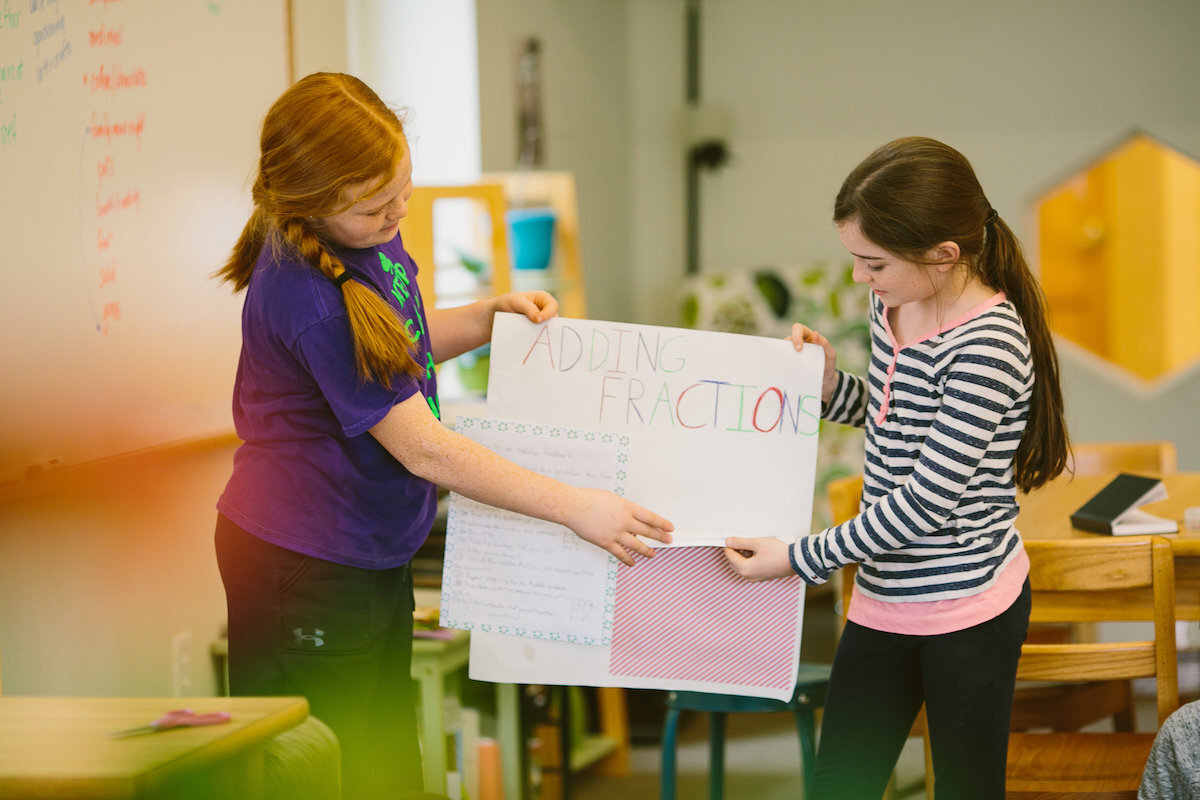
Another interesting aspect of a Montessori classroom is that even young children have frequent opportunities to present their work and ideas to their classmates.  Being able to stand up and speak in front of a group of people from the time one is six years old seems to have a profoundly powerful effect on how we are able to convey, with confidence, our ideas and feelings.  

Did you know that there are a number of well-known figures who attribute their Montessori education at least partially to their success?  In this video, NBA MVP Stephen Curry shares how his own Montessori education gave him the confidence necessary to become the successful adult he is today.

Montessori Basics: How we Teach Handwriting

handwriting.jpg

Handwriting or penmanship; no matter what you call it, it was likely an important part of your early education.  Pressured by time and content constraints, many schools have abandoned explicit handwriting instruction.  This is resulting in a generation of children who do not know how to write in cursive, and who sometimes even struggle to form legible printed letters.

A number of scientific studies point to the importance of handwriting, including this one which concluded that handwriting (as opposed to typing or tracing) guides preliterate children toward developing reading skills.  

Interested in learning more about the scientific evidence that supports the importance of teaching handwriting as a skill?  Check out this article that highlights five of the important reasons we should not allow direct instruction in this area to go by the wayside.  Not only does learning handwriting early help children develop skills needed for reading, evidence suggests it makes children better writers, spellers, and leads them towards future success in academics.  Higher brain density and gray matter volume have been connected to high-quality handwriting, suggesting that frequent practice may aid in neural processing.  Studies also conclude that it is critical for teachers to model the correct way to form letters, but also to utilize direct instruction.

In Montessori schools, handwriting is a critical component of children’s learning.  As with so many other skills, our curriculum takes a spiraling approach, indirectly preparing children prior to direct instruction.  Very young children develop the muscles necessary for a pincer grasp while they manipulate materials such as the knobbed cylinders, a Montessori favorite!  

There are two other important materials in the primary classroom that facilitate handwriting readiness: the metal insets and the sandpaper letters.

The metal insets are wooden trays that hold a series of stencil-like shapes.  Removable shapes are blue with a pink background.  Some shapes have straight-lined sides while others are curved.  Children trace the shapes with a pencil, giving their hands a chance to practice creating a variety of lines.  Increasingly challenging activities encourage children to create different patterns with colored pencils while staying inside the original traced lines.  At first glance, this may appear to be a fun art activity (which it certainly is!) but its main intention is to prepare children for their upcoming work in handwriting.

Montessori sandpaper letters take the work a step further.  Twenty-six wooden tiles are adorned with gritty, sand-textured letters of the alphabet.  Children are given lessons on how to trace these letters with their fingers and say the sound.  (As a side note, Montessori children are taught the sound of each letter in conjunction with its name, which makes much more sense for reading preparation.)  Perhaps you have observed this in a Montessori classroom; if you have not, we highly suggest coming in to watch the magic of this work in person.

Interestingly, children who attend Montessori schools are typically able to write even before they have begun to read.  Once they do begin reading, these previously developed skills allow them to seamlessly work on the various components of literacy development simultaneously.

Once children enter the elementary years in a Montessori school, they are required to write throughout the day.  Typically, children work throughout the three-hour work period in the morning on a largely independent basis, unless they are receiving a direct, small-group lesson from the guide.  During this independent work they record parts of what they do in notebooks.  For example, if a child uses a card material to learn about the internal body functions of a fish (how they perform the tasks of respiration, circulation, movement, and so on), they will record at least part of this work in their notebook.  For example: “Circulation.  Fish have two chambers in their hearts.”  This writing continues throughout the day and is directly connected to other content children are learning.

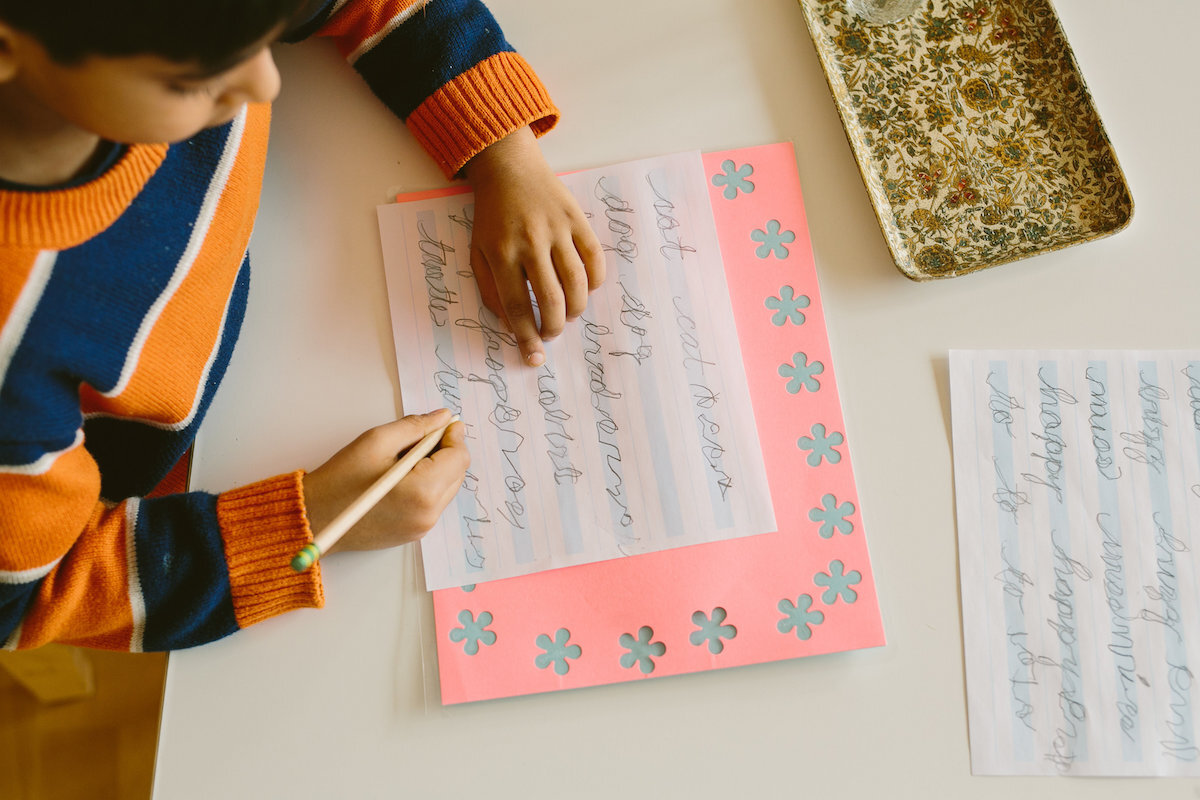
Some classrooms include direct handwriting practice even in the elementary years.  This is typically something for children to copy in their notebooks, such as a poem or a paragraph about something they recently had a lesson on.

One final and very important reason to teach handwriting: when children learn how to form beautiful letters early on, they are better able to focus on a myriad of other things.  For example, when writing a story, they can actually think about their story ideas instead of belaboring over how to write a ‘q’.  

Interested in learning more?  As mentioned earlier, we encourage you to come visit the school and observe in one of our classrooms.  Doing so is common practice in Montessori schools, is unobtrusive to the children, and can provide excellent insight for those who are looking to learn more about this unique educational approach.

Montessori Basics: Reality vs. Fantasy

Hollis Montessori General Photos June 2016-10 copy.jpg

Our Montessori Basics posts are created in order to teach parents about Montessori philosophy and curriculum.  Today’s post helps illuminate how one element of the philosophy drives the curriculum.  We all know Montessori classrooms differ vastly from their more conventional, traditional counterparts, and views on how children developmentally react to fantasy and reality are one of the key components of those differences.

You may or may not already know, but Montessori schools discourage the introduction of fantasy to young children (children under the ages of 5 or 6).  This means we do not use play kitchens, have a dress-up area in the classroom, or rely on books with dragons and fairies.  This often evokes a visceral reaction from those new to the approach, but after learning the scientific reasoning it makes much more sense.

Some people hold a misconception about Montessori regarding their assumption that the method stifles imagination and creativity.  The is unequivocally false.  We wonder if this misconception stems from tangled definitions of fantasy and imagination, which are two very separate concepts.  Fantasy is the stories and ideas drawn from a world which does not exist (those fairies, dragons, talking horses, etc.).  Imagination is the ability to conjure images or scenarios in one’s own mind, separate from present sensorial input.  

So, what is the difference, really?

Fantasy is giving wooden fruit to play with instead of a real banana to slice.  Fantasy is reading a book about a talking dog rather than reading a book about the different breeds of dogs around the world.  

Imagination is a child on the playground pretending they are an eagle because they saw a live one for the first time that weekend.  Imagination is children playing ‘family’ because they are driven to practice the roles that are modeled for them in their own homes.

Imagination is inherent in the human mind. It’s where our creativity comes from, and it’s one of the ways we process learning about the amazing world around us.  As Montessorians, we revel in the magic of imagination (and, as children get a bit older, we use it to our advantage, but more on that later).

As Montessorians, we recognize that young children have a difficult time distinguishing the differences between reality and fantasy, and that blending the two within their experience can be confusing.  We also know, from Dr. Montessori’s own observations, that young children typically prefer reality to fantasy.  For example, in her first classroom, she had a dollhouse and read folktales.  Children were far more interested in leaving those activities behind to observe an earthworm or serve tea to visitors.

Our perspective asserts that in a young child’s life, everything they encounter is awe-inspiring and fills them with wonder.  We need not tell them tales of unicorns, in part because they often have a hard time distinguishing between whether they are real or not, but also because an actual horse is just as fantastic to them.  When the whole world is still relatively brand-new, animals, plants, the environment, and real people provide more than enough inspiration for their young minds.

We all know that even very young children utilize their imaginations (as we mentioned several examples above).  This is a normal and natural part of development which we value and honor.  We would just rather give our students real, authentic opportunities as opposed to presenting them with fake ones.  We know that a three-year-old is fully capable of learning basic food preparation skills, so we guide them and leave them with a sense of empowerment.  Even a toddler is old enough to begin learning how to sweep up a mess on the floor.  Rather than supplying a toy cleaning set, we make available real cleaning tools that are appropriately sized, and we guide young children as they learn to use them effectively.

Once children enter the second plane of development, around age 6, our approach shifts.  We know children are more able to differentiate between reality and fantasy, so we don’t discourage fantasy books (although we do provide plenty of nonfiction).  We also know that children at this age, through about age 12, are highly motivated to learn through the use of their imaginations.  

While we still do not rely on fantasy to drive our teaching, we do lean heavily on imagination for older children.  Several of our most important, foundational lessons about the universe, life on Earth, and humanity itself are delivered with the use of storytelling.  The stories we tell are true, but we allow children to mentally picture themselves in historically critical moments.  Elementary-aged children are seeking to find their own place in the universe, and their developed sense of imagination helps take them there.

Are you interested in learning more about this topic?  We would love to start a conversation, and we also welcome you to come observe in our classrooms.  Most traditional schools do not allow prospective parents to come and sit in a classroom, but we believe it is the very best way to discover Montessori for yourself.

2 Types of Assessment: Which One Do Montessori Schools Favor?

Assessment is a topic often discussed in the many corners of the education world.  Whether a child is enrolled in their local public school, an independent school, or is homeschooled, assessment will most likely play a role in that experience.  To what extent it plays varies greatly, however, as does the prevalence of the different styles of assessment.

Parents often have strong feelings about assessment, although their perspectives can vary greatly.  Many are frustrated by the now-common high-stakes testing, the amount of time testing can take, and the young age at which formal assessments are now taking place.  Others, with their child’s future firmly in the forefront of their mind, want to be sure there are assessments in place that will clearly identify their child’s strengths and weaknesses.

So why do we assess in the first place?

One important reason is to measure learning.  Another is to (theoretically) encourage success.

We pose the following questions:  How do we define success?  What exactly is it that we value and want to encourage in our children?  What kinds of time restraints should (or should not) be placed on children as they progress through the learning of various skills?  Should learning be measured in a standardized and linear fashion?

The following types of assessment are regularly used in educational settings.  We describe each one and take a look at how Montessori does (or does not) implement them.

Formative Assessment

Formative assessment can be classified by the following characteristics:

  • It is generally done while the student is learning.

  • It is either unobtrusive or minimally intrusive to student work.

  • It is almost never graded.

  • It allows teachers to shift their approach mid-lesson.

Summative Assessment

Summative assessment is quite different.  It can be classified by these characteristics:

  • It is done periodically to determine whether a student has mastered a skill/skills.

  • Learning and instruction must stop and time must be set aside to administer assessment.

  • Grades/scores are typically assigned.

  • It serves to categorize students and define success/failure.

Just by reading through the characteristics you will likely draw your own conclusions as to which style is more helpful to both students and teachers.

Keep in mind that in Montessori schools, we believe the following basic principles:

  1. Learning is not linear. There are general developmental phases that children pass through, but we recognize that there is great variation among individuals. This variation is honored and even celebrated. One of the greatest benefits of our three year cycles is that teachers have that much time to work with children and guide them toward various goals. Most teachers understand that a child may progress in reading for 6 months while their math skills plateau, but that could easily switch in time. Not feeling the pressure of having a child for one year only allows us to support natural learning and growth, and to let children learn according to more normal timelines.

  2. We believe that children do not need to compete with one another, but rather draw on internal motivation to better themselves. Grades lead to such competition. All people have areas of strength and areas that we may have to work harder at. When children begin comparing themselves to one another, many will be left with completely unnecessary feelings of inadequacy. Such dips in self-confidence can take a serious toll on children in the long term.

  3. To expand upon point number three, we do not utilize external rewards. We find them ineffective and would rather guide children toward trusting their own process. There is significant scientific research that backs this approach. More on that here.

  4. We provide learning materials that allow children to assess themselves. Most Montessori materials are autodidactic, that is the children learn the skill just from using them. If there is a series of different sized pegs with corresponding holes to place them in, there is only one way to complete the activity correctly. When a child is working independently with such a material and the last peg does not fit into the last remaining hole, they know a mistake has been made along the way and they can work toward correcting it.

  5. Scientific observation is the most effective method for teachers to learn about students’ understanding. Dr. Montessori based her entire set of teaching methods on what she had observed about children’s learning over a span of 40+ years. Her constant observations allowed her to make changes in the environment and her approach. We believe this form of assessment to be the most effective tool we have. Montessori guides observe the children to determine what changes need to be made in their instruction in order to meet academic goals, but we also observe how the environment serves the children so that it can act as another tool to support learning.

What it boils down to is that we hope to teach children how to learn, not how to get a good grade.  We want them to be enamored with the world and find a deep and authentic desire to learn as much as they can about it.  We do not wish to interrupt their learning with tests that do not actually serve them in the long run; rather we believe that the summative assessment approach of highly trained and skilled educators is the best way to support growth.

Montessori Basics: A Brief History

mm1951.jpg

Have you ever wondered how Montessori got its start?  You likely know the educational model is named after its founder, but the beginnings of this approach are fascinating.  Read on for a brief history of Montessori education.

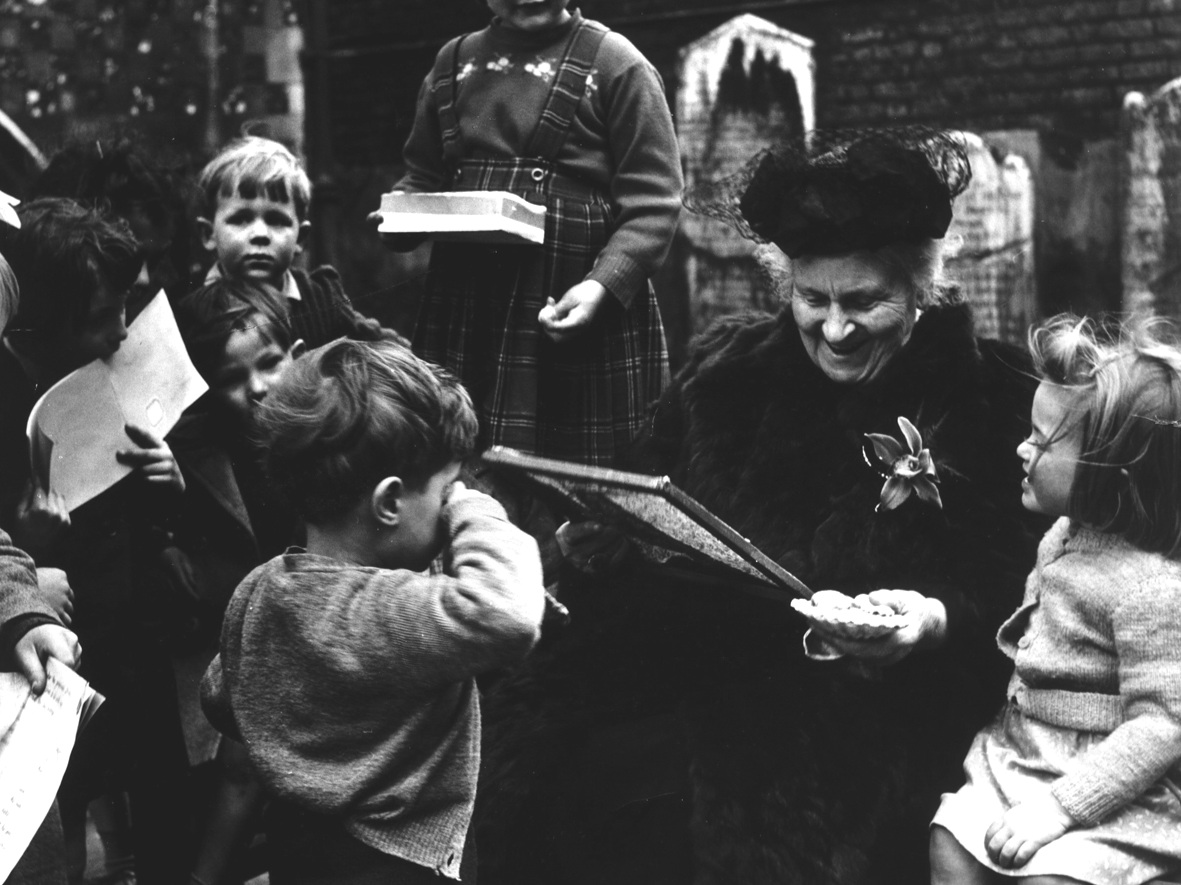
Maria Montessori was born on August 31, 1870.  She lived with her family in Chiaravalle, Italy, though they eventually moved to Rome.  An excellent student, she decided upon graduation to apply to the University of Rome to study medicine.  Just as in her younger years, Montessori was an outstanding student in medical school, even though she faced plenty of discrimination as a woman.  Her chosen career was nearly unheard of for women at the time, yet she continued undeterred.

Dr. Maria Montessori is often credited with being the first female physician in Italy.  There were actually other women that came before her (for example, Maria Dalle Donne was the first woman to receive a doctorate in medicine), but her achievement in this area was astounding nonetheless.  After graduating she began her work in pediatric psychiatry, which is where the first seeds of Montessori education were sown.

The children in her charge were cognitively impaired; no one expected them to engage in any sort of meaningful education.  During this time she became an advocate for children with disabilities, and began to develop many of the materials that would later become what we now know as Montessori materials.

In 1907 Dr. Montessori opened a child care center in a poor neighborhood in Rome.  She called it Casa Dei Bambini (Children’s House) and the first Montessori school was established.  The intention was for her to create a place to educate the children of poor, working parents.  She began to apply what she had learned previously in her pediatric psychiatry setting, as well as using the materials she had developed there.  

A highlight of Dr. Montessori’s work was her use of scientific observation.  A scientist first and educator later, she looked at child development through a different lens than had many others.  She noticed several surprising things:

  • The children were able to focus deeply on independent work that interested them.

  • The children were interested in practical life activities, such as preparing food and caring for their classroom environment.

  • The children learned (seemingly absorbing information) according to what was available in the environment.

  • The children responded positively to learning materials they could complete by themselves.

Casa dei Bambini was regarded as a huge success, and people began to take notice of Dr. Montessori’s ideas.  The approach began to spread, with several other schools opening in Italy, as well as a training center led by Dr. Montessori herself.  After publishing several papers, the international community began to take notice early in the twentieth century.

Schools began to open around the world, including in the United States.  Over time, her original focus on early childhood shifted to elementary and adolescence, leading her to develop her famous Planes of Development.

Montessori’s popularity in the United States waned after a period, but found a resurgence in the 1950s.  Today there are two main organizations that support Montessori education in the United States; AMI (Association Montessori International) was created by Dr. Montessori and her son Mario in order to standardize and preserve her methods, and AMS (American Montessori Society) which was created by Nancy McCormick Rambusch who is often credited with sparking the revival of Montessori in the US.  Both organizations are similar in many ways, with AMI adhering more closely to Dr. Montessori’s original ideas and AMS feeling that some changes are needed to fit with the nation’s culture.

Montessori education has become increasingly popular over the decades, with variations of its materials and implementation of its ideals found in even more conventional classrooms.

Still have questions?  Send them our way - we love to teach others about the history of this powerful method of teaching!

A Peek at the Montessori History Curriculum

IMG_4645.jpg

Montessori elementary classrooms certainly do lots of work with math and language, but they also rely heavily on what is often referred to as cultural studies.  These cultural studies include geography, science, and history, and today’s post will focus on the latter.

Think back to when you first learned anything about history.  Perhaps your earlier lessons were based on holidays we celebrate, or on the political history of the nation.  Later (in high school), you may have been introduced to more about the history of the world and expanded upon earlier learning.

The Montessori study of history is much like all its other subjects: we start with the largest, overarching concepts, then gradually zoom into the smaller details.  With that said, we officially begin teaching history in the first grade, and it all starts with the birth of our universe.

It starts with a bang

Imagine this: one sunny afternoon, very early in the school year, the children come in from recess.  The classroom is dark and soft music is playing.  Second and third year students immediately know there is an exciting surprise in store, and they do everything they can to contain themselves so as not to spoil the magic for the younger children.

The guide is at one end of the large rug, and in front of her lay a series of curious items.  The children sit facing her, with the youngest ones in the front so that they may have the best view.  The guide waits for the children to settle into silence, then begins her story.

She tells of a time when our darkest night would have seemed blindingly bright, and our coldest winter would have been warm in comparison.  She continues into tales of particles forming, connecting, and repelling away from one another.  She incorporates information about states of matter and weights of liquids, giving demonstrations as she speaks.  They talk about the vast quantity of stars in the universe, the incredible distances, and eventually, the formation of earth.  The children hear how the particles on earth heated up and cooled, how the water filled in the crevices, how storms raged and volcanoes exploded (they see a model revealed from beneath a black cloth!), and how eventually all was calm and our planet was ready to support life.

In addition to the scientific view of earth’s beginnings, the children may hear creation stories from cultures around the world in the weeks following.  The stories may be read to them, or they may read them or perhaps even act them out.  They will have a sense that there is always more than one version of history.

Impressionistic lessons

Following the creation story, there are several materials that give the students a deeper understanding of time.  

The Long Black Strip is just that: a strip of fabric that is nearly 100 feet long.  (Dr. Montessori’s original was much longer and had to be unrolled by teachers holding it on a dowel and riding bicycles!).  As the guide unrolls the strip she talks about the beginning of the earth, how the planet changed over time, the coming of the first single-celled organisms, early plants, the evolution of fish, reptiles, amphibians, birds, and mammals.  By the time she gets to the end of the fabric the children will notice a tiny strip of fabric at the end, just a fraction of an inch wide.  She tells them that this tiny strip represents the time humans have spent on earth.  This can be an amazing lesson, even for adults, when they see it for the first time. What a concept to grasp! 

The Clock of Eras gives the children their first look at how life began to evolve over the course of time.  Earth’s geologic time periods are represented as if all of our planet’s history were on a 12-hour clock.  The circle chart shows representations of the various eras via colored pie slices.  Check out this fun stop motion video made by some Montessori students:

Time through an evolutionary lens

The Montessori guide may introduce various timelines in the classroom to spark curiosity among the children.  Through a series of discussions, research, reading, and other activities, children learn about the evolution of life on earth.  This history work connects directly to a large portion of the lower elementary science curriculum, which is based in botany and zoology.  

These lessons, oftentimes stemming from a material called the Timeline of Life, give children a deep understanding of the connection between our physical world, the living things on it, and how species have changed throughout history.  

Human history

As you may have noticed, human history is not the focus in the Montessori curriculum.  It is important however, and an emphasis is placed on how humans have changed over time and to the various contributions different groups of people have made.

Much like the Timeline of Life, many Montessori classrooms use a timeline of early humans.  There are also several other areas of human historical study that are covered, oftentimes connecting children to other areas of study in the classroom:

  • The history of writing

  • The history of mathematics

  • How different civilizations have met the fundamental needs of humans

As a final note, you may be wondering why Montessori schools begin teaching such deep concepts at such a young age.  Our reasoning lies in the readiness of the children and a deep respect for the elementary child’s capacity to grasp larger concepts.  Our methods rely less on what has been traditionally taught to children in schools (as well as the traditional timing), and more on what is developmentally appropriate and engaging to children.  We know that elementary aged children, even those as young as 6, are incredibly eager to learn about the world and their place in it.  By giving them a larger historical framework in which they can place the immense amount of historical, geographic, and scientific information they acquire, we are providing them with a better understanding of themselves and the world (and universe!) around them.  

Curious about our methods?  Want to learn more?  Please contact us with questions or to schedule a visit today.

Montessori Basics: Respecting the Child as an Autonomous Person

FAQmontessori2.jpeg

The title of this post may seem a little unnecessary.  You may be thinking, “Of course the child is an autonomous person, and of course we respect that!”  If you are here reading this, chances are you care deeply about your child’s education, and more importantly, you care about your child as a person.  When it comes to parenting, however, our inclinations are often to protect and guide.  There is nothing inherently wrong with this (in fact, we can all agree those are our critical tasks), but our good intentions can sometimes get in the way of our child’s individual path.

You’ve probably heard Montessori guides talk about how we “follow the child”.  What this means is that we suspend our own assumptions about how things ought to be done and instead observe the child to see what they actually need and/or want.  Sometimes we forget that children are capable of doing more than we realize, or that they have interests that are vastly different than our own.

We want to show our children that we trust them.  We trust them to learn, to do things for themselves and for others, and we trust that they know what they need.  

What does this look like in the classroom?

As a teacher, especially if one is trained in traditional methods prior to discovering Montessori, there is a sense that we are obligated to engage with the child at all times.  Our society leads us to believe that stepping back and allowing the child to work without us must mean that we are not doing our jobs.

Dr. Montessori, however, had other ideas.  She said, “The greatest sign of success for a teacher is to be able to say, ‘The children are now working as if I did not exist.’”

We want to guide the children in such a way that they are eventually able to direct their own learning.  Our job is to present new material in a way that drives curiosity rather than conveying ready-made answers.  We want to create a classroom environment that supports each child in every stage of development to do as much for themselves as they are capable of doing.

When a child doesn’t need us?  We consider that a win.  Of course, as they grow they will need help in other ways, but the long-term goal is to gently help them reach their potential as they work toward adulthood.  We want them to trust themselves and their abilities, so we show them that we trust them.

Some examples of what you may see in a Montessori classroom that honors a child’s independence:

  • Open shelves at an appropriate height for the children using them.

  • Real (not toy), child-sized cleaning supplies like dustpans, brushes, sponges, buckets, and mops.

  • Clearly defined spaces to store personal belongings on hooks and shelves that the child can easily access.

  • Freedom to use the restroom whenever the need arises, without having to ask permission.

  • Snacks and water available to serve oneself whenever the child feels hungry.

  • Freedom to choose work that feels important and meaningful.

  • Freedom of movement; children may sit wherever and with whomever they like.

  • Work occurring at an individual pace. Children are not expected to all learn the same thing at the same time, but rather progress through skills at a pace that is right for them as individuals.

  • Children using materials that are not typically seen in other settings: glass cups and containers, knives for cutting, and so forth.

What might this look like for families?

Some moments to consider: 

  • Let your child (even your toddler) choose their own clothing. Perhaps you wouldn’t pick the cow-print pants and the polka-dotted dress, but does that make the choice any less valid? Relish in their delightfully unique sense of style! It’s okay to set some parameters; for example require pants instead of shorts on a cold winter day is perfectly reasonable.

  • Show your child how to do something rather than just demanding it be done. Remember, even if you have shown something once (or even five times), learning requires repetition. For example, instead of telling your 6-year-old to make their bed, give them a short lesson on how to do so.

  • Consider your child’s physical autonomy. Don’t force them to hug and kiss relatives if they are uncomfortable. Talk to them about how we are all in charge of our own bodies, and that they have the right to say no (even to you!) if they do not want physical affection.

  • Make sure your child has access to toys and supplies around the house. This might mean having a low shelf in the kitchen stocked with their own bowls, cups, utensils, and even snacks. A designated area in the refrigerator could hold a small pitcher of water, milk, or juice for the child to pour independently. A small dustpan and a basket of rags should be accessible to allow them the ability to clean up their own messes. You will be surprised at how often your child will be motivated to take care of themselves rather than asking you to get or do things for them.

  • Create routines. If your child knows that in the morning they are to use the toilet, wash their hands, brush their teeth and hair, and get dressed, then they know what to expect every single day. Support them with reminders as long as they need it. Some families find a visual reminder helpful - a small note can have a list with words or pictures to keep the child on track.

  • When the urge to intervene strikes, remind yourself to pause and observe. When we see our child struggle it’s natural to want to help, but jumping in and fixing their problems all the time does little to convey that we trust they can do it for themselves. If you see their frustration building, try saying, “I’ll be over here if you need anything.” They will ask if they really need you.

Questions?  Interested in seeing one of our classrooms in person?  Contact us today.  We would be happy to help!