Work or Play? A Peek Inside the Montessori Classroom

20141120-0130 copy.jpg

You know Montessori classrooms are different than most.  You’ve heard the rumors: children run around doing whatever they please.  It’s all play and no work.  Or perhaps you’ve heard the opposite: our structures are so rigid we stifle creativity and natural childhood behavior.

What’s it really like?

We can practically guarantee that once you step inside a classroom for yourself, sit quietly in a corner, and observe the children and adults at work, your impressions will be transformed.  We encourage parents to do so whenever possible; the children are used to visitors and we have tips on how your presence can be unobtrusive to them but informative for you.  We hope you’ll schedule a visit soon if you’ve never been, or even if it’s just been a while.

In the meantime, this post will give you some idea of what you might see in a typical, high fidelity Montessori classroom.

Arrival

From the moment they step in the door, expectations are different for Montessori children, even as young as our toddlers.  Children are responsible for hanging their own bags and coats on hooks.  They learn to change their own shoes, with most classrooms requiring that children wear either slippers or a special pair of shoes designated for indoor school use only.  This is done in part to keep our classrooms clean, but also to give children a sense that their classroom feels more comfortable and home-like.

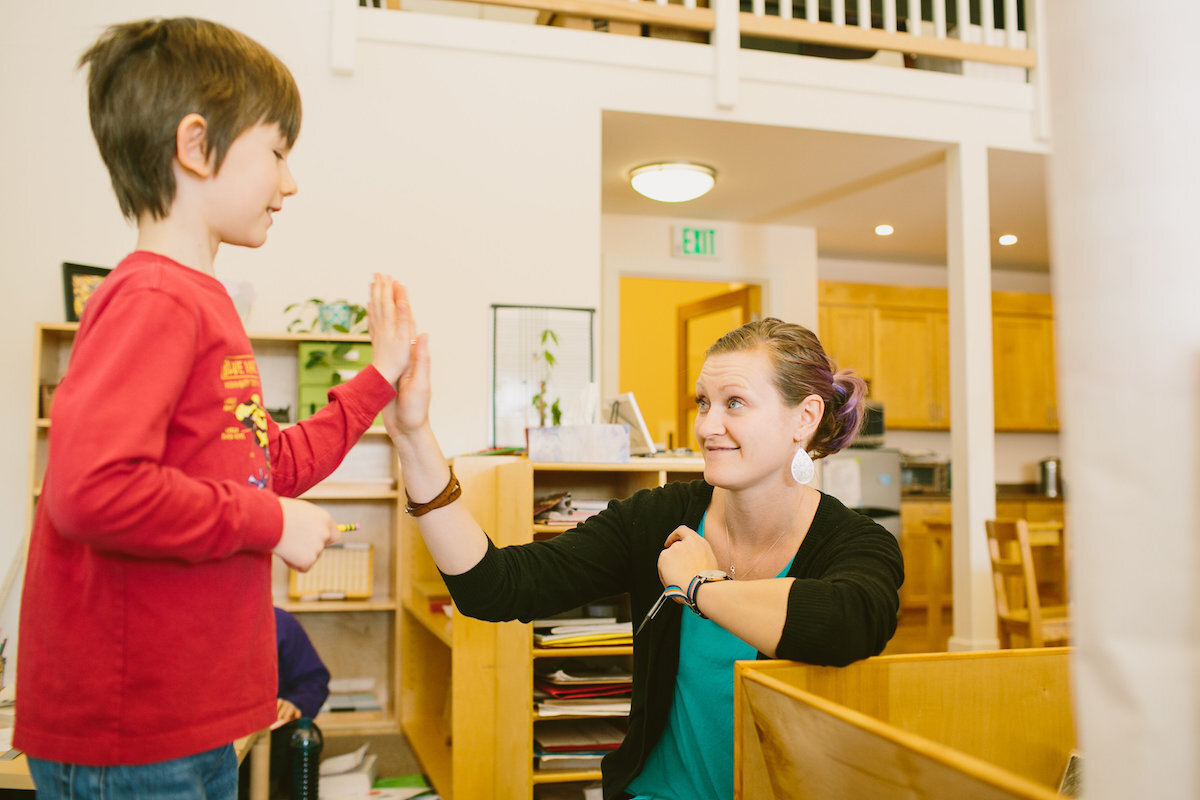
Guides greet students upon their arrival.  They often make a point of shaking a child’s hand, looking them in the eye, and saying their name along with a friendly hello.  By doing this, we are intentionally modeling polite human interactions.  Before long, the children learn how to greet us back, and they are even able to apply this skill outside of school.

The Work Period

Also called the morning work cycle, this period of time is a hallmark of the Montessori approach.  We believe that children need a longer stretch of time to involve themselves deeply in independent work, so we honor this need by providing an uninterrupted block of time each morning.

How much time?  That depends on the age of the child.  Typically, for children ages 3 and up, the work period is three hours long.  It’s not quite so long for younger children, and older children may have a second work period in the afternoon.  

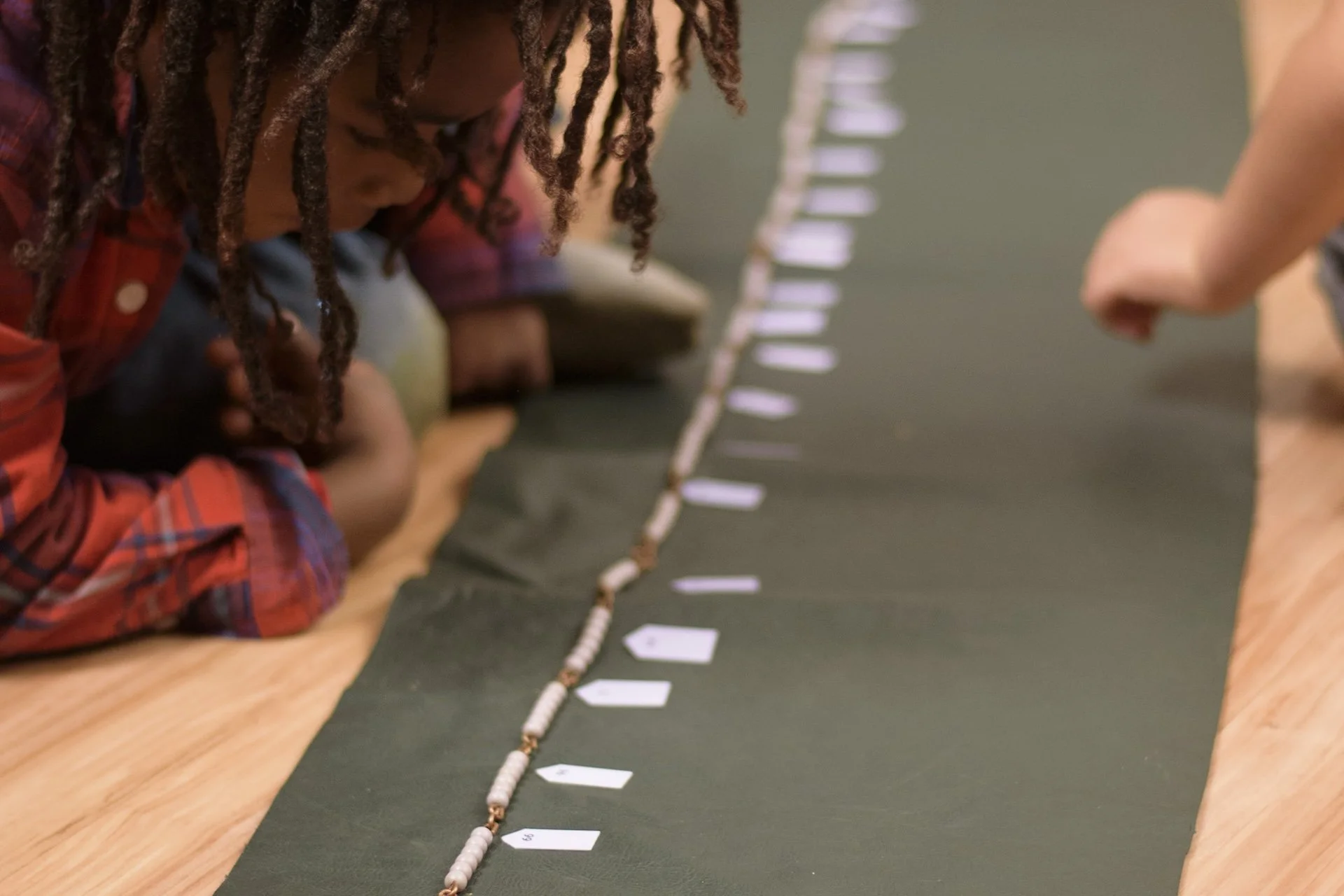
During this time children work independently while guides give small group or independent lessons.  Sometimes it may appear that a child is playing, and while that is true, certain types of play are critical to learning.  It is also important to note that Dr. Montessori developed her educational materials to appeal to children, so what may look like a simple puzzle could actually be a manipulative biology diagram.  What looks like pretty colored beads are, in fact, tools for exploring complex mathematical concepts.

Montessori children are able to make a lot of choices during this time.  We allow freedom of movement: that is, they may sit where they like, stand and walk around the room if their bodies require a break, and use the restroom safely without needing an adult’s permission.  We provide a range of seating options as well.  Some children prefer to work alone or with others, some like to sit at a table or on the floor.  Adults appreciate having choices while they work, and we believe children should be afforded the same respect.

What types of work might you see?  You may be surprised to see even very young children working on the following subjects:

  • Math

  • Language

  • Biology

  • Geography

  • Practical life skills

  • Sensory refinement (up to age 6)

  • Geometry

Socializing

Montessori education takes the perspective that we must nurture the whole child.  This is a popular concept with parents and teachers across a wide variety of settings, but Montessori schools have structures built into their programs that allow for deeper exploration and support of the social self.

The aspects of choice are one way we support children’s social development.  Rather than assigning seats or requiring children to work alone or in pairings that are predetermined by adults, we generally let children choose if they would rather work independently or cooperatively, and with whom they would like to work.  That being said, in any group of people, some personalities work well together, while others do not; we help guide children to differentiate between what makes a positive complementary work partner for them, and what constitutes a fun (and perhaps silly) friendship that can be developed outside the work period.

As children grow older, they begin to place a stronger emphasis on friendships.  The process of figuring out what healthy friendships should look and feel like is a major work of children in the elementary years.  Attachments form, and children come to rely on the company of one another.  Of course, another reality of these years is that all children will face social conflict at some point or another.  

One benefit of a Montessori environment is that the guides are able to set aside time and space to help children navigate conflict.  We teach mediation strategies, inclusivity, and conflict resolution.  We are able to assist children both proactively and reactively.  We often use stories to teach children important lessons about social skills.  Role play is another tool used in classrooms when negative patterns begin to form; when children are able to have fun and remove themselves personally from an experience, they can learn positive approaches to resolving common dilemmas. 

The Guide’s Role

Another often surprising element of the Montessori classroom is the role our guides take.  To begin with, they are typically referred to as guides, rather than teachers, as we believe the name is a far better descriptor of the task.  Instead of feeding children a stream of information we expect them to internalize, we lay a path before them, open the door, and give them the tools to explore and learn.

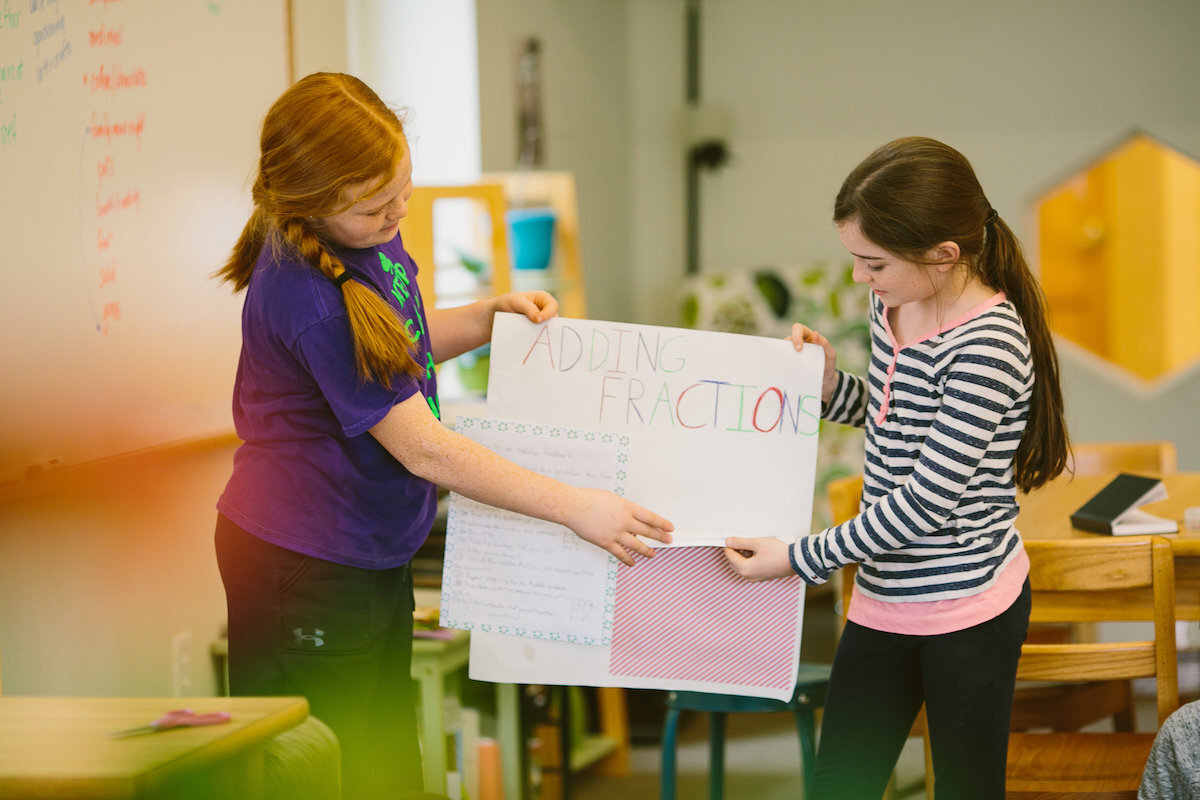
In the primary years (ages 3-6), lessons are usually given individually.  This allows the guide to give their full attention to the child before them, and to honor their individual needs.  In the elementary years, lessons are typically given to small groups of children, honoring their developmental desire to work alongside their peers.

Another delicate task of the Montessori guide is to know when to step in and assist a child, and when to stand back and allow them to find a solution themselves.  Generally speaking, we tend to take the latter approach.  We believe that children are capable of much more than we often give them credit for, and given the opportunity, they will rise to the occasion.  This approach helps build resilience and confidence.

Lastly, the guide’s job is to observe.  We watch the children in our care to learn which skills they have mastered, which they are progressing in, and which they may require additional support with.  Though we may not always intervene, we notice what they are doing, both academically and socially.  We take copious notes to inform our practice, record their progress, and to share our findings with parents.

Montessori guides don’t consider themselves the center of the classroom.  We are merely there to support the learning of the children.

Still curious?  Good!  Call us today to schedule a time to observe.  See a Montessori classroom in action for yourself.  We know it will be an amazing experience.  

Montessori Basics: The Language Curriculum

Moveable-Alphabet.jpg

Have you ever wondered how Montessori guides teach children about language?  Parents are often astounded when they observe children learning to read at a young age in our schools.  What’s the secret?

There’s no secret - we’re happy to share our methods!  Read on to learn more about our approach, how we align our teaching with a child’s natural development, and what the progression looks like as children get older.

Early Language Activities

Children’s language development begins long before they enter the classroom.  Dr. Montessori asserted that children from birth to age 6 were in the age of the absorbent mind.  During this time they are able to learn language simply by living around others who are using language.  Montessori classrooms incorporate both spoken and written language into the environment to further enrich this early learning.

In our primary classrooms we teach children songs and poems so that they may hear and experience language in a fun and playful way that appeals to them.  We encourage parents to do the same!  Share poems from your childhood with your children and discover new ones together.  Sing your favorite songs from when you were little, or enjoy kid-friendly tunes from musicians such as Raffi or Tom Chapin.

Montessori guides introduce children to as much vocabulary as possible in their early years.  This may start with naming objects around the classroom, but will also expand toward specialized nomenclature.  Children learn the names of the continents, plant and animal names, and specific terms that apply to areas of interest.  These vocabulary words are spoken and shown in written form. 

Writing

As you may have guessed, writing starts earlier in Montessori classrooms than in many other settings.  Consider the goal of writing: to visually communicate one’s ideas with others using standardized symbols.  This is actually separate from the ability to hold a pencil and form strings of letters, words, and sentences on a piece of paper.

Once a child has a basic understanding of most of the letter sounds, they begin to use a material called the moveable alphabet.  Exactly what it sounds like, the moveable alphabet is a box containing sorted wooden letters.  Children lay the letters out to write words, and eventually sentences.  At this stage we do not expect children to conform to conventional spelling, but rather we allow what is often referred to as inventive spelling.  “I love my mom” may look like “I luv mi mom”.

Montessori classrooms use many materials to help children strengthen their finger muscles in preparation for the physical act of handwriting beginning at age 3, or arguably even earlier.  Our experience has taught us that children are ready to express themselves in writing before they are ready to start writing in the traditional sense.  That pencil-to-paper writing usually starts in kindergarten, though it varies with individual children.

Reading

One beautiful material that you have likely seen is called the sandpaper letters.  The letters are used to teach both reading and writing.  

It’s important to note that when Montessori guides begin teaching children about letters, our focus is on the sounds the letters make and not so much their names.  This means we do not teach the alphabet song, because knowing the names of letters isn’t really helpful in learning how to read.  That’s not to say there is no value in such learning; it will certainly come in handy when learning to alphabetize, or when talking about letters when they are a bit older.  We just want parents to know that if you want to continue the work we do in our classrooms, consider using a letter’s most commonly used sound when referring to it.  

An example: when a Montessori child learns to spell cat, they will say, “k-ah-t” rather than “see-ay-tee”.

Object boxes are used to help children learn to read as well.  A box labeled with the letter p may contain tiny toy versions of a pig, pot, pin, etc.  Eventually, children are able to match the objects with label cards.

Much of our reading work is done while teaching children other subjects.  For example, if they are learning about mammals, they will read lots of text at their level about mammals.  

There are also special series of books used by many Montessorians, including Miss Rhonda’s Readers (created by a Montessori guide) and Bob Books.  Guides typically prefer that families not use these same books at home.  Young children are often able to memorize text, and if they have been exposed to the same books at home and school, it can be difficult for guides to have an accurate observation of the child’s true decoding skills.  Check with your child’s guide if you’re curious or would like some advice on what books to read at home.

Card materials are also used as children progress, allowing guides to help children isolate specific sounds and blends.  One series of cards/lessons may focus on the various ways to make a long a sound.  One color of cards displays words containing ai, another will contain ay, and yet another will teach children about words with the silent e.

Word Study

This area of study includes a wide variety of skills and begins once a child has begun to read; some of the earlier lessons are given during the final (kindergarten) year of primary, but many are given during the first two years of lower elementary.  The guide will give the child a lesson teaching the skill.  In the days and weeks following, children practice the skill independently using special card materials.  The skills include:

  • Classification

  • Alphabetizing

  • Compound words

  • Synonyms

  • Antonyms

  • Prefixes

  • Suffixes

Grammar

Grammar is taught early and in what we call a spiraling curriculum; that is, we circle back on the same content as the child gets older, building on previous knowledge and giving more depth to their understanding.  Parts of speech are taught in a very specific order, and each one has a corresponding symbol that children use in many activities.

Beginning in the final year of primary, children typically learn about nouns, articles, and verbs, as well as their corresponding symbols.  This helps them to understand the core parts of our sentences and gives them an introduction to grammar in a way that appeals to them. 

Sometime during that final year in primary or the first year of lower elementary, children are introduced to grammar through what we call the function of words.  Traditionally, a model of a farm, complete with animals, is used to guide children through the process.  Again, they begin by learning that nouns are naming words, and they name each animal and feature of the farm.  They then go on to learn the corresponding articles, followed by all other parts of speech, including adjectives, verbs, adverbs, pronouns, conjunctions, prepositions, and interjections.

Once a child has learned the functions of words, they will move on to the Montessori grammar command cards.  Knowing that children learn by doing, these cards give children specific directions to physically follow so that they may experience the words for themselves.  

Another classic Montessori activity involves the use of colored wooden grammar boxes.  Children use cards to recreate sentences, word by word, and sort the words by various parts of speech.

There are many extensions to grammar work that Montessori children enjoy.  Some will write their own sentences and use colored pencils to label each word with its corresponding grammar symbol.  Others enjoy using grammar strips: a material that shows a series of grammar symbols which students must use a guide to write a sentence with that particular pattern.

Sentence Analysis

Going beyond grammar, elementary-aged children learn to analyze sentences.  This begins simply with subjects, verbs, direct, and indirect objects.  As children get older and have a better grasp on language, the work extends considerably.

Children in upper elementary classes learn about complex sentence structures.  This includes structures like predicate adjectives and nominatives, attributive adjectives, various types of phrases and clauses, and many more.

For seasoned Montessori parents: did you learn anything new from this article?  New families: what do you find the most interesting, or what do you still have questions about?  As always, we believe in the power of observation, and we invite you all to schedule a time to sit and observe in one of our classrooms.

Happy New Year!

newyear.jpg

New Year’s Eve can be a really fun night for adults and kids alike.  There’s something special about a fresh start and finding ways to celebrate as a family has the potential to establish traditions and make memories.

Whether you already have plans or not, read on for some fun facts and ideas!

Go out or stay in?

One time-honored way to celebrate the new year is to hire a babysitter and head off to a party.  This can be a fun way for busy parents to reconnect with a partner, catch up with friends, and have a little fun.

If you plan to spend the night with your kids, you still have options: stay home for a night of celebrating or attend local festivities.  Many cities and towns have their own first night celebrations - if you have never been, you are in for a treat!  Activities and sights might include live music, ice sculptures, street performers, face painters, and of course, plenty of tasty food.  Some events even include a fireworks display.  One benefit of taking your younger children to a first night event is that they can participate in the festivities, and still get home for a reasonable bedtime.  

One last (really great) option is to stay home for the night and celebrate.  This is a great idea for all ages; little ones get the rest they need, older kids can invite friends over to join in the fun, and there’s a whole lot less pressure on the adults.  Add in a few games and snacks, and maybe watch the ball drop on the TV, and the night will surely be a success.  We share more fun ideas toward the end of this post.

Traditions around the world

People across the globe celebrate the new year in a variety of fascinating ways.  Here are just some of the many traditions:

  • In some parts of Brazil, it’s customary to head to the beach and jump over seven waves for good luck in the coming year.

  • Buddhist temples in Japan ring their bells to celebrate. The interesting part is they ring them 108 times, to symbolize the number of human desires - which lead to human suffering - in order to alleviate some of that suffering. Eating soba noodles is another tasty tradition!

  • One of the more famous international traditions takes place in Spain, where twelve grapes are eaten during the twelve strokes of the clock at midnight. The catch is you must finish them all before the clock finishes chiming for good luck during each month of the coming year.

  • The Dutch eat a donut-like dessert called olie bollen. Its ring shape is meant to symbolize coming full circle.

  • Many places, like the United States and France, look to champagne as their drink of choice on New Year’s Eve. People in parts of the United Kingdom enjoy Wassail (a type of hot mulled cider) instead. Russians like champagne, but they write a wish on a piece of paper, burn it, and toss it into a glass of bubbly that they must then drink.

  • In Greece, a special sweet bread is made to be eaten at midnight. A single coin is baked within, and the person who gets the piece with the coin is considered lucky. Greeks also hand an onion from the doors and wake their children in the morning by tapping them with it!

  • In the Philippines, circles are important and lucky; people eat plenty of round fruits for New Year’s to bring prosperity.

  • In Denmark, people save up all their old and chipped plates and dishes to throw at each other’s front doors on New Year’s Eve. The more shards on your doorstep in the morning, the better. In South Africa they throw old appliances out the window.

  • Red is a lucky color in Chinese culture, and many families make sure their front door is painted red for the new year.

  • The Swiss drop dollops of whipped cream on the floor - intentionally - to wish richness into the new year.

  • In Estonia, eating is serious business when ringing in the new year. Seven, nine, and twelve are all lucky numbers, and you must choose one of the numbers and eat that many times.

  • In Finland, tin is melted and dropped into water. The shapes the hardened tin create are meant to represent what the new year will bring.

  • The Scottish call their celebration Hogmanay, which involves swinging balls of fire, enthusiastic parades, and a special tradition regarding whoever steps first over the threshold of a home in the new year.

Fun family ideas

So you’ve decided to stay in and have fun together as a family?  Looking for ideas that will help make memories?  Look no further…

Food!

Eating tasty snacks is half the fun when it comes to celebrating.  Here are a few ideas to help break away from your typical nightly routine.

  • Appetizers for dinner - brainstorm everyone’s favorite snacks, make up a bunch of plates, and leave them out to munch on throughout the evening. Think cheese and crackers, veggies and hummus, cut fruit, chips and dip, or perhaps something a little more fancy.

  • Cook a fancy meal together. Flip through your cookbooks and choose something that sounds good to everyone. Even the youngest children will have fun mixing and measuring. Set the table, light some candles, and feast in great company.

  • Mix up some mocktails. A little juice plus a bit of seltzer, with a few pomegranate seeds tossed in, and you have something special.

Fun!

Pass the hours away enjoying each other’s company and having a few laughs.

  • Break out the board games. With the whole night ahead of you, what’s the rush? Whether it’s CandyLand or Monopoly, or a silly made-up card game, your children will remember this quality time spent together.

  • Have a movie marathon. Rewatch your favorites or try something new. Even better? Share one of your childhood favorites with your kids.

  • Make New Year’s Eve crowns, using whatever you have on hand. It can be as simple as cut paper and markers, or you can add stickers, glitter, or whatever else you and your children come up with.

  • Plan out some family fun for the coming year. Set goals, dream about vacations, or figure out what projects you want to do together around the house.

Countdown!

If you plan on staying up until midnight, figure out a fun way to ring in the new year.  Countdown from ten together, add in some noisemakers, and shout out Happy New Year!

May 2020 be a great year for us all.  

7 Little Ways to Create a Montessori Home Environment

home.jpg

Many families of young children are turning to Montessori methods when it comes to parenting.  After all, it’s one approach that honors the child as an autonomous being and gives them the respect they are due.  But how can we make space for our children in our homes without the place becoming one giant toy bin?  This list of seven helpful tips will get you started on the right track.

1. Have a kid-friendly shelf or cabinet in the kitchen.

This is one of the simplest ways to encourage your child to be independent and show that you trust them.  Starting when your children are toddlers and continuing until they are able to reach and use everything the adults do, set aside a small cabinet or drawer in your kitchen just for them.  This is where you will keep child sized plates, bowls, cups, silverware, and perhaps even a few cloth napkins.  This will allow your child to get what they need whenever they need it; you won’t need to stop what you are doing to help them, and they can feel good about doing something for themselves.

Want to take it a step further?  Keep pre portioned snacks in the cabinet for your child to access whenever they want.  Some families also designate an area of the refrigerator for this purpose, along with a small pitcher containing water or milk that little hands can easily pour themselves.

2. Consider a few minor additions to your entryway.

Getting out the door in the morning can be one of the most rushed and sometimes stressful times of day for families of young children.  A few quick additions to your entryway can help make everything run a bit more smoothly.

Consider your child’s height and hang one or two hooks near the door just for them.  Keep a small box or bin that they can toss their shoes into, thus keeping them contained, tidy, and easy to find when they need them.  We have even seen some families hang a small mirror at child height in the same area.  Taking these steps will help build responsibility, keep your home organized, and ease the frantic pace of many of our mornings.

3. Put most of the toys away.

This recent study covers the scientific reasoning behind why less is more.  That said, it isn’t easy.  Even if you are mindful of not buying your child too many toys (a feat in itself), there are always gifts from family members, party favors, and so many unpredictable little treasures that kids collect.

How can we manage all that stuff?

When your child is at an age where they can comprehend the ideas, it’s good to talk to them about waste and consumption, then ask for their help in working to manage it all.  Until then, observe your child at play, determine what they actually use or enjoy, then rotate toys according to what you notice.  Avoid the bottomless toy box and opt instead for using low shelves as storage.  Items are easier to see and manage that way.

4. Keep baskets of books handy.

Reading is great for children in so many ways, so keeping books handy wherever you are is important.  It can even be fun to make your selections.  Some ideas:

  • Keep a basket of seasonal books in the corner of your living room.

  • Stack your potty training books in the bathroom.

  • Your child loves dinosaurs? Check some dino books out from the library and keep them in a bag in the car so they’re always on hand (for trips, waiting rooms, an older sibling's soccer game…)

  • Basically, anywhere your child spends time and there isn’t a bookshelf nearby, collect up a few books and tuck them within reach.

5. Build independence into children’s bedrooms.

One of the earliest ways to build independence into your child’s bedrooms is with your choice of bed when they are infants.  Many Montessori families choose to use a floor bed.  If the rest of the child’s room is safe, this allows them freedom of movement when they wake.  Many babies and toddlers will wake up and crawl/walk around the room, keeping themselves occupied with their toys until their parents wake up and come to get them.  The floor bed can be implemented whenever the parents feel comfortable giving it a try.  If your little one starts crawling out of the crib but isn’t quite ready for the height of a toddler or regular bed, a simple solution is to just lay the mattress on the floor until they are ready for the next stage.

Another area to keep in mind: your child’s access to their clothing.  Older toddlers and preschool aged children can begin selecting their own clothes.  By making a limited number of choices available to them, you can ensure they will wear something appropriate for the weather while still giving them the empowering ability to decide for themselves.

6. Keep color schemes and decor simple and natural.

Depending on our own childhoods and other factors, sometimes we feel like we need to decorate children’s spaces in bright colors.  The truth is, we all function better in calming environments.  There’s no need to spend lots of money to replace what you already have, but consider the following swaps:

  • Paint over bright walls with a more neutral color.

  • Opt for wood, glass, metal, and natural fibers over plastics.

  • Framed art (inexpensive prints or thrift store finds) or photos can replace cartoon posters.

7. Make space for your children.

It all really comes down to shifting our perspective.  Our children are human beings who are worthy of living in a home that serves them and their needs.  The key is balance.  Should our children’s things take over the entire house?  Definitely not!  (You live there, too, after all.)  Small adjustments in each room children spend time can make a huge difference in their lives.  

Do you already implement some of these ideas in your home?  How has it worked out for your family?  Do you have other suggestions to share with families who are looking to make their home more Montessori friendly?

It’s Okay to Set Limits

limits.jpeg

As parents today we are bombarded with advice, ideas, suggestions, and rules on how to be the best parents we can be for our children.  Some change is good; emerging research tells us more and more about human development and how our brains work, and making progress as a society is always a good thing.  Still, it can be hard to weed through the good ideas and those with good intentions that don’t really serve us or our children.

Giving children choice is important.  Respecting children as autonomous human beings is important.  We should recognize that even though they are young, their lives are not ours to live.  Their dreams are not ours to fulfill.

So, we give our kids choice.  We let them make their own decisions.  We honor their growing independence and understand that their ideas may sometimes (often) conflict with our own.  And we try to be okay with that.

But should we let our children do whatever they want all the time?  We would argue that no, that is a very different scenario.  Giving choice is one thing, neglecting to set any boundaries is something altogether different.

What do children need?

In order for a child to strengthen their sense of independence they need to be able to make their own decisions, but they need to make these within a framework that feels safe.  As kids learn and grow, they need to be able to take risks and make mistakes; after all, making mistakes is one way we learn.  It is critical, however, that we keep give our children boundaries within which they are able to make choices.

As children grow and develop, it is critical that they form bonds with adults in their lives that are trusting and secure.  Our kids really do test us sometimes; they push against the rules we set because they are seeking a sense of how strong our limits are and whether or not we mean what we say.  Giving guidance and setting boundaries isn’t just okay, it’s critical to letting our children know we are here for them and care about their well being.

In short: kids need choice.  They also need those choices to fall within limits that keep them safe, both physically and emotionally.  When they’re younger, they need fewer choices and more limits.  As they grow, we increase the choice and decrease the limits.  This way, once they are fully mature adults, they have had plenty of time to practice making decisions prior to any expectation that they actually do so successfully on their own.  Isn’t that what childhood is all about?  Human children are able to experience a joyful period of time in which we get to practice becoming a responsible adult.

What does this look like in our classrooms?

Montessori classrooms are carefully prepared environments with built-in choices and limits.  Some examples of how we achieve this balance:

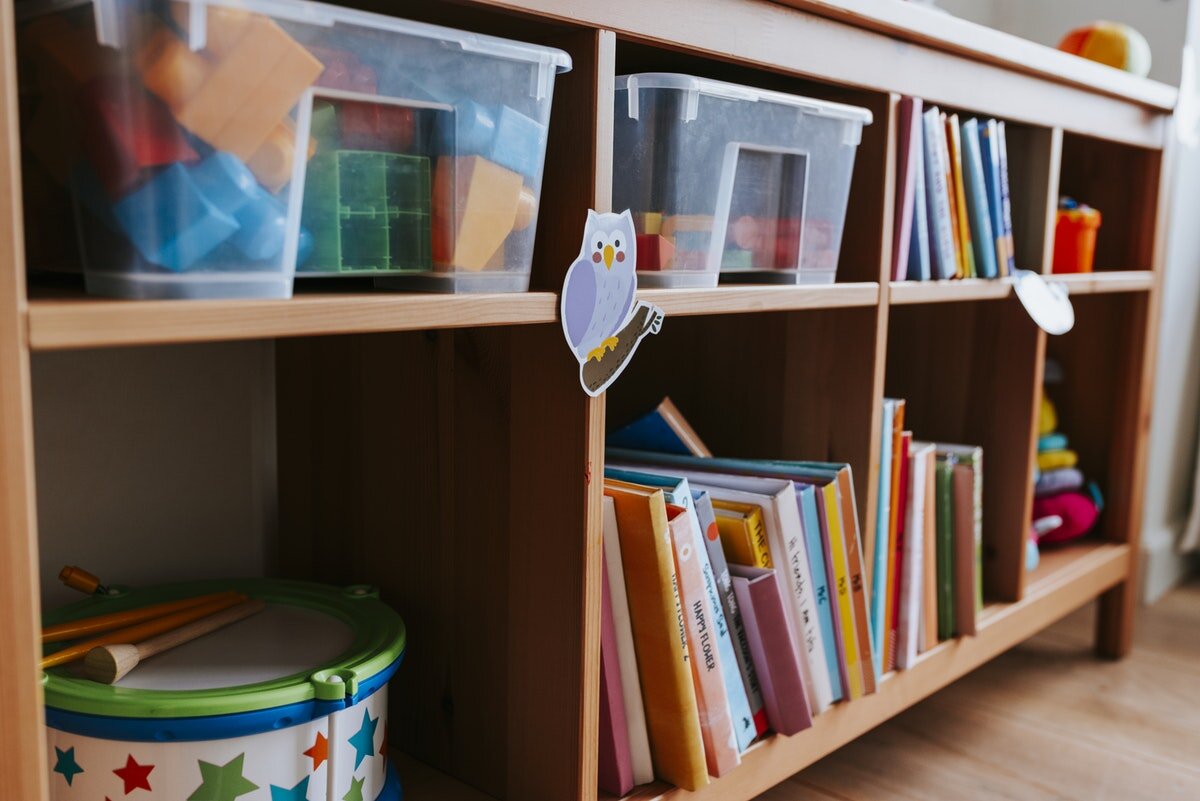
  • Furniture is arranged so that children are free to move around, but most classrooms are devoid of large open areas that might encourage running in such a confined space. Those shelves are placed with intention!

  • Materials on the shelves are rotated frequently. Children may only access what is available to them. Materials that we do not want the children to have access to are kept stored away in a cabinet or closet.

  • The snack table might be just large enough for two chairs. We want children to eat and socialize when they choose, but we also know that if there is space for ten children to do so at once, the activity may become disruptive and lose its original intent.

  • Older children may utilize work plans. This enables them to determine the pace, order, and details of their work, but requires them to be accountable for completing all desired tasks within a specified amount of time. For example, a child may be asked to complete a range of math, reading, and biology work within a given timeframe, but there is plenty of choice in how they accomplish the goal.

  • Children in Montessori classrooms do not typically have to ask permission to use the restroom. Instead, we create structures so that they may do so safely whenever the need arises. Some schools have restrooms located within the classroom, others have hall passes available, or hold class meetings to discuss procedures with the children.

What might this look like in our homes?

If your family is new to Montessori, it can sometimes take a bit of time to shift ideas and expectations.  Once you do, however, it’s hard to imagine doing things any other way.  Some ideas to get you started:

  • Allow your children to make decisions about what they wear. For older babies and toddlers, this may be as simple as allowing them to choose between two different color shirts. For older children, you may just set guidelines, such as their clothing must be appropriate for the weather.

  • If you need your child to get a few things done, let them choose the order. For example, ask them if they would rather take a bath or make their lunch first. Be clear that your expectation is that they will do both, but that you value their opinion and want to let them help decide how to spend their time.

  • Define boundaries when your child is struggling with emotions. It’s great to let your child feel whatever they are feeling, but that doesn’t mean they should mistreat those around them when they are frustrated or angry. “I see that you are frustrated. It’s normal to feel that way but you may not scream in our house. Here are some other ways to express that feeling…”

  • Have frank and open discussions with your older children. Have you been feeling like they’re overdoing it with video games or staying out too late? Tell them what your concerns are, what your limits are, and solicit their ideas with solutions. Rather than implementing sudden new rules, engage your older children in problem solving talks until you come to a conclusion you can both live with.

We hope this post has been helpful and inspiring.  In a world of permissive parenting and misunderstandings about what Montessori really means, it can be easy to get caught up in giving in to our children’s every desire.  The good news is, you don’t have to.  Our children look to us to be the adults in their lives.  Each and every child deserves adults who love and respect them for who they are.

Why Montessori?

whymontessori2.jpeg

How does a parent prepare their child for an unpredictable future?  Don’t we all just want to give them every possible advantage?

How do we define success in our children’s lives?  Is it about being able to provide for oneself or is it finding joy in the work we do?  Is it about contributing to our communities or perhaps continuing to learn throughout our lives?  Couldn’t it (shouldn’t it) be a little bit of all of those things?

Goals

We think Montessori is one beautiful way to work toward all of these goals, and we are prepared to make some bold statements:

  • Montessori gives children a strong understanding of basic math and language skills, starting earlier than most methods and using materials that support their development and methods that correlate with current research findings.

  • Building a sense of independence and confidence is a major component of what we do. We know that children of all ages are fully capable of doing more for themselves than they are often given credit for. We have learned to sit back, observe, and assist only when necessary. This allows children to grow in incredible ways, amazing their parents (and frankly, us, too!).

  • Respect for and connection to the earth is built directly into our curriculum, especially in the elementary grades. We know that around age 6, children start to think about where they fit into the bigger picture. We teach them about the universe, our solar system, the beauty of our planet, and the variety of life on it, just at a time when they are seeking those answers.

  • Choice and freedom are important for all human beings. We give both to children because we believe they are capable of knowing what they need and want, and the more practice they have the better they will get at making decisions when we are not there to support them.

  • We value teaching responsibility and time management skills. This goes hand in hand with focus and attentiveness. The ability to make choices about one’s learning must be balanced with accountability; as the children in our classrooms get older, they know there are certain expectations. For example, they may be able to choose the order of their work, but they know that they have to do grammar at some point during a specific time period, even if it’s not their favorite subject.

  • Rather than drilling arbitrary facts into children and forcing them to memorize information that may not serve them in the future, we take a different approach. All children are exposed to a wide variety of basic scientific, geographical, and historical information, and are given extensive opportunities to more deeply explore the topics that they find fascinating.

Graduates of Montessori schools go on to be successful in other settings, whether they go on to attend other private schools or their local public schools.  They tend to view the world a little more creatively than the rest of us, and their contributions are often felt throughout society.  There are many notable public figures that credit their early Montessori education to the successes they experienced later in life.  To learn more about some of these people, take a look at this article.

Research

Montessori-specific research is a fairly new field, but the initial results in recent years are fascinating.

One study conducted in Hartford, Connecticut, took a look at preschool students in a public Montessori magnet school.  Federal magnet grants are awarded to public schools who commit to special, high-quality educational programming (in this case, Montessori) in an attempt to create a socioeconomically diverse school community within an urban setting.  In the study, two groups of preschool-aged children were observed over time: 70 children in the Montessori setting and 71 who were in other settings.  While the children tested similarly at the onset of the study, eventually the Montessori children outperformed the others academically, as well as notable increases in their enjoyment of work, social understanding, mastery orientation, and executive function.  Subgroups within the study showed some other interesting findings that suggest Montessori education might help close the gaps on certain factors that typically hinder children’s success (such as income and executive functioning).

Another study in public Montessori schools in Milwaukee concluded that a Montessori education has long-lasting positive benefits for children.  The study also determined that when Montessori-educated children eventually transitioned into more traditional educational settings they were successful and the transition was positive.

While there are other great studies out there, we will touch on just one more here.  This study took a look at the effects of a high fidelity Montessori environment versus a low fidelity Montessori or conventional classroom environment.  Children who learned in a classic Montessori program in which the guides adhered to traditional methods made significantly higher gains during the school year than their counterparts in conventional classrooms or Montessori classrooms that were supplemented with other types of learning materials and methods.

Community

Montessori schools are also something unexpected: they provide a community for more than just the children.  Parents, educators, students, and local community members gather together in support of common goals.  They work together, socialize together, and find ways to solve problems together.  In our society today, many people have lost the sense of community that is so important to our well being; Montessori schools serve an important function of not just educating children, but giving like-minded adults a way to connect and form meaningful relationships.